
121d. Samuel Thomas von Sömmerring to Christian Gottlob Heyne in Göttingen: Frankfurt, 6 April 1793 [*]
Frankfurt, 6 April 1793
. . . Mainz is now completely, impenetrably surrounded. [1] The Favorite has been completely razed, the Carthaus almost completely, [2] though neither Mainz nor Castel [3] has yet been bombarded.
The hostages that were to be taken from Mainz to Landau to cover the Clubbists were no longer able get through and had to return to Mainz. Similarly also Simon, Reubel and Merlin, Dorsch. [4]
Madam Wedekind, Mother Forkel, [5] and the widow Böhmer similarly could get no further than Oppenheim. [6] Although the latter three were trying to reach Göttingen and Gotha by way of Frankfurt, [7] it was Madam Böhmer’s fault they were put under guard in Hattersheim and then brought here. [8]
I saw her both before and after the hearing, where to me she seemed to behave in a quite unwomanly fashion. [9] Among other things, in my presence she quipped to the General-Auditeur that he “certainly was an excellent editor in having recorded everything so succinctly,” to which he responded — without ceasing writing and without looking at her — “I have endeavored not to get too involved in the details that I might avoid having to view odiosa.” [10] —
Although they were set free, they were nonetheless told to linger a few days yet. But then yesterday, Madam Forkel asked whether they might depart, to which query the General-Auditeur gave the same response, namely, that they remain until he received a response from the cabinet; whereupon she asked what one would have said had they departed, to which, instead of an answer, each of the three women received a three-man guard detail; [11] only time will tell what their further fate will be — — —
I know for certain now from Madam Böhmer’s own statements that she was the cause of the separation between Forster and his wife; she congratulated herself for having finally prompted a declaration between Forster and Therese; nota bene only after Therese’s departure.
Madam Forkel assured me that Forster told her explicitly he would not be taking Madam Böhmer as his wife. And Forster allegedly also confessed to her, quite with annoyance, that he had been pushed into politics. [12] All his belongings are still in Mainz. . . .
Today Professor Blau, Scheurer, and the chaplain of Castel, all of them tied up, were brought here along with other captured Frenchmen by the Saxons, and right after arriving they allegedly received 50 lashes, something they are to receive yet again today. [13] — They are currently being held in the prison here. . . .
Wedekind is allegedly in Landau. . . .
I am really quite sorry that the oh-so-clever Göttingen ladies were unwilling to follow my serious advice and leave immediately after the hearing, their names being simply too detested here, humiliating attestations of which, after all, they themselves certainly experienced insofar as they could hardly find lodging and even the waiter declined to serve them coffee.
S[ömmerin]g
Notes
[*] Source: Forster’s Briefwechsel mit Sömmerring, 614–16. Most of the persons mentioned in this letter play a role in the satirical play The Mainz Clubbists in Königstein. Back.
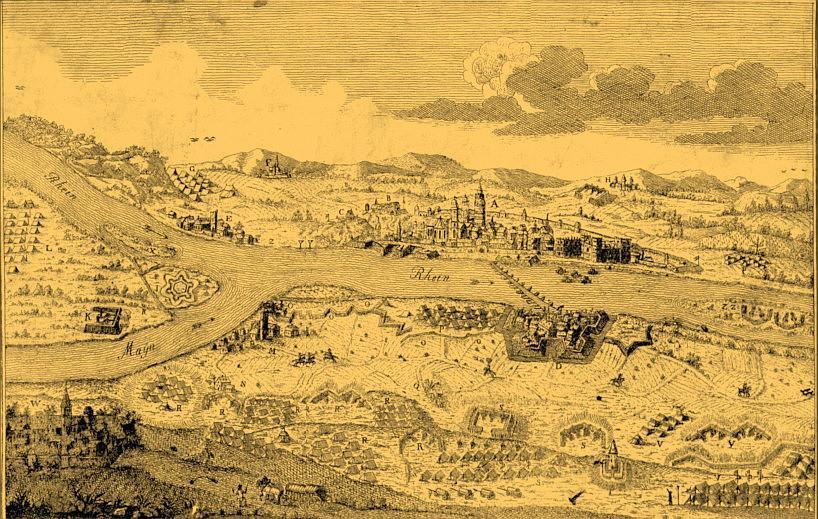
[1] Here a view of Mainz during the spring and summer of 1793 with the various encampments of the French and surrounded by the Prussians, Saxons, and Hessians (Vue de la ville & des environs de Mayence, avec celle des camps des François, des Prussiens, des Saxons, & des Hessois, pendants le Siege de 1793, l’an deux de la République françoise [n.p., n.d.]; Bibliothèque nationale de France):
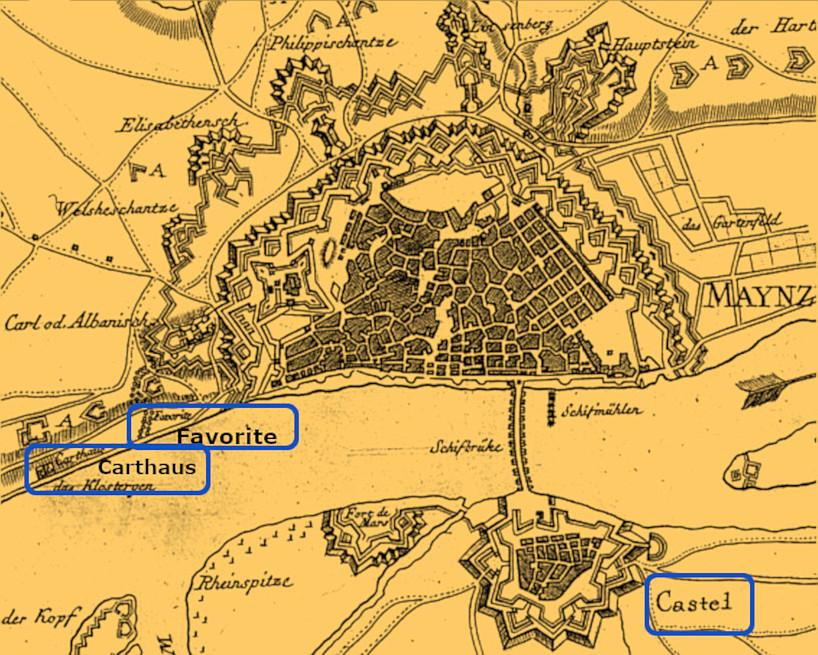
[2] The Favorite was a Baroque castle on the banks of the Rhine River with gardens and fountains essentially contiguous with the southern town limits of Mainz, finished in 1722; here the location along with that of the “Carthaus” and Castel (see below) in an excerpt from Plan der Gegend von Maynz nebst dem sehr starck bevestigten, und von der kays. königl. Armee unter Commando S. E. des Herrn General Feldmarschal Graf v. Clairfait d. 29.ten Oct. 1795 gluklich eroberten Erdhüttenlager der Französen, mit allen Schantzen Linien etc, Gallia belgica rhenana, Pläne in folio, Falz 31 (Augsburg [ca.] 1800):
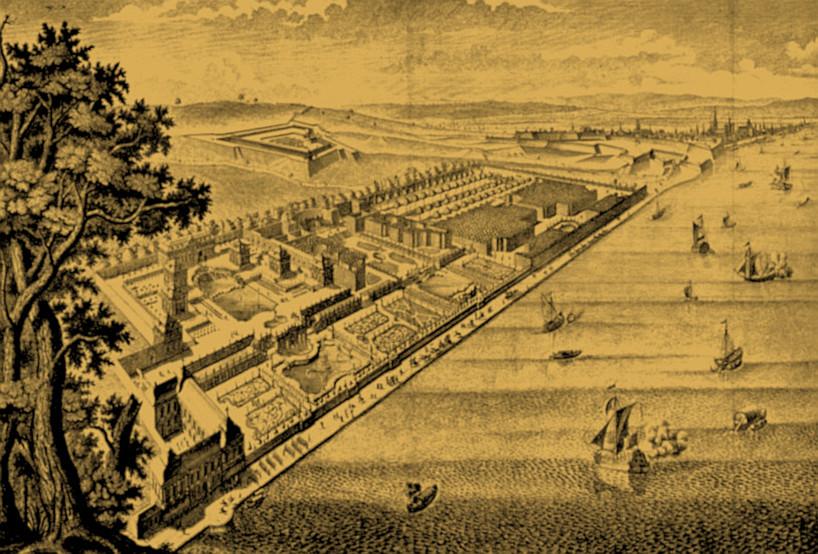
Here a 1726 illustration of the Favorite complex by Salomon Kleiner, in Heinrich Wohte (ed.), Mainz: Ein Heimatbuch, vol. 2 (Mainz 1928):
The Carthaus also Karthaus, was a former Carthusian monastery in Mainz located opposite the confluence with the Main on the St. Michaelsberg and contiguous with the Favorite grounds (Salomon Kleiner, in Heinrich Wohte [ed.], Mainz: Ein Heimatbuch, vol. 2):
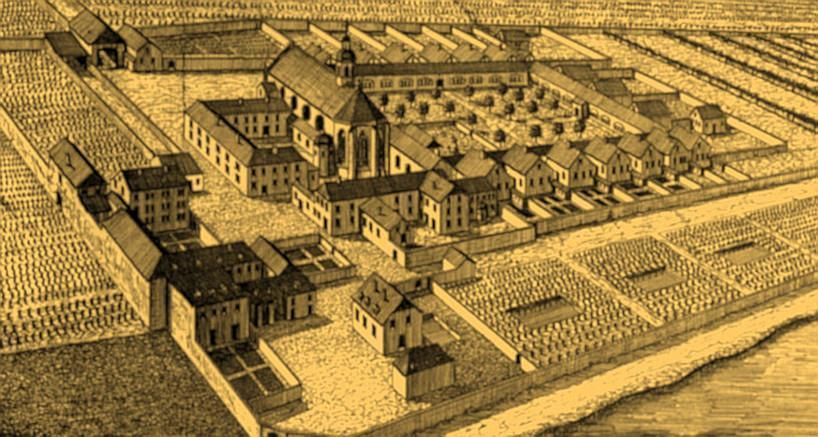
Friedrich Karl Joseph von Erthal had the church torn down between 1790 and 1792, connected the area with the adjacent Favorite, and had just begun to renovate the Favorite castle complex with the idea of replacing the cloister with a fifty-meter-long garden hall when General Adam Philippe de Custine occupied the city and had both complexes destroyed. Back.
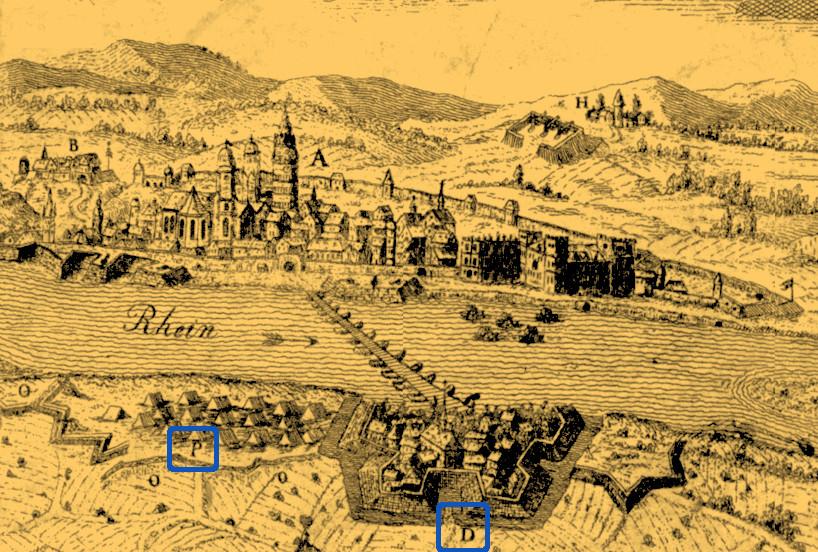
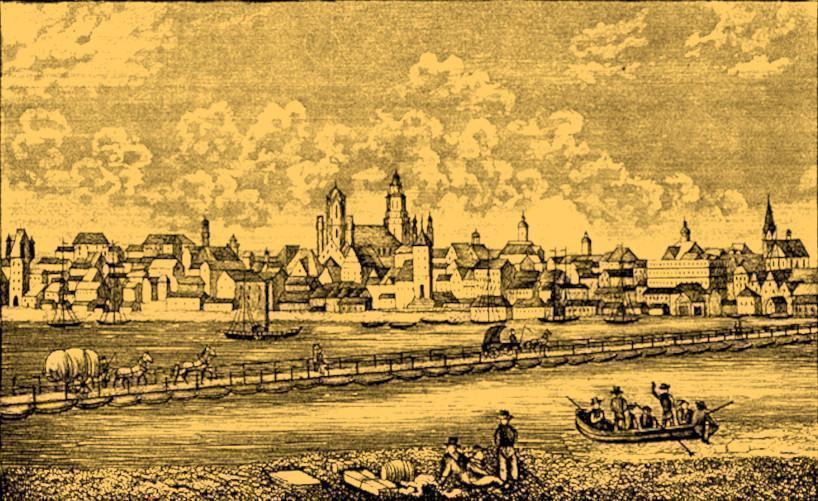
[3] Also “Kastel,” “Kassel”; district administered today by the city of Wiesbaden but formerly a district of the city of Mainz. It is located about 1 km below where the Main River flows into the Rhine (see 1793 map above) and facing the city of Mainz on the opposite shore of the Rhine river; it connects Wiesbaden with the older part of Mainz with a bridge that Kastel itself was originally intended to protect (excerpt from 1793 map above; “D” is keyed as “Cassel” or “Castel,” “P” as “French encampments”; closeup of bridge: Balthasar Frederic Leizel, Prospect von der Churfürstl. Residenz-Stadt Maijnz zwischen Rhein und Mayn von Bingen aufwärts anzusehen [ca. 1780]):
In 1792, the French army under General Adam Philippe de Custine had resecured Kastel as a military installation. Back.
[4] Figures more closely associated with the Mainz Republic: Simon (unidentified), Jean-François Reubell (earlier the president, now a deputy in the National Convention), Antoine-Christophe Merlin de Thionville, Anton Joseph Dorsch. Back.
[5] Sömmerring seems to be confused and is presumably referring to Madam (Meta) Forkel and her mother, Mother (Madam) Wedekind. Back.
[6] Caroline’s anticipated route, see Erich Schmidt’s introduction to Mainz, note 5.
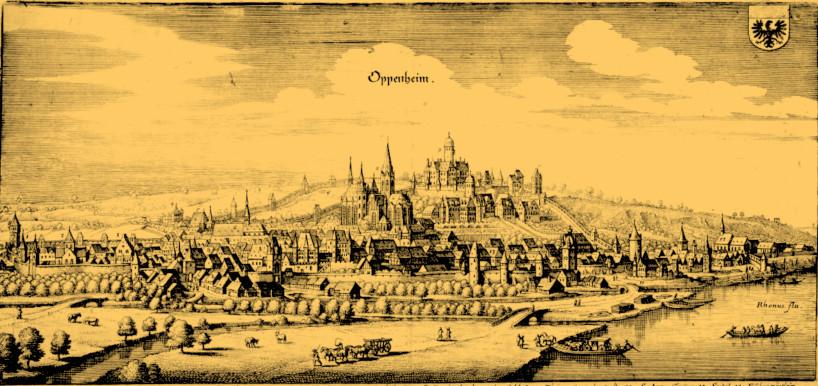
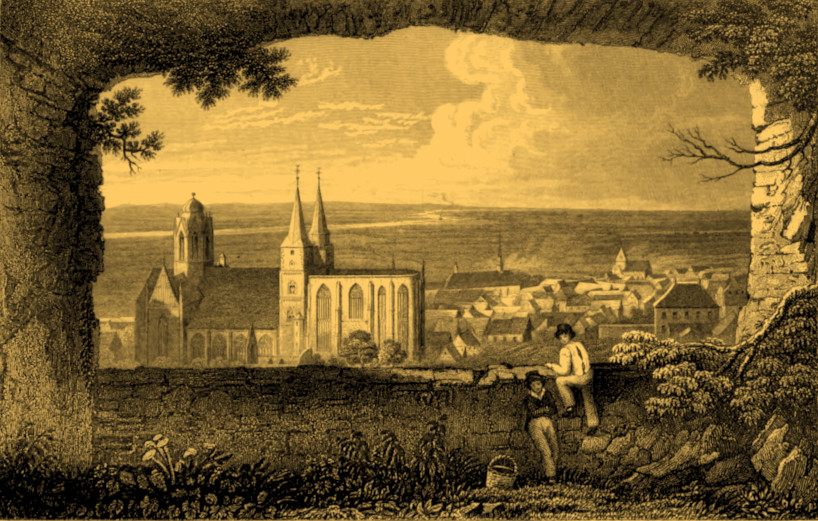
Caroline left Mainz on 30 March 1793, setting out in the (southerly) direction of Mannheim. Oppenheim is located between Mainz and Worms, ca. 18 km almost due south and on the same (west) side of the Rhine River (map: Post Karte Durch ganz Deutschland, ed. J. Walch [Augsburg 1795]; illustrations: [1] Matthäus Merian, Oppenheim [am Rhein] [1645–50]; Herzog August Bibliothek; Museums./Signatur Top 21c:51; [2] in 1834: William Tombleson, Ober Rhein, vol. 2 [London 1834], plate preceding p. 35):

That same day (30 March), Sömmerring wrote from Frankfurt to Heyne in Göttingen (Forster’s Briefwechsel mit Sömmerring, 613): “Madame Böhmer now intends to return to Göttingen, something I know with absolute certainty — she has caused considerable ill among us and has behaved quite repugnantly.” Back.
[7] Meta Forkel and her mother, Sophia Magdalena Wedekind, were from Göttingen and were trying to return there; Madam Wedekind’s daughter-in-law, Wilhelmine, wife of Georg Christian Wedekind, was also traveling with them; Caroline was trying to reach Gotha to stay with Luise and Friedrich Wilhelm Gotter. Counting Auguste as well, four children accompanied them. Back.
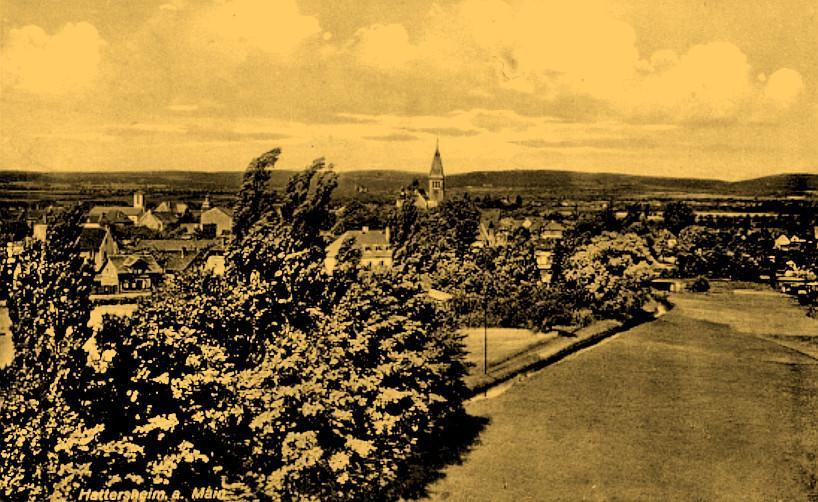
[8] Hattersheim is located ca. 17 km northeast of Mainz on the north side of the Main River. See the map mentioned above in Erich Schmidt’s introduction to Mainz, note 5 (map: J. Walch, Neueste Post-Karte von Deutschland und dessen angrenzenden Laendern [Augsburg 1813]; photograph: 1935 postcard):

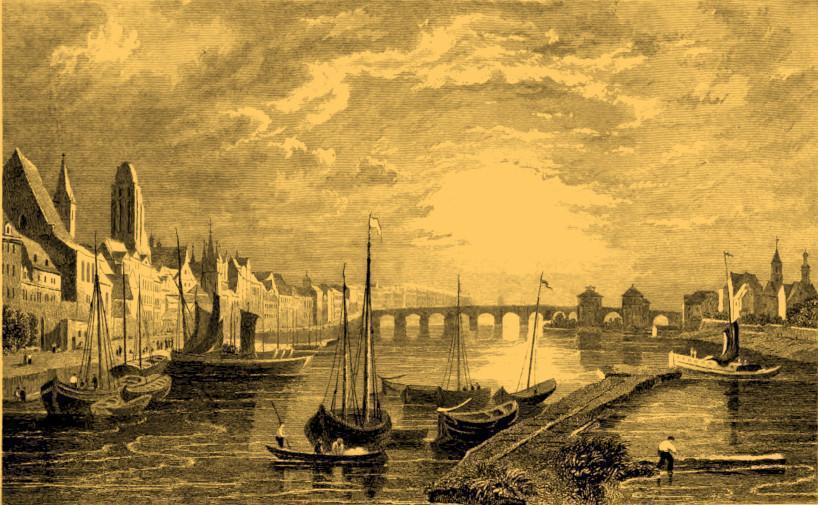
“And then brought here,” i.e., to Frankfurt, where Sömmerring was writing (William Tombleson, Ober Rhein, vol. 2 [London 1834], plate preceding p. 3):
[9] See also Christian Gottlob Heyne’s remarks to Therese Forster on 11 April 1793, after severely reproaching her because of the separation from Georg Forster (Ludwig Geiger, “Aus Therese Hubers Herzensleben,” Westermanns Illustrierte Deutsche Monatshefte 94 [April–September 1903], 680–81):
How many people have you made unhappy through your wild enthusiasm, which has been utterly unguided by any and all cold reflection! As pardonable as the initial steps may well be, they were certainly not intelligently considered — quite apart from how easily one could foresee how things would go.
But now the farce is over. It is good that F[orster] is in Paris, since otherwise he would have to countenance all the barbarity and abuse visited upon the Clubbists who tried to flee.
That most disgraceful and shameful of all creatures, Madam Böhmer, who contributed so immeasurably to your mistakes, is now also sitting incarcerated on the Königstein, having also dragged other innocents into her unfortunate fate, namely, poor Madam Forkel, Madam Wedekind, and the mother.
Again, the women’s identities and even their number are confused, since Madam Wedekind is in fact the mother; see the text of the bulletin in the French newspaper Moniteur. Back.
[10] Latin, “repugnant, despised, i.e., odious things”; possibly an allusion to Cicero, Oration for Sextus Roscius Amerinus, xvi:47, “nomina sunt odiosa,” “names are objectionable,” approximately in the sense “mentioning actual names is an invidious, unpleasant business.” Back.
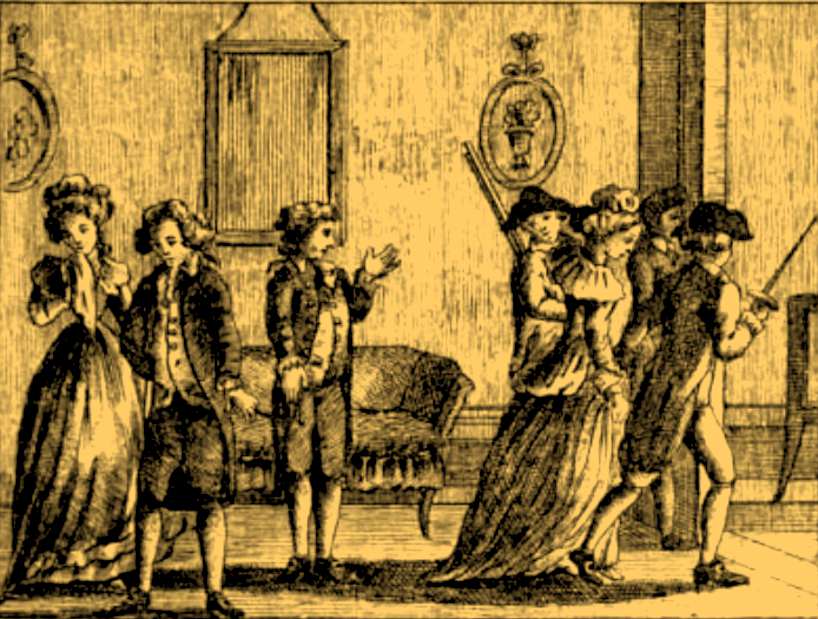
[11] Illustration: Carlo Goldoni, Opere complete, vol. 6 (Venice 1909), 137:
[12] Waitz (1871), 1:113n2, reads (or relates) these passages quite differently than does Hettner:
Madame Böhmer herself related that she was the cause of the separation between Forster and Therese and that Forster was still caught in Therese’s claws. Forster, however, assured Madam Forkel that he had loaned Huber 500 Thlr., that he would not take Madam Böhmer as his wife, and that he had been pushed into politics. Back.
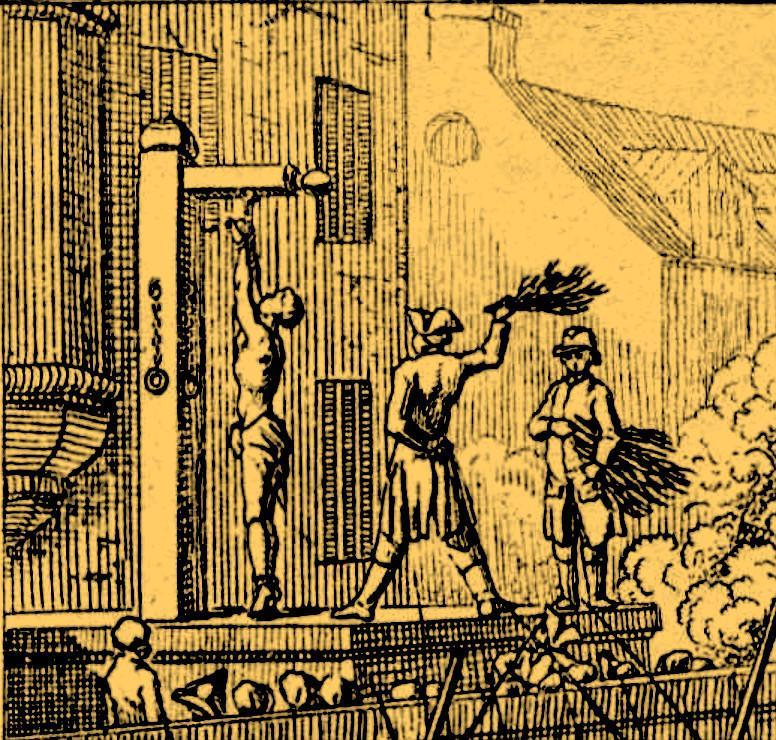
[13] Sömmerring’s almost casual reference to lashes or flogging as punishment was not unusual at the time even apart from transgressions such as sedition, as in the present case. Flogging, e.g., was included among references to various types of “public punishments,” even in books for young people (excerpt by Daniel Nikolaus Chodowiecki, “Vorstellung einiger öffentlichen Strafen,” from the Kupfersammlung zu J[ohann] B[ernhard] Basedows Elementarwerke für die Jugend und ihre Freunde: Erste Lieferung in 53 Tafeln. Zweyte Lieferung in 47 Tafeln von L bis XCVI [Leipzig, Dessau, Berlin 1774], plate xxxiv):
Translation © 2011 Doug Stott