
• 85a. Caroline to Lotte Michaelis in Göttingen: Clausthal 1788? [*]
[Clausthal 1788?]
|685| If the Hannibals did not invite us over, and were my heart not thus cheered up, I would surely become desperate. [1] We were there on Friday; but what crazy people they are. Again, everyone was there, and I calculated that exactly one year ago to the day, even counting the Leap Year advance, they entertained thus as well. The plump young Fräuleins were also all there along with all the young gentlemen scamps. [2] Mamsell Hannibal’s right sleeve was torn open round about — attesting thus her subtle movements — and just how |686| it happened that through the opening of the sleeve one could see straight up to her shoulder the way Mrs. Jenkins got a look at Humpfrey’s skin — well, I simply have no way of knowing. [3]
Notes
[*] Erich Schmidt (1913), 1:685–86, originally included this undated excerpt in a footnote to letter 77 (Wednesday, 28 March 1787) in connection with the “Hannibals”; problems dating the excerpt, however, remain.
That Caroline is still in Clausthal is suggested by the fact that she is still writing to Lotte, who was in Göttingen (rather than, e.g., Gotha, whence she returned in April 1782). Moreover, the Hannibals, despite their uncertain identity, were indeed a family associated with Clausthal (see notes).
The mention of Leap Year (here literally: “intercalary day”), regardless of whether Caroline is referring to the present or previous year, provides the terminus a quo and ad quem, namely, 1784 and 1788. In 1780 Caroline was not yet married and was still in Göttingen; in 1792 she was initially in Göttingen, then — from ca. late February — in Mainz, where she socialized primarily (and often) with Therese and Georg Forster, a situation to which the initial lines in this letter seem not to apply.
That she is not writing in 1785 derives from her not having arrived in Clausthal until June 1784, i.e., the intercalary day of 1784 in February could not be adduced with respect to invitations she and Franz Böhmer might have had in 1785 as far as advancing the day from the previous year.
Because she was in Marburg after approximately Easter/Pentecost 1789, she would not be writing about visiting the same family in the same town a year later. The other possibility is 1788, after the intercalary day of February 29 (which would thus move the day of the week a day forward from dates the previous year). But Franz Böhmer had died on 5 February 1788, before that intercalary day.
The (albeit uncertain) conclusion is that Caroline is writing in March 1788 or later (she traveled to Göttingen in July for the birth of her son, returned to Clausthal, then left Clausthal for good in late autumn 1788 for Göttingen).
The puzzling question is who is meant by “us” in the first sentence: “If the Hannibals did not invite us over . . . ” Is she including Auguste, who would turn three years old in April? Therese would turn one year old in April. Or is she referring to close friends in Clausthal or someone she otherwise mentioned in the letter to Lotte? That is, did she attend as a widow, albeit with other friends (Frauenzimmer-Almanach zum Nuzen und Vergnügen [1788]; Inhaltsverzeichnis deutscher Almanache, Theodor Springmann Stiftung):
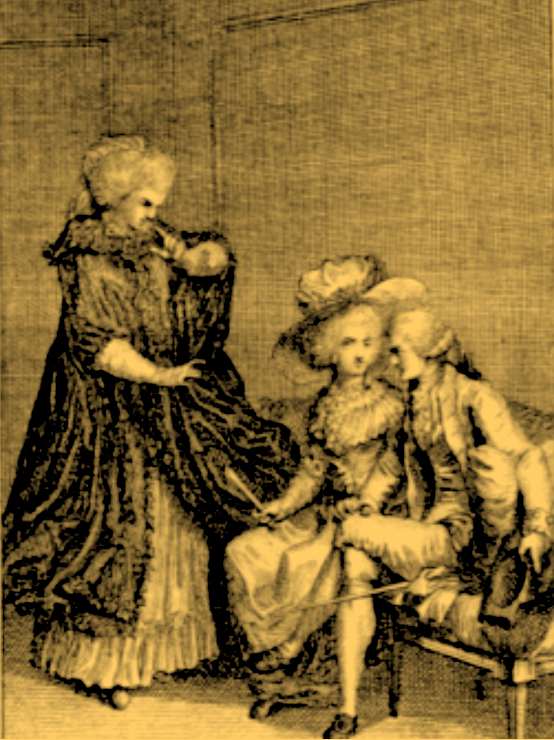
In any event, although nothing in the letter confirms or mentions Böhmer’s death in early February, neither does anything rule it out, and Caroline’s reference to her heart needing to be cheered up lest it become desperate might allude to her emotional disposition immediately following his death. Back.
[1] Perhaps part of the later extended family of Ehrenreich Hannibal, Master of the Mint and Die-Cutter of the Clausthal Mint until 1741, when his son, Martin Conrad Hannibal succeeded him in office until 1758. The latter’s brother, Friedrich Wilhelm Hannibal, was from 1739 and as late as 1785 senior pastor in Sankt Andreasberg, southeast of Clausthal in the Harz Mountains (Karl Baedeker, Northern Germany as Far as the Bavarian and Austrian Frontiers, 15th ed. [Leipzig 1910], map following p. 312):
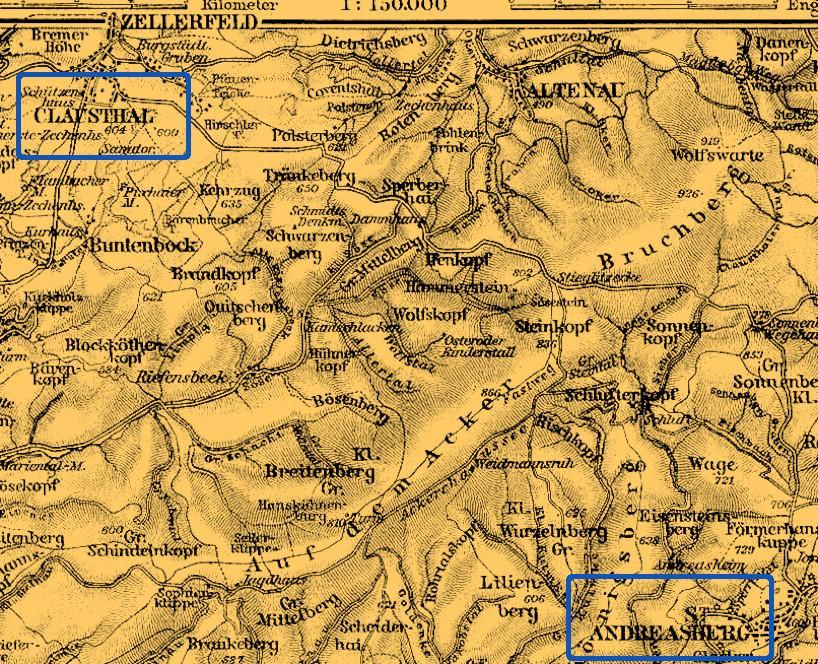
The son of the Primarius in Sankt Andreasberg, however, Heinrich Ehrenfried Conrad Hannibal († 15 July 1795) succeeded his father in 1776, though from 30 December 1784 till 1795, i.e., when this letter was presumably written, he was deacon (second preacher) in Clausthal. Georg Christoph Dahme was first, or senior preacher in Clausthal from 24 May 1776 till 1792, i.e., when Caroline lived there, after which he became a consistory councilor in Celle, where Caroline will meet him again.
Caroline seems to be referring to the family of the second preacher, Heinrich Ehrenfried Conrad Hannibal, especially if this letter was written after the death of her husband (W. Rothert, Die leitenden Beamten der Bergstadt Clausthal von der ältesten Zeit bis zur Gegenwart, Festschrift zur 31. Jahresversammlung des Harzvereins für Altertum und Geschichte am 25.–27 July 1898 [Clausthal 1898], 72, 68, no. 16 [Hannibal] under the enumeration of “Diakonen bezw. Archidiakonen,” and no. 19 [Dahme] under the enumeration of “Erste Prediger zu Clausthal [Generalsuperintendenten]”). Back.
[2] (1) Taschenbuch für das Jahr 1810: Der Liebe und Freundschaft gewidmet (Frankfurt); Inhaltsverzeichnis deutscher Almanache, Theodor Springmann Stiftung; (2) Goettinger Taschen Calendar für das Jahr 1791; Inhaltsverzeichnis deutscher Almanache, Theodor Springmann Stiftung; (3) Almanac de Goettingue pour l’anneé 1786; Inhaltsverzeichnis deutscher Almanache, Theodor Springmann Stiftung:


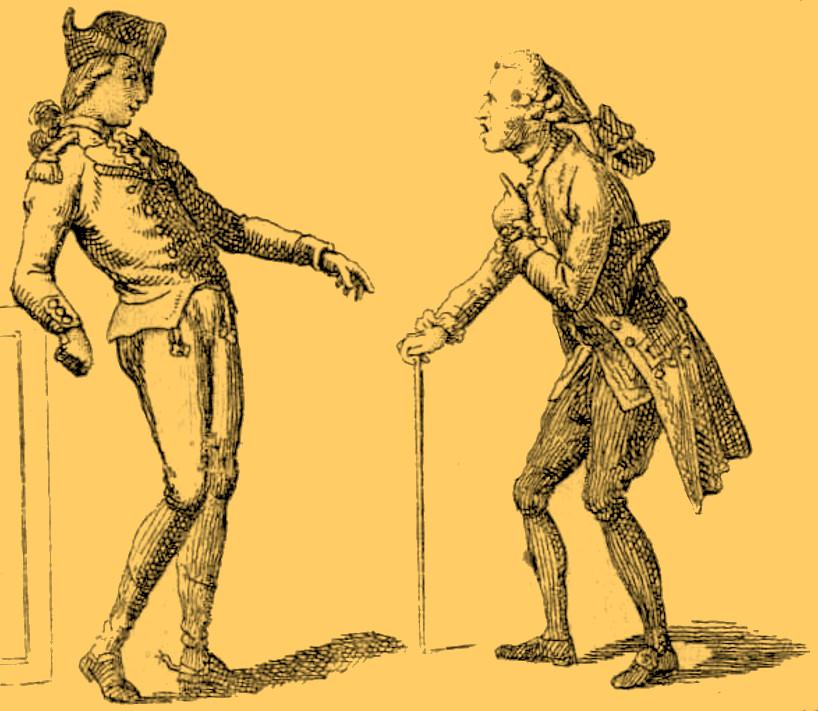
[3] Allusion to a scene in Tobias George Smollet, The Expedition of Humphry Clinker (London 1771), book 2, in the letter to Sir Watkins Phillips on 24 May from J. Melford in London (text see supplementary appendix 85a.1). Back.
[3] Allusion to a scene in Tobias George Smollet, The Expedition of Humphry Clinker (London 1771), book 2, in the letter to Sir Watkins Phillips on 24 May from J. Melford in London (text see supplementary appendix 85a.1). Back.
Translation © 2011 Doug Stott