
• 47. Caroline to Lotte Michaelis in Göttingen: Clausthal 1784
[Clausthal 1784]
[Beginning of letter is missing.]
|100| And now “ding ding”! Front and center in the fool’s cap! As long as I have the bell, the cavaliere servante always appears on his own. [1] He is a foolish boy, not dumb, but there is just so much sancta simplicitas about him. [2]
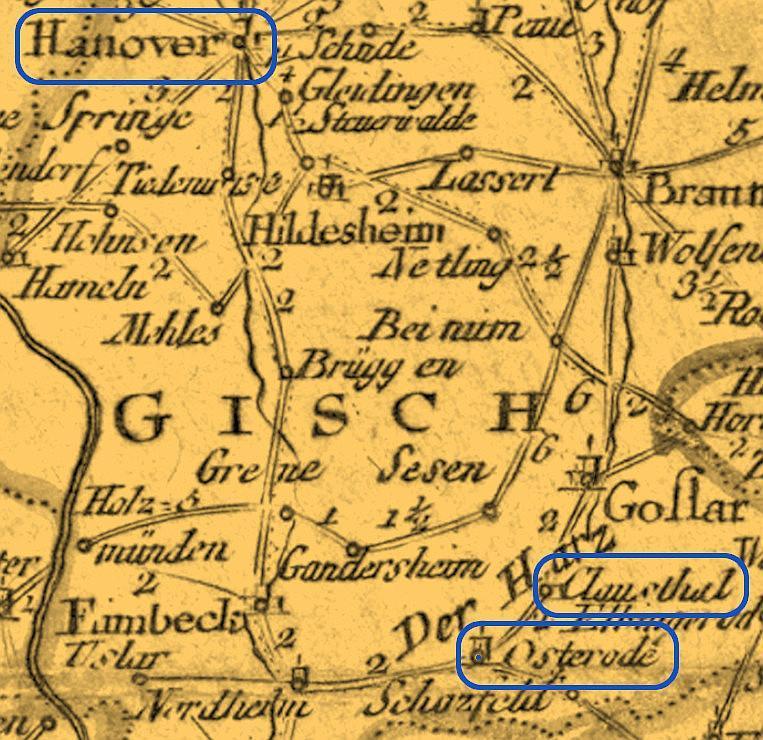
This morning I ask Böhmer whether I might travel with the Meyers from Osterode to Hannover. [3] He says yes, that he would indeed like the chance to be alone, and that I ought to take Friedrich along. Marie [4] was to groom and wash and comb him. Friedrich says, “I would like that very much,” in his mind is already packing his vest and pants and pigeons, and asks later in all seriousness whether the good doctor’s wife would be coming back again from Osterode (where we will be going on Saturday).
For my own part, I have been throwing myself more and more each day into life here in Clausthal without, however, taking on the Clausthal form. Please begrudge not an honest person the entertainment afforded by 20 to 30 foolish-looking faces, and instead have a mass read in the Catholic church in Short Street now that I have begun to look at the whole thing from a different side. [5] . . .
Today I again paid some visits, to Cousin Schichtrupp, among others; [6] his wife — a fine piece of livestock — looks like a human tam-‘o-shanter. He is horribly ignorant. He once heard about the American war but did [not] know whether Hansel or Gretel was fighting it.
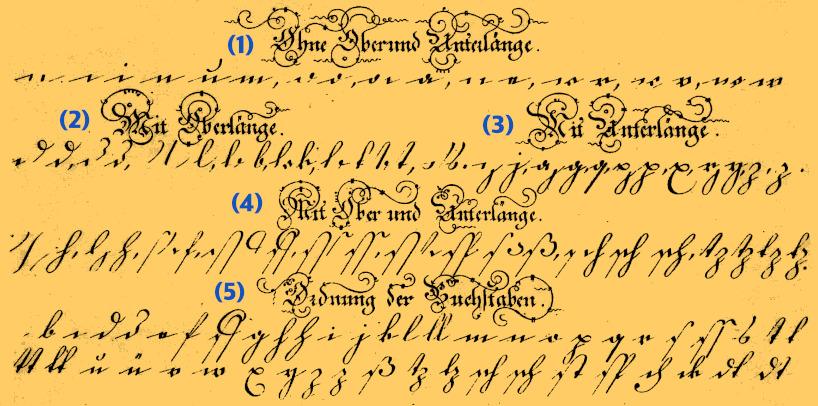
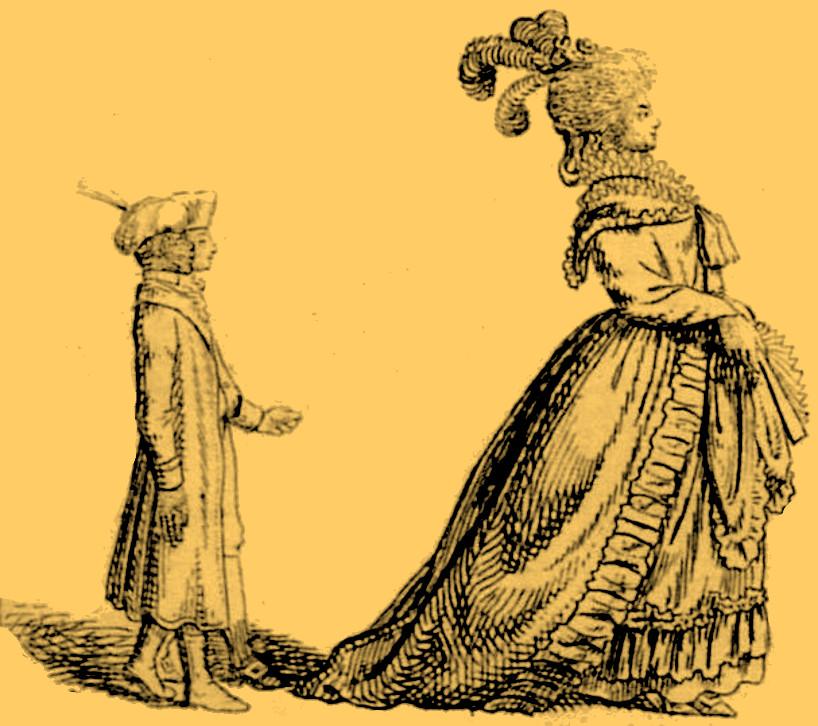
At the Prauns’s house, [7] where, as I wrote the long letter characters, I did go after all, I was quite entertained. [8] Madam von Reden was quite sweet, adorned from head to toe like a royal maternity bed. Bouche close! [9] She doubtless does not like me because of the black belt and because her husband spoke English with me.
|101| Send me Gallisch [10] with the messenger woman, do you hear? Böhmer is paying Schneider. [11] And the remaining volumes of Möser [12] if possible as well as the last part of Cecilie, [13] or whatever else there is to read on the — in the wardrobe. Therese made some good choices in what she sent me. . . . More next time about everything else, for Böhmer just came in and said: “You are not to write a moment longer.” Adieu, adieu, dear. A thousand thanks to Mother.
C.B.
Notes
[1] c\Cavalier servente (Caroline: cavaliere servante), Fr., “gentleman in waiting, male mistress, cicisbeo, escort or lover of a married woman” (Carlo Goldoni, Opere complete, vol. 1, Commedie die Carlo Goldoni [Venice 1907], 275):

Here a tongue-in-cheek reference to the Böhmers’ manservant, Friedrich. Back.
[2] Latin, “holy simplicity,” here ironically (or touchingly) in reference to Friedrich’s — the manservant’s — naiveté (frontispiece to Deutsche Schaubühne, 3, no. 4 [Augsburg 1791]):

[3] Uncertain which Meyers are meant; Hannover is over 80 km northwest of Osterode (Post Karte Durch ganz Deutschland, ed. J. Walch [Augsburg 1795]; illustration: anonymous, Departing Postal Coach [ca. 1830]):

[4] Presumably the maidservant. Back.
[5] There was no Catholic church proper in Göttingen at the time, or rather, no church edifice in the traditional sense. Although as early as fifty years earlier Catholics had made several attempts to acquire property to build a church, they were consistently thwarted by the magistrate and/or the established Lutheran church; nor, for that matter, did they generally have the requisite funds.
Finally, in January 1774, the Catholic church itself being prohibited from purchasing such land, a lay member of the congregation, Pierre Graf, bought the property at the site of the present church for 1800 Thaler, property located in a less desirable area of Göttingen inhabited generally by poorer citizenry and bounded by the Kurze Strasse (Short Street) and what is today Turmstrasse.
But the only edifices on the property were livestock stalls and a barn, along with a courtyard area and garden. Masses were initially celebrated in the barn, which was gradually renovated into a normal residential house since it was not allowed to be “recognizable” as a church, and it is to this structure that Caroline is likely referring here.
Construction of the church edifice proper, St. Michael’s Church, began in 1787 — the first Catholic church to be built new in Göttingen after the Reformation — by Georg Heinrich Borheck, and dedicated on 26 September 1789. See Sabine Wehking, “Ein jeder darf sich gleichen Rechts erfreu’n . . . ” Die Geschichte der Katholischen Kirche Göttingen 1746–1990, Studien zur Geschichte der Stadt Göttingen 17 (Göttingen 1992), 22–31, here esp. 22 (personal communication Pater Manfred Hoesl SJ, Göttingen). Back.
[6] Daniel Nikolaus Chodowiecki, Aimable Miss Beverley! (1787); Herzog August Bibliothek; Museums./Signatur DChodowiecki AB 3.756:
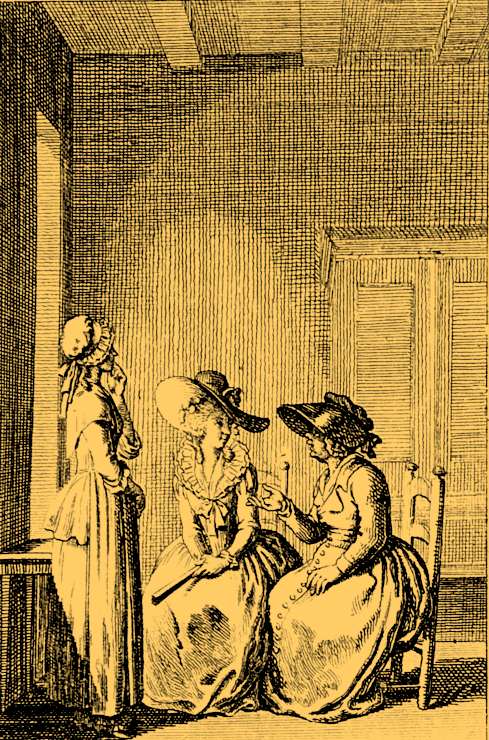
“Cousin Schichtrupp” should doubtless read “Schachtrup” instead; see Johann David Michaelis, Lebensbeschreibung von ihm selbst abgefasst . . . (Leipzig 1793), 144:
I have been married twice, and my second marriage continues. First on 28 October 1749, with Johanna Christiana Friederike Schachtrup, daughter of a merchant [Johann Conrad Schachtrup] in Clausthal. She died on 24 January 1759. I had only one son with her, born on 13 May 1754, Christian Friedrich Michaelis, formerly field surgeon with the Hessian-Kassel troops in America, currently Hofrath and [from Easter 1786] professor of medicine in Marburg.
The second time, on 17 August 1759, I married Louise Philippine Antonette Schröder, daughter of the senior postal administrator, Herr Schröder, in Göttingen; I had nine children with her, of whom only one son, Gottfried Philipp Michaelis, who studied medicine, and three daughters [Caroline, Lotte, Luise] are still alive.
Caroline is presumably referring — either loosely or precisely as “cousin” — to a member of the Schachtrup family in Clausthal. Back.
[7] Presumably Carl von Praun (see Wilhelm Rothert, Die leitenden Beamten der Bergstadt Clausthal, von der ältesten Zeit bis zur Gegenwart [Clausthal 1898], 24). Back.
[8] “Long letter characters” (Germ. lange Buchstaben), i.e., descenders and ascenders, those parts of (here:) handwritten letters extending below or above the “x”-height of the letter. Concerning Kurrent handwriting, which Caroline used, see Johann Wilhelm Kessler, Lehrbuch der Kunst schön und geschwind zu schreiben (Heilbronn, Rotenburg ob der Tauber 1793), 54 (illustration from Johann Friedrich Pixis, Vollständiger Unterricht der Schönschreibkunst für die Kurpfälzische Jugend sowohl als auch für alle Liebhaber derselben [Augsburg 1795?], plate 1):
Letters of the Kurrent alphabet are either short or long. Short letters are those that extend neither above nor below the line, such as: a c e i m n o r u v w. Long letters are those that require either descending or ascending, or ascending and descending features. Those that ascend but while remaining on the line with their lower parts include: b d dt k ck l ll s t tt. Those that descend while remaining on the line with their upper parts include: g j p q x y z. Those that both ascend and descend while maintaining the line with their middle parts include: f ff h ch s ss sz st tz.

See also the following 1798 illlustration of these distinctions in actual handwriting: (1) “Without Ascenders and Descenders”; (2) “With Ascenders”; (3) “With Descenders”; (4) “With Ascenders and Descenders”; (5) “Normal Letter Order”:
These explanations notwithstanding, Caroline’s allusion remains unclear. Back.
[9] Fr., “keep it to yourself, mum’s the word!” (Frauenzimmer Almanach zum Nutzen u. Vergnügen für das Jahr 1799):

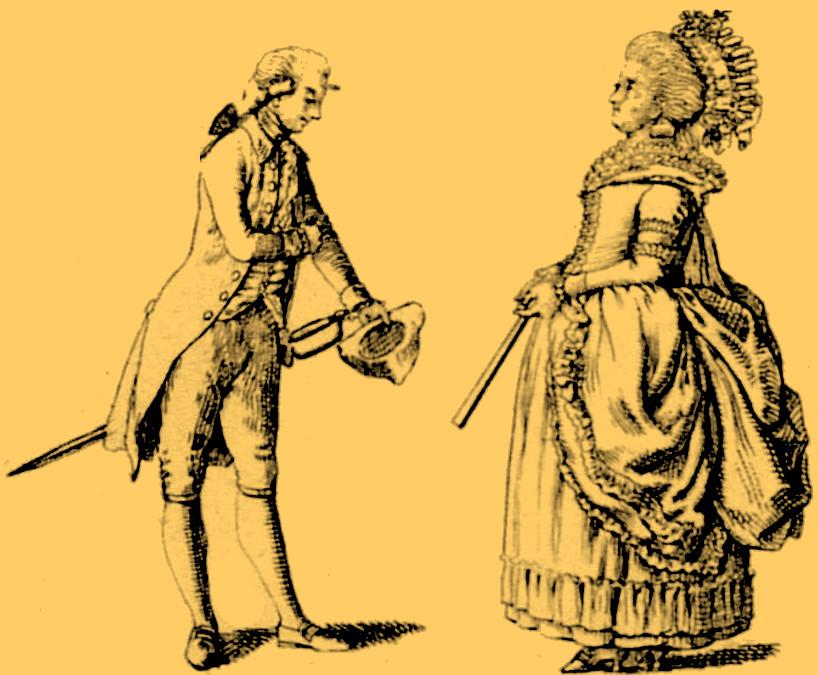
Although the illustration above probably fairly depicts the social situation about which Caroline is speaking, it reflects the fashions of 1799, which had changed considerably (note the young woman’s clothes at right) since the sometimes considerably more extravagant styles, at least in more urban settings, of 1784 and generally during the period in which Caroline lived in Clausthal (till 1788). Here several general styles in women’s fashion depicted in a Leipzig journal from 1786 (Frauenzimmer Almanach zum Nuzen und Vergnügen 1786; Inhaltsverzeichnis deutscher Almanache, Theodor Springmann Stiftung):

The following styles or some variation presumably prompted Caroline’s inspired metaphor ([1, 2] Goettinger Taschen Kalender vom Jahr 1784; [3] Goettinger Taschen Kalender vom Jahr 1787 both illustrations: Inhaltsverzeichnis deutscher Almanache, Theodor Springmann Stiftung):
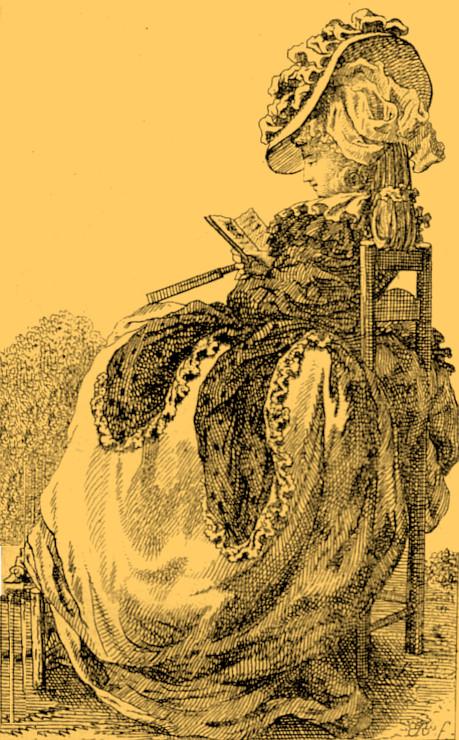
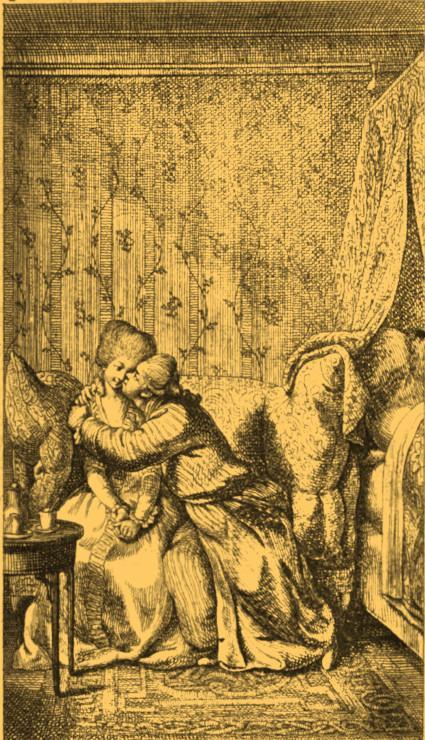
[10] Although Caroline’s reference is likely to some recent essay Gallisch published in Georg Christoph Lichtenberg’s Göttinger Taschenkalender, Gallisch’s other works include Ein Dutzend leichter Erzählungen (St. Petersburg 1782) (here the frontispiece):
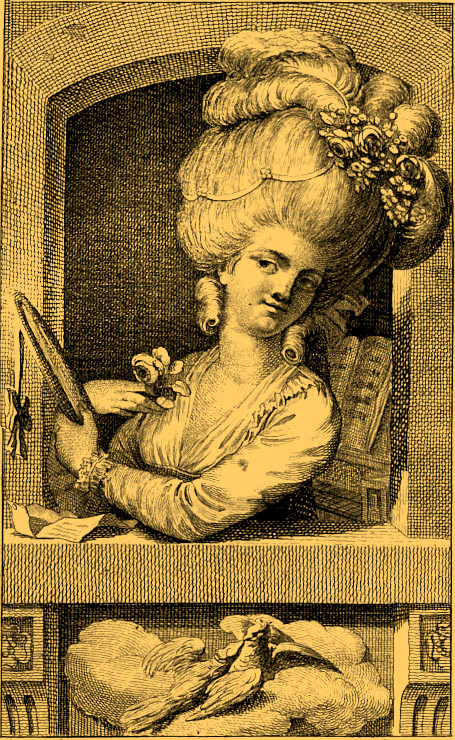
Gallisch also published the novels Nettgen Rosenfarb: Das Mädchen, vol. 1 (Leipzig 1782); Nettgen Rosenfarb: Die Frau, vol. 2 (Leipzig 1783); and his volume of poetry, Gedichte, ed. Johann Friedrich Jünger (Leipzig 1784). Here the frontispiece to Nettgen Rosenfarb: Das Mädchen:
[11] Librarian at the lending library in Göttingen. Back.
[12] The reference is to Justus Möser’s more recent edition of Patriotische Phantasien eines Kameralisten. Möser’s essays concerning international relations and the public activities of states were collected by his daughter beginning in 1774 and published in Patriotische Phantasien eines Kameralisten; volumes 1–3 appeared in 1778 in Berlin, volume 4 not until 1786; they were intended to inform the educated reading classes. Back.
[13] Cecilia, oder die Geschichte einer reichen Waise. Aus dem Englischen (orig. Frances Burney, Cecilia, or memoirs of an heiress [London 1782]), 3 vols., in Briefe für Kinder, zum Nutzen und Vergnügen, ed. Erdmann Hannibal Albrecht (Leipzig 1783–84), attributed to Christian Felix Weisse in Deutsches Anonymen-Lexikon 1501–1850, ed. M. Holzmann and H. Bohatta, vol. 1 A–D (Leipzig 1902) 293, no. 8575; illustrations by Daniel Nikolaus Chodowiecki appeared as “12 Blätter zu Cecillia oder Geschichte einer reichen Waise,” in the Königl. Grosbritannischer Historischer Genealogischer Calender für 1789, mit Kupfern von Chodowieki (Lauenburg, Göttingen 1788) (click image to open):

Translation © 2011 Doug Stott