
265e. Friedrich Schlegel and Dorothea Veit to Wilhelm Schlegel in Bamberg: Jena, after 21 July 1800 [*]
[Jena, after Monday, 21 July 1800]
I accompany you in thought on your sad journey. [1] May heaven but grant that you not have as bad weather as we here since yesterday evening. I longingly await news from you
I took care of all the letters you wanted me to write and am sending along what has arrived in the meantime, also the 1st issue of the Poetisches Journal. [2] . . .
The house is empty and desolate. Stay well.
Friedrich
see reverse side
Dorothea is almost completely finished with the copying, and the parcel will go out on Friday. [3]
If there is still room in the box, I will also send along Percy, since you do have the English lexica. [4] I will keep the Spanish books until I receive further word. —
[Dorothea:] My warmest regards and best wishes! I am enclosing Flemming as comfort, counsel, and guide, though I am loath to part with it myself. [5]
Dorothea
Notes
[*] Source: Walzel, 429–30; KFSA 25:143. — Dating according to Wilhelm’s letter to Goethe on 20 July 1800 (letter 265d). Back.
[1] Wilhelm left Jena on 21 July 1800 (see his letter to Goethe on 20 July 1800 [letter 265d]; also Dorothea’s to Schleiermacher on 28 July 1800 [letter 265i]) and likely arrived in Bamberg on 24 July 1800 (concerning the logistics of the journey, see Romantische Liebe und romantischer Tod, 50).
Caroline and Schelling had in the meantime returned to Bamberg from Bocklet (attested in the same letter: Dorothea to Schleiermacher on 28 July 1800 [letter 265i]) and had taken quarters in the hotel Bamberger Hof, concerning which the Hochfürstlich-Bambergisches Intelligenzblatt (1800) 56 (Tuesday, 22 July 1800), 258), accordingly relates: “Arrivals from elsewhere between 13 and 19 July . . . In the hotel Bamberger Hof: . . . Madam Prof. Schlegel [i.e., wife of Professor Schlegel], Herr Professor Schelling, from Jena.”
Auguste died on 12 July 1800, and her burial would unlikely have taken place before 13 or 14 July (Daniel Nikolaus Chodowiecki, Höltys Elegie auf ein Landmädchen [1794]; Herzog Anton Ulrich-Museum; Museums./Signatur DChodowiecki AB 3.985):

Because Wilhelm’s letter to Goethe on 20 July 1800 (letter 265d) attests that Caroline’s health had understandably suffered yet another setback, it seems unlikely she and Schelling would have left Bocklet much before 15 July, though such is not excluded.
In any event, because postal service between Bamberg (or Bocklet) and Jena rarely took more than three days, and because Wilhelm did not receive news of Auguste’s death until 20 July, it seems Caroline and Schelling informed him not immediately after her death (e.g., on 13 July), but rather only just before their departure from Bocklet on 16 or 17 July or even after their arrival in Bamberg (a two-day carriage ride from Bocklet). That they were in Bamberg at the latest on 19 July is attested by the Intelligenzblatt entry cited above.
Whether Wilhelm, Caroline, and Schelling stayed in this hotel after Wilhelm’s arrival is uncertain; on 22 September 1800 Schelling writes to Carl Eschenmayer that he could be reached in care of Andreas Röschlaub in Bamberg (Plitt 1:313; Fuhrmans 2:258); i.e., Wilhelm presumably remained with Caroline (in the Bamberger Hof?), Schelling with Röschlaub.
Concerning the hotel Bamberger Hof, in the center of town, see Joachim Heinrich Jäck, Bamberg, wie es einst war, und wie es jetzt ist, ein Taschenbuch (Bamberg n.d. [1819]), unnumbered pages, here s.v. Bamberger Hof:
The Bamberger Hof on the outer market square is one of the most beautiful inns in the kingdom of Bavaria, with a consistent reputation for order, cleanliness, swift service, the best menu, purest wines, and most inexpensive costs.
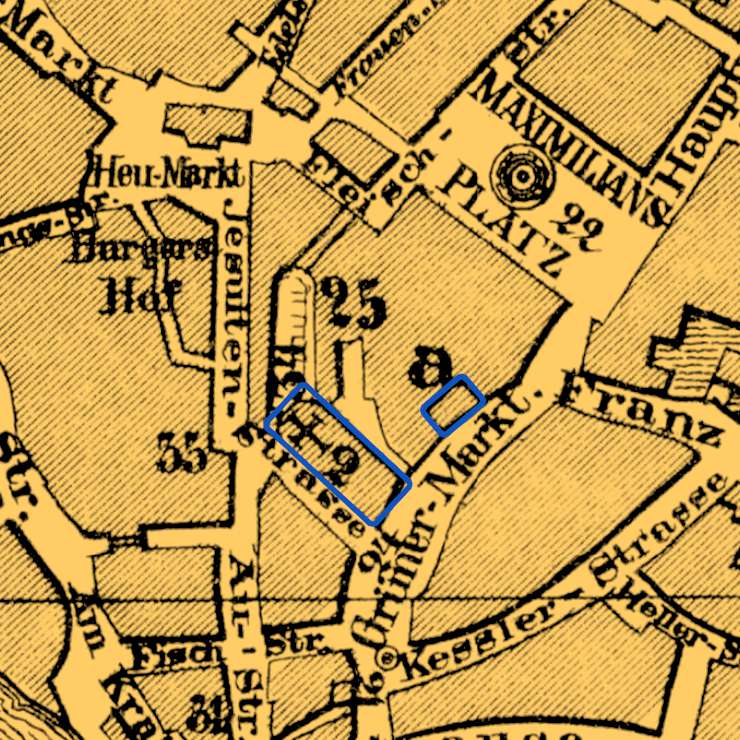
Map: St. Martin’s (“2”), the vegetable market (the street Grüner Markt), the Bamberger Hof (“a”), and Maximilian Square (Bamberg: Plan der Stadt Bamberg (nach officiellem Plan bearbeitet) [Bamberg N.d.]):
See also Jäck’s earlier Bamberg und dessen Umgebungen: Ein Taschenbuch (Erlangen 1813), 31:
If we move further along down the main street, we are charmed by its almost perfectly straight course and by the comely buildings enclosing it.
Among these, the Bamberger Hof is especially striking . . . the first enterprise of this sort in our town — built in 1798 with a cost far exceeding the usual construction capacity of our rich private citizens. For fourteen years now, the most distinguished travelers have found quite handsome accommodations and dining, though without persons of lesser status going unsatisfied.
To protect both the inn as well as the neighboring, invaluable institutes of the Royal Library, Natural History Cabinet etc. from further danger posed by the sort of incautious fire that occurred on 9 March 1811, the newly constructed stables built on the location of the former Jesuit hospital were appropriately vaulted. The former Banzer House is immediately next to the inn, and similarly belongs to the wholesale merchant Joseph Ernst Strüpf.
And finally Anton Schuster, Alt-Bamberg, Bamberger Taschen-Buch 5,5 (1902), 153–54:
This building, today still one of the main adornments of the Green [Vegetable] Market, consisted at the time of 2 eating halls, 21 heated and 9 unheated rooms; the two-story neighboring building (no. 23) consisted of a kitchen, 5 heated and 7 unheated rooms along with chambers, 3 stables for 36 horses, places for 12 carriages, 3 fountains, and spacious cellers.
Here an engraving of the hotel (to the right of the church, with three chimneys and the vaulted entrance) from Joseph Heller, Taschenbuch von Bamberg. Eine topographische, statistische, ethnographische und historische Beschreibung der Stadt und ihrer Umgebungen [(Darmstadt 1832), plate 26:

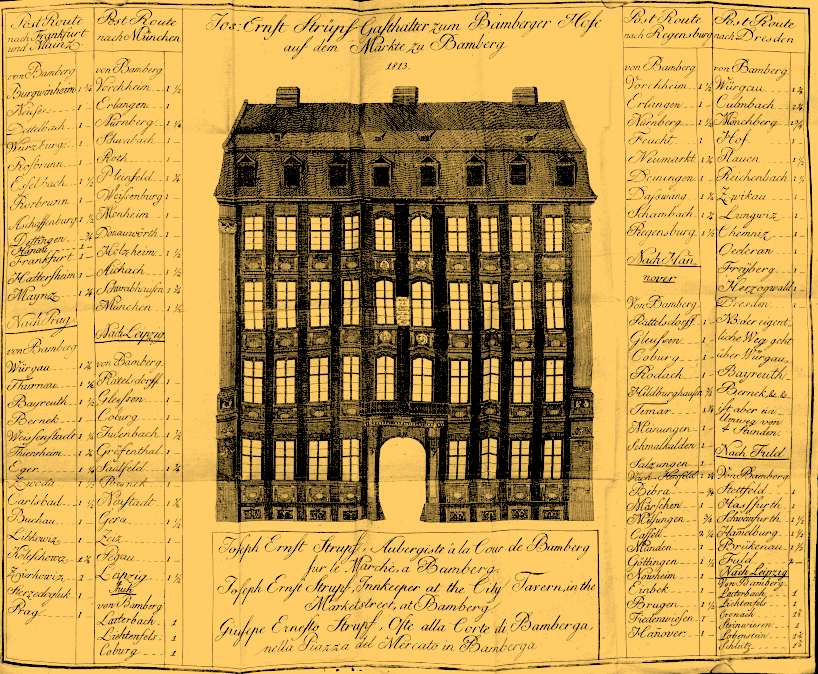
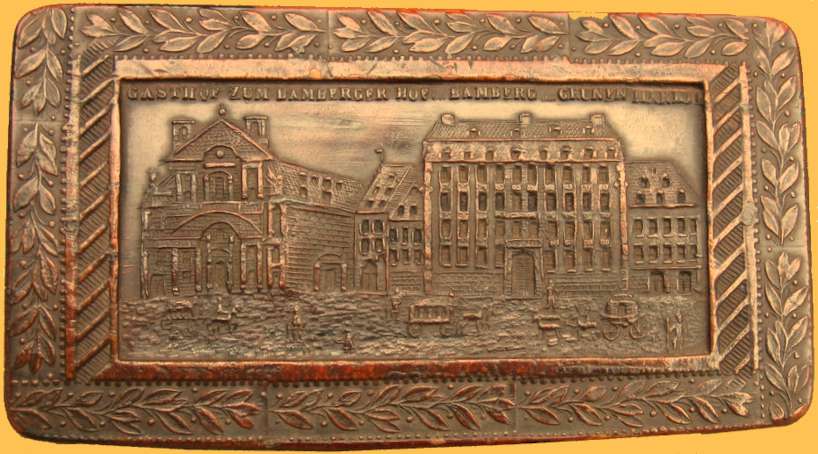
Here a (1) frontal view and (2) excerpt from Jäck’s Bamberg und dessen Umgebungen: Ein Taschenbuch: Mit fünf Abbildungen (Erlangen 1813), foldout after final printed text page (256); and (3) an illustration on a mid-19th-century snuff or tobacco tin of the sort Wilhelm used (note St. Martin’s to the left, vegetable market in front):

[2] Ludwig Tieck’s Poetisches Journal (Jena 1800). Back.
[3] Dorothea was copying out one the translations for Wilhelm’s edition of Shakespeare to send to his Berlin publisher, Johann Friedrich Unger (see Friedrich’s letter to Wilhelm on 26 July 1800 [letter 265g]); the reference is presumably to volume 7. Back.
[4] Thomas Percy, Reliques of Ancient English Poetry, 3 vols. (London 1765).
As is profusely evident both here and in coming letters, Auguste’s death, as tragic and grievous a loss as it was, did not stop the Jena group from continuing work on its literary projects and other professional plans, apparently even for a brief period of time.
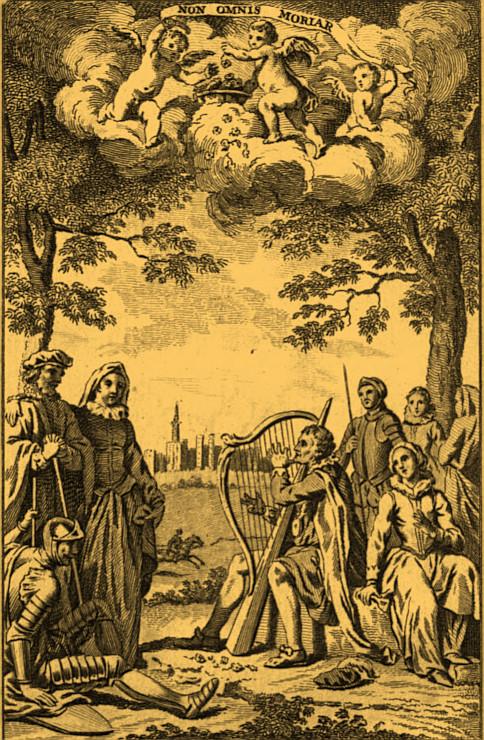
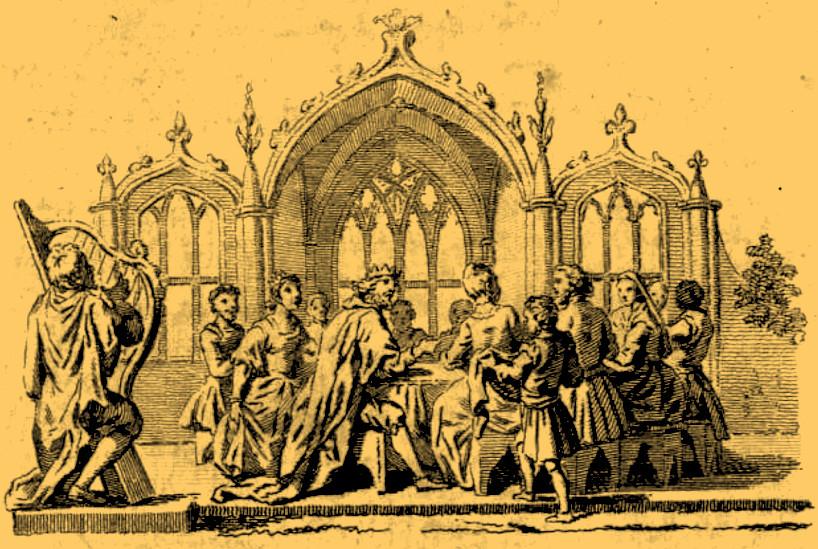
Such plans included considerable attention to European literature at large, as demonstrated the request of these volumes. Here a frontispiece (1794) and illustrations from the 1767 (vol. 3) and 1794 (vol. 1) editions of Percy’s Reliques:




[5] In her letter to Schleiermacher on 28 April 1800 (letter 259m) (this particular passage not included in letter 259m), Dorothea had urged Schleiermacher to “go to the antiquarian booksellers and try to find Fleming’s poems, the complete title is Geist und Weltliche Poemata Paul Flemmings — it was published in a new edition in 1685″; Dorothea had even copied out for Schleiermacher one of her favorite poems from the edition. Here the title page:

The exact title, as seen above (see also KGA V/4 10–11; KFSA 25:449fn28), was Geist- und Weltliche Poëmata, Paul Flemmings, Med.D. & Poët. Laur. Cæs. Jetzo Auffs neue wieder Corrigiret und ausgefertiget In Verlegung Christian Kolbens Buch-Händ[lung] zur Naumburg (Merseburg 1685). Here the frontispiece to that edition:

A copy — possibly this one from Dorothea — was found in Wilhelm Schlegel’s literary estate (Walzel, 430fn2).
Other collections of Fleming’s poems that might have been appropriate in this context include Klagegedichte Über das unschuldigste Leiden und Todt unsers Erlösers Jesu Christi (Leipzig 1632) and Paul Flemings Poetischer Gedichten, So nach seinem Tode haben sollen herauss gegeben werden, Prodromus (Hamburg 1641). Back.
Translation © 2014 Doug Stott