
265f. Dorothea Veit to Clemens Brentano in Altenburg: Jena, 25 July 1800 [*]
Jena, 25 July 1800
. . . Hence please do come visit us; it is quite nice here even though we have had a quite unfortunate event, and though the house is now empty and desolate. But a properly pure bit of misfortune always has something good about it, like a proper thunderstorm that cleanses the atmosphere from all the oppressive, thick vapor and haze. [1]
But what do you think about Auguste? How could this blossoming young girl possibly die? it is as if one had to be ashamed in her presence. [2] . . .
Notes
[*] Sources: Dorothea Schlegel und deren Söhne 1:[15]–[16]; Wieneke (1914) 328 (frag.); KFSA 25:144.
Coincidentally, Brentano had been in Altenburg since 12 July 1800 visiting the Reichenbach daughters, Julie (1777–1835) and Minna (1782–1835), the latter of whom declined his proposal of marriage (KFSA 25:477). Altenburg is located 60 km east of Jena (Post Karte Durch ganz Deutschland, ed. J. Walch [Augsburg 1795]):

Friedrich Schlegel had in the meantime become interested in Sophie Mereau in Jena, Brentano’s later wife; see Friedrich’s letter to Brentano on 5 July 1800 (Heinz Amelung, “Briefe Friedrich Schlegels an Clemens Brentano und an Sophie Mereau,” Zeitschrift für Bücherfreunde, N. S. 5, 1 [1913], 183–92, here 185): “Since you have been gone, I have seen Madame Mereau several times. Her charming personality has made a very pleasant impression on me.”
That the relationship was romantic is attested by Friedrich Karl von Savigny, who related to Clemens Brentano on 7 or 8 June 1803 that Sophie Mereau herself had told him how she had deceived Brentano with her affair with Friedrich Schlegel (Ludwig Achim von Arnim. Briefwechsel 1802–1804, ed. Heinz Härtl, Weimarer Arnim Ausgabe [Tübingen 2004], 445). Back.
[1] Dorothea clearly is thinking not primarily about Auguste’s death (her next paragraph changes the subject: “But what do you think about Auguste?”) or Wilhelm’s departure on 21 July, but about the unpleasant experiences with Caroline during the spring and the latter’s subsequent departure in early May essentially in Schelling’s company. Back.
[2] Auguste had just turned 15 years old on 28 April 1800, about the age of the young woman in the following representative illustration (Wiener Damenkalender zum Nutzen u. Vergnügen auf das Jahr 1801; Inhaltsverzeichnis deutscher Almanache, Theodor Springmann Stiftung):
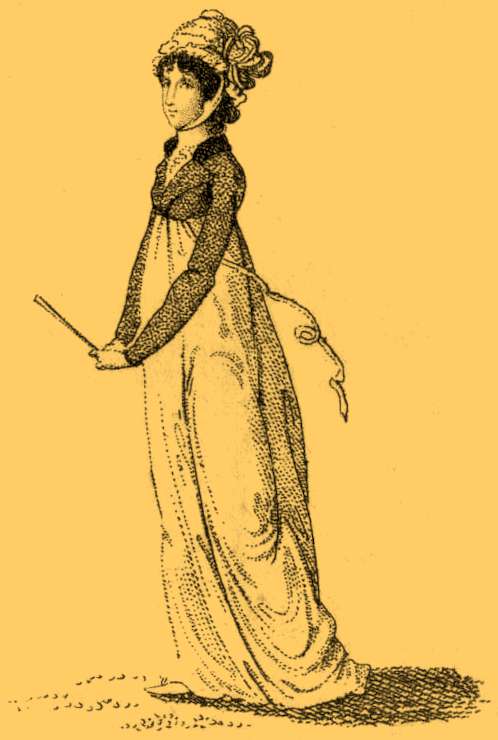
At the same time, she had already attracted the romantic attentions of Henrik Steffens (see his letter to Schelling on 8 or 20 August 1800 [letter 265l] with note 1), possibly Friedrich August Eschen (see his letter to Wilhelm Schlegel on 30 May 1800 [letter 260b]), and, as becomes evident in coming letters, allegedly Schelling. Back.
Translation © 2014 Doug Stott