
• 262. Auguste and Caroline to Schelling in Schorndorf: Bamberg, 8/9 June 1800 [*]
[Bamberg] Sunday, 8 June 1800
|600| We received your exquisite letter yesterday, which gave us great pleasure indeed. It was quite good of you |601| to write us so quickly, since we were so longing for a letter from you.
Mother is doing quite well, and the cold weather has not bothered her at all, we also went for a walk every day when the weather allowed it. But not a single person will take a walk in the evenings with poor little me.
Once, when it was just too beautiful, it occurred to me that I might go with Röschlaub and his cousin, but they immediately dragged me out to Buch; but I remained steadfast and absolutely refused to go in and instead kept on going past it toward the village, so they had no choice but to follow after me, else they really would have dragged me up into that foul dance hall again. [1] That is what happens to us little children when you are not here, so please do return soon.
And furthermore, you have not written a single word about your dear sister, about how you like her; is that not quite ill-behaved of you?
But just imagine our misfortune now that nothing has come of the wonderful accommodations with Hofrath Faber; [2] the good Herr Hofrath did indeed want to rent it out, and we had even agreed on a price, namely, 5 carolins for 3 months.
But the good Herr Hofrath also has a father, who is a titular Geheimrath and on whom the son is dependent, the latter of whom is, first of all, dumb and, second of all, quite in debt, and this father absolutely refuses to allow the accommodations to be rented out.
Röschlaub himself went to see him, but he gave all sorts of excuses, for example, that there is no woman in the house, since the son is a widower with small children, and disorder may arise and the furniture might get damaged, and the house is up for sale and — in a word, he absolutely refuses, and the son can do nothing and stands there like someone who has just gotten a whipping from Papa. [3]
It is not enough that the women here have husbands who are of a different opinion than they and can thus torment us, the sons also have such fathers, and the titular Geheimräthe seem |602| particularly obstinate to us. And I can only imagine what you will say when I tell you that this stubborn father is the same one whose repugnant nose once made us utterly unable to eat dinner, the one whom we encountered during our walk.
So that possibility has come to nothing as well, and it aggravates me even having written to you about it. But now we are on the trail of yet another possibility even though we do not yet know anything for certain.
Monday [9 June 1800]
Yesterday your poor child could not finish writing her letter; she had such pains in her shoulder that she was unable even to hold the quill and almost had to spend the whole day in bed. But today all the pain is gone again.
Old Madam Schindler, [4] who was our intermediary with the Faber logis, since she knows the Hofrath very well herself, believes the old man did not want to give in because of religious hatred. Only imagine: religious hatred!
You are to hear nothing more about any new logis until everything has been satisfactorily arranged.
Mother also wants to write quite a bit now. Stay very well, dear Mull, and please do not forget Uttelchen, who would so much like to take a walk with you. [5]
[Caroline:]
Monday morning, 9 June
I directed the dear, tender soul to bed because, despite her insistence to the contrary, she has in fact not recovered yet and had a fever yesterday [6] — but nothing more will come of it except that I will now postpone my departure until the 12th, also because it is presently so cold and I certainly do not want to |603| arrive with the chill in Bocklet, which is even cooler.
Marcus went to Nürnberg today, and I had to promise to wait for his return on the evening of the 11th. I will not write about the arrangements I have made here until I get to Bocklet —
We have done nothing but worry day and night since you left, and I would easily compose a song in the old style with a double refrain — “Were he only here with us!” and “Good thing he is not here with us!” I almost wished you had been here to help me make a decision, but then I was heartily glad you were relieved of all these torments, particularly since I was better able simply to bear them alone.
The only thing that stood in my way was — my own shyness at acting in your stead, since I do view it as entirely your matter — you know that I will follow you wherever you go, for your life and work are sacred to me, and serving in the sanctuary — in the sanctuary of the god — means having dominion on earth.
Nonetheless, I could not allow myself to forget that our stay here is already as good as decided, declared, and arranged, and that it offers you so many advantages; and that is what prompted me to endure all the annoyance after all, which I otherwise genuinely was often on the verge of simply casting off from me that I might proceed on to Bocklet without coming to any other agreement in that regard. It will probably be only when I am there that I will hear whether you genuinely have found the peace and quiet in your parents’ house on which so much depends —
I will doubtless not receive any more letters from you here. I am glad I can still wait here for another letter to arrive, namely, from my mother, since I will still be here on Wednesday. [7] You have not sent a single shred of military news. I almost suspect that you might be getting imperial soldiers, which will certainly distress you. [8]
The day before yesterday, Marcus took me to visit one of his sisters-in-law, [9] where I also met the other along with Countess Rothenhahn |604| and Hofmarschall Redwitz. [10] Both sisters-in-law are pleasant women. Of course, this particular brother of Marcus, who is sick with cramps, looks just like an idealized Hofrath Schütz. [11] Countess Rothenhahn was not “aristocratic” at all, as one might expect; she was so pleased to meet me, and we had an infinite number of things to chat on about — really, it was more a rendésvous with her. [12]
Röschlaub just now brought me the money. [13]
The wife of commerce Rath Markus just paid me a visit.
Notes
[*] Concerning Schelling’s journey and the location of Schorndorf, see Auguste’s letter to him on 4/5 June 1800 (letter 261), esp. editorial note and note 1.
This letter is the last extant document Auguste herself wrote, and is the first extant letter from Caroline since her letter to Johann Diederich Gries on 27 December 1799 (letter 258). The next one is that to Luise Gotter from Bamberg on 18 September 1800 (letter 268), after Auguste’s death. Back.
[1] See Auguste’s account of her initial visit to the dance hall in Buch (Bug) just outside Bamberg: Auguste to Cäcilie Gotter on 16 May 1800 (letter 260), esp. with note 7. Back.
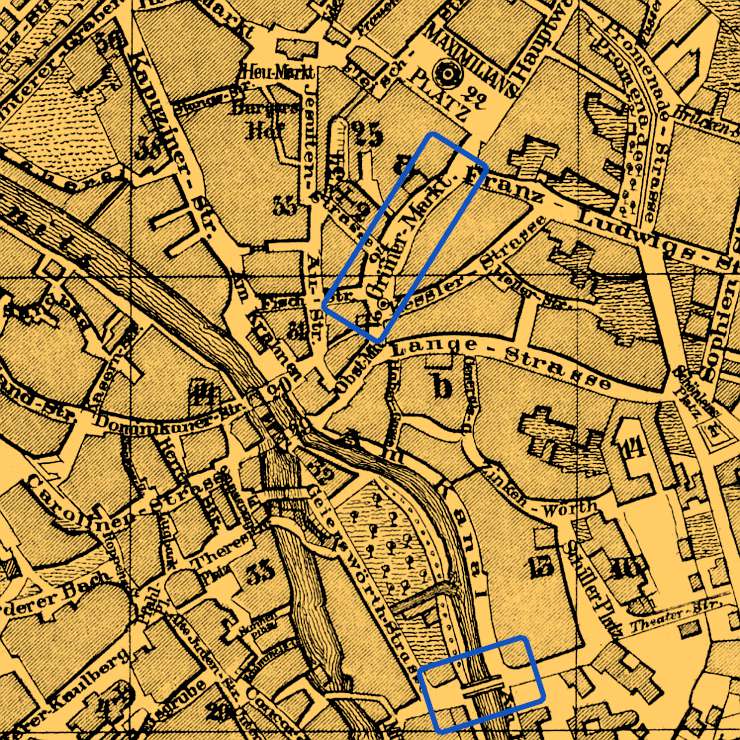
[2] The property Caroline was interested in leasing was located at what was formerly designated as Eckgrundstück 84 (corner property 84), today known as Nonnenbrücke 1 in Bamberg across from what would later be Schiller Square; it was originally built in 1736 and used as a residence by the architect Justus Heinrich Dientzenhofer (1702–44) (here the bridge in an excerpt from the illustration of Bamberg by Matthaeus Merian [1648]; the vegetable market is indicated at top right; 2nd map showing the later layout of the town with the vegetable market similarly indicated: Bamberg: Plan der Stadt Bamberg [nach officiellem Plan bearbeitet] [Bamberg N.d.]):

[3] Göttingischer Taschen-Kalender für das Schalt-Jahr 1808; Inhaltsverzeichnis deutscher Almanache, Theodor Springmann Stiftung:
[4] Unidentified. Back.
[5] “Mull” in Swabian is a common pet name for cats; Auguste uses the nickname for Schelling in her previous letter as well (4/5 June 1800 [letter 261]). Back.
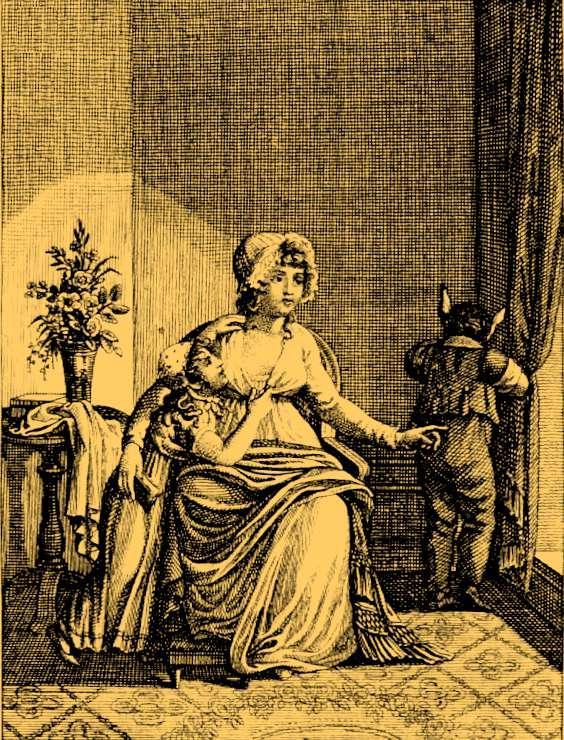
[6] Since nothing more is said about Auguste’s illness, and considering that she would die a month later, on 12 July 1800, these remarks might suggest — tragically — that she had indeed already contracted the ultimately fatal illness in Bamberg itself (Taschenbuch für die Deutsche Jugend auf das Jahr 1804; Inhaltsverzeichnis deutscher Almanache, Theodor Springmann Stiftung):

As Caroline goes on to say, she and Auguste would depart for Bocklet on 12 June. Back.
[7] Wednesday, 11 June 1800, when Caroline agreed to wait for Marcus’s return. Back.
[8] Concerning the military situation, see Auguste’s letter to Schelling on 4 June 1800 (letter 261), note 3.
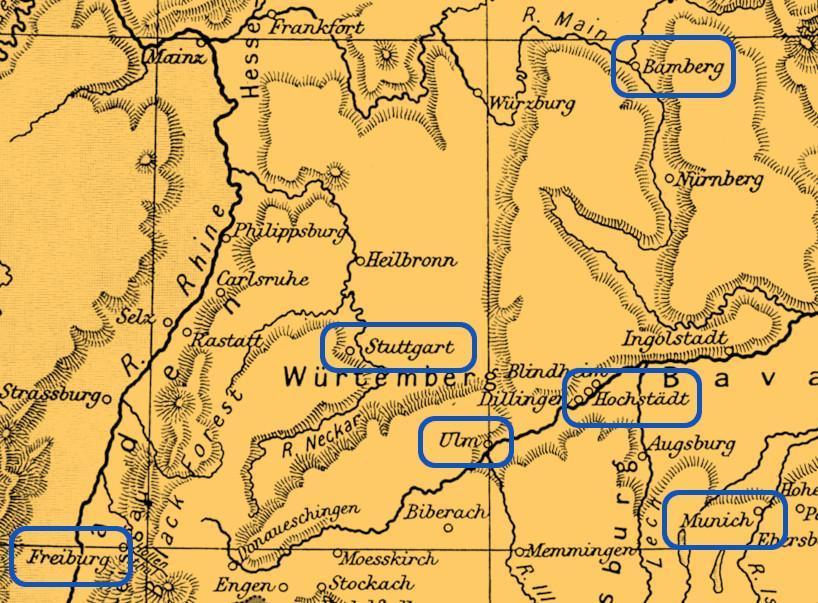
The French general Moreau seized the town of Freiburg in southwest Germany and forced the Austrian (imperial) forces back to Ulm, some 75 km southwest of Stuttgart and 60 km southwest of Schorndorf, where Schelling was staying with his parents. The French soon took Ulm as well, and on 19 June — just over a week after Caroline is writing here — Moreau beat the Austrians at Höchstadt, south of Bamberg itself — though by then Caroline and Auguste were already in Bocklet, some 75 km northwest of Bamberg — before moving on and taking Munich on 2 July 1800.
It is in connection with these troop movements, of which Caroline would unlikely have had accurate or up-to-date information, that she suspects the movement of imperial troops around Schorndorf (Central Europe: The Austrian War 1809; Neighborhood of Vienna, in The Cambridge Modern History Atlas, ed. A. W. Ward, G. W. Prothero, Stanley Leathes, and E. A. Ben [London 1912]; University of Texas, Perry-Castañeda Library Map Collection):
[9] Adalbert Friedrich Marcus had two brothers in Bamberg: Friedrich and Philipp Nathan. Back.
[10] Identify of Hofmarschall (court/royal marshal) (von) Redwitz uncertain. Back.
[11] Uncertain which brother is meant. Marcus’s brother Philipp Nathan seems to have died that very year, 1800, while his other brother, Friedrich, died a year later, in 1801. Back.
[12] Genealogische Kalender auf das Jahr 1810; Inhaltsverzeichnis deutscher Almanache, Theodor Springmann Stiftung):

[13] Unknown reference, though Caroline is here assuming that Schelling is familiar with it. Back.
Translation © 2014 Doug Stott