
255e. Dorothea Veit to Rahel Levin in Berlin : Jena, 18 November 1799 [*]
Jena, 18 November 1799
I wish you had received all the letters I wrote to you in thought with such ardent earnestness, then I would have a good conscience. But I do not want to have this bad conscience any longer. —
I am doing quite well here, my friend. As you rightly pointed out, I ask for nothing more than to be content! Were I not so here, then I would be beyond hope. How could I not be doing well? if for no other reason than that I am around no one who merely values what tradition has taught them to value, but rather: here ever person holds his own! —
And what people I am living with! In the 6 weeks I have now been here, [1] I have heard not a single word that might have made me feel uneasy. I am quite satisfied with Caroline and am du dernier bien with her, [2] which is no small feat, since she never, ever engages in flattery, nor ever does so merely as an accommodation; that is, I had to pass a rather severe test from her side before she warmed up to me, though she was cordial from the very beginning.
What I really appreciate about her, though, is her admittedly rather severe but always upright straightforwardness and honesty. Although she judges every work of art and indeed all things quite boldly and brazenly, what would be arrogance in others merely derives from the unaffected candor and unreflected straightforwardness of her character. She really is quite good, and she in her own turn appropriately registers every good quality in every other person. Although she does have an extremely high opinion of herself, actually every fair, just person ought to have such of himself, especially when accompanied by fairness with respect to the merits of others, as is the case with Caroline, manifesting itself so utterly naively at every opportunity, never concealing her lofty opinion of herself in her heart while hypocritically professing to have such an opinion of another person.
One also eats quite well in her house; she is a fine hostess, always functioning thus with a light sense of propriety; it is admittedly difficult to say what figure she cuts in someone else’s house with her brazen confidence and unconcerned, nonchalant nature; she probably makes it rather unpleasant for someone to be her host!
But I have become quite affectionate toward her and have come to trust her completely. It is quite nice the way this woman maintains her youth, both physically and intellectually. What you told me about her coquettishness toward Wilhelm made me suspicious from the very beginning that she does not love him, something about which I am now utterly convinced.
I saw Hardenberg, he was here for several days, [3] and my being able to observe his personality explained to me how he was once able to escape your attention; [4] his friends maintain he has changed for the worse; I, however, maintain that one does not become common or ordinary, one is born thus.
And now finally: a bright spot in my life’s course. I saw Goethe! and not merely saw him, he also accompanied me and the two Schlegels on a walk for a good half hour; [5] he gave me a distinguishing look when greeting me after hearing my name and then conversed with me quite cordially and freely and easily.
He made a grand and indelible impression on me; having this god so visibly next to me, and in human form, having him so immediately focused on me, that for me was a grand, eternal moment! —
I noticed little of the intimidating personality everyone has talked so much about; quite the contrary, even though my timidity and anxiety were great indeed, they quickly dissipated, and I increasingly gained a certain element of sisterly trust in him. But what a shame that he is becoming so corpulent, that really does spoil one’s imagination a bit! [6]
While he was walking so close alongside me and speaking with me so cordially, I compared his person with all his works I could think of in my haste, and I found that he most closely resembles Meister and Hermann, and has the least resemblance with Faust. Everything else, however, seemed quite clearly present, the Vermischte Gedichte, Tasso, Egmont, Werther, Götz, Elegien, absolutely everything, everything! [7] —
The paternal tone in his most recent pieces also became clear to me! —
He visits no one but Schiller, whose wife is extremely ill; [8] Madam Schlegel has, however, given me hope that he will accept an invitation for a soupé sometime. If that does indeed happen, you shall certainly hear about it. For you, my dear, actually deserve to be there yourself! [9] —
So, here you have all the joys I would actually like to relate to you in greater detail, but I can spend only a little time corresponding with my friends, since otherwise I must work, at least to the extent my still shaky health allows.
Notes
[*] Sources: Denkschriften und Briefe zur Charakteristik der Welt und Litteratur, 5 vols., ed. Wilhelm Dorow (1838–41), 4:104–8; Dorothea Schlegel und deren Söhne 21–23; Wieneke (1914) 309–10 (frag.); KFSA 25:25–27. Back.
[1] Dorothea had arrived in Jena on 6 October 1799. Back.
[2] Fr. “on extremely good terms.” Back.
[3] Friedrich von Hardenberg had been in Jena on 11–15 November 1799. Back.
[4] Rahel Levin had made Hardenberg’s acquaintance in Teplitz (Töplitz) during the summer of 1798. Concerning Dorothea’s recently acquired acquaintance and perhaps surprising opinion of Hardenberg, see the first two paragraphs to her letter to Schleiermacher on 15 November 1799 (letter 255b). Back.
[5] See Dorothea’s accounts in her letter to Schleiermacher on 15 November 1799 (letter 255b). Back.
[6] Here a portrait of Goethe in 1800 by Friedrich Bury:

[7] An eloquent testimony to Dorothea’s familiarity with and enthusiasm for Goethe’s work.
In order: Wilhelm Meisters Lehrjahre. Ein Roman, 4 vols. (Berlin: 1795–96) (illustration of the protagonist: from Goethe-Galerie. Charaktere aus Goethe’s Werken. Gezeichnet von Friedrich Pecht und Arthur von Ramberg [Leipzig 1864]):
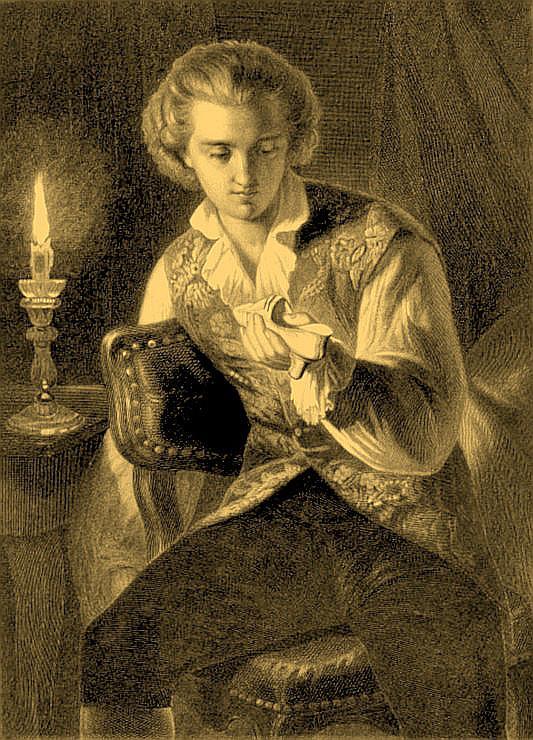
Hermann und Dorothea, published as Taschenbuch für 1798 (1797) (illustration: Göthe-Gallerie: Stahlstiche zu Göthe’s Meisterwerken / nach Zeichnungen von Julius Nisle, issue 5 [Stuttgart 1840], plate 3);

“Faust. Ein Fragment,” in Goethe’s Schriften, vol. 7 (Leipzig 1790) 1–160 (illustration: George T. Andrew et al., Songs and Scenes from Goethe’s Faust [Boston 187], 13);
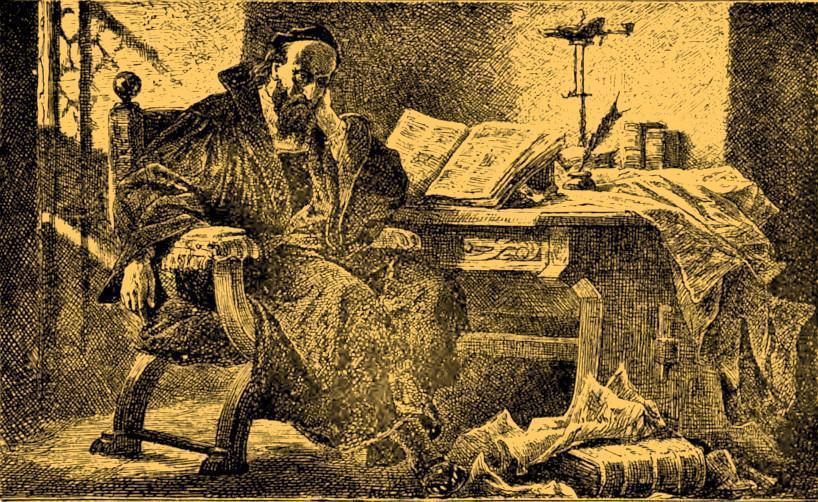
Dorothea returns to this publication in later letters to Karoline Paulus, drawing from it her malicious name for Caroline as “Marthe Schwerdlein” (Dorothea spells the name “Martha Schwerdtlein”) (see Dorothea’s letter to Karoline Paulus on 13 January 1805 [letter 389a]);
“Vermischte Gedichte,” in Goethe’s Schriften, vol. 4 (Leipzig 1791), 323–454 (here the frontispiece portraying a scene from Jery und Bätely);

Torquato Tasso, in Goethe’s Schriften, vol. 6 (Leipzig 1790), 1–222 (illustration: Tasso [left] is speaking to Antonio in the play’s final scene: Goethe’s Works, trans. George Barrie, vol. 1 [Philadelphia 1885], 149);

Egmont, in Goethe’s Schriften, vol. 5 (Leipzig 1788) (as “Ein Trauerspiel”), 1–148 (here Egmont and Klärchen in that edition’s frontispiece by Angelika Kauffmann);
 ;
;
Die Leiden des jungen Werthers (Leipzig 1774) (illustration: Die Leiden des jungen Werthers von Goethe, ed. Ludwig Geiger, illustrations by Franz Skarbina [Berlin 1883], 58);
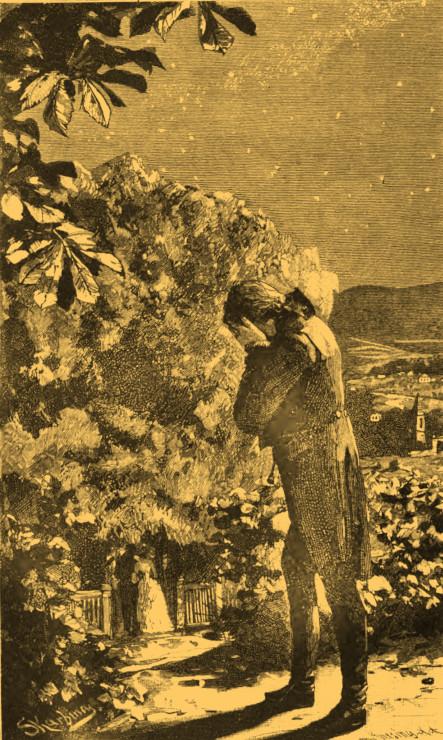
Götz von Berlichingen mit der eisernen Hand. Ein Schauspiel (Darmstadt 1773) (illustration: Göthe-Gallerie: Stahlstiche zu Göthe’s Meisterwerken / nach Zeichnungen von Julius Nisle, issue 8 [Stuttgart 1840], plate 9);
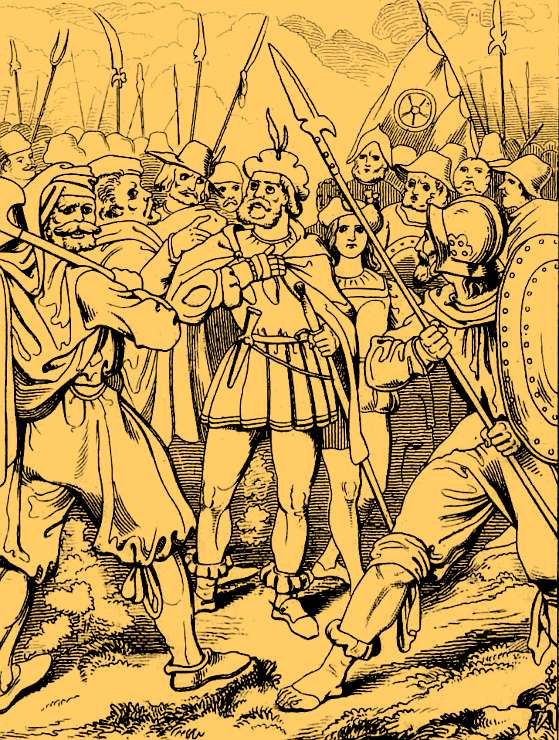
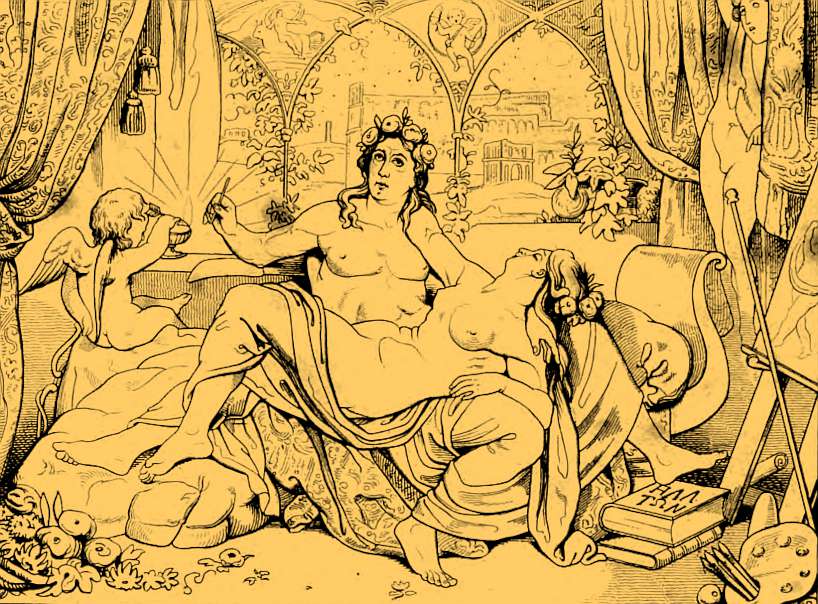
Elegien, in Die Horen (1795) 2, no. 6, 1–44, later title: Römische Elegien, though their erotic content prompted Herder to quip that perhaps Schiller ought to change the “o” in Horen to a “u” (Huren, “whores”) (illustration: Göthe-Gallerie: Stahlstiche zu Göthe’s Meisterwerken / nach Zeichnungen von Julius Nisle, issue 1 [Stuttgart 1840], plate 1);
Wilhelm Schlegel helped Goethe rework these latter poems metrically for the edition of 1800 (see Caroline’s letter to Auguste on 30 September 1799 [letter 245] and supplementary appendix 245.1). Back.
[8] Concerning Charlotte Schiller’s extremely difficult illness after the birth of her daughter, Karoline, on 11 October 1799, and her enduring delusional spells, see Caroline’s letter to Auguste on 28 October 1799 (letter 252), note 16. Back.
[9] Rahel’s own salon in Berlin had early admired Goethe’s writings. Back.
Translation © 2013 Doug Stott