
255d. Dorothea Veit to Karoline Paulus in Jena: Jena, ca. 15–16 November 1799 [*]
[Jena, ca. 15/16 November 1799]
How are you doing, dear, after all the fatiguing difficulties you have been through? But things were just so nice yesterday evening, just as it should be. [1] I would come visit you this morning, but I cannot avoid the fact that I really must work.
This afternoon at 3:00, however, the harvest garland is being erected at the Saw Mill; [2] if you are as fond of attending such rural festivals as I, then I will pick you up sometime after 2:00. —
Friedrich’s unreasonable and unfair jealousy would have made me laugh were I not so utterly serious! but it was interesting for me to see that he is jealous and how he is. [3]
Dear, only use your entire understanding, since Friedrich misuses his own, and mine cannot be used in any case; my understanding is like that of your little girl: precisely when it is supposed to say something, it says nothing.
The old gentleman (who, by the way, is not old at all; Goethe and I, neither of us are aging) was quite charming, and quite charmed me. [4] Can you not arrange for us to meet him sometime alone during a promenade?
D[orothea]
Notes
[*] Sources: Briefe von Dorothea und Friedrich Schlegel an die Familie Paulus 111–12; KFSA 25:25.
Dating according to KFSA 25:391: Dorothea and Karoline Paulus are now using the familiar form of address (Du), whereas earlier (mid-October 1799; Briefe von Dorothea und Friedrich Schlegel an die Familie Paulus 111; KFSA 16) they had used the formal address (Sie).
Dorothea seems, moreover, only just to have encountered Goethe during the walk on Thursday, 14 November (see her letter to Schleiermacher on 15 November 1799 [letter 255b]), and Karoline may even have been present at the Schlegels when Ludwig Tieck read from his Genoveva the evening of 14 November (see Friedrich Schlegel to Schleiermacher on 15 November 1799 [letter 255d]).
Finally, the harvest festival was presumably on the weekend, which meant the letter would likely have been written on Saturday, 16 November 1799. Back.
[1] As noted above, possibly a reference to the gathering on the evening of 14 November 1799 when Ludwig Tieck read aloud from his Genoveva (see Friedrich to Schleiermacher on 15 November 1799 [letter 255d], esp. with note 8). Back.
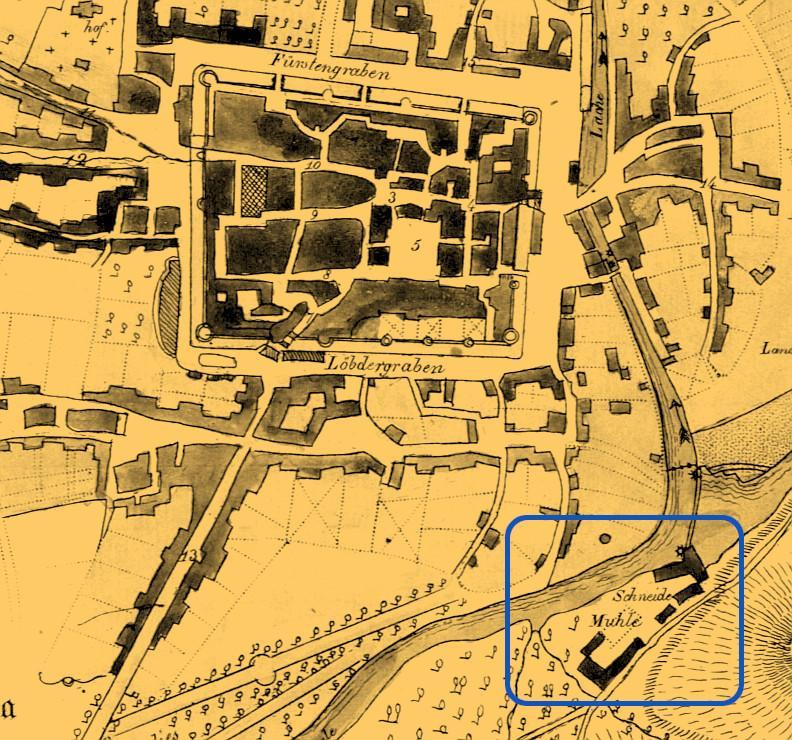
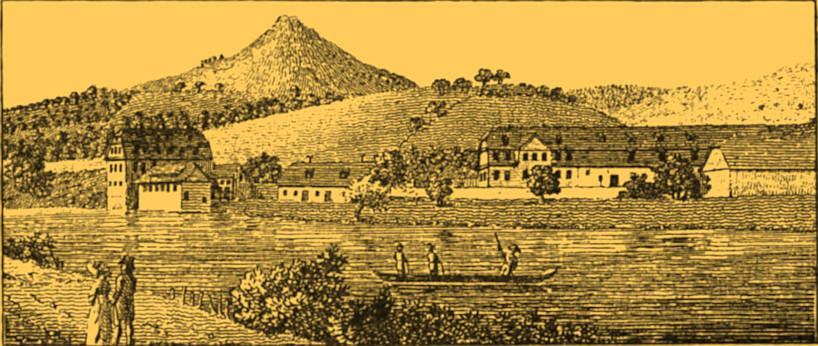
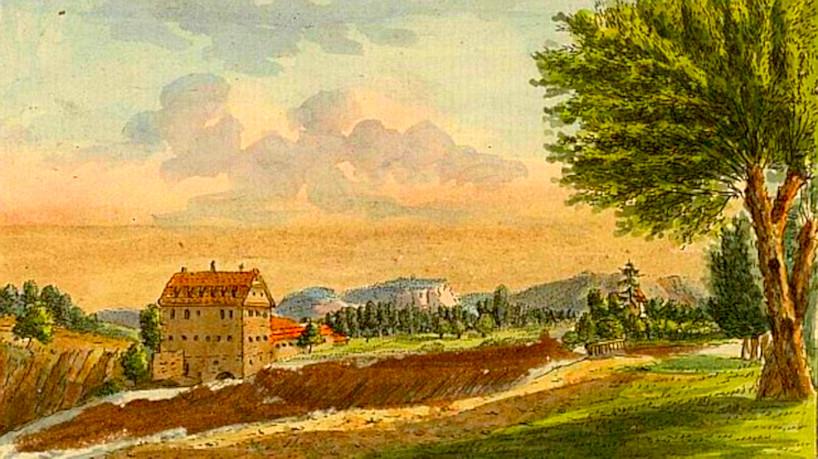
[2] “The Saw Mill (Schneidemühle) was located essentially in the southeastern part of Jena that began on the other side of the Saale River as part of the former freehold Oberkamsdorf, connected with Jena by the Camsdorfer Brücke (the original bridge was demolished in 1912).
It was known as a rural entertainment locale (with a sometimes less-than-staid reputation) and is mentioned as such in the first stanza of Goethe’s song “Die Lustigen von Weimar” (Briefe von Dorothea und Friedrich Schlegel an die Familie Paulus 183fn111,21). That first stanza reads (“The Jolly of Weimar,” in Goethe’s Poems, trans. Paul Dyrsen [New York 1878], 124):
Thursday means: to Belvedere
Friday is the Jena day,
For that is, indeed, a very
Charming city, I must say.
Saturday is somewhat fickle,
But the pick-nicks Sunday claim.
Zwäzen, Burgau, may us tickle,
Schneidemühlen be our aim.
The locale consisted of the saw mill itself, the support buildings of the freehold estate, a brewery and associated inn, and the Weimar weaving factory. See Historisch-topographisches Taschenbuch von Jena und seiner Umgebung, besonders in naturwissenschaftlicher und medicinischer Beziehung, ed. J. C. Zenker (Jena 1836), 127:
Kamsdorf, first Lower Kamsdorf [Unter-Kamsdorf] with a freehold to which the inn belongs, then Upper Kamsdorf [Ober-Kamsdorf], also a freehold with a kiln and the saw mill, built by [Johann] Moritz Richter; relatively speaking it has the most populated, with 318 residents in 52 houses. These two freeholds were once owned by Hofrath Teichmeyer (†1744), whose son-in-law, Albrecht von Haller [1798–77; poet and physician, Göttingen professor, medical authority], editor of the [Henricus Bernhardus] Ruppius Flora Jenensis (Jena 1745), lived here for a time.
Here the location across the Saale River to the southeast of Jena (Jena von seinem Ursprunge bis zur neuesten Zeit: nach Adrain Beier, Wiedeburg, Spangenberg, Faselius, Zenker u.a. [Jena]):
Here its setting along the Saale River (Gustav Heinrich Schneider, Die Burschenschaft Germania zu Jena [Jena 1897], 345):
A similar view ca. 1780 by Christian Gotthilf Immanuel Oehme (Dresden, Sächsische Landesbibliothek – Staats- und Universitätsbibliothek [SLUB], Kartensammlung, Signatur/Inventar-Nr.: SLUB/KS B2446):

And another illustration by Christian Gotthilf Immanuel Oehme ca. 1780 from a different direction (Dresden, Sächsische Landesbibliothek – Staats- und Universitätsbibliothek Dresden [SLUB], Kartensammlung, Signatur/Inventar-Nr.: SLUB/KS B2447):
[3] Friedrich, who, along with others, including Wilhelm Schlegel and Goethe, had entertained an amorous interest in Karoline Paulus, may have been jealous of the friendship developing between the two women; see the supplementary appendix on Karoline Paulus.
Later letter exchanges between the two women show in any case how perhaps surprisingly ardent was their friendship, at least from Dorothea’s side. Back.
[4] See Dorothea’s description of the encounter with Goethe in her letter to Schleiermacher on 15 November 1799 (letter 255c). Back.
Translation © 2013 Doug Stott