
235b. Wilhelm Schlegel and Caroline to Georg Joachim Göschen in Leipzig: Jena, 29 April 1799 [*]
You may recall an earlier discussion we had concerning the possibility of an Almanach devoted primarily to wit and jest. Although several of the rather witty minds on whom you were counting at the time have since departed this life — we are nonetheless still alive and, one hopes, still witty — namely, Ludwig Tieck and I myself, along with a couple of other friends with whom I have communicated concerning these things in writing.
I wanted to relate to you that I have in the meantime received proposals from other booksellers and ask whether you might yet be inclined to pursue our earlier plans and perhaps even to bring them to fruition this year for 1800. [1] The timing seems favorable considering that Lichtenberg’s Kalender has ceased [2] and Schiller will not be publishing any real anthology this year. Please do consider it! We would perhaps need only a rather elegant copper engraving for the title page, which could easily be ready by Michaelmas. We already have various pieces ready and ideas for many more, and would be ready to go in plenty of time.
And what might you be prepared to invest in the project? We all know that you are a generous bookseller. Falk is receiving 400 Thlr. for his pocketbook (which, between us, is not worth much, or even anything at all). [3] — Prithee! what will you offer us?
Please let me know as soon as possible in a few lines what you think, for as you can easily see, we must move quickly indeed if anything is to be done this year. [4]
Let me know as well how you and your family are doing, especially your dear wife. My own wife sends her kindest regards.
The incurred expenses have, I hope, been properly compensated from Dresden. Do accept my apologies for the delay.
Stay very well.
Sincerely yours,
AWSchlegel
[Caroline’s postscript:] [5] Once Marianne has left, I will once again show up with my inordinately long letters to your wife. Till then, she will doubtless have little time indeed to read them. Tell her only that I will remain fond of her my entire life, nor am I at all cross with you, my dearest Göschen [in margin: except that you want nothing to do with Schlegel] But do come for a visit sometime that we may quarrel here in a proper fashion. [6]
I received the receipt from Marianne. I will not see her in Berlin, however, because we will not be traveling there as soon as we were hoping — but may things go well for her there. [7]
Notes
[*] Sources: Wilhelm’s letter: Karl Gödeke, “Vier Briefe A. W. Schlegels an Göschen,” Weimarisches Jahrbuch 4 (1856), 26–30, here 27–28. Caroline’s postscript not in Erich Schmidt, (1913); text from Digitale Edition der Korrespondenz August Wilhelm Schlegels.
Part of the background to his letter was Wilhelm’s financial concerns prompted by the deteriorating relationship with the Allgemeine Literatur-Zeitung. See his correspondence with Gottliebe Hufeland during this period. Concerning this dispute, see also the supplementary appendix Garlieb Merkel on Christian Gottfried Schütz and the Allgemeine Literatur-Zeitung; also Wilhelm Dilthey on the break between the Romantics and the Allgemeine Literatur-Zeitung (supplementary appendix 258a.1). Back.
[1] Literary almanacs dated for the following year often appeared the previous autumn at the Michaelmas book fair. Back.
[2] Georg Christoph Lichtenberg’s Göttinger Taschen Calender (1778–99); Lichtenberg had just died in February 1799. See the gallery on several of Daniel Nikolaus Chodowiecki’s charming illustrations to the 1799 issue. Back.
[3] Taschenbuch für Freunde des Scherzes und der Satire (1797–1803), which, incidentally, contained lushly illustrated satires on, in 1797, Kantian philosophy and its followers (including Fichte, Friedrich Immanuel Niethammer, and Schelling); color illustrations, e.g., from 1800; and in 1801 a satire on the Romantics including Schleiermacher and Ludwig Tieck (Inhaltsverzeichnis deutscher Almanache, Theodor Springmann Stiftung):
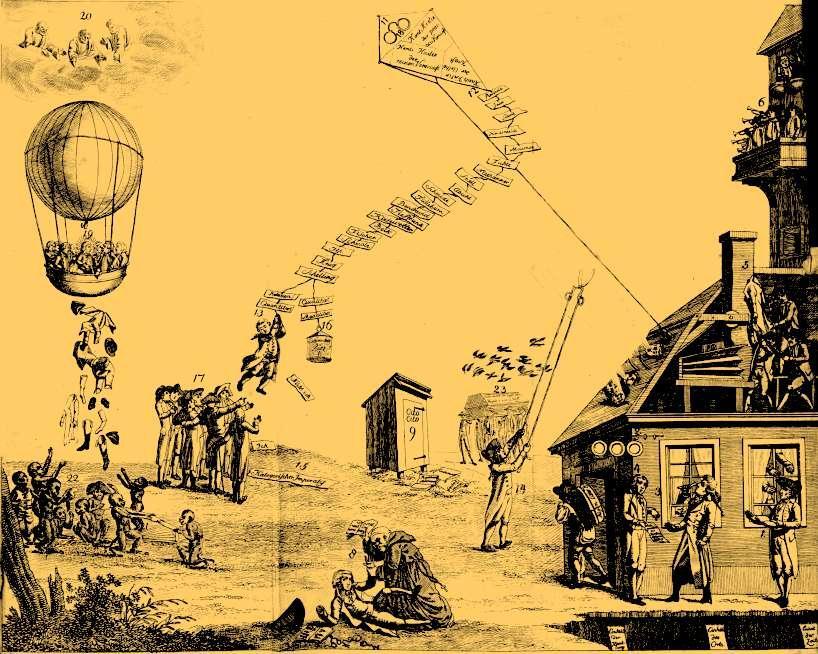
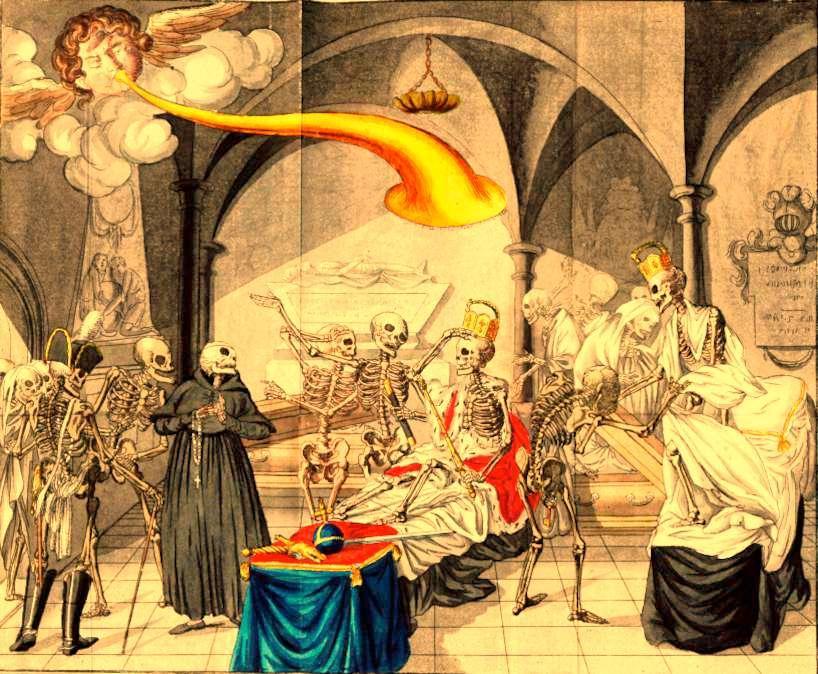

Satirical illustrations were a popular means of lampooning philosophical or literary adversaries or allegedly wrongheaded thinking (see the satirical illustration contra the Xenien and additional illustrations contra the Romantics themselves).
In the following excerpt from the satire against the high-flying kite of Kantian philosophy with its three critiques emblazoned on the kite (of pure reason, of practical reason, and of judgment), one has a listing of, literally, “hangers on,” including, as mentioned, Fichte.
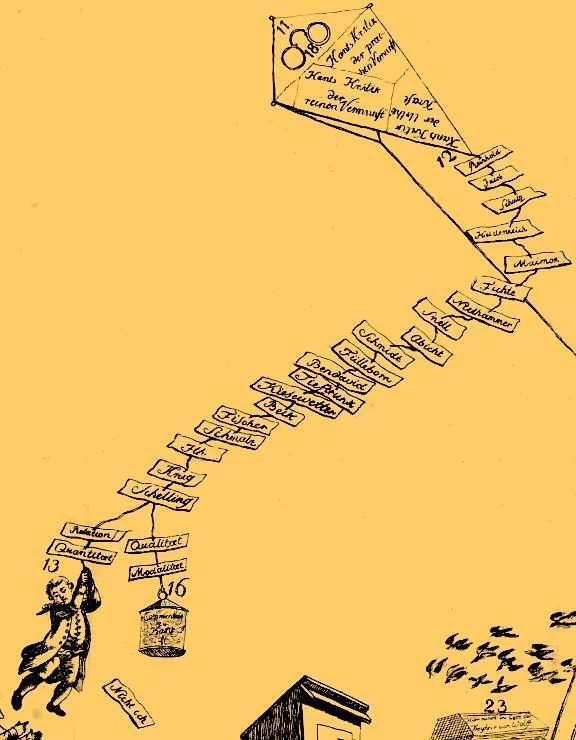
Falling away at the bottom beneath the ballast of “Commentary to Kant” (no. 16), however, and beneath the still-attached Kantian notions of “Relation,” “Quantity,” “Quality,” and “Modality,” is Fichte’s Nicht Ich, or non-ego, part of Fichte’s controversial response to Kant’s enigmatic Thing-in-itself that constitutes a fundamental break with Kantian thinking and also an anticipation of Schelling and Hegel.
Readers unfamiliar with this key concept in Fichte’s thought may refer to the following succinct remarks, albeit necessarily taken in medias res, from the tenth edition of the Encyclopædia Britannica (“Metaphysics,” The New Volumes of the Encyclopædia Britannica, 10th ed. [London 1902], vol. 30, 646–91, here 653–54):
Fichte now set himself in the Wissenschaftslehre (1794) to make transcendental idealism into a system of metaphysical idealism without Kant’s inconsistencies and relics of realism. His point was that there are no things in themselves different from minds or acting on them; that man is no product of things; nor does his thinking arise from passive sensations caused by things; nor is the end of his existence attainable in a world of things; but that he is the absolute free activity constructing his own world, which is only his own determination, his self-imposed limit, and means to his duty which allies him with God.
In order to prove this novel conclusion, he started afresh from the Cartesian “I think” in the Kantian form of the synthetic unity of apperception acting by a priori categories; but, instead of allowing, with all previous metaphysicians, that the Ego passively receives sensations from something different, whether bodies, or monads, or God, or an unknown thing in itself, and not contenting himself with Kant’s view that the Ego, by synthetically combining the matter of sensations with a priori forms, partially constructs objects, and therefore Nature as we know it, he boldly asserted that the Ego, in its synthetic unity, entirely constructs things; that its act of spontaneity is not mere synthesis of passive sensations, but construction of sensations into an object within itself; and that therefore understanding makes as well as shapes Nature, as the Ego in thinking constructs both its own knowledge and its own world.
This construction, or self-determination, is what Fichte called positing (setzen). According to him, the Ego posits first itself (thesis); secondly, the non-Ego, the other, opposite to itself (antithesis); and, thirdly, this non-Ego within itself (synthesis), so that all reality is in consciousness.
But, he added, as the Ego is not conscious of this self-determining activity, but forgets itself, the non-Ego seems to be something independent, a foreign limit, a thing in itself, or per se. Hence it is the office of the theory of knowledge [Wissenschaftslehre] to show that the Ego posits the thing per se as only existing for itself, a noumenon in the sense of a product of its own thinking.
Further, according to Fichte, on the one hand the Ego posits itself as determined through the non-Ego — no object, no subject; this is the principal fact about theoretical reason; on the other hand, the Ego posits itself as determining the non-Ego — no subject no object; this is the principal fact about practical reason. Hence he united theoretical and practical reason, which Kant had separated, and both with will, which Kant had distinguished; for he held that the Ego, in positing the non-Ego, posits both its own limit and its own means to the end, duty, by its activity of thinking which requires will.
The conclusion of his epistemology is that we start with ourselves positing subjective sensations — e.g., sweet, red — and refer them as accidents to matter in space, which, though mental, is objective, because its production is grounded on a law of all reason.
The metaphysics resulting from this epistemology is that the so-called thing in itself is not a cause of our sensations, but a product of one’s own thinking, a determination of the Ego, and object, limit, and means to the end of the Ego, a thing known to the Ego which constructs it. Fichte thus transformed the transcendental idealism of Kant by identifying the thing with the object, and by interpreting noumenon, not in Kant’s sense of something which speculative reason conceives and practical reason postulates to exist in accordance with an idea, but in the new meaning of a thought, a product of reason.
This change led to another. Kant had said that the synthetic unity “I think” is in all consciousness one and the same, meaning that I am always present to all my ideas. Fichte transformed this unity of the conscious self into a unity of all conscious selves, or a common consciousness; and this change enabled him to explain the unity of anything produced by the Ego by contending that it is not the different objects of different thinkers, but the one object of a pure Ego or consciousness common to them all. According to Kant, the objective is valid for all consciousness; according to Fichte, it is valid for one consciousness.
Here he was for the first time grappling with a fundamental difficulty in metaphysical idealism which is absent from realism, namely, the difficulty of explaining the identity of a thing, e.g., the sun. As long as even the meagre realism of the Kantian thing in itself is maintained, the account of there being one sun is simply that one thing causes different phenomena in different minds. But as soon as the thing in itself is converted into something mental, metaphysical idealists must either say that there are as many suns as minds, or that there is one mind and therefore one sun. The former was the alternative of [George] Berkeley (1685–1753), the latter of Fichte.
In fact, Fichte differed from Berkeley, as from Kant, in two respects. In the first place, while Berkeley said that God, and Kant that an unknown thing, is the cause of our sensations, Fichte said that we posit the sensations and the thing, and falsely regard the thing as the cause of sensations, until the theory of knowledge [Wissenschaftslehre] shows that it is only a mental product and a noumenon in this sense.
Secondly, while Berkeley supposed that there might be as many suns as ideas, and Kant that an unknown thing causes many appearances of the sun in many minds, Fichte said that there is one mind positing one sun, a single pure Ego positing a single mental object, one and the same in all human persons.
Thus the complete metaphysical idealism of Fichte’s Wissenschaftslehre, formed out of the incomplete metaphysical idealism of Kant’s Kritik, is the theory on its epistemological side that the Ego posits the non-Ego as a thing in itself, and yet as only a thing existing for it as its own noumenon, and on its metaphysical side that in consequence all reality is the Ego and its own determinations, which are objective, or valid for all, as determinations, not of you or of me, but of the consciousness common to all of us, the pure or absolute Ego.
Lastly, Fichte called this system realism, in so far as it posits the thing in itself as another thing; idealism, in so far as it posits it as a noumenon which is a product of its own thinking; and on the whole real idealism or ideal realism. Back.
[4] The project never materialized. Back.
[5] Caroline’s postscript reads as follows in the manuscript (Digitale Edition der Korrespondenz August Wilhelm Schlegels; line breaks as in original; transcription by the translator and Hedwig T. Durnbaugh):
Wenn Marianne weg ist, dann werde
ich mich einstellen mit meinen recht langen
Briefen an Ihre Frau. Bis dahin hätte
sie gewiß gar keine Zeit mich zu lesen.
Sagen sie ihr nur, ich hätte sie lieb
mein Leben lang, und bin auch Ihnen
keines weges böse liebster Göschen.
[in margin: außer daß Sie nichts
mit Schlegel zu thun haben wollen] Kommen
Sie nur bald einmal her, damit
wir uns hier recht zanken können.
Die Quittung von Marianne habe ich
erhalten. Ich werde sie nicht in Berlin
sehn weil wir nicht so früh hingehn wie wirs
wollten — möge es ihr dort wohl gehn. Back.
[6] Caroline’s allusion to disagreements of some sort with the Göschens is unclear except for the possible conflict created by Wilhelm and Friedrich Schlegel’s satire of Christoph Martin Wieland in their periodical Athenaeum. It may be recalled that Göschen was publishing the expansive and elegant edition of Wieland’s collected works (see below). See Friedrich’s mentions of Heinrich Frölich’s — the next publisher of Athenaeum — keen interest in Wilhelm’s anticipated “annihilation” of Wieland in Friedrich’s letter to Wilhelm on 22 December 1798 (letter 213):
And one other strange, almost comical point. He may have heard something from Vieweg about your taking up arms against Wieland. He is so attracted to this idea, however, believing it will have such a grand effect, that he is requesting and indeed wishes to receive this piece for one of the four (initial) issues he has agreed to undertake.
See Friedrich’s letter to Caroline of 20 October 1798 (letter 205) and esp. the supplementary appendix on the break with Wieland, specifically its section on Wieland’s annihilation. Göschen had given Wilhelm complementary copies of Wieland’s lavishly illustrated collected works, Sämmtliche Werke (Leipzig 1794–1802), which eventually comprised forty-five volumes. Wilhelm never carried out the proposed “annihilation.” Back.
[7] Wilhelm and Caroline were anticipating a trip to Berlin for the premiere of their translation of Hamlet; although the planning for this journey has occupied many of the letters prior to this one extending back to December 1799, neither the premiere nor the trip came off as planned. See Ella Horn’s essay on the background to the premiere of Hamlet in Berlin. Back.
Translation © 2016 Doug Stott