
• 210. Friedrich Schlegel to Caroline in Jena: Berlin, 27 November 1798 [*]
[Berlin] 27 November [1798]
|477| I cannot give you a solid answer today. [1] Certainly perceptions and ideas enough. But only facta. For I have not yet really had a proper chance to see Unger since Wilhelm’s proposal, Henriette was also not home yesterday, and from Vieweg there is yet another note that admittedly says little more than that he is a scoundrel and that Wilhelm’s letter gave him a considerable fright. I need Wilhelm to let me know quite soon whether he is willing to grant Vieweg such a date at all, and if so, how late a date. I cannot tell whether the fellow really is hoping and wants to hope, or whether in his fright |478| over Wilhelm’s threats he is simply trying to avoid a clear, unequivocal no.
Nothing further has occurred in our house, and everything is proceeding quite of its own accord just as you want and advise. [2] Everything has fallen into forgetfulness for now, and he is more indulgent and accommodating toward us than ever precisely if we but leave things amid that forgetfulness, which for the moment is quite pleasant. We are hoping he will be going to Paris this summer on business. If that happens, then we will not only live more freely and, for my part, in a fashion more conducive to my work either here or in Dresden or wherever else is best, but our path into the wider world will also open up almost by default. I do not believe we would go along to Paris, at least not initially. —
But who knows whether all that is just castles in the sky. Were the project merely his alone, we would take no notice of it, but since Josef is taking part as well, we are more justified in entertaining some measure of hope.
The only thing that follows from this situation for the moment is that before all that has been settled and she is free, I may leave Madam Veit now less than ever. [3] — A civil union has never really been our goal even though for some time now I have considered it impossible that anything short of death itself could separate us. —
It does, I acknowledge, run wholly contrary to my own feelings to balance and calculate the present and future in such a way; and if the hated ceremony (something neither appropriate nor possible) were to become the only condition of that inseparability, then I would act according to the exigencies of the moment and destroy my most cherished ideas. —
But even if I look past that consideration and everything else as well, the age difference alone would be reason enough militating against it for me. Just now, when we are both still young, it does not really make any difference at all |479| that she is seven years older. [4] But when it is no longer proper for her to be my wife in this sense, I will still be quite young, and, if I judge myself entirely without other considerations, as a stranger would, then I will as little be able to live without a wife as simply to make do with a female companion. [5] She would probably not be my last love even were she my only one, just as her love for me is not her first.
Everything you have written me in this regard has made me very glad and is correct and wonderful. Write me more and please do take a concerned interest in me in this regard.
The day before yesterday I had a visit from Hülsen, who has, however, already departed again. I was quite pleased with him, and I would very much like to visit him sometime, something he invited me to do. Might we not all go see him at Easter? He is seven miles from here. [6] —
He would have been an extremely capable collaborator for Athenaeum. He told me about all sorts of things, including a treatise on the central sun; and I do think he would be the right man for developing astronomy into one of the aesthetic disciplines. —
He had some rather crazy dealings with Fichte, who, as Hülsen was departing for Halle, told him all sorts of things about Homer to relate to Wolf, namely, how he had come to the same result a priori concerning the inauthenticity of the Homeric poesy. [7] And Hülsen conscientiously carried out the request. Now, one need have only very little a posteriori or a priori acquaintance with Wolf to know how comical he must have found this report. Well, Fichte heard about these quite natural Wolfian ironies and accused Hülsen of abusing his trust, something Hülsen, of course, doubtless never remotely considered.
Is it perhaps because one wants to pull the wool over the eyes of the Schöne Wissenschaften that they have been assigned to me? [8] |480| I accept them, and request even more ardently part IV of Kant’s Kleine Schriften, which was long ago offered to me and which I accepted and without which I cannot review the first parts. [9]
I will perhaps answer Hirt simul[taneously] Ox [10] with a couple of lines at the next opportunity when Wilhelm thoroughly ridicules him. Actually, it runs wholly contrary to my maxim of not responding to such allusions to facta and personalities involving literary legitimacy. In the meantime, however, the manner is admittedly so pathetic that it is almost unworthy of any notice at all. [11]
I am very, very pleased that all of you want to take in and have Henriette with you. Actually it would be a real shame were she to become a governess. [12] Her company would be an irreplaceable gain for Auguste, and she could also learn a great many useful things from her. The real problem that has arisen is that she is somewhat anxious about the money, and that after this domestic breakup and in the heat of her initial attack of independence she can no longer sustain the financial support she has hitherto gotten from Veit and Josef, and yet the interest from her small principal does not quite cover the needs of her modest elegance. —
If you two seriously want her to come stay with you, then if at all possible try to find some opportunity for her to earn a little something through translation from English or French. She can surely do this quite well; of course, it goes without saying it must be something easy, a novel, travelogue, something of that sort.
I will take care of your request right away, and even though I have little money just now, you must not send any.
If possible, please just do not withdraw the “Die Gemählde” from the publication. [13] At this point Wilhelm could always quickly write to Hartknoch. [14] Might it not nevertheless be possible to accept the contributions of our friends? I really am |481| extremely concerned about this. Wilhelm needs to mention the names Hülsen — Hardenberg — Schleiermacher — to the bookseller. After all, we all belong to the same central sun! — Please consider this business both with your intellect and with your heart.
My warmest thanks for the news from Goethe, and let me request that you both continue to dispense to me the crumbs from your master table. — Although you opened Hardenberg’s letter, it appears you did not read it, otherwise you surely would have expressed some measure of astonishment at our symbiblicisms. [15]
Auguste’s impetuosity and yearning for Henriette utterly enchanted me, as did her letter in the larger sense. Please give her a kiss from my heart, but without her knowing it.
Notes
[*] Reprinted in KFSA 24:201–3. Back.
[1] Concerning the fate of Athenaeum and the negotiations with Johann Friedrich Unger, see Friedrich’s letter to Caroline on 20 November 1798 (letter 209) with the editorial note. Back.
[2] At issue is Friedrich’s relationship with Dorothea Veit and her marital status. Back.
[3] The following section, beginning with “A civil union has never really been our goal . . . ,” was first published in Leben Schleiermachers 1:471 (3rd ed., 1:482–83) (not Aus Schleiermacher’s Leben as in Schmidt, [1913], 1:732).
Friedrich’s relationship with Brendel [Dorothea] Mendelssohn-Veit, which he describes here with what Erich Schmidt, (1913), 1:732, describes as astonishing coolness, was finally legalized matrimonially in April 1804 after a long period as a free alliance. Dorothea was married to the Berlin businessman Simon Veit on 30 April 1783, when she was almost nineteen. Friedrich’s mother, however, did not learn of this relationship until 1800 (see Mother Schlegel to Wilhelm Schlegel on 5 January 1800 [letter 258b]).
Friedrich wrote to Friedrich von Hardenberg on 17 December 1798 that “in external cultivation and prettiness she lags far behind my sister-in-law” (for complete text, see letter 212b). She bore Simon Veit three sons: Abraham, who died in the first year of life, Jonas, and Philipp, the latter of whom later attained considerable renown as a painter.
Wilhelm von Humboldt was acquainted with Veit because of his intimate association at the time with Brendel, whom he adored, in what was the self-styled social “alliance of virtue” of their youth in Berlin, at the time certainly not an atypical collection founded by Henriette Herz of idealistic, earnest young people — not unlike the alliances of young poets such as the Hainbund in Göttingen to which a young Friedrich Wilhelm Gotter belonged — devoted, indeed committed to intellectual culture, mutual social edification, practical love for fellow human beings, and the development of a deeper knowledge of humanity as such, and one of whose objects of admiration was Goethe (Henriette Herz: Ihr Leben und ihre Erinnerungen, ed. J.Fürst [Berlin 1858], 157–59; illustration: “We swear,” Taschenbuch für Frauenzimmer zum Nutzen und Vergnügen auf das Jahr 1794 [Leipzig]; Inhaltsverzeichnis deutscher Almanache, Theodor Springmann Stiftung):
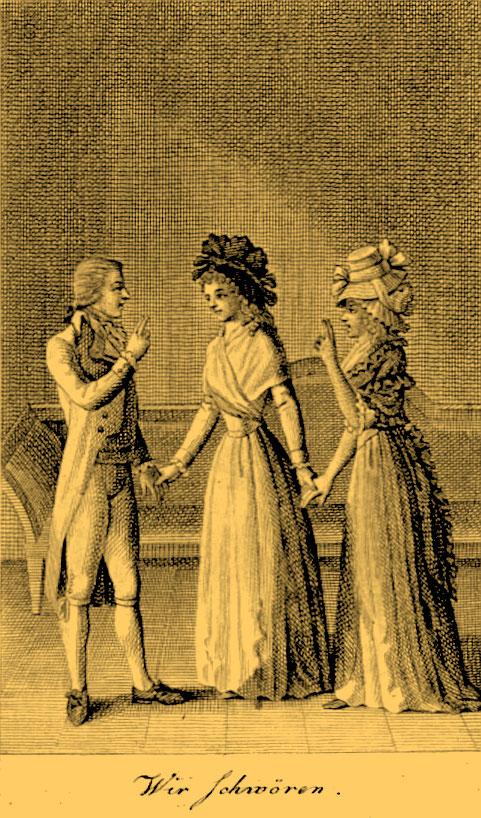
It was in this circle of acquaintances [into which Henriette had introduced the seventeen-year-old Wilhelm von Humboldt] that an alliance was established into which we gradually attracted even persons whom we otherwise did not know but to whose earnest striving and distinction common friends had alerted us. The purpose of this alliance, a kind of “alliance of virtue,” was mutual moral and intellectual edification as well as the practical exercise of love. It was an alliance in every aspect, for we had not only a charter and statutes, but also our own code, and even in later years I still possessed several pieces from the hand of Wilhelm von Humboldt written in this code.
Members included, among others, Carl von La Roche, the son of the excellent Sophie von La Roche . . . Dorothea Veit and her sister Henriette Mendelssohn, but also persons with whom we were not immediately acquainted, including Caroline von Wolzogen, Therese Heyne . . . and Caroline von Dacheröden, with all of whom an epistolary correspondence of ideas and feelings commenced. My relationship with Therese Heyne was prompted by Wilhelm von Humboldt from Göttingen, where the approximately seventeen-year-old youth had made the acquaintance of the young woman. . . . [Henriette thought Humboldt would eventually marry Therese] . . .
Our alliance must indeed have been quite imposing. When we also wanted to invite Wilhelm von Humboldt to join, he arrived one Saturday morning and asked my mother whether he might see me . . . whereupon he declared to me shamefacedly that he did not feel worthy of entering into our circle! But we appreciated the young man’s remorse and severity toward himself, perhaps also his respect for our moral integrity, so highly that he accepted him in spite of it all.
In a letter to his fiancée, Caroline von Dacheröden on 26 June 1790, Wilhelm von Humboldt described Simon Veit rather cruelly (Wilhelm und Caroline von Humboldt in ihren Briefen. 1 Briefe aus der Brautzeit: 1787–1791 [Berlin 1906], 178): “Brendel . . . is inexpressibly unhappy. Once you know this man, you can see there is simply no way to describe such dullness and hollowness and harshness and femaleness.”
Concerning Dorothea’s relationship with Friedrich, her precarious position socially with respect to her decision to leave her husband, and the position taken by their mutual friend Schleiermacher in the matter, see Wilhelm Dilthey’s discussion in Leben Schleiermachers 468–78; 3rd ed., 480–88 (supplementary appendix 210.1). Back.
[4] Dorothea Veit was born in 1764 (see her biographical entry), Friedrich in 1772. Back.
[5] Dorothea herself later posits precisely this ideal. Back.
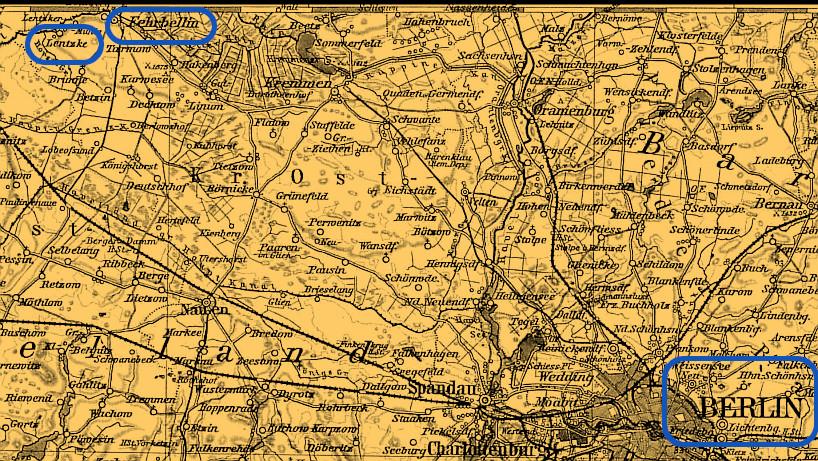
[6] Approx. 52 km; Hülsen had just moved to Lentzke, just to the west of Fehrbellin, northwest of Berlin (Karte des deutschen Reichs, ed. C. Vogel [Gotha 1907], no. 14):
[7] The reference is to Friedrich August Wolf’s significant Prolegomena ad Homerum, sive de operum Homericorum prisca et genuina forma variisque mutationibus et probabili ratione emendandi (Halle 1795) concerning the authorship of the Homeric poems (Eng. trans. Prolegomena to Homer 1795, trans. Anthony Grafton, Glenn W. Most, and James E. G. Zetzel [Princeton 1985]). Back.
[8] Johann Gottfried Dyk, Neue Bibliothek der schönen Wissenschaften und Künste (Leipzig 1765–1806).

Although Friedrich did not review the piece, see Caroline’s letter to Luise Gotter on 25 December 1796 (letter 175) with note 21. Back.
[9] Immanuel Kant, Sämmtliche kleine Schriften, 4 vols. (Königsberg, Leipzig 1797–98). Friedrich never wrote the Kant review, which was intended for the Allgemeine Literatur-Zeitung. Wilhelm wrote to Gottlieb Hufeland on 15 July 1798 that Friedrich would very soon send in various contributions and “has already largely finished a review of Kant’s shorter writings, though he has inquired whether part 4, which has appeared in the interim, ought not also be included as well” (Erich Schmidt, “A. W. Schlegel an Gottlieb Hufeland,” Litterarische Mittheilungen. Festschrift zum zehnjährigen Bestehen der Litteraturarchiv-Gesellschaft in Berlin [Berlin 1901], 22–25, here 24). Back.
[10] Thus Erich Schmidt’s reading of these difficult words; he understood Friedrich to be making a joke, saying that the “shepherd” (Germ. Hirt, namely, Alois Hirt) was simultaneously the “ox” as well. Back.
[11] See the supplementary appendix on the vitriolic Laokoön dispute with Alois Hirt. Back.
[12] Henriette Mendelssohn visited the Schlegels in Jena during the spring of 1799 on her way to Vienna to take a position as, indeed, a governess (W. R. Shepherd, Historical Map of Central Europe about 1786 [1926]):
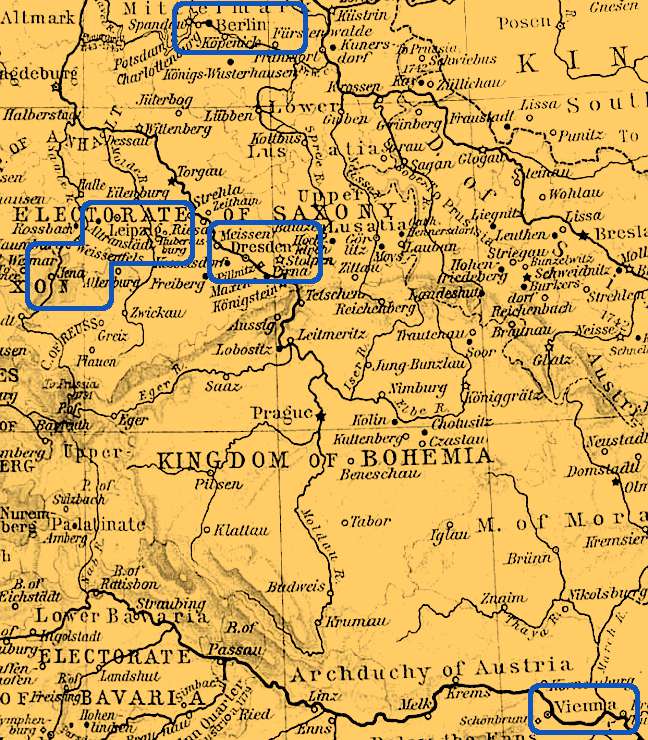
Concerning her journey to Vienna, see Friedrich’s letter to Caroline and Wilhelm Schlegel on 15 December 1798 (letter 212). Also earlier Caroline’s letter to Friedrich 14–15 October 1798 (letter 204) with note 30. Back.
[13] The “publication” which Friedrich does not want to see lose inclusion of “Die Gemählde. Ein Gespräch von W,” ultimately published in Athenaeum (1799) 39–151, is not Athenaeum (as Erich Schmidt, [1913], 1:733, thought); see KFSA 24:422n17: “The reference is more likely to an alternative publication the Schlegel brothers were considering to replace the one they might have to give up [viz., Athenaeum]. Otherwise the ‘contributions of our friends’ would not be in doubt.” Back.
[14] The relationship with the Königsberg bookseller Johann Friedrich Hartknoch is unclear. Back.
[15] Friedrich’s and Hardenberg’s shared religious plan. See Hardenberg’s letter to Friedrich on 7 November 1798, where Hardenberg writes among other things (KFSA 24:194–95; Novalis Schriften 4:262–63):
One of the most striking examples of our symorganization and symevolution is your own letter. You write about your Bible project, whereas in my own study of science in the larger sense — and its body, the book — I similarly came upon the idea of the Bible — the Bible — as the ideal of every book. The theory of the Bible, fully developed, yields the theory of literary writing as such or word formation in the larger sense — which simultaneously yields the symbolic, indirect doctrine of construction of the creative spirit as such. From my letter to your sister-in-law you will see that I am occupied with an extremely comprehensive piece of work — which is absorbing all my activities this winter.
This is to become nothing less than a critique of the Bible project — an attempt at a universal method of biblicizing — the introduction to a genuine encyclopedisticism. Back.
Translation © 2013 Doug Stott