
• 168. Friedrich Schlegel to Caroline in Jena: Dürrenberg, 2 August 1796 [*]
Dürrenberg, 2 August [17]96 [1]
|393| Since Hardenberg is sending a courier to Jena, [2] I will seize this opportunity to send you my greetings and let you know that I will probably yet be spending the entire week here. [3]
Right on the first day, Hardenberg went so far with his Moravian nonsense that I really could have left right then. [4] But I could not help recovering my fondness for him, so it will be worth the trouble of being away from you for a few days longer — despite all the wrongheadedness in which he is now irretrievably submerged. —
Otherwise I am completely free here and am thus able to spend a large part of the day working, which I am also diligently doing, and yet am also able to enjoy to the full a pleasure I have long done without, namely, that of exchanging ideas with someone. — I will be surprised if you find me as one-sided and obstinate as I invariably appear to others.
|394| It was three years ago today that I first saw you. [5] Imagine that I am standing before you now and silently thanking you for everything you have done for me and for my development. — What I am and will be, I owe to myself; the fact that I am thus, I owe in part to you.
I would be glad for any news about “Cäsar.” [6] If you write immediately, it will in all likelihood still reach me here. As long as it is not a case of Schiller’s fussy faultfinding, I am certainly willing to wait until issue 10 [of Die Horen]. But if it is what I suspect, I would rather he immediately return the whole thing to me; then I would use it instead of “Diotima” to adorn volume one. [7]
It is enormously important to me to find this essay right after my arrival in Jena. Hence let me repeat my request to Wilhelm in this regard, as well as the request for “Dionys.” [8] It would be extremely unpleasant if Schiller had lost “Diotima.” Who knows whether I could buy the issues right away?
If I had your letter before me or at least had it entirely in memory, I would write much more. If I were in the mood, as I was recently, I would also have much to carp about with regard to Wilhelm’s having to become angry, and about other, similarly incomprehensible things. In my present mood, however, I would prefer to answer the economic issues in your letter, which made me very glad indeed.
The most charming idea, namely, in all seriousness to be my guardian, is doubtless not your own. You borrowed it (like all beautiful things) from the ancients; one must assume you saw an engraved gem on which a representation of Amor playfully tames a lion. It must be almost as interesting to see such a small, delicate, fragile, frivolous woman so colossally in love — like the Gracchi-mother, as it is to see Wilhelm’s patriarchal dignity, with regard to which you have made me quite greedy. [9]
My address is: Weissenfels in care of Saltern Director von Hardenberg. |395| — Please also write Expedite on the couvert, otherwise the letter might get stuck in Weissenfels.
Wilhelm may want to reflect on whether he wants to send Reichardt his own essays for inclusion in Deutschland, considering the relationship with Schiller. [10] If this consideration does not hold him back, however, he has no need to worry about the honorarium. I will stand surety for it and could indeed collect it. —
If you two wanted to send me what you have to say about W[ieland] [11] and would allow me to send the whole thing, along with my addenda, to Reichardt under my name, we could easily share the honorarium. — Reichardt, too, views W[ilhelm?] as an ally. — But do not be concerned on my account: his praise will never seduce me into being impertinent, and I will be cautious lest Reichardt misuse my candor for his own purposes.
It would be extremely irksome were I not to receive the honorarium for “Cäsar” before Easter [17]97.
If a letter or package arrives with D on the seal, please break it open. It is from the printer in Berlin. One may even already be there; it might contain something urgent about which I would like to be informed immediately. My luggage should already have arrived yesterday with the transport driver Gottfried Tieftrunk.
I would also appreciate it if you would carefully read the treatise on the “Studium” etc. [12]
What I first wanted to contribute to Die Horen was a biography of Tiberius Gracchus. It is not really suitable for Deutschland, and I must either do it on speculation for the book fair at Easter [17]97 for Die Horen, or incorporate it into the compilation.
Would you be so kind as to read “Diotima” once more and mark in pencil those passages in which you believe a small change might be necessary and easy enough to implement?
|396| My reference above to Moravian nonsense was merely the most succinct description of absolute rapturous enthusiasm: for Hardenberg is still at least wholly free of even the slightest trace of the typical Moravian baseness and meanness.
I have received no further news from Charlotte.
Wilhelm has probably already received the letter with 1 ducat from Leipzig.
See also if you can get a copy of a crazy essay by the philosopher Schmid (in Niethammer’s Philosophisches Journal) on the beautiful soul. [13] This spineless weakling believes the worthless creature is too good.
My warm regards and embraces to you all, including Auguste, who must forgive me for not answering your letter. Give your master, Father Wilhelm, a sincere kiss in my name, or do you consider that a sin? Be sure to thank him for his last letter and for fulfilling my request.
χαιρε [14]
Fr. S.
“Der Republikanismus” successfully slipped through the censor. [15]
Notes
[*] Also published in KFSA 23:326–28. — This letter copiously documents Friedrich’s recent literary activity. — Concerning the locations of Dürrenberg, Weissenfels, and Jena, each of which is mentioned in this letter, see the editorial note to Friedrich’s letter to Hardenberg on 23 July 1796 (letter 167a), and his letter to Wilhelm Schlegel on 28 July 1796 (letter 167b), note 3. See also below. Back.
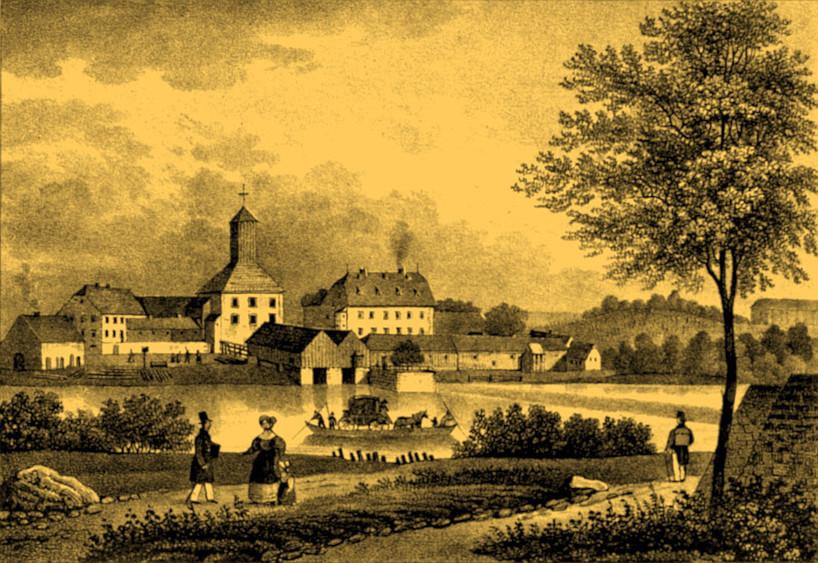
[1] Friedrich Schlegel was currently staying with Friedrich von Hardenberg, who since February 1796 had been a mining administrator in Weissenfels; at this time, Hardenberg had professional responsibilities at the saltern works in Dürrenberg, one of the mines under the direction of his father (here ca. 1830; illustration from Saxonia: Museum für Sächsische Vaterlandskunde, vol. 2 [Dresden 1836], no. 4 [June 1835], print between pp. 14 and 15]):
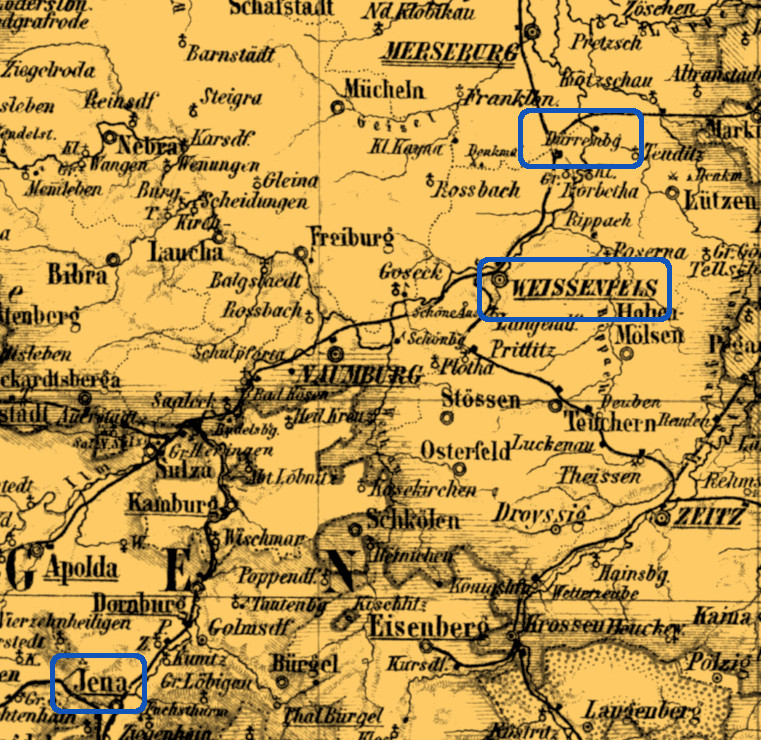
Dürrenberg is situated ca. 23 km west of Leipzig and ca. 12 km northeast of Weissenfels, Wessenfels in its own turn being ca. 43 km northeast of Jena (see also cross reference in next footnote; here: Ludwig Ravenstein, Atlas des Deutschen Reichs, no. 5 [Leipzig 1883]):
[2] Because of the serious illness of his young fiancée, Sophie von Kühn; see Friedrich’s letter to Hardenberg on 23 July 1796 (letter 167a), note 1. Back.
[3] Friedrich remained until 6 August, then arrived in Jena on 7 August. Back.
[4] Concerning Hardenberg’s Moravian inclinations, see the brief remark from F. H. Hedge, “The Reviewer’s Answer” [to a protest from the author of the work previously reviewed, A Short History of German Literature, namely, J. K. Hosmer], The Unitarian Review 11 (1879), 576, that “when in my review I characterized Novalis as ‘Moravian to the very root of his being[,]’ I did not mean that he was formally of the Moravian communion, but that he imbibed from his parents the Moravian spirit. He belonged himself to the Lutheran Church, a communion which he never ‘abjured.'”
In any event, a rather complicated problem attaches to the reading of this passage. Later in this same letter, Friedrich will explicate “Moravian nonsense” — “the wrongheadedness in which he is now irretrievably submerged” — as “absolute rapturous enthusiasm.”
In his own annotation to this passage, Erich Schmidt (1913), 1:713, cross-references Wilhelm Dilthey, Leben Schleiermachers (Berlin 1870), 1:223fn15. There, however, Dilthey identifies this passage as coming from a letter to Johann Friedrich Reichardt on the same date. The third edition of Leben Schleiermachers (ed. Martin Redeker [Göttingen 1970], 1:246) silently eliminates this footnote (i.e., no. 15).
The remaining peculiarity, however, concerns the clause “despite all the wrongheadedness in [to] which he is now irretrievably . . . ”
Schmidt reads “submerged” (Germ versunken) in the text of letter 168 here (as does KFSA): “the wrongheadedness in which he is now irretrievably submerged.” The editors of Novalis Schriften 4:598–99, letter 34a, also read “submerged” (versunken), citing Schmidt (1913) as the first-published source (notes on 4:1000).
In his own annotation to this passage, however, Schmidt (1913), 1:713, inexplicably reads “addicted, be subject to, prey to” (verfallen rather than versunken), after which he then cross-references Dilthey’s Leben Schleiermachers (1870).
Dilthey (1870:223n15), however, reads “lost” (verloren, rather than either versunken or verfallen): “the wrongheadedness in which he is now irretrievably lost.”
Concerning the understanding of Moravians at the time, see the brief remarks in John Evans, A Sketch of the Denominations of the Christian World, Accompagned with a Persuasive to Religious Moderation (London 1804), 200–202 (orthography and punctuation as in original):
The Moravians are supposed to have arisen under Nicholas Lewis, Count of Zinzendorf, a German nobleman, who died 1760. They were also called Hernhuters, from Hernhuth [Herrnhut], the name of the village where they were first settled. The followers of Count Zinzendorf are called Moravians, because the first converts to his system were some Moravian families; the society themselves however assert, that they are descended from the old Moravian and Bohemian Brethren, who existed as a distinct sect sixty years prior to the reformation. They also stile themselves Unitas Fratrum, or the United Brethren; and, in general, profess to adhere to the Augsburgh confession of faith.
When the first reformers were assembled at Augsburgh in Germany, the Protestant Princes employed Melancthon, a divine of learning and moderation, to draw up a confession of their faith, expressed in terms as little offensive to the Roman Catholics as a regard for truth would permit. And this creed, from the place where it was presented, is called the Confession of Augsburgh.
It is not easy to unravel the leading tenets of the Moravians. Opinions and practices have been attributed to them of an exceptionable nature, which the more sensible of them disavow. They direct their worship to Jesus Christ; (addressing hymns even to the wound or hole in the side of the Saviour); are much attached to instrumental as well as vocal music in their religious services; and discover a predilection for forming themselves into classes, according to sex, age, and character. Their founder not only discovered his zeal in travelling in person over Europe, but has taken special care to send missionaries into almost every part of the known world.
They revive their devotion by celebrating agapæ, or love-feasts, and the casting of lots is used amongst them to know the will of the Lord. The sole right of contracting marriage lies with the elders. In Mr. La Trobe’s edition of Spangenburgh’s exposition of Christian doctrine, their principles are detailed at length. There is a large community of them at a village near Leeds [in England], which excites the curiosity of the traveller; and they have places of worship in various parts of the kingdom.
Mr. Rimius published his candid narrative of this people, and Bishop Lavington (who wrote also against the Methodists) replied, in 1755, in his Moravians compared and detected. Mr. Weld, in his Travels through the United States, gives a curious account of a Settlement of Moravians at Bethlehem, honourable to their virtue and piety.
Dr. Paley, in his Evidences of Christianity, pays the following compliment to the religious Practices of the Moravians and Methodists; he is speaking of the first Christians —
“After men became Christians, much of their time was spent in prayer and devotion — in religious meetings — in celebrating the eucharist — in conferences — in exhortations — in preaching — in an affectionate intercourse with one another, and correspondence with other societies. Perhaps their mode of life in its form and habit, was not very unlike that of the Unitas Fratrum or of modern Methodists.” “Be it, however, the desire of every body of Christians not only thus to imitate the primitive disciples in their outward conduct, but to aspire after the peaceableness of their tempers, and the purity of their lives.” Back.
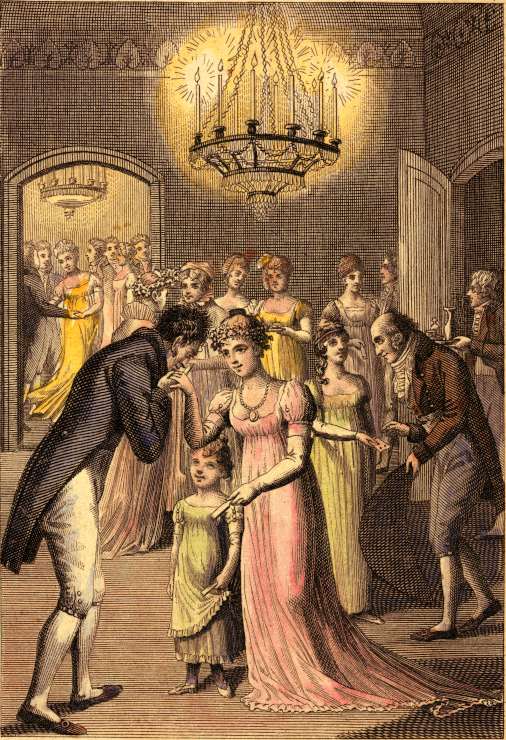
[5] This passages dates Friedrich’s initial acquaintance with Caroline (and Auguste) to 2 August 1793 in Leipzig (Der Freund des schönen Geschlechts: ein angenehm und nützlicher Taschenkalender für das Jahr 1808):
[6] “Cäsar und Alexander,” which Schiller unfortunately did not accept for inclusion in his journal Die Horen. See also Friedrich’s letter Wilhelm Schlegel on 28 July 1796 (letter 167b) with note 4 (there also bibliographical information). See Rudolf Haym, Die romantische Schule, 200:
So on 28 July 1796 Schlegel sent Schiller the essay “Cäsar und Alexander” from Dresden, to be followed by a biographical study on Tiberius Gracchus. Die Horen would have had no reason to be ashamed of this essay . . . though the way it presents Caesar — not much is said about Alexander — as an exemplary manifestation of the disposition of antiquity in the larger sense, and the way, from the author’s own preferred perspective concerning the pure naturalness of the culture of antiquity, the various developmental stages of Caesar’s life are sketched out — all that is admittedly quite ideologically conceived and construed, that is, more an example of historical philosophy than of history.
On the other hand, the way the man himself is characterized within precisely this framework, the way the sobriety of his personality is portrayed in such strong strokes, the way the combination of the consummate power and understanding of an imperious personality is emphasized, the way his specific talent transitions into a talent for victory, his passion into a passion of triumph, and how, finally, Caesar, having attained the goal of all his desires, seems “wholly sated with life amid such satisfaction” — such a portrayal doubtless presages an extraordinary master of accurate characterization, one who has at his disposal a perhaps ponderous, perhaps even coarse and stark, but for precisely that reason also trenchant powers of expression.
Be that as it may, Schiller’s own stylistic sense simply could not tolerate Schlegel’s severity, and the essay was not published in Die Horen. Back.
[7] The first volume of his work Griechen und Römer. — “Über die Diotima“: concerning its publication, see Caroline to Friedrich in June 1795 (letter 152) with note 1 and Friedrich’s letter to Caroline on 2 October 1795 (letter 157) with note 2. See especially note 12 in the latter letter concerning Friedrich’s understanding of the figure.
Schiller had wanted to publish this essay in his Thalia; he writes to Christian Gottfried Körner on 19 October 1795 (Schillers Briefwechsel mit Körner. Von 1784 bis zum Tode Schillers, 2nd ed., ed. Karl Goedeke, Dritter Teil [Berlin 1847]; here Correspondence of Schiller with Körner, 3 vols., trans. Leonard Simpson [London 1849], 26):
[Wilhelm] Schlegel has written to me about an article of his brother’s, “Diotima,” in the Berlin Monthly [Berliner Monatsschrift], which he regards as his best work. If you are of the same opinion, send it to me, if you can, that I may look at it. The other Schlegel sent me yesterday something for the Horen, on poetry and metre, which I have not yet found time to read [“Briefe über Poesie, Sylbenmaass und Sprache,” Die Horen (1795) 11:77–103; (1796) 1:54–74; 2:56–73]; but I am prejudiced in favour of all he writes, as he is a severe critic of his own works, and seems to ponder well over his subject. Back.
[8] “Kunsturtheil des Dionysios über den Isokrates” appeared in Christoph Martin Wieland’s Attisches Museum 1 (1797) no. 3, 125–60 (translation), 161–75 (translator’s afterword); Jugendschriften 1:194–200 (translator’s afterword only). Back.
[9] Erich Schmidt (1913), 1:713, remarks that the reading “Amor playfully tames a lion” is unclear, looking instead like “Amor playfully tames a lioness,” which contradicts not only the sense but also the familiar gem motif.
Friedrich’s allusion in any case engages a bold and in part puzzling metaphor with respect to Caroline. Concerning the familiar gem motif “Cupid Curbing a Lion,” see supplementary appendix 168.1. Back.
[10] After the first issue of Johann Friedrich Reichardt’s journal Deutschland appeared, Schiller wrote a vehement letter to Wilhelm von Humboldt on 1 February 1796 (Der Briefwechsel zwischen Friedrich Schiller und Wilhelm von Humboldt, ed. Albert Leitzmann, 3rd ed. [Stuttgart 1900], 274):
I have now read the first issue of the journal Deutschland, and not without considerable vexation at Reichardt’s false character, who has insulted both me and Goethe sans rime et sans raison [“without rhyme or reason”], who did, after all, treat him as a friend; you yourself have doubtless seen quite on your own that the whole thing is infinitely stupid. Reichardt will, however, not have an easy time of it, since both Goethe and I have already provided for his judgment. Since I heard from Hufeland here yesterday that Reichardt is indeed the editor, I have disavowed myself of the ménagements [here: regards] I might have harbored for him for your sake.
Friedrich’s caution was not successful in any case, since his reviews of Schiller’s Musen-Almanach and Die Horen precisely in Deutschland sabotaged any relationship he might have had with Schiller. Back.
[11] First mention of a possible essay or piece on Christoph Martin Wieland; although it will appear in later letters as the “annihilation of Wieland,” it was never realized. Although KFSA 23:510 remarks that this idea “apparently originated with Caroline,” it is not entirely clear why such should necessarily have been the case. Back.
[12] “Über das Studium der griechischen Poesie” for the anthology Griechen und Römer. Back.
[13] Karl Christian Erhard Schmid, “Einige Gedanken veranlasst durch das Lesen der Bekenntnisse einer schönen Seele,” Philosophisches Journal einer Gesellschaft teutscher Gelehrten (1796), 185–98.
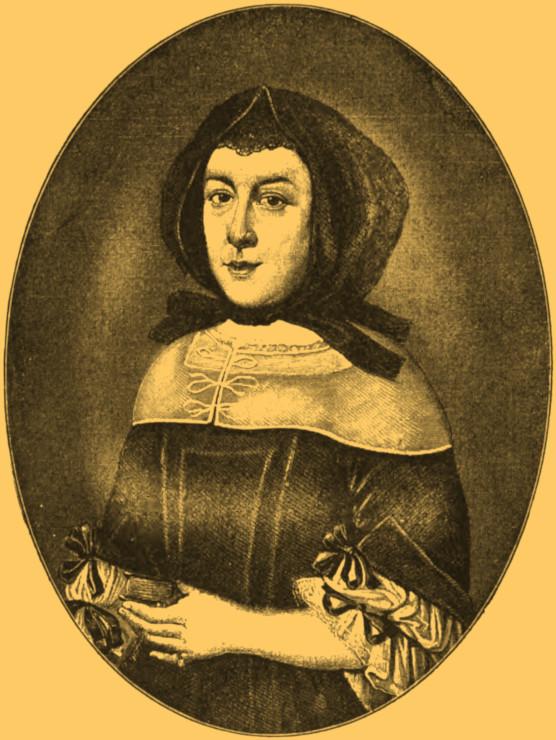
The “Confessions of a Beautiful Soul” appeared as book 6 of Wilhelm Meisters Lehrjahre; the figure was based on Susanne von Klettenberg, a friend of Goethe’s mother who helped care for Goethe himself when he became ill in July 1768 (portrait from Otto von Leixner, Geschichte der Deutschen Literatur, 6th ed., vol. 2 [Leipzig 1903], 626):
See the description of anonymous, “Goethe’s Relation to Women: Conclusion,” The Open Court: A Monthly Magazine 26 (1912) no. 1 (January) no. 668, 85–88:
While convalescent in Frankfort from his Leipsic illness, Goethe became acquainted with Fraulein Susanna Catharina von Klettenberg, an old lady and a friend of his mother. She belonged to the Moravian church and took a great interest in religious mysticism which made a deep impression on Goethe without, however, converting him to pietism. Her personality is mirrored in the “Confessions of a Beautiful Soul” incorporated in his novel Wilhelm Meister. Goethe here made use of her letters explained and enlarged by personal conversation with her, and it is commonly assumed that as to facts and sometimes even in the letter of descriptions she is virtually to be considered as the author of this autobiography.
“The Confessions of a Beautiful Soul” is of an extraordinary interest and belongs to Goethe’s most beautiful sketches of a pure and truly pious personality. In her childhood the author of these “Confessions” had been thrown upon herself by a severe disease which cut her off from the sports of childhood. “My soul became all feeling, all memory,” says she, “I suffered and I loved: this was the peculiar structure of my heart. In the most violent fits of coughing, in the depressing pains of fever, I lay quiet, like a snail drawn back within its house: the moment I obtained a respite, I wanted to enjoy something pleasant; and, as every other pleasure was denied me, I endeavored to amuse myself with the innocent delights of eye and ear. The people brought me dolls and picture-books, and whoever would sit by my bed was obliged to tell me something.”
She regained her health and tells of her studies, but her enjoyments lacked the giddiness of childhood. Only gradually she became fond of dancing, and for a while at this time her fancy was engaged by two brothers, but both died and faded from her memory. Later on she became acquainted with a young courtier whom she calls Narcissus, and on one occasion when he was attacked and wounded by a quick tempered officer, she became engaged to him and cherished this young man with great tenderness.
In the meantime her relation to God asserted itself at intervals. For a while she says (and these are her very words) “Our acquaintance had grown cool,” and later on she continues: “With God I had again become a little more acquainted. He had given me a bridegroom whom I loved, and for this I felt some thankfulness. Earthly love itself concentrated my soul, and put its powers in motion; nor did it contradict my intercourse with God.”
But Narcissus was a courtier and wanted a society woman for a wife, while she found social enjoyments more and more insipid. They disturbed her relations with God, so much so indeed that she felt estranged from him. She says: “I often went to bed with tears, and, after a sleepless night, arose again with tears: I required some strong support; and God would not vouchsafe it me while I was running with the cap and bells. . . . And doing what I now looked upon as folly, out of no taste of my own, but merely to gratify him, it all grew woefully irksome to me.”
The lovers became cool and the engagement was broken off, — not that she no longer loved him. She says in this autobiography: “I loved him tenderly; as it were anew, and much more steadfastly than before.”
Nevertheless he stood between herself and God and for the same reason she refused other suitable proposals. Her reputation did not suffer through the rupture with her fiancé. On the contrary the general interest in her grew considerably because she was regarded as “the woman who had valued God above her bridegroom.” . . .
Finally through the influence of her uncle and a friendly counsellor whom she calls Philo she found composure of mind which she expresses thus:
“It was as if my soul were thinking separately from the body: the soul looked upon the body as a foreign substance, as we look upon a garment. The soul pictured with extreme vivacity events and times long past, and felt, by means of this, events that were to follow. Those times are all gone by; what follows likewise will go by; the body, too, will fall to pieces like a vesture; but I, the well-known I, I am.”
She does not consider her life as a sacrifice but on the contrary as the attainment of an unspeakable joy. She says at the conclusion of her autobiography:
“I scarcely remember a commandment: to me there is nothing that assumes the aspect of law; it is an impulse that leads me, and guides me always aright. I freely follow my emotions, and know as little of constraint as of repentance. God be praised that I know to whom I am indebted for such happiness, and that I cannot think of it without humility! There is no danger I should ever become proud of what I myself can do or can forbear to do: I have seen too well what a monster might be formed and nursed in every human bosom, did not a higher influence restrain us.” Back.
[14] Gk., “greetings”; thus also in the New Testament, e.g., Acts 15:23; 23:26; James 1:1. Back.
[15] “Versuch über den Begriff des Republikanismus. Veranlasst durch die Kantische Schrift zum ewigen Frieden,” Deutschland 3 (1796) no. 7, issue 2, 10–41 (Jugendschriften 2:57–71; KFSA 7:11–25.). Back.
Translation © 2012 Doug Stott