
• 10. Caroline to Luise Gotter in Gotha: Göttingen, 24 January 1780
Göttingen, 24 January 1780
|21| Please accept these congratulations from your tender loving friend! [1] Behold how the satisfaction of your heart gladdens my own, and how unutterably happy I am in my firm conviction that you are happy. How can I, how am I to describe my feelings to you, my beloved Louise? Words are simply too weak . . .
I confess I was not at all expecting this news, and even though I have been thinking of nothing else, I still can hardly get used to the idea of seeing Gotter united with my Louise. I had already grown accustomed to imagining Gotter as unmarried, almost considering it a foregone conclusion that he would always remain so, and in my heart had already even reproached him for it whenever I thought about how infinitely happy he might make someone with a soul as noble as his own [2] . . .
Notes
[1] Friedrich Wilhelm Gotter of Gotha became engaged — Erich Schmidt (1913), 1:674: without passion — to Luise Stieler in January 1780 (“Braut/Épouse,” Göttinger Taschenkalender für das Jahr 1798, Inhaltsverzeichnis deutscher Almanache, Theodor Springmann Stiftung):

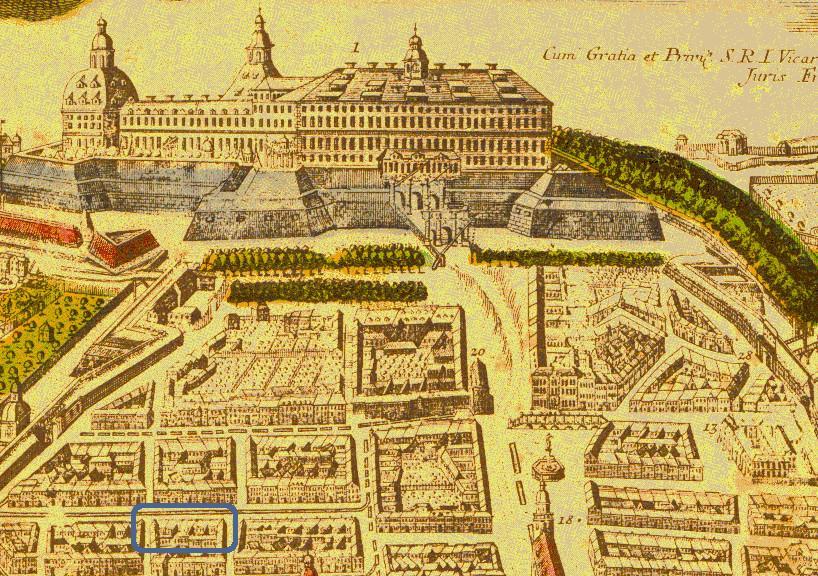
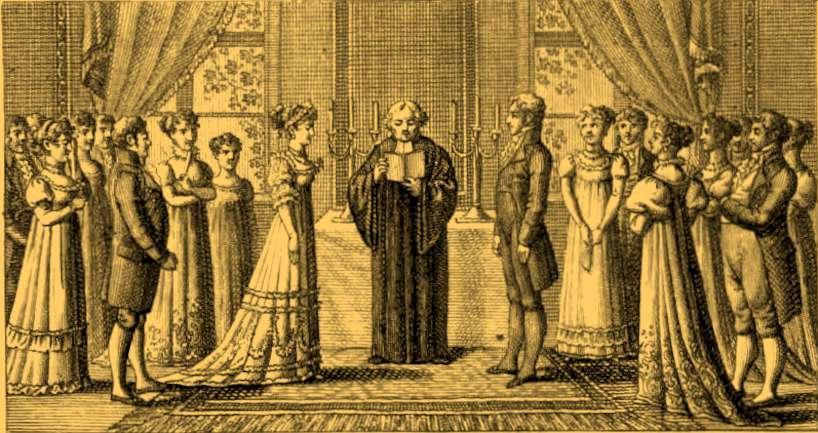
The couple was married by senior court preacher Christian Wilhelm Bause allegedly in her father’s house at Schwabhäuserstraße 17 in Gotha on 30 March of the same year (concerning the location of the house, see Rudolf Schlösser, Friedrich Wilhelm Gotter, 118n3; approximate location indicated on following map by Matthäus Seutter and H. A. Koenig, Hochfürstliche Residentz Frieden und Hauptstadt Gotha [1730]; illustration: wedding ceremony held in the home: Taschenbuch für das Jahr 1813: Der Liebe und Freundschaft gewidmet [Frankfurt], Inhaltsverzeichnis deutscher Almanache, Theodor Springmann Stiftung):
Oddly, however, Schmidt still has Caroline writing to Luise “Stieler” on 15 May 1780 (letter 15), and, more oddly still, Caroline herself — according to Schmidt’s reading in her letter to Luise Stieler on 17 March 1780 (letter 13) — seems to have had a slip of the pen in confirming the date as 30 May, unless Schmidt misread “March” (Germ. März) as “May” (Mai or May). Rudolf Schlösser, Friedrich Wilhelm Gotter, 118, confirms the March wedding in citing a letter Gotter himself writes in which he mentions being an “extremely happy husband” since early April (see note 2 below).
Similarly, in her letter to Julie von Studnitz in Gotha itself on 17 March 1780 (letter 12), Caroline remarks that “the nuptials of Mademoiselle Stieler are so close now that I simply do not have sufficient time to make preparations for the journey.” –
Of the Gotters’ five children, three daughters grew to adulthood and appear repeatedly in these letters: Cäcilie (Cecilie), Julie (Julchen), both remaining unmarried, and Pauline, Schelling’s second wife.
Concerning Gotter in general for those who read German, see Friedrich Schlichtegroll, Nekrolog auf das Jahr 1797. Enthaltend Nachrichten von dem Leben merkwürdiger in diesem Jahre verstorbener Personen. Achter Jahrgang, 2 vols. (Gotha 1801); especially Rudolf Schlösser, Friedrich Wilhelm Gotter. For Erich Schmidt’s comments on Gotter, see (1913), 1:674–75:
|674| Like Friedrich Ludwig Wilhelm Meyer, Gotter was a rare theater talent and a master at reading aloud; he contributed to the development of the German stage through a considerable number of in part quite skillful adaptations and through numerous dramas of his own, whose strongest literary value was their ability to mediate |675| between Greek and French classicism.
As a lyric poet, he was already a frequent contributor to the first German [Göttinger] Musenalmanach, composing light, pleasantly flowing and delicate Anacreontic verse, poems for various occasions, romances, epistles, and chatty didactic poems after the fashion of Christoph Martin Wieland, though Friedrich Schlegel finds evidence in his poems only of the “mediocrity of his spirit.”
Friedrich Schlegel writes to Wilhelm Schlegel 4 October 1791 (Walzel, 21; KFSA 23:26):
When I read Gotter’s poems [Gedichte, 2 vols. (Gotha 1787–88)] a while back, I wondered why he is so popular and so widely read. That such is indeed the case I have heard for myself. I think the reason is the mediocrity of his spirit. All the powers of the spirit have attained a certain degree of cultivation and development in him without the one or other predominating. — He wholly exhibits the opinions, principles, standards for value, the same desires, the same feebleness and limitations that are otherwise the general heritage of all people. How could he not be pleasing to them?
Schmidt continues:
This pleasant man, restricted to the meager position of a private secretary, lacked energy, depth, and straightforwardness; Schiller, with characteristic severity, described him as “a personality at odds with himself” (to Christian Gottfried Körner, 29 July 1787), as someone who “has much culture and education, but of the French sort, much spirit and wit, but at the same time an element of sobriety that scares me away.” His association with Goethe, which he developed in Wetzlar, did not last. Back.
[2] Concerning Friedrich Wilhelm Gotter’s own reaction to his engagement, see his letter to Gustav Friedrich Wilhelm Grossmann on 26 January 1780 (Schlösser, Friedrich Wilhelm Gotter, 117–18):
Let me relate to you that I recently entered down the path of the second epoch of life, as Gellert describes it: “He lived, he — took a wife etc.” The lot heaven put aside for me is now richly rewarding my patent perseverance.
She is the eldest daughter of Herr Hofrath Stieler. I doubt you are acquainted with her. At the time [of Grossmann’s presence in Gotha], she was not yet at an age that attracts attention. But your wife will remember her as a charming child [Grossmann’s wife was a native of Gotha], and your sisters-in-law can attest that she has become no less charming as a young girl, full of innocence and grace, full of feeling and understanding — coming from my own quill, all that would sound too biased.
Anyone in Gotha not considering expanding his own circle of domestic activity and joy runs the risk of dying of boredom. The court and town are becoming quieter and more desolate by the day. The redoutes only began a week ago, and already at the second there were not enough dancers, from which you can, of course, draw your own conclusions.
Despite the rather sober tone of these remarks, Gotter did offer a bit more lively assessment to Grossmann on 25 July 1780: “I have been an extremely happy husband since the beginning of April; in fact, too happy insofar as I have been unable to unite successfully the pleasantries of my new status with my professional tasks, the leisurely pace of the honeymoon still clinging to me as it does” (Taschenbuch für das Jahr 1804: Der Liebe und Freundschaft gewidmet [Frankfurt]; Inhaltsverzeichnis deutscher Almanache, Theodor Springmann Stiftung):

Translation © 2011 Doug Stott