
265a. Wilhelm Schlegel to Johann Diederich Gries in Göttingen: Jena, 7 July 1800 [*]
Jena, 7 July 1800
I am so sorry, my good friend, for causing your divinatory acumen to be so laboriously and, moreover, also so futilely taxed. It was, however, no doubt less a matter of my own handwriting than that you simply did not want to believe that the name of the locale really was exactly as you read it, and then also a problem with your geographical, statistical, and topographical books, which contained no reference to it.
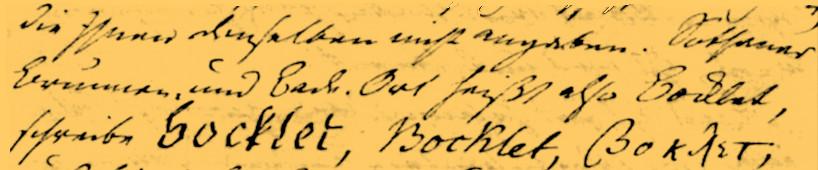
Said mineral springs and spa is called Bocklet, written bocklet Bocklet βοκλετ, and is located near Schweinfurt in Franconia, which you may want to add to the address if, for example, you are writing to Caroline. [1] She will be staying there until toward the end of July, and has described the setting and surrounding area there as being quite pleasant. [2] If you yourself are visiting the area, you will probably also find Madam Paulus there, to whom a stay in Bocklet or Brückenau has been recommended for health reasons; [3] the latter is located but six hours from the former. [4]
One might hope that the war will not prove to be a hindrance of any sort to you on your journey, for it does seems that the most recent events will result in a quick peace. [5] Let me wish you a satisfying and entertaining journey. [6]
I myself will be staying in Jena for now — although I initially thought I would be leaving on a journey in early summer, one’s work always takes longer than one thinks, and then becomes a real fetter. In the meantime, I am hoping to take a journey toward the autumn, in which case I may perhaps even be traveling by way of Göttingen. It is still uncertain whether I will be spending the entire winter here.
Tieck has been gone since the Feast of John the Baptist, going first to Giebichenstein, whence I hear, however, that he paid a visit to Berlin. [7]
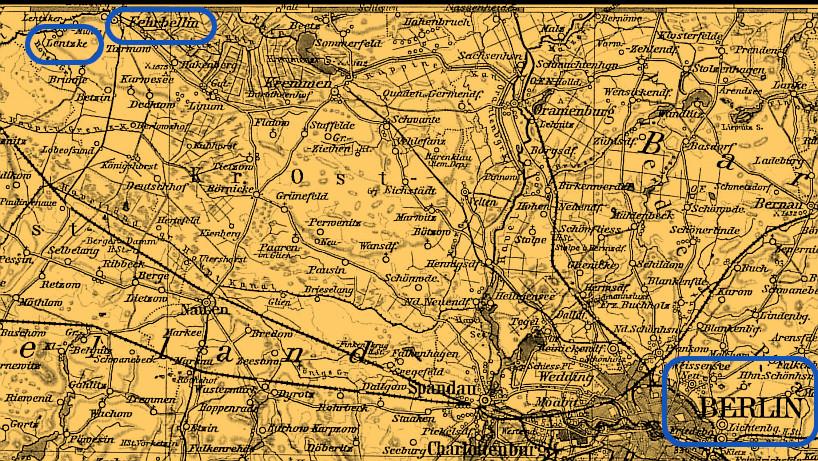
I have not received a letter from our good Hülsen since time immemorial. Our friend Schleiermacher learned that his wife’s illness is the reason for his silence, who is allegedly hopelessly ill with consumption. This is extremely sad, and our friend has unfortunately isolated himself so from the world that no one can do anything to help distract or cheer him up. His address, by the way, is as far as I know still Lentzke bey Fehrbellin. [8]
Schelling spent some time with his parents in Swabia and is presumably now back in Bamberg, where he will yet be giving lectures. . . .
I finished the very last of your Tasso, and I can say that doing the proofs was a real pleasure for me, I was just sorry that despite my attentiveness a couple of typographical errors were nonetheless left standing; but that is unavoidable. The book will no doubt be quite handsome; I myself do like the larger format far better. [9]
The books from the library are now, I hope, on their way. [10] Unfortunately, just after sending the package off I noticed that I forgot to include one book, namely, Ameto by Boccaccio. [11] You have no doubt noticed it missing yourself. Because I am disinclined to send the book back alone, since that would involve double costs, I would instead like, if possible, to know whether I might wait and send it back with those we will now be receiving.
Stay well, valued friend, have a good and safe journey and please do remember me.
Yours,
A. W. Schlegel
Notes
[*] Source: Körner, (1930), 1:114–16.
Concerning Gries’s stay in Göttingen and his anticipated journey south (he departed on 22 July 1800), see the editorial note and note 2 to Wilhelm’s letter to him on 10 May 1799 (letter 236c); concerning Gries’s studies and translation in Göttingen during the preceding winter 1799–1800, see the editorial note to Caroline’s letter to him on 27 December 1799 (letter 258); concerning Gries’s in part wry responses to his examiners during his doctoral exam in Jena during the spring of 1800, see Wilhelm’s letter to him on 16 March 1800 (letter 258r), note 11. Back.
[1] The two versions of the name “Bocklet” standing between the first mention and the Greek, rendered in Fraktur font in Körner, (1930), 114, are here rendered in normal and bold Fraktur; Wilhelm is using the earlier Fraktur handwriting, which differed from the Current handwriting (Currentschrift, Current Schrift) common at the time (manuscript excerpt: Staats- und Universitätsbibliothek Hamburg; Signatur: SUB Hamburg : CS 4 : Schlegel AW : 15–16; Blatt-/Seitenzahl: 4 S. auf Doppelbl., hs. m. U.):
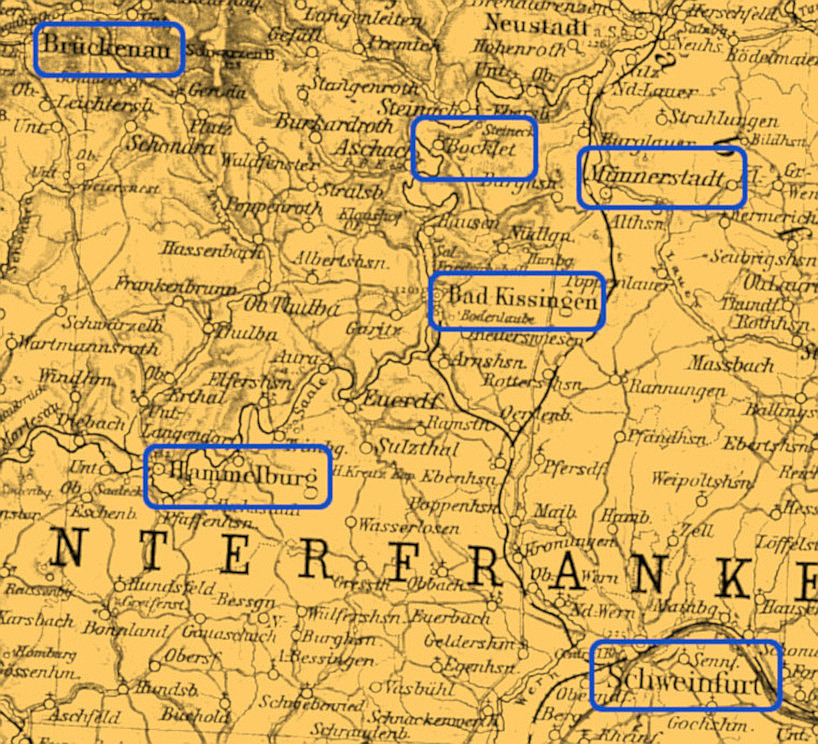
Schweinfurt is the larger postal station south of Münnerstadt, the latter the nearest postal station to Bocklet itself (Post Karte Durch ganz Deutschland, ed. J. Walch [Augsburg 1795]):

One could also travel from Schweinfurt to Kissingen and then with a private carriage to Bocklet (final map in S. Hänle and Dr. von Spruner, Guide of the Bathing Places of Franconia: Kissingen, Bocklet, Brückenau and Their Environs, trans. S. Louis [London 1845]):

[2] As mentioned earlier, regrettably none of Caroline’s letters to Wilhelm from Bamberg and Bocklet seem to be extant. It is noteworthy, however, that Caroline, Auguste, and Schelling were not planning to remain in Bocklet beyond the end of July. Back.
[3] The Paulus family traveled to Bocklet approximately in mid-July 1800; while there, they passed along various rumors to Dorothea Veit concerning Auguste’s death and concerning the comportment of Caroline and Schelling.
Concerning the Pauluses’ stays in Bocklet in general, see Dorothea Veit’s letter to Schleiermacher on 28 July 1800 (letter 265i), note 2.
Gries was about to depart on a journey to southern Germany and possibly Vienna (see below); he would not visit Bocklet but would find Caroline, Wilhelm, and Schelling in Bamberg in September 1800. Back.
[4] Brückenau, another popular mineral-springs spa, is located on the Rhön River ca. 20 km just northwest of Bocklet. No postal route, however, connected the two locales (the nearest to Bocklet was Münerstadt); see Augustus Bozzi Granville, The Spas of Germany, vol. 2 (London 1837), 326:
There is no high road, but a pleasant and tolerably good cross-road from Bocklet direct to Bruckenau. The more general course, however, is to retrace one’s steps back from Bocklet to Kissingen, and thence through Hamelburg, and a most delightful drive across a smiling country, to reach Bruckenau at a distance of a post and a half.
Here the various locales (Karte des deutschen Reichs, ed. C. Vogel [Gotha 1907], no. 18):
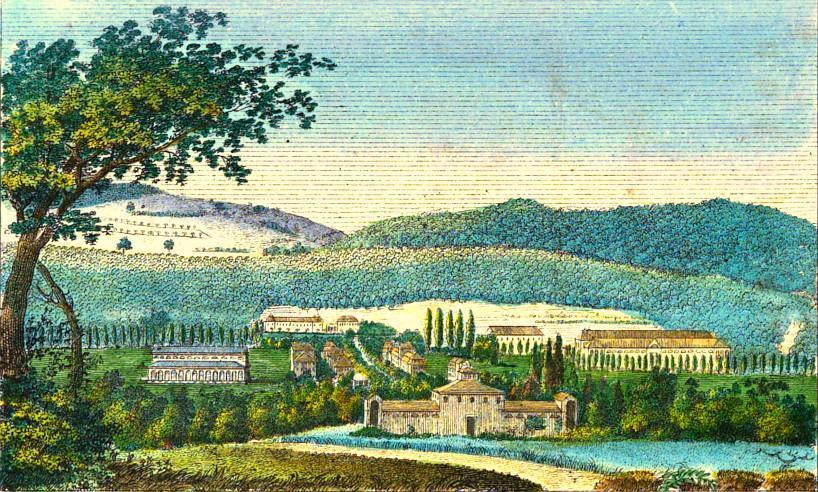
Here a color image of Brückenau (rare in publications at the time) used as the frontispiece to Dr. Schneider and Dr. Wolf, Das Bad Brückenau und seine Umgebungen geschichtlich topographisch dargestellt und betrachtet (Fulda 1831):
[5] The War of the Second Coalition.
Concerning the French general Moreau’s advance through southern Germany, see Auguste and Caroline’s letter to Schelling on 8/9 June 1800 (letter 262), note 8, and the cross reference there to Auguste’s letter to Schelling on 4 June 1800 (letter 261), note 3.
Moreau took Munich during July, and after this suspension of arms between Moreau and the Austrians at Parsdorf, near Munich, on 15 July 1800 — also in view of Napoleon’s victory at Marengo on 14 June 1800 — military operations were suspended for four months, prompting hopes in a peace accord, which, however, did not come until the Treaty of Lunéville in February 1801. Back.
[6] Gries departed Göttingen on 22 July 1800 on a trip to southern Germany and would visit Bamberg in mid- to late September (he departed Frankfurt on 17 September 1800), where Wilhelm seems to have arrived around 24 July 1800 after departing Jena on 21 July (Dilligence [19th century]; Bibliothèque municipale de Bordeaux, Album d’illustrations diverses] [278]):

For an account of Gries’s journey, see Aus dem Leben J. D. Gries 44–48.
He journeyed first to Kassel, Marburg, Wetzlar (which was disrupted by Batavian soldiers while Gries was there), Garbenheim (just northeast of Wetzlar, the model for “Wahlheim” in Goethe’s Die Leiden des jungen Werthers [Leizpig 1774]; here Gries “pilgrimaged” to the various locales incorporated into the novel), Neuwied, Montabaur, Ehrenbreitstein (where he saw the Rhine River for the first time), Cologne (though he was unable to view the cathedral, which had been converted into a hay magazine by the French), Bonn, and then on to Frankfurt am Main, where he spent four weeks and encountered Friedrich Karl von Savigny and Clemens Brentano, former fellow students from Jena; he spent three days at Savigny’s estate, Trages (Post Karte Durch ganz Deutschland, ed. J. Walch [Augsburg 1795]):
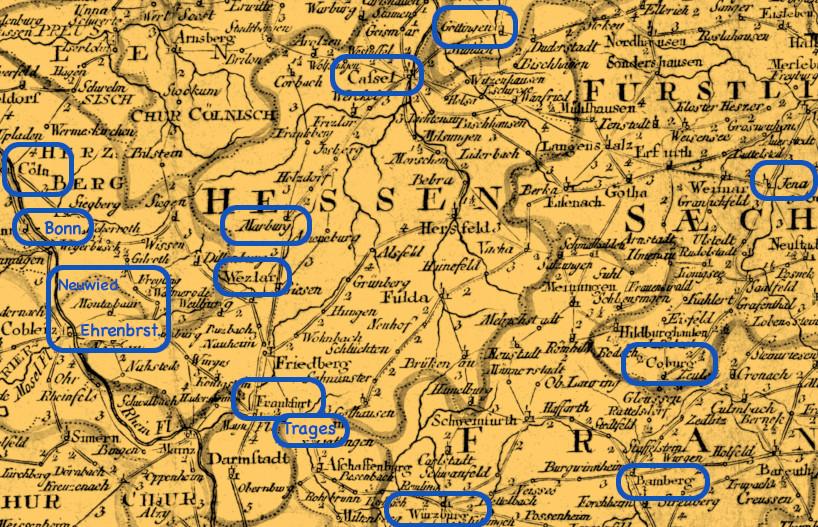
Gries departed Frankfurt on 17 September 1800 to journey on to Bamberg, where he found Caroline, Wilhelm, and Schelling. For the account of his visit to Bamberg, see the continuation of his biography in Caroline’s letter to Luise Gotter from Bamberg on 18 September 1800 (letter 268).
Although Gries was hoping to travel on to Vienna with Schelling (see Schelling’s letters to Fichte in September and November 1799 [supplementary appendix 241.1, entries 5, 6, along with note 13]), they instead returned to Jena by way of Coburg on 1 October 1800 (see map above). Wilhelm, on the other hand, after leaving Jena on 21 July 1800, did not return until more than a year later, in August 1801, and then only for three months. Back.
[7] The Feast of John the Baptist falls on 24 June, though this date is not to be taken too literally here, since other witnesses suggest that on his way to Giebichenstein, Tieck, along with Amalie and Dorothea, spent Friday through Sunday, 20–22 June 1800, in Weissenfels visiting Friedrich von Hardenberg (see esp. also Wilhelm’s letter to Gries on 22 June 1800 [letter 264a], note 6).
Hardenberg’s sister, Sidonie, gives a lengthy account of the visit in a letter from Weissenfels on 7 July 1800 to Wilhelmine Thielmann, including an extensive characterization of Amalie Tieck, one quite different from the harsh judgments passed on her by the Jena circle (Novalis Schriften IV:659–60):
I have become even better acquainted with her, and my initial impression has been consistently confirmed; she is a completely pure, unspoiled being full of profound feeling and delicate imagination, she has a sense for everything and is always able to discover the most beautiful and best elements in things. She is truly quite extraordinarily cultivated, and yet it seems everything has become second nature to her, so naturally and unaffectedly does she articulate her judgments, which are, by the way, usually quite correct and penetrate to the very heart of writers.
What pleases me most about her is the tenderness and affection she feels for her husband and child, both of whom she loves with the greatest passion; she related to me the story of their love, which really is quite wondrous and a new example of the guidance of providence. Each was the other’s first love, and each has remained faithful to the other quite despite the fact that he was only 18 years old when he made her acquaintance. What do you have to say about this radiant demonstration of masculine faithfulness, in which you sometimes seem quite not to believe?
Ironically and quite unbeknownst to Sidonie, who died the following year, the Tiecks would later act quite contrary to this comely portrait of marital fidelity. Back.
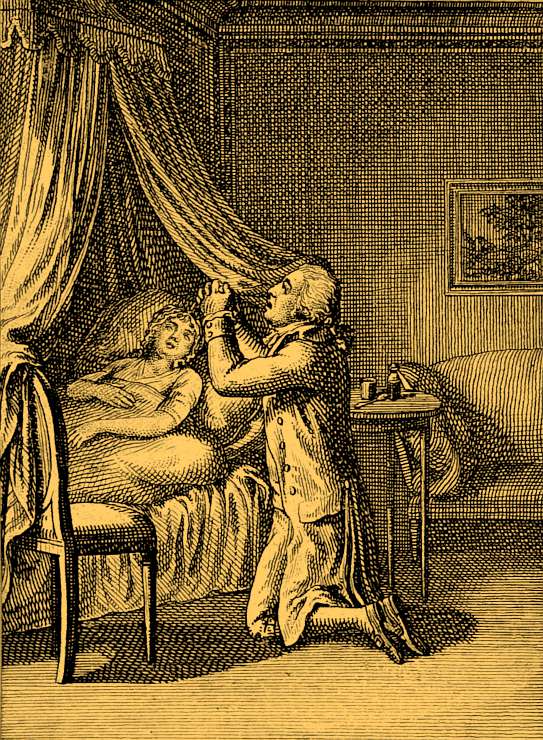
[8] August Ludwig Hülsen’s mortally ill wife, Leopoldine, would die in October of this same year, casting Hülsen himself into profound grief (Daniel Nikolaus Chodowiecki, Gott, du hörst es, ich will ihr gern mein Glück aufopfern [ca. 1787–95]; Herzog August Bibliothek; Museums./Signatur Uh 4° 47 [265]):
Fehrbellin is located ca. 50 km northwest of Berlin, Lentzke just to the west of Fehrbellin (Karte des deutschen Reichs, ed. C. Vogel [Gotha 1907], no. 14):
[9] Concerning Gries’s translation of Tasso’s Gerusalemme liberata (Jerusalem Delivered) (1580), see Wilhelm’s letter to him on 22 June 1800 (letter 264a), note 7.
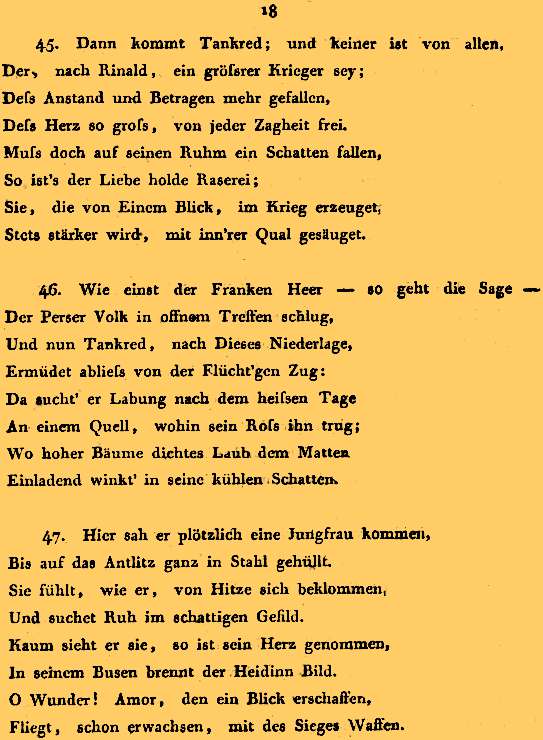
Wilhelm is referring to the small quarto format of Gries’s translation; the publisher, Friedrich Frommann, entered the following announcement in the Intelligenzblatt of the Allgemeine Literatur-Zeitung (1800) 148 (Saturday, 13 September 1800) 1255:
Torquato Tasso’s Befreytes Jerusalem, vol. 1, has just been finished and shipped to all booksellers.
It is not for me to pass judgment on the value of the original and translation, though an assessment of the former has certainly long been passed, and I might hope that the voices of connoisseurs will quickly add this present translation — the first in the poetic meter of the original — to the most successful in our language! Such was in any case the reaction two years ago, when the first samples of this translation appeared, one that remains far behind what Herr Gries has accomplished here.
I might similarly hope that the external format of this translation does not lag behind the inner content of the work. In order to avoid the extremely ill situation in which verses are always broken when only two stanzas appear on a single page, I have chosen the small quarto format, and I flatter myself that I will receive the approval of the informed public for having done so! The font and paper have similarly been carefully chosen. I am offering the public two editions: one extremely elegant one printed on beautiful Basel vellum, smoothed and bound for 2 Rthlr 12 gr., and one on good stationary, similarly bound, for 1 Rthlr 8 gr..
The continuation will appear during the coming year.
Jena, 31 July 1800
Friedrich Frommann
Here an entire page from Gries’s translation in this format:
[10] Concerning these books, see Wilhelm’s letter to Gries on 22 June 1800 (letter 264a). Back.
[11] Boccaccio’s allegorical pastoral romance Comedia delle ninfe fiorentine, also known as Ameto (1341); Friedrich Schlegel had requested this book from Gries back on 28 January 1800 (KFSA 25:52). Here the classicizing engraved initials from the edition of 1558 (Boccaccio, Ameto, ed. Francesco Sansovino [Venice, 1558]; © University of Tasmania, Australia, Manuscript and Early Printed Book Image Collection):
Translation © 2014 Doug Stott