
Wilhelm Schlegel
Todtenopfer
Offerings for the Deceased [*]
I. Change of Heart
This life would I have raised,
Through striving never ending,
E'en to eternity itself.
I asked not 'bout the beyond,
My hoping and my loving
Had beauty here and now.

What nature weaved,
What humans raised e'en higher,
For me in poesy united.
Thus I thought to clearly shape
Good along with evil, too,
To higher harmony.

What suddenly was broken off
To expression yet did come
To the ordering sense inside.
Youth to me: a song, the fall
Of heroes' noble virtue,
A tragedy divine.

But quickly, quickly vanished
All courage, hardly had I begun,
And contentedness in vapor.
Fettered by fate
In this earthly prison here:
What helps me art, even wise?

The rose, hardly in blossom,
Yet to me sweeter in its form
Than all the world's adornment, —
A serpent then did bite,
And death break down,
And a storm felled.

Now to the stars do I gaze,
To those eternal spheres,
As from deep and desolate cave;
And, to draw her blue eyes
Down from heaven itself
Do I kiss the empty air.

O, but do my oracle be,
Thou, who without blemish
Did flee this false world here!
Behold me in my humility
And breathe into my melancholy
Love's gentle comfort dear.

If in the beyond that rose does blossom,
Then sacred goodness itself
Would endlessly blessed become.
Though I myself do yearn and long,
Yet never presumptuous attempts shall I make
To loose myself from this mortality.

There where I meet again
With my child so sweet,
Cannot but be salvation, bliss, and light.
She, when long my own
Lament has faded long away,
Will she be my celestial poem.

The radiant red garnet
Did I in dreadful darkness take
From the head of serpent death,
Now to keep with me;
For all the nights and days of life
Never will it from me be seized.
II. During the Journey
From faraway did the tidings to me come.
Mountain and forest and cliffs alike,
Shimmering blue in the horizon's vapor,
Now separate me from where I suffered the mortal blow.

I set out on the journey the very hour:
Where brooks through ravines rush down,
And rocks tower up to darkened vaults,
There the path accords with my own inner self.

Here, too, did recently travel whom I do mourn,
Heedless of the coarse route's burdens;
Drawn instead to serene landscapes south.

May it was, but summer now, and I do shudder
From frigid storm; the earth her grave did become:
Spring did lie to all, youth to her.
III. The Health Spring
Heaven smiles amid a gentle breeze,
Fields verdant with wine and grain.
Hills round about thwart the north wind's wrath
From this small valley full of meadows' fragrance.

From the womb of cool clefts springs forth
Salutary drink from eternally active fount.
Yet intimation dark and confused does also
Befall me: for here, too, are graves of the dead.

How, O nature, can you soil yourself with murder?
How, else were all your powers, all your virtue,
Bound by intransigent fate?

Indeed, here, even where the springs of life bubble up,
Did my sweet life find death
Amid the fullness of youth and roses.
IV. First Graveside Visit
Weeks have passed, weeks and more, since here they lowered
Her sweet body, affectionate grace flowing round about it fine,
Which did enclose the beloved being,
Whom in vain my yearning does now seek.

Wilted the garland, freshly bequeathed to the grave,
Nor a single stalk new upon the hillside;
The sun aims with glowing darts,
Neither dew nor rain has since watered this dust.

Nor will I have need of heaven for such.
Turn but away, unfeeling eye of the world!
O clouds, go pour forth elsewhere.

May my tears alone this sacred ground accept!
Amid ardent gaze of love and coolest breeze
Of sighs shall flowers of wonder now blossom.
V. Beloved Traces
And though I should hate you, yet must I love you,
O place that would my jewel stingily keep!
Though not to rejoice in its presence, no, but to bury it;
Yourself now all the richer, while I remain impoverished.

Here her traces are yet etched:
On these meadows did she sit; shade from
Bush and tree did she enjoy, and fruits to refresh her;
In meadow and field did she find the fragrance of flowers.

Here, cheerfully, did she sing to her echo;
She wandering about, in girlish youth, cornflowers in her hair,
Her golden hair graciously charming the breeze.

But soon did she sink, alas! soulless, away,
Like Eurydice, from the bite of false adders,
Torn from her playmates' dance.
VI. Swan Song
Oft, when her pure voice took flight,
Shy and bold, and whisp'ring strings did mix in between,
I observed her heart, yet unconscious,
On wings of melody, emerge from her breast.

The last song she sang
Of the goblet did tell, enveloped by waves,
How once the old king, dying, did imbibe
From the pledge exchanging love and loyalty true. [1]

How fitting that this carouser, life-weary
When dark waves quietly kiss his shores,
Into her heart all his yearning pours.

From our loving grasp was torn
Slender, golden, sweetly filled, crowned, the goblet;
And at our feet now roars a sea of tears. [2]
VII. The Heavenly Mother
Heaven, they say, can endure violence.
O may the loving arrows of my gaze but penetrate
Through the clouds, that amid your salutary fortune,
Beloved child, my heart may feast!

From your faithful mother you had to part:
Do you find another there on high?
Who does comfort you and ease your sympathy
When you, so far removed, gaze down on us two?

Sacred words have, it seems, made known
That there a feminine image of maternal love does reign,
The very heart of the world, in eternal embrace.

O, when, blinded by the ray of more serious glory
The tender soul does flee to the womb of love:
May you shelter her, Mary, in your arms.
Notes
[*] Wilhelm Schlegel’s Todtenopfer (Offerings for the deceased) was a series of poems published in the Musen-Almanach für das Jahr 1802, 171–86, essentially as — as the title suggests — an offering or eulogy for deceased friends and family, Auguste Böhmer and Friedrich von Hardenberg. The poems translated here (approximate prose renderings) are those addressed to Auguste.
The entire cycle was reprinted as Todten-Opfer für Augusta Böhmer (Im Sommer und Herbst 1800), Sämmtliche Werke 1:127–40.
Concerning Dorothea Veit’s reaction to two of the poems, see Dorothea to Wilhelm from Jena on 25 August 1800 (letter 266b). Back.
[1] Goethe, “Der König in Thule,” sung by Gretchen in Faust, part I, 2759–82. Eng. “The King in Thule,” Goethe’s Works, vol. 1, trans. Hjalmar Hjorth Boyesen [Philadelphia 1885], 66 (illustrations: Göthe-Gallerie: Stahlstiche zu Göthe’s Meisterwerken nach Zeichnungen von Julius Nisle, vol. 1 [Stuttgart 1840]):
The King in Thule
In Thule liv'd a monarch
Still faithful to the grave,
To whom his dying mistress
A golden goblet gave.

Beyond all price he deem'd it,
He quaff'd it at each feast;
And, when he drain'd that goblet,
His tears to flow ne'er ceas'd.

And when he felt death near him,
His cities o'er he told,
And to his heir left all things,
But not that cup of gold.

A regal banquet held he
In his ancestral hall,
In yonder sea-wash'd castle,
'Mongst his great nobles all.

There stood the aged reveller,
And drank his last life's-glow,
Thun hurl'd the sacred goblet
Into the flood below.
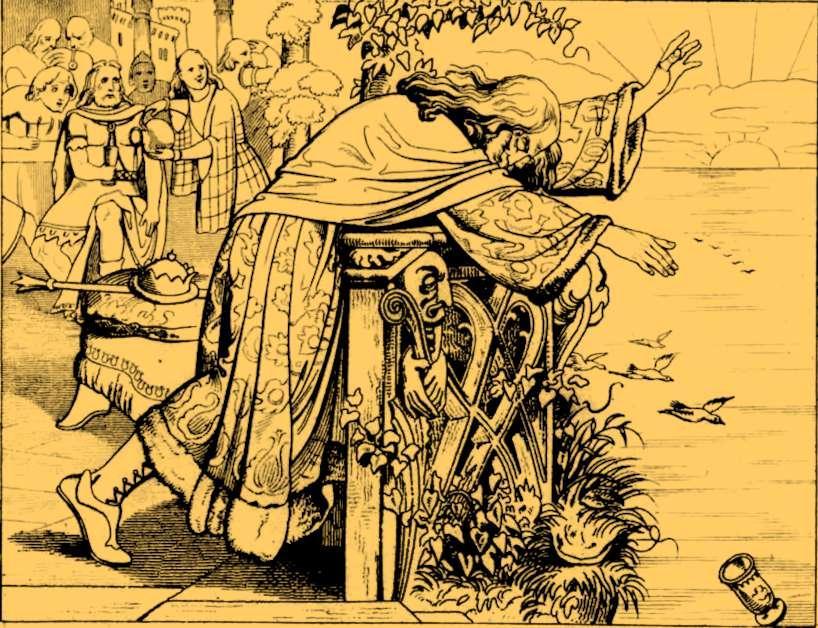
He saw it falling, filling
And sinking 'neath the main,
His eyes then clos'd forever,
He never drank again.
Here the score from the first edition by Siegmund von Seckendorf, Volks- und andere Lieder, Begleitung des Forte piano, in Musik gesetzt, 3rd collection (Dessau 1782), 6–9, the version Auguste likely sang:
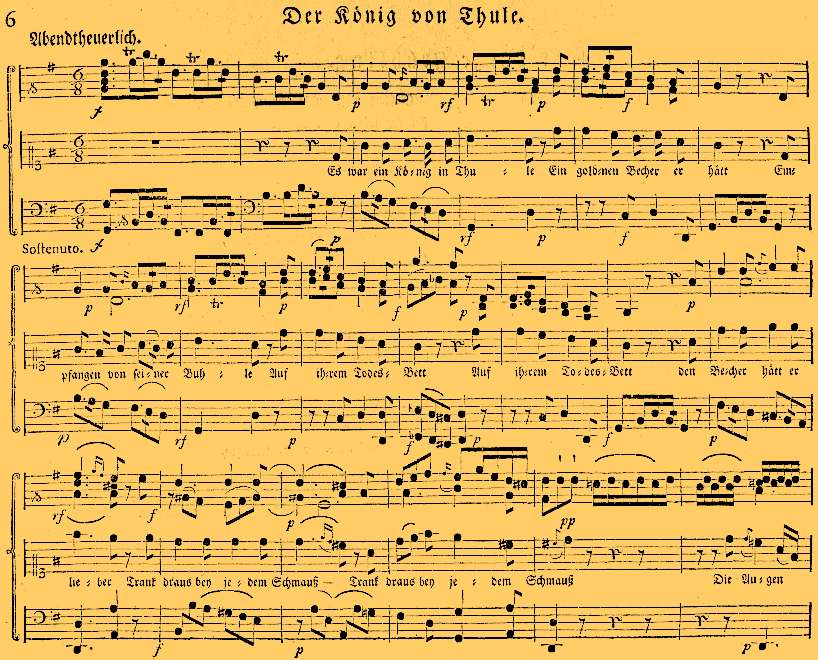
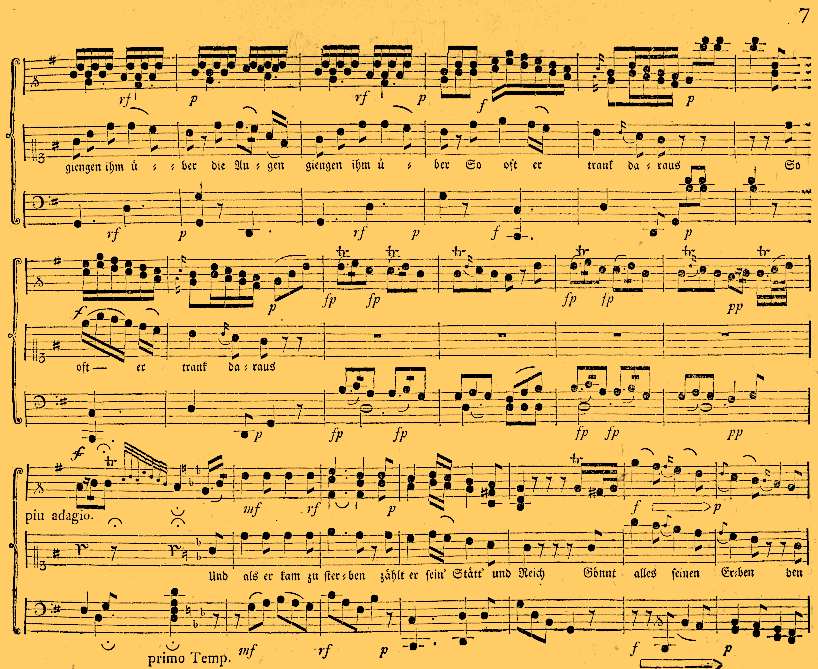
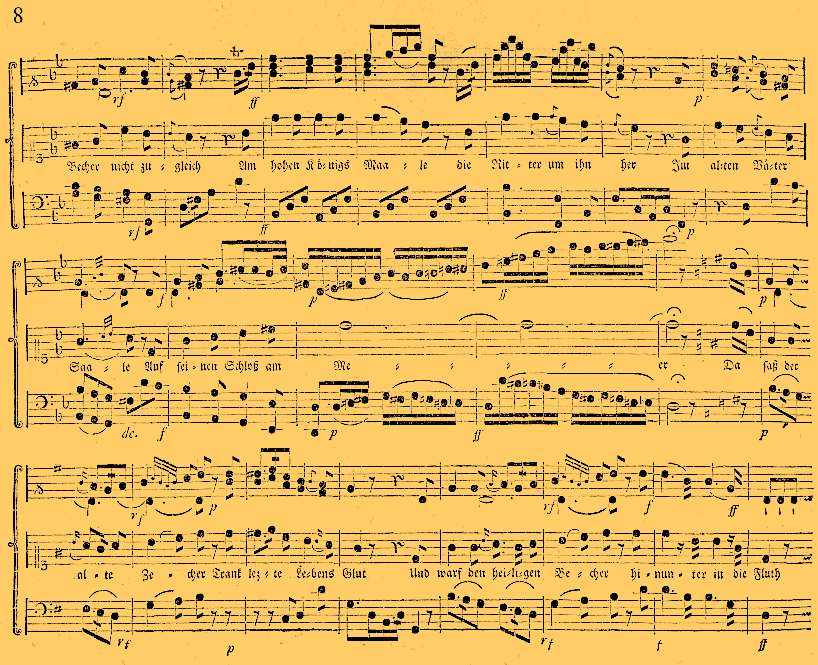
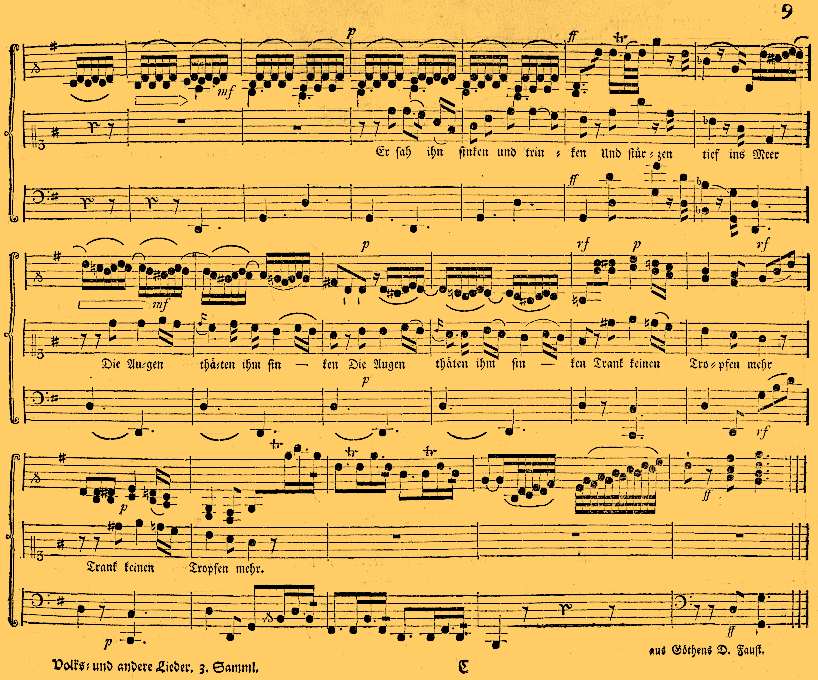
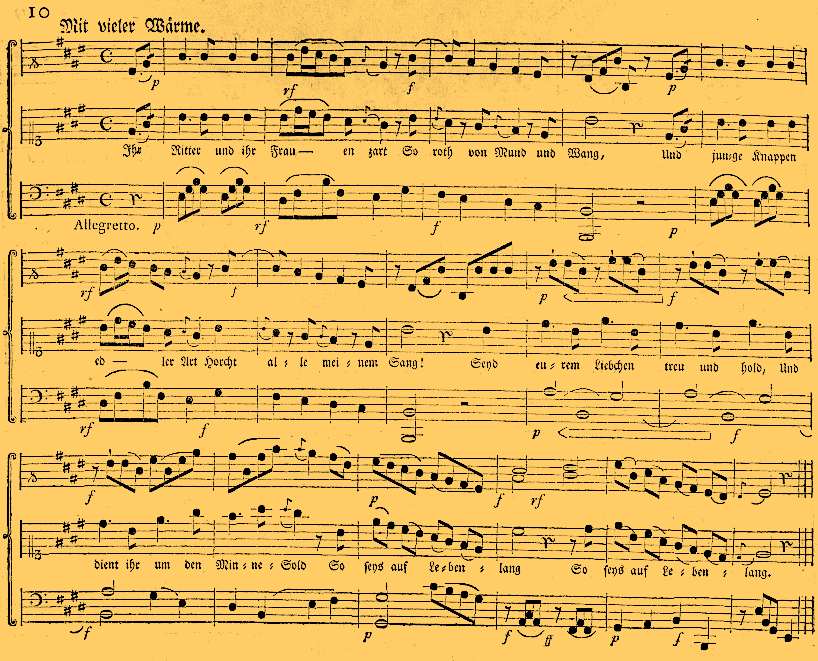
[2] In a later version of the “swan song,” Wilhelm replaced “at our feet” with “at my feet” in the final stanza. Back.
Translation © 2013 Doug Stott