
• 222a (was 217). Caroline to Luise Gotter in Gotha: Jena, 25 February 1799 [*]
Jena, 25 January February [17]99
|492| The enclosure to Cecile should have gone off several days ago, and I dare not tell Auguste that I am only sending it today. [1] —
How are all of you doing, my dear people? How have you dealt with this harsh winter, or rather it with you? It is truly a pleasure to be able to breathe a bit warmer air again, were it only not simultaneously accompanied by flooding, as is the case here. The entire valley is covered with ice and water. Especially the day before yesterday, it rose high enough to enter through the city gates, and the castle was surrounded like an island. Although there was quite a bit of damage, it was not much at all compared to the horrendous water problems on the Rhine — which are unfortunately coinciding with the dire circumstances brought on by the war. [2]
For that reason especially I must ask that you forgive me for not having written earlier, since I did have something to relate to you from Iffland. He is keeping one play for the Berlin theater (I know not which), and also wants the other one, which he is counting on performing in Leipzig. [3] |493| — If perchance he again neglects it, it will not be for lack of reminders from us. He really is enormously burdened with business matters. — At the very least, everything will be put into the proper order when we ourselves get to Berlin, which was supposed to happen in three weeks but will now perhaps not come about until Whitsun. [4]
I spoke with Löffler yesterday at a club. He told me he had read aloud to you the passage from Iffland’s Memoirs about which I wrote you. [5] — He brought his daughter to Weimar, the poor man. [6] For one really must feel sorry for him even though he does not quite look as if he were asking for such sympathy. [7] One notices a certain tension in him. He is quite voluble but not particularly animated, and completely different from when I saw him first. — What will he be doing now? There is probably all the less hope for Caroline, since she allegedly was still not on good terms with Madam L[öffler] [8] . . .
Schlegel ate lunch with Löffler today at the Frommanns.
Ever since Madam Schütz returned from Berlin, where she distributed 120 calling cards and attended 36 banquets and did who knows what else, the old demon has been completely turned loose again. She has come up with a plan for an amateur theater for whose initial setup close to 500 Thlr. must be collected. The individual contribution is 1 Carolin. [9] It goes without saying that she will also be performing, and is intending, as it were, to be the directress as well. Her Herr Eichstädt, who is the true spy from Erfurt, always betrays to me what she is planning and thinking. —
We are not planning on opposing the implementation, since it does provide a certain measure of relief for the plan to get a proper company here from time to time. (The previous amateurs have been horrible performers.) We are signing on but will not be performing.
|494| In the meantime, Schiller issued a rather coarse opinion on the matter, suggesting that the entire business is allegedly to be implemented solely at the expense of a proper theater. The amateur performances would allegedly hinder the latter without any compensation for doing so. Goethe is here and has probably exerted some influence in the matter, since he would like to bring the Weimar theater ensemble over here occasionally [10] — in the meantime, however, it could have been said more politely, and Madam Schütz is infuriated. Although I do think it will probably be implemented, I doubt anyone will be performing apart from the previous members. —
Auguste is writing here about the fun we will be having this week. [11] Goethe attended our rehearsal yesterday — he cut a charming figure standing completely alone in the middle of the hall in front of the theater, representing the audience — a service the audience cannot pay back in kind — since it can never represent him. [12] People are talking about nothing but the theater here now. First it was Schiller’s new play [13] — now the Jena chronicle, then we will be seeing the end of Wallenstein. [14] Then Madam Unzelmann from Berlin will probably be performing in Weimar. [15] Then we ourselves will be seeing some wonderful things in Berlin. [16] [Errand requests.]
Notes
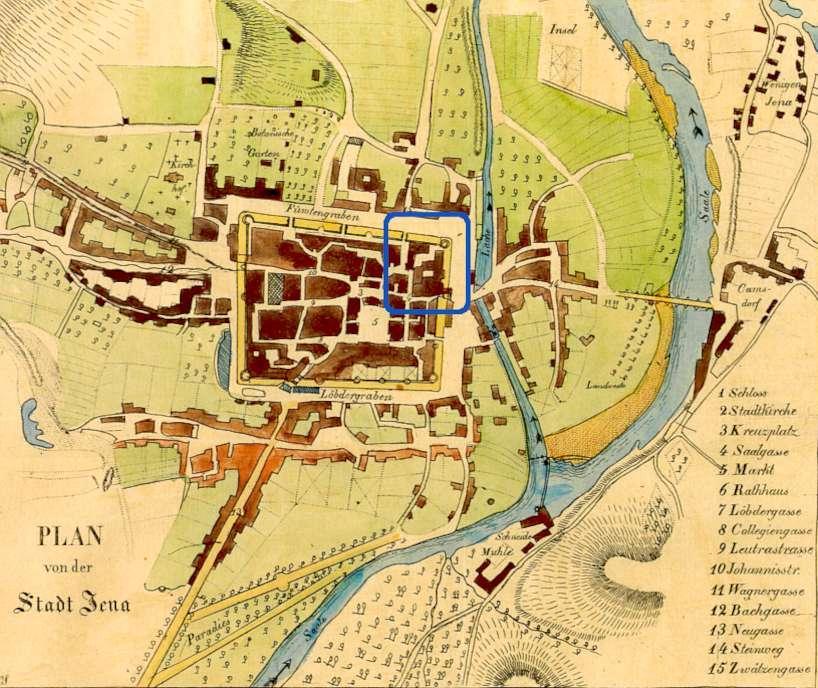
[*] Originally letter 217, this letter must be incorrectly dated (Caroline slips up similarly elsewhere as well), not least because Goethe was not in Jena at the time (he would be there 7–28 February 1799 [Weimarer Ausgabe 3:2:232–36]). Albert Leitzmann, “Aus Karolinens Lebenskreisen”, 128, points out that the high water and flooding to which Caroline refers in the initial paragraph is confirmed by Goethe’s diary on 23 February, precisely the day to which Caroline refers (Weimarer Ausgabe 3:2:236): “Last night the water attained its highest point, reaching up to the castle’s fourth step” (castle indicated in the northeast corner of the old town; Carl Schreiber and Alexander Färber, Jena von seinem Ursprunge bis zur neuesten Zeit, nach Adrian Beier, Wiedeburg, Spangenberg, Faselius, Zenker u. A. von Carl Schreiber u. Alexander Färber: Mit Kupfern, Karten, Lithographien u. Holzschnitten [Jena 1850], map following p. 52):
[1] Auguste’s letter to Cäcilie Gotter of 18 February 1799 (letter 220). Back.
[2] In connection with the War of the Second Coalition (1798–1802), in which Friedrich Wilhelm III of Prussia remained neutral, while Russia withdrew later; see The New Illustrated Encyclopedia of World History, ed. William L. Langer, 2 vols. (New York 1975), 1:617:
An Anglo-Russian army under the duke of York was to drive the French from the Netherlands; an Austrian army under Archduke Charles was to expel them from Germany and Switzerland; a Russo-Austrian army was to force the French from Italy. . . . March 25 [1799]. The Archduke Charles defeated Jourdan and the army of the upper Rhine, at Stockach. Jourdan retreated across the Rhine and laid down his command. His army and that of the middle Rhine (Bernadotte) were united under command of Masséna. Back.
[3] Iffland was interested in the posthumous plays of Friedrich Wilhelm Gotter; see Caroline’s letter to Luise Gotter on 24 October 1798 (letter 206), with note 10, and in late 1798, early 1799 (letter 214), with note 1. Back.
[4] Caroline and Wilhelm Schlegel were planning a trip to Berlin, where they hoped to see the premiere of Wilhelm’s translation of Hamlet; the trip never materialized, nor did they attend the premiere in Berlin on 15 October 1799. See Ella Horn’s essay on the background to the premiere of Hamlet in Berlin. Back.
[5] August Wilhelm Iffland thought extremely highly of Luise Gotter’s husband, Friedrich Wilhelm Gotter, from his own theatrical beginnings in Gotha; in his book, A. W. Ifflands dramatische Werke, vol. 1, Ueber Meine Theatralische Laufbahn, (Leipzig 1798), 69–70 (the book had appeared during the fall of 1798), he expressed effusive gratitude to this “extremely noble-minded man” for his powerful guidance at the time:
Gotter!
Celebrate his memory! Grateful tears and ardent, childlike emotions consecrate the garland I would like to weave around his urn!
I owe him everything people find laudable in me as an artist and much of what constitutes my happiness as a human being. Indefatigably did he guide my every step, with infinite and untiring patience turning me away from false paths, and then with incomparable cordiality welcome me back.
Noble man! I know not whether you were sufficiently appreciated in life — but I do know that your soul never knew either hatred or ill will, regardless of how harshly life may have treated you. Your husk has been lowered into the grave, and with it all misunderstanding.
Your fatherland reveres your genius, which lives on in your students and will live on perpetually in the creations of your spirit.
I remember you often and vividly, and sometimes my own eyes well up when I think of your last handshake, the last glance of those gentle, departing eyes. Back.
[6] Amalie (Henriette?) Charlotte or Wilhelmine (Minchen) Löffler; uncertain why Löffler brought her to Weimar. Back.
[7] Löffler had lost his second wife, Catharina Sophia Elisabeth, née Silberschlag, on 12 January 1799, and was about to enter a period in his own life when his health, too, was not particularly good (“breast fever,” liver problems), prompting him to seek out mineral springs and spas in 1800, first Karlsbad, then also Aachen, and in 1803 and 1804 Pyrmont. Here may have been on his way to Berlin, whither he was traveling by way of Jena, and perhaps he was leaving his daughter with someone in Jena until he returned to Gotha (Josias Friedrich Christian Löffler, Kleine Schriften, nach seinem Tode gesammelt und herausgegeben, 3 vols. [Weimar 1817–18], 1: xlvi; map: Post Karte Durch ganz Deutschland, ed. J. Walch [Augsburg 1795])):

[8] “Caroline” uncertain reference. Back.
[9] Amid a fluctuating exchange rate, approximately 6 1/6 Thaler. Back.
[10] The next year, Goethe did indeed step forward to oppose the theatrical enthusiasm of Madam Schütz; in fact, on 22 December 1800, in the name of Karl August, he forbid such entertainment as being contrary to the declared academic purposes of Jena. Back.
[11] See Auguste’s letter to Cäcilie Gotter on 18 February 1799 (letter 220) concerning the amateur theater performance on 28 February 1799. Back.
[12] Since Auguste, in her letter to Cäcilie Gotter on 18 February 1799 (letter 220), mentions plays to be performed on Justus Christian Loder’s birthday on 28 February different from that mentioned by Henrik Steffens, it is uncertain to which similar birthday celebration Steffens is referring, Was ich erlebte, 4:97–100. Here Steffens relates how he, in the main role in August von Kotzebue’s play Der Schauspieler wider Willen. Ein Lustspiel in einem Act. Nach dem Franzoesischen frei bearbeitet (Leipzig 1803) (a piece replete with satirical allusions to the faults of actors and actresses; original French: Louis Archambault Dorvigny, La fête de campagne ou L’intendant comédien malgré lui, comédie épisodique en un acte, prose et vers [Paris 1784]), was calmly but firmly corrected by Goethe after having parodied some of Schiller’s lines at the dress rehearsal (illustration: Calendar für das Jahr 1796; Inhaltsverzeichnis deutscher Almanache, Theodor Springmann Stiftung):
The family of the famous anatomist Loder was among those who had been quite cordial to me. With his birthday approaching, some people decided to celebrate the day with a theater production; the choice fell on Der Schauspieler wider Willen, and my own considerable adroitness made people think that perhaps I might be able to take over the main role. . . .
The theater was set up, there were several rehearsals, and I was not only the main actor, but also the director. . . . Cultivated women had taken some of the roles. As is well known, the main role contains a considerable number of declamatory passages from various other plays; those in the original play were largely antiquated and rather ordinary. Hence I substituted exaggerated declamatory passages from plays by Iffland and Schiller. . . .
The days of rehearsal passed, we had come to the dress rehearsal itself; and behold, suddenly Goethe himself walked in. He had cordially promised, as he was wont to do on such occasions, to direct the dress rehearsal, though everyone had concealed it from me.
After greeting the women, he came to me and spoke quite cordially and warmly, as if to an old acquaintance. “I have,” he said, “long anticipated having you as my guest in Weimar; I have much to speak about with you, much to relate to you. When these days have passed, I do hope you will accompany me.” No one could have been happier than I.
Only now did I finally, genuinely feel at home in Jena. I reveled, and the joyous delight of my high spirits poured itself into my performance. Here and there Goethe gave this or that piece of advice, and all the dramatic scenes in Wilhelm Meister hovered before my mind’s eye, scenes that seemed to be actualized here through the hand of the great author himself.
After I had recited the declamatory passages from Schiller’s pieces, Goethe cordially approached me and said, “Let us choose passages from other plays; I think it best if we leave our good friend Schiller out of things here.” —
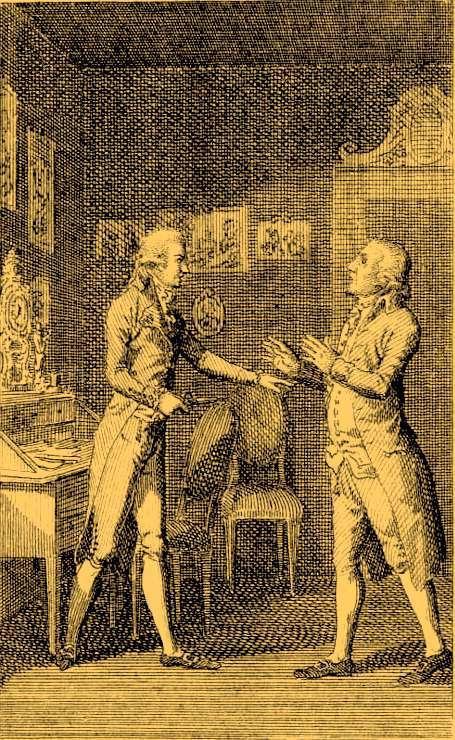
It was odd that neither I nor the other actors had sensed anything offensive in my original choices. Everyone was doubtless influenced at least in part by the opinions the Schlegel brothers had of Schiller, opinions that not infrequently were quite harsh. . . . The birthday festivities passed, and the play was performed at least without giving offense. Back.
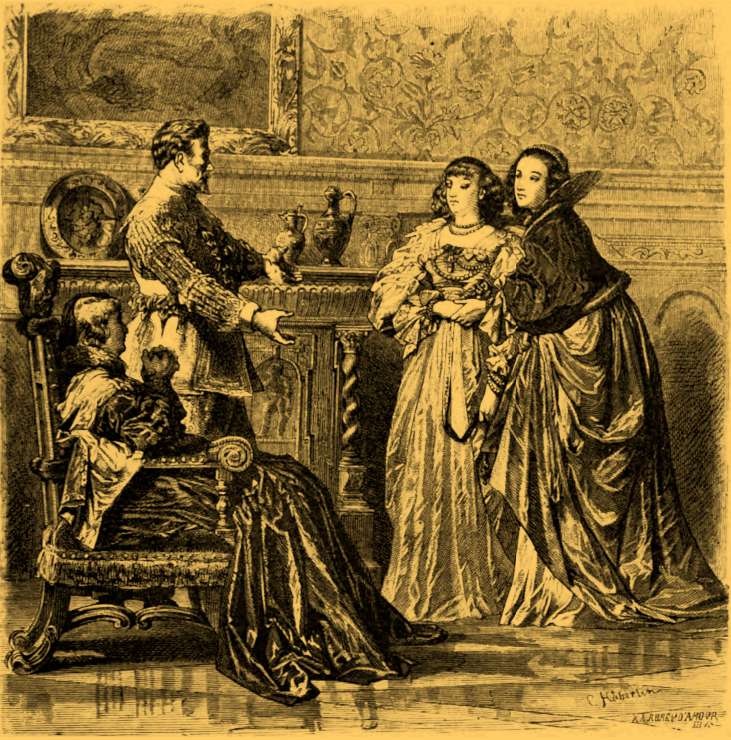
[13] Die Piccolomini on 30 January and 2 February 1799 in Weimar, part of Wallenstein; here act 2, scene 2 (illustration from Schiller’s Works, ed. J. G. Fischer, vol. 2 [Philadelphia 1883], 147):
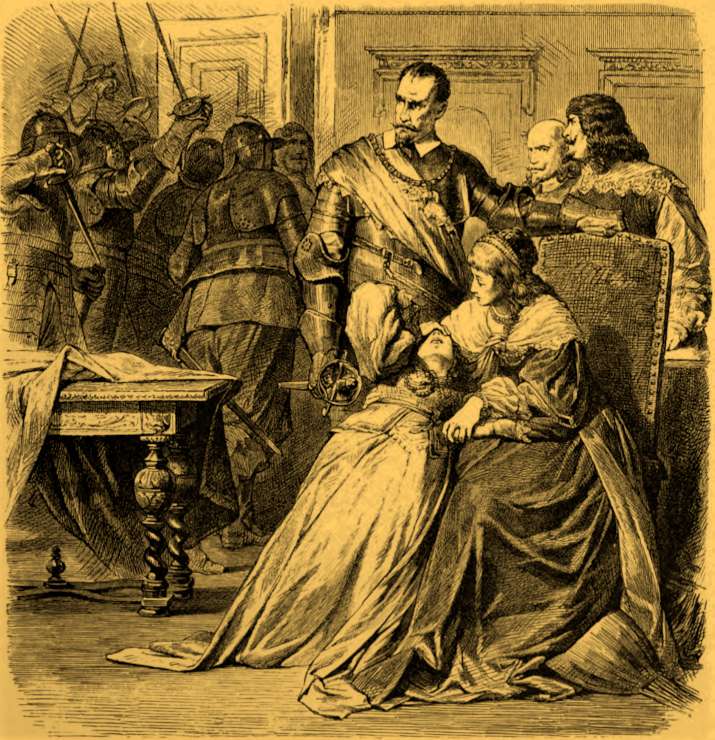
[14] The “Jena chronicle” is possibly an allusion to the plays in which Caroline and Auguste would be performing in Jena on 28 February (see letter 220). Wallensteins Tod (with the title Wallenstein) would be performed on 20 and 22 April 1799. Here act 3, scene 23 (illustration from Schiller’s Works, ed. J. G. Fischer, vol. 2 [Philadelphia 1883], 227):
[15] In April 1799, Friederike Unzelmann appeared in six guest performances at the Royal Theater in Vienna; she empowered August Wilhelm Iffland to negotiate guest performances in Weimar on her return trip to Berlin. Unfortunately, Franz Kirms, conducting negotiations on behalf of the Weimar theater and in place of Goethe, could not agree with Iffland’s conditions; Goethe concurred, negotiations in May yielded no progress, so the performances never materialized. See “Goethe und Friederike Unzelmann-Bethmann,” Deutsche Dichtung 12 (April–September 1892), 78–80, here 78–79. Friederike Unzelmann would not perform in Weimar until the autumn of 1801. Back.
[16] The “wonderful things” were to include the performance of Wilhelm’s translation of Hamlet; see note 4 above. Back.
Translation © 2013 Doug Stott