
• 171. Caroline to Luise Gotter: Jena, 15–17 October 1796
[Jena] 15 [–17] October [17]96
|399| [Errand requests.] And you see, in return she [1] is bringing along the Allmanach for you, which you would already have if I owned more than one copy, and Schlegel took that one with him [2] — who — I might add in passing — has not yet returned. But should I buy one, you will have it at the end of the week!
As I hear it, there are numerous false interpretations. The Schüzes were in Leipzig and were able to take in the entire spectacle. My good |400| child, how utterly horrified you will be when you finally get it in your hands! Admittedly, [some of] the names are indeed completely written out, at least Manso and Nicolai. But that is not a problem, since the more public they are about it, the less can one reproach them for using these deceitful weapons. Really, they simply should have been explicit about everyone, including themselves.
I can tell you that I am finding the whole thing increasingly unpleasant and have in the meantime (just between us) become considerably less fond of Schiller, for believe me, five sixths come from him, and only the funny and less insulting ones from Göthe. Schiller will also be the one who alone will have to atone for this quarrelsome business — he makes himself so painfully vulnerable — is exposed from every angle, and is touchy, something betrayed precisely by his vengeance.
Fromman hastily took Schlegel away from me, and I know not yet when he will be returning. He will presumably go on farther. I have, however, used the time to move in here and have even managed to get tolerably settled in. [3] All sorts of things are still being done in the house itself. The cabinetmakers and painters are still here, so that at least the avenues [corridors] are not yet as nice as my rooms. I am very glad Schlegel escaped all the commotion and that I will be able to introduce him to the neat and tidy apartment later. He is not one of those scholars with no sense for order and elegance; notwithstanding the element of elegance here is still of the rather frugal sort, in the meantime things do already look differently than they did in the garden house. [4] Ah, my dearest Louise, were you but here!
My first visitor in our new residence was Blumenbach, as pliable and charming as ever. I did not really expect him to come by and visit me — I was just sorry Schlegel was not here and Blumenbach did not stay longer. |401| I would have been proud had he been able to see a bit of my second happy marriage. He was quite edified by my first on more than one occasion, and, truly, I have certainly gotten no worse myself since then. [5]
You two really do have a problem with Minchen. [6] Schlegel did not compose any epigrams referring to the schoolmaster, and Schiller certainly did not spare Schlegel’s brother [7] — anyone who happens to be seized by the spirit ends up composing some about his friend and his beloved lady. If she hears about it, only tell her that I have declared myself to be vehemently opposed.
. . . Madam Paulus is here again and is wearing the tricolor cocarde. [8] Here she is allowed to do that — and yet I myself never — never — did it in Mainz. Thus does it stand with how fair the world is. [9] She is, by the way, a dainty little woman whom the French doubtless found quite pleasing.
17th [October]
Schlegel just arrived back home, the dear soul. What a joy for me. He was in Dessau at the Tischbeins’.
Notes
[1] Luise Gotter’s sister, not more closely identified. Back.
[2] Schiller’s Musen-Almanach für das Jahr 1797:

See Caroline’s letter to Luise on 3 October 1796 (letter 170), with note 2 concerning the overall disposition of the Xenien, to which Caroline will be more specifically referring here.
Wilhelm seems to have traveled to the Michaelmas trade fair in Leipzig (ca. 75 km northeast of Jena) with the bookseller Karl Friedrich Ernst Frommann (see Caroline’s letter to Luise Gotter on 3 October 1796 [letter 170]) and then (as will be seen later in this letter) traveled “on farther” to Dessau (ca. 55 km further north of Leipzig) before returning to Jena ([1] Post Karte Durch ganz Deutschland, ed. J. Walch [Augsburg 1795]; [2] Rudolf Koch and Fritz Kredel, Deutschland und angrenzende Gebiete [Leipzig 1937]):


[3] Wilhelm, Caroline, Auguste, and possibly also Friedrich Schlegel had moved into their new apartment inside the town gates of Jena at Leutragasse 5, having previously lived in a garden apartment outside town between the Löbder gate and the Paradise greenspace. See Caroline’s letter to Luise Gotter on 4 September 1796 (letter 169) with note 4 concerning the new apartment. Back.
[4] Wilhelm wrote to Georg Joachim Göschen from Jena on 7 November 1796 (Körner [1930], 40):
Your trip to Weimar has not come to nothing, has it? I am hearing nothing about it. — Surely you will pay your respects to us if you do end up making the trip after all. Please do come, you will be pleased to find us so nicely situated in our residence.
Wilhelm writes to Karl August Böttiger from Jena shortly thereafter (21 November 1796; “August Wilhelm Schlegel an C. A. Böttiger,” Archiv für Litteraturgeschichte 3 [1874], 152–61, here 154–55):
Might we not hope to see you here at some point, and for a longer period than last summer? You will now find me in town in a more spacious and amply furnished apartment. Do come! . . . my Caroline sends you her warmest regards.
On 1 December 1796, however, Wilhelm was already writing to Schiller with regard to an honorarium payment Schiller made to him (Körner-Wieneke, 36–37):
The payment is very welcome to me insofar as furnishing my small household has been rather expensive, and since I cannot soon expect any considerable sums for works already delivered. Back.
[5] A bit of self-satisfaction comes to expression here on Caroline’s part, since Johann Friedrich Blumenbach was one of her first suitors but apparently did not wish to pursue the relationship further (Daniel Nikolaus Chodowiecki, Die sonderbare Art Schwiegermutter zu gewinnen [1780]; Herzog August Bibliothek; Museums./Signatur Chodowiecki Sammlung [4-255]):

See her letter to Luise Stieler (i.e., Luise Gotter) on 4 September 1778 (letter 1).
Blumenbach had visited Caroline on several occasions in Clausthal after her marriage to Franz Wilhelm Böhmer, including once on 7 November 1785; see esp. her mention of this visit letter to Lotte Michaelis on 9 November 1785 (letter 62) with note 6. Back.
[6] Because of the Xenien Schiller and Goethe composed about Johann Kaspar Friedrich Manso; see Caroline’s letter to Luise Gotter on 3 October 1796 (letter 170) with notes 3 and 4. Back.
[7] Xenia 179, 301–8, and 320–31 all were directed at Friedrich Schlegel. See, e.g.:
302. Most recent samples of criticism.
You lack very little indeed to be called a "master" according to my own concepts,
Providing, of course, I forget how daft are your fantasizations.

303. A second.
Your feelings are charming and delicate, your expression cultivated,
But a single thing would I reproach: that you are frosty of heart — and dull.

320. Our two fevers.
Hardly has the cold fever of Gallomania subsided
Than a heated one breaks out in Grecomania.

330. Swift writers.
What they yesterday learned, would they teach us already today,
Ach! what a short intestine these gentlemen have!

331. Sunday's children.
The master works for years and is never satisfied,
While this ingenious generation receives it . . . in their dreams! Back.
[8] The (in Erich Schmidt’s opinion, [1913], 1:715) pretty wife of the theologian Heinrich Eberhard Gottlob Paulus, about whom Goethe quipped to Schiller on 29 March 1802 (Correspondence between Schiller and Goethe 2:410; translation altered): “Nature may go on working for a long time before she manages a second time to produce so pert a creature.” — Regrettably, there seem to be no portraits of Karoline Paulus. See, however, the evocative illustration from the Goettinger Taschen Calender vom Jahr 1789 (Inhaltsverzeichnis deutscher Almanache, Theodor Springmann Stiftung):
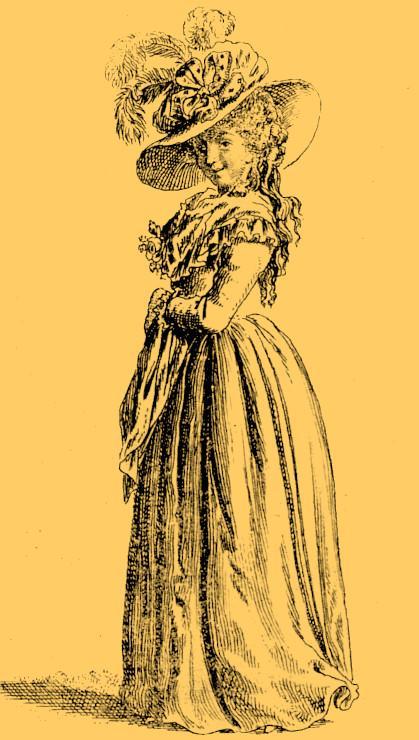
See also the supplementary appendix on Karoline Paulus’s reputation.
Concerning the tricolor cocarde, see Caroline’s letter to Friedrich Ludwig Wilhelm Meyer on 6 October 1792 (letter 116) with note 6. Back.
[9] That is, that Madam Paulus was able to get by with such expressions of support for the French Revolution even outside Mainz, while Caroline, allegedly without such expressions, was imprisoned and essentially ostracized. Concerning Caroline’s reputation at the time, see her letter to Friedrich Ludwig Wilhelm Meyer on 7 June 1794 (letter 145), note 13. Back.
Translation © 2012 Doug Stott