
169a. Johann Friedrich Reichardt to Wilhelm Schlegel in Jena: Giebichenstein, 15 September 1796 [*]
Giebichenstein, 15 September 1796 [1]
. . . We are both [2] delighted to know that you, my dear and valued friend, are now resting in the womb of domestic bliss and that the addition of your excellent brother has rounded out the sacred number so nicely for you. Please do favor us quite soon by acquainting us with your charming wife so that this beautiful picture of harmonious love, friendship, and fraternal love may become wholly concrete for us. [3] Both of us send you our most heartfelt and cordial regards.
Your
Reichardt
Notes
[*] Körner (1930), 1:38. Back.
[1] At the beginning of the letter and in a postscript, Reichardt discusses various contributions of both Wilhelm and Friedrich Schlegel to and other matters concerning the journal Deutschland, which he edited.
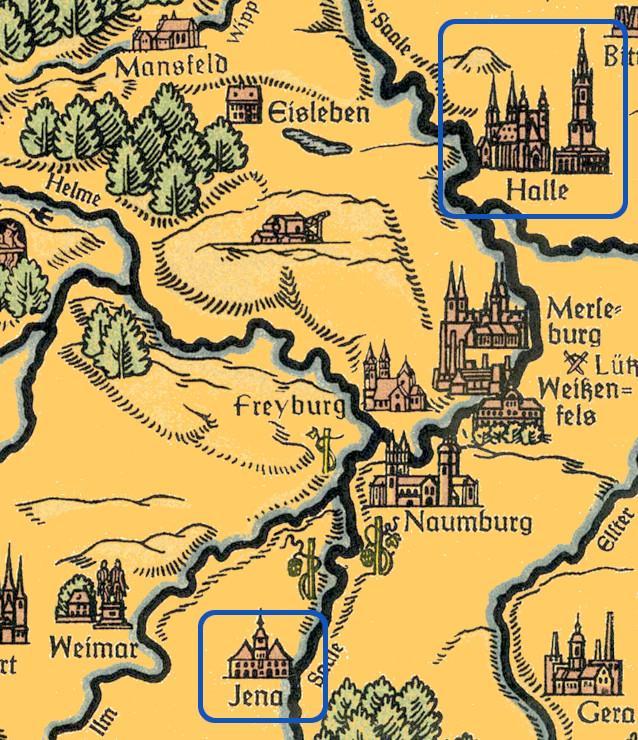
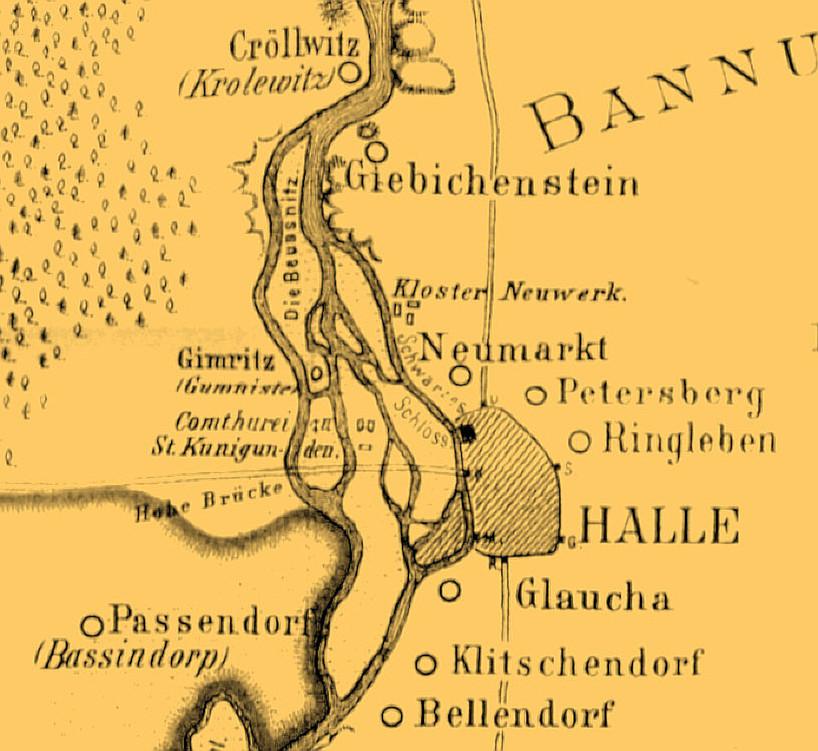
From 1794 Reichardt owned an estate quite near the castle Giebichenstein just north of Halle on the Saale River whose grounds and gardens he transformed (at considerable cost) according to the contemporary view of Rousseau’s understanding of nature (maps: [1] Rudolf Koch and Fritz Kredel, Deutschland und angrenzende Gebiete [Leipzig 1937]; [2] Gustav Friedrich Hertzberg, Geschichte der Stadt Halle an der Saale von den Anfängen bis zur Neuzeit, vol. 1: Geschichte der Stadt Halle an der Saale im Mittelalter [Halle 1889], 559):
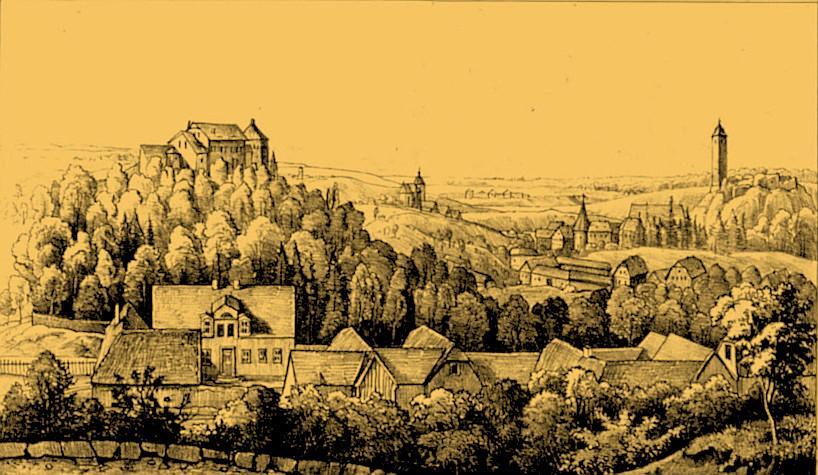
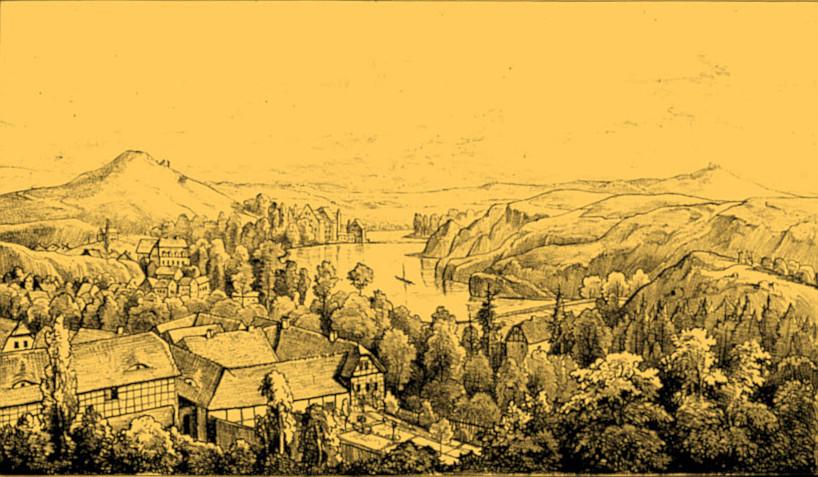
Here a view of (1) the castle, and (2) the estate itself (anonymous, Soolbad Wittekind in Giebichenstein bei Halle a. d. S. [Halle 1846], both plates following p. 16):
Concerning the estate, see the classified advertisement for its sale in 1823 by the person who purchased it in 1815 after Reichardt’s death (Allgemeiner Anzeiger der Deutschen 256 [20 September 1823], 2939):
Country House in Giebichenstein
I am considering selling privately the country house in Giebichenstein near Halle that Musical Director Reichardt owned for several years and which I purchased from him in 1815. The main house is quite spacious, fit for habitation, and contains 1 larger hall, 9 rooms, 11 chambers, 2 kitchens, and 2 cellars. —
The house is bordered on one side by the parklike garden, encompassing 22 Magdeburg square units, that Reichardt himself laid out 25 years ago. The whole parcel offers an extremely pleasant place of sojourn during the summer whose amenities are enhanced by the immediate proximity of town [Halle] and the charming surrounding area. Anyone interested in purchasing this rural parcel should inquire with the undersigned by post concerning the conditions of sale.
District of Giebichenstein, 28 August 1823, Administrative Rath L. Bartels
Here the village Giebichenstein and castle in 1854 (Dr. Graefe, Über die Wirksamkeit des Solbades und Salzbrunnens Wittekind bei Giebichenstein und Halle a./S., 2nd ed. [Halle 1854], plate following p. 6):
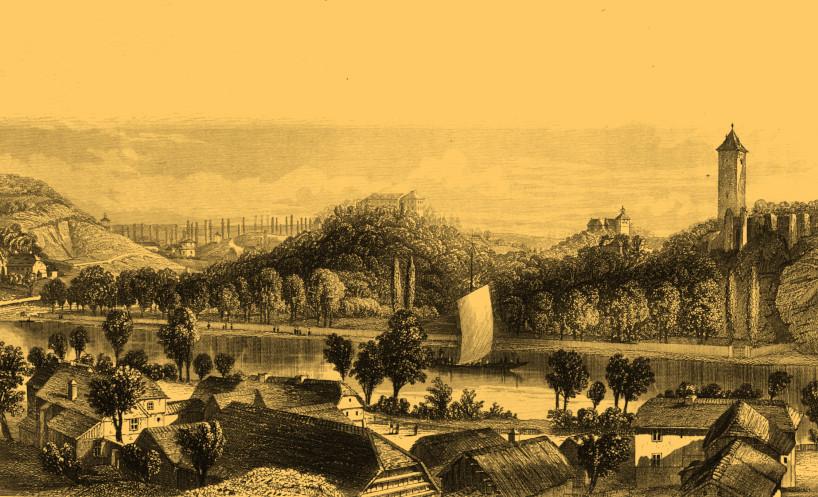
The gardens had what at the time were rather exotic plants and trees. It was at this estate that many of the literary figures generally associated with Romanticism met, whence its nickname “Hostel of Romanticism”; guests included Ludwig Tieck, Clemens Brentano, Friedrich von Hardenberg (Novalis), Achim von Arnim, Jean Paul, Wilhelm Heinrich Wackenroder, Karl Friedrich Zelter, and Friedrich Schlegel, and even Goethe. In the twentieth century, however, the grounds largely fell victim to development. Back.
[2] Reichardt’s wife (from 1783) was Johanna Reichardt, née Alberti. Back.
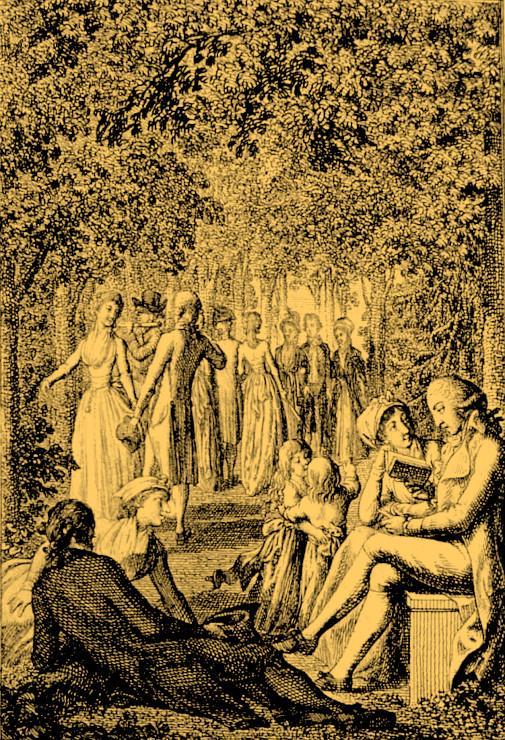
[3] The popular societal iteration (here: 1796) of Rousseau’s understanding of nature mentioned above (Taschenbuch zum geselligen Vergnügen von W. G. Becker für 1796; Inhaltsverzeichnis deutscher Almanache, Theodor Springmann Stiftung):
Translation © 2012 Doug Stott