
• 136b. Friedrich Schlegel to Wilhelm Schlegel in Amsterdam: Leipzig, Sunday, 24 November 1793 [*]
Leipzig] 24 November 1793
Here is what Caroline writes me concerning her health, should perhaps the news in the shorter letter not be sufficiently detailed:
For 2 weeks now I have gotten no stronger; on Monday evening [1] I began to fear all sorts of bad things — the following night, my pain and cramps dissolved into an opium-like inebrity — in which I was blithely content, lying there rigidly, without sleeping, and utterly dazed — this alternated with severe headaches and lasted for a couple of days. The physician is not at fault — he cannot prevent my tongue from repeatedly becoming coated regardless of how much nastiness he removes. My leg pain has abated somewhat — but this detestable weakness!
But do not worry excessively, for she always perceives her ills to be much worse than they are. None of this yet goes beyond what she should have expected in any case, and none of it is cause for serious alarm.
Many thanks for your generous letter, which I cannot really answer today the way it deserves. — Caroline probably already wrote you that she herself was surprised before she even had time to deceive you as she wanted. —
Please accept my sincere gratitude for wanting to help me; [2] in so doing you have performed an immeasurably grand and meritorious service benefiting the entire rest of my life, which as it were I have now received from you that I might also enjoy it with you. May your reward be the fulfillment of your hopes for me, and the indissolubility of our connection; you, Caroline, and I. — . . .
It was my duty, my dear friend, to remind you in Caroline’s own, harsh terms that she currently needed nothing as much as the most extreme consideration, even more than the most necessary, justified reproach. Whether your own concerning Cranz was such, I could not presume to judge. — My own, general assessment, however, does not depend on that, nor can I withdraw it, even though I present it only as my own feeling on the matter, and am also perfectly willing to acknowledge that Caroline’s reproach was far more indignant than yours.
It was, however, no doubt a wholly innocent gesture on her part to have given me, among many other letters, also yours to her in Mainz to read. [3] In the latter I did find, quite on my own, considerable tenderness, but even more offended vanity. She had irritated you, [4] and you perhaps viewed mockery as one way to save her; but I do forgive her for such mockery having effected quite the opposite, and neither of you should be surprised that even the most noble trust can eventually go sour through idolization. —
Her faith in the eternal nature of this brief republic could not but appear quite anemic outside the actual town walls of Mainz itself — though inside those walls it was certainly possible even for someone with considerable understanding.
I will never, however, be able to forgive her for allowing herself to become so caught up in her own female giddiness that she was capable of luring her friend into this ghastly maelstrom of pathetic dangers and base characters. I also wish she had simply left public matters to men once and for all. I do not, however, find in her view of things any particularly pure truth or profound wisdom once she strayed off course, but rather genuine zeal for all that is great, and that is indeed something I will always find venerable despite all the influences exerted by the infectious, general delirium of vanity, sensuality, novelty, and female inclinations that never left her. The latter of these is the only excuse against your not entirely unjust accusation of cruelty, which in precisely that fashion is so profoundly interwoven with the female character. —
It is with considerable emotion that I admire your noble humanity, which abhors even the slightest element of violence, be it perpetrated in the name of order or in the name of freedom. I am less pleased, however, that your hatred makes you unreasonable toward the French, that the only empathetic concern you have for such a great people is bitter ridicule and mockery. Even though I may well be prejudiced against the English, who deserve less respect, I certainly forget such petty considerations when seriously assessing such lofty matters. Although I completely share your opinion concerning the affiliation of all other nations with the French republic, I do wish to see French freedom preserved.
But enough; my heart is too inclined to pour itself out in a fiery torrent, and I would like to forget the cessation, forget, that is, that you explicitly wished not to hear anything I have to say on this matter, and that you condemn me without even hearing me out apart from a few utterances that in reality allude to nothing but bravery and enthusiasm, which, after all, alone really constitute the man adorned by humanity and moderation. —
Just one more thing: there is no for or against with me; [5] indeed, I hardly comprehend it. —
My political reading is not simply a hobby, but rather preliminary studies for a treatment of the history of the fatherland, on which I will work with the utmost conscientiousness in Dresden; [6] only the remaining time will be spent following other inclinations, inclinations that by nature are so open that nothing definite can really be said about them beforehand. —
There a new life will begin for me; I will impose on myself the sacrifice of renunciation and incessant diligence I have long owed to myself. Then I will summon you to be the unrelenting censor of my life. —
But do not expect anything particular before then. All my worries have robbed me of any peace of mind till now, fragmenting my leisure time alongside my visits and concerns for Car[oline] and leaving me, apart from the considerable political reading and Greek writers, no time for anything that might be viewed as more than preliminary. . . .
Notes
[*] Sources: Walzel, 144–46; KFSA 23:159–61. Friedrich’s letter to Wilhelm here is the source of the embedded excerpt constituting letter 136b in Erich Schmidt (1913), Caroline to Friedrich Schlegel in Leipzig: Lucka, November 1793. Back.
[1] Presumably Monday, 18 November 1793. Back.
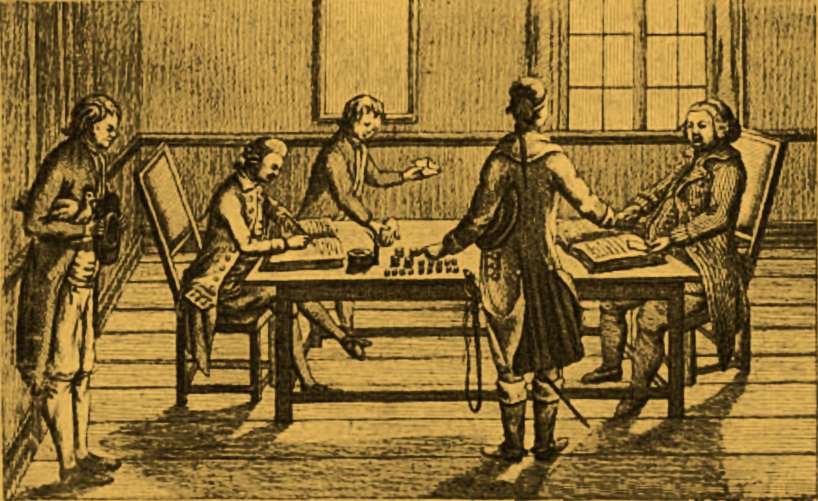
[2] Wilhelm had essentially agreed to pay off Friedrich’s not inconsiderable Leipzig debts ([1] title vignette to August von Kotzebue, Die Verläumder: Ein Schauspiel in fünf Akten [Leipzig 1808]; [2] title vignette to Heinrich Arnold Lange, Anmerkungen und Berichtigungen zu weyl. Herrn Joh. Jodoci Beck rechtlichen Abhandlung von Nachsteuer und Handlohn . . . nebst einem Anh. vom Handroßhandlohn [Bayreuth 1781]):

[3] None of the letters Caroline and Wilhelm exchanged while she was in Mainz seem to have survived. Back.
[4] Caroline seems to have declined Wilhelm’s offer to join her in Mainz. Back.
[5] That is, no for or against the French Revolution. Back.
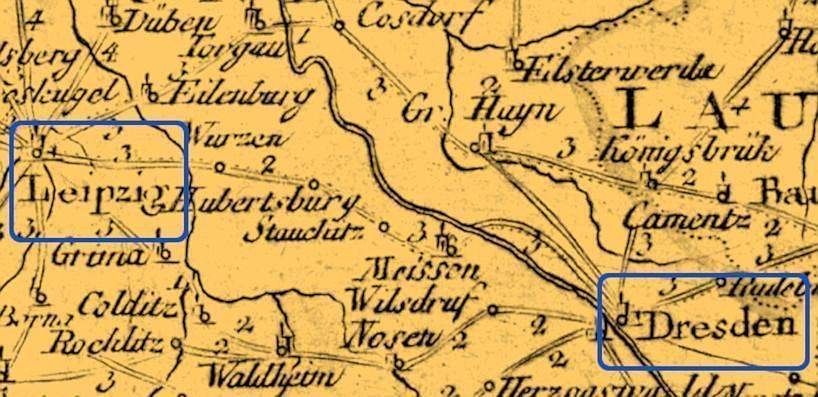
[6] Friedrich would be moving from Leipzig to Dresden in January 1794, ca. 100 km to the southwest (Post Karte Durch ganz Deutschland, ed. J. Walch [Augsburg 1795]):
Dresden in 1748 with the bridge over the Elbe River:

Translation © 2011 Doug Stott