
• 74. Caroline to Lotte Michaelis in Göttingen: Clausthal 1787
[Clausthal 1787]
|156| O thou mild spring air, I do hear you woo and call: “My Lotte, come out! come hither!” [1] I hear that you took a stroll, and I am enjoying the restorative, fragrant warmth within my four walls. It really is much nicer living upstairs here than downstairs, even though I am not to get any new wallpaper [2] —
I cannot really describe the difference in detail — it probably derives from extremely obscure, murky notions. It just now seems to me that things would have to be thus, as if I were now elevating myself more above this Clausthal existence, and such is certainly more the case socially, since the entire house is now more occupied the way things are now distributed, instead of me entering with genuine horror into the dreary, cold rooms as I once did, rooms in which not a single living, warm breeze ever blew. [3]
The esteemed young ladies just tore me away from you and this letter for three hours; their mother is returning in a few days, and it should all be quite fun. [4] Ah, well, tomorrow will also be an enormously amusing time — we are going to a wedding at the Schröders. [5] We are going over there at 12:00, then from 2:00 till 7:00 we will be sitting at the table, |157| and I will explode. [5a] Nor will the Hofrath be conducting the wedding until tomorrow.
Mademoiselle Luther’s paramour is also here again; [6] on Saturday she will be leaving. She has pleased everyone quite well, and has dined heartily and paid visits every where. [7]
Here are the two remaining books for Ruprecht. Can you not perhaps give something to the messenger woman to bring along? Indeed I would worship you could you but come up with Herder’s Gott for me [8] — oh, Lotte, as thanks for my good deed; is it not in some lending library, or might Arndswald, who does not seem to have departed, know how to round up a copy? [Various requests and errands.] [9]
Notes
[1] These initial lines are based loosely on the Ossian-passages in Goethe’s Die Leiden des jungen Werthers (Leipzig 1774; Weimarer Ausgabe 19:175–76), though Caroline seems to conflate two different passages in this emotional scene in which Werther reads aloud to Lotte from Goethe’s own German translation of James MacPherson’s Ossian (J. W. von Goethe, The Sorrows of Young Werther, trans. R. D. Boylan, J. W. von Goethe’s Works [London 1903], 121, 123; here a broader section of the passage with its disastrous result).
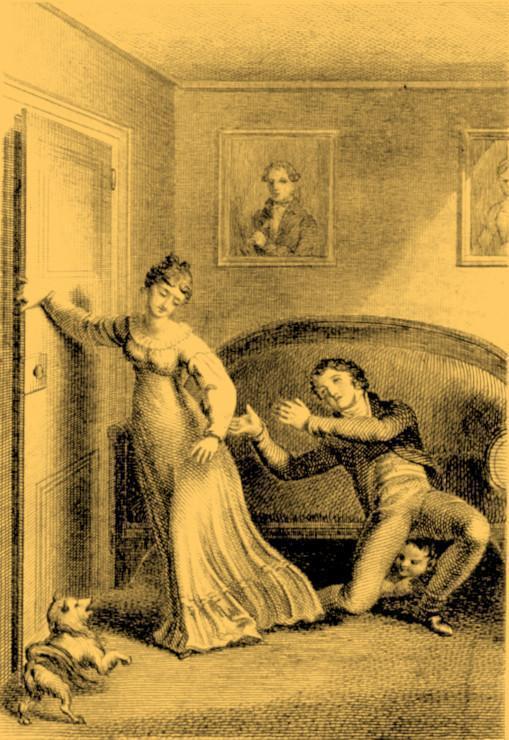
The initial portraits of the two characters include (under Werther’s portrait) one of the associated scenes, one of many such charged emotional encounters in the work (remaining illustrations: [1] James Northcote, The Last Interview of Werther and Charlotte, Frankfurter Goethe-Haus/Freies Deutsches Hochstift; [2] The Sorrows of Werther engraved by Jean Baptiste Simonet after Jean Michel Moreau, the Younger; Bibliotheque National de France; [3] Minerva Taschenbuchausgabe für das Jahr 1831 22 [N.F., Jg. 1] [1831]; Frankfurter Goethe-Haus/Freies Deutsches Hochstift):
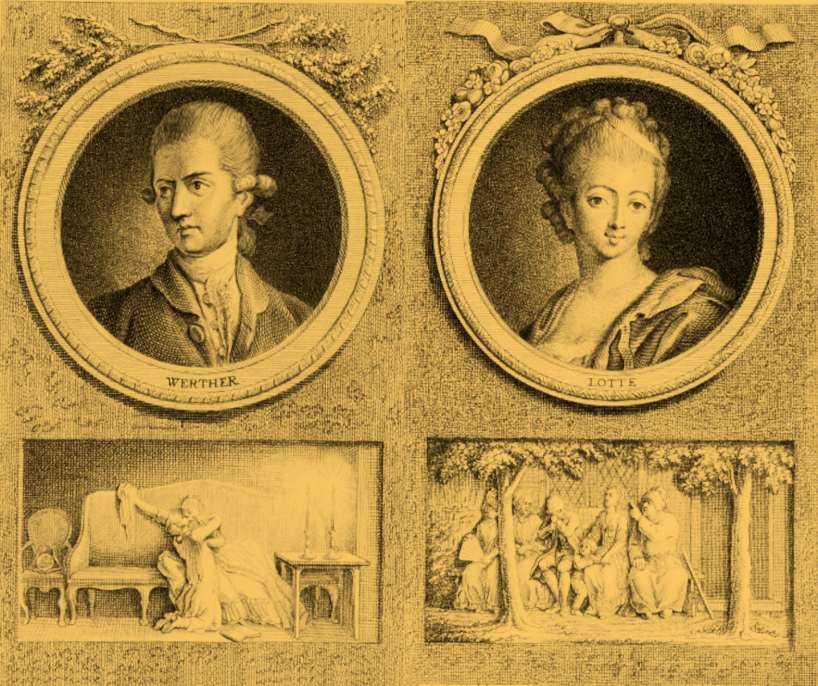
“Arise, winds of autumn, arise: blow along the heath. Streams of the mountains, roar; roar, tempests in the groves of my oaks! Walk through broken clouds, O moon! Show thy pale face at intervals; bring to my mind the night when all my children fell . . .
“Why dost thou waken me, O spring? Thy voice woos me, exclaiming, I refresh thee with heavenly dews; but the time of my decay in approaching, the storm is nigh that shall wither my leaves. To-morrow the traveller shall come, — he shall come, who beheld me in beauty: his eye shall seek me in the field around, but he shall not find me.”
The whole force of these words fell upon the unfortunate Werther. Full of despair, he threw himself at Charlotte’s feet, seized her hands, and pressed them to his eyes and to his forehead.
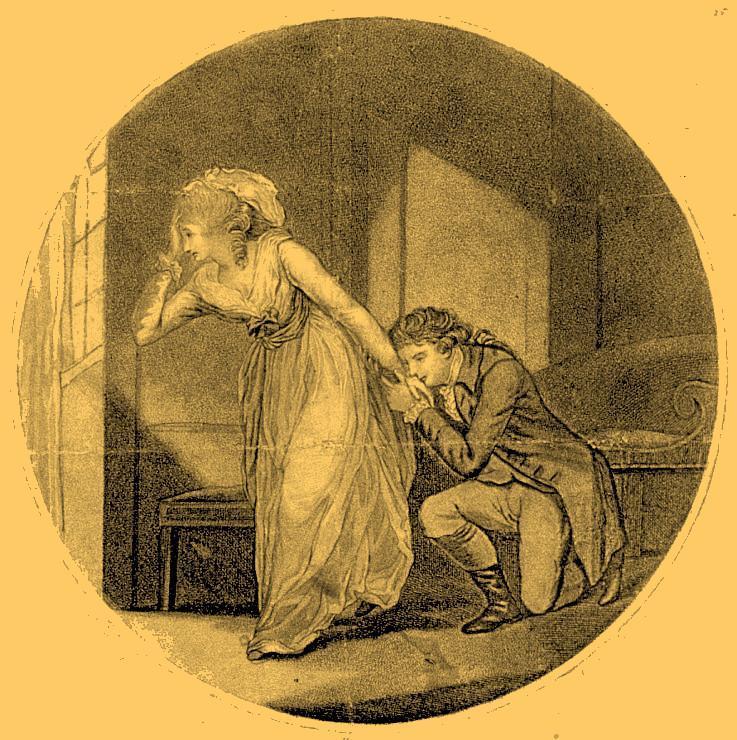
An apprehension of his fatal project now struck her for the first time. Her senses were bewildered: she held his hands, pressed them to her bosom; and, leaning toward him with emotions of the tenderest pity, her warm cheek touched his. They lost sight of everything. The world disappeared from their eyes. He clasped her in his arms, strained her to his bosom, and covered her trembling lips with passionate kisses. “Werther!” she cried with a faint voice, turning herself away; “Werther!” and, with a feeble hand, she pushed him from her. At length, with the firm voice of virtue, she exclaimed, “Werther!”
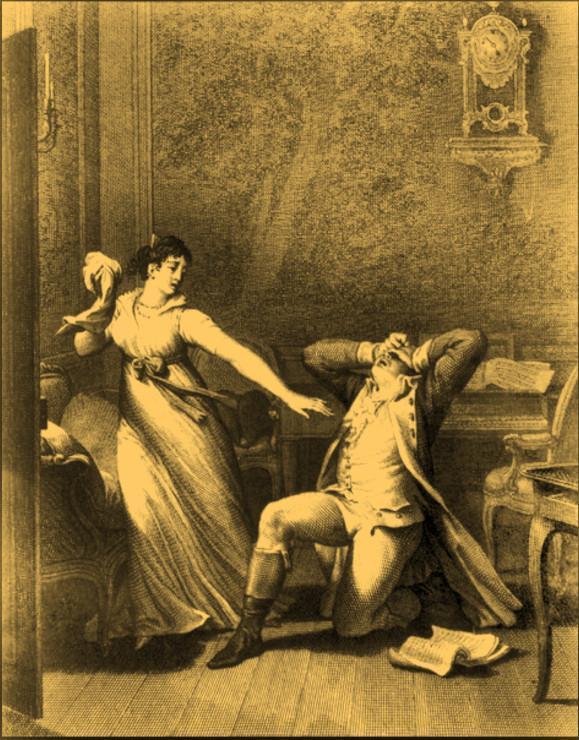
He resisted not, but, tearing himself from her arms, fell on his knees before her. Charlotte rose, and, with disordered grief, in mingled tones of love and resentment, she exclaimed, “It is the last time, Werther! You shall never see me any more!” Then, casting one last, tender look upon her unfortunate lover, she rushed into the adjoining room, and locked the door.
[2] Caroline and her family had moved from the ground floor to the second floor of their house at what is today An der Marktkirche 5. Living in this house on the town square specifically reserved for the town physician — the “physician’s house” — Caroline would have enjoyed, upstairs or downstairs despite her remarks, comfortable bourgeois surroundings typical of the period.
Click on the image below to open a gallery of illustrations of a typical mid-18th-century bourgeois residence of the sort to which Caroline was likely accustomed:

[3] Caroline is, it seems, vaguely alluding to her sense, in having moved upstairs from their earlier apartment, of leaving behind not only the site of what seems to have been her post-partem depression, but also the restricted nature of her existence Clausthal in the larger sense. Back.
[4] These persons are not otherwise identified. Back.
[5] Caroline’s mother’s maiden name was Schröder (also Schroeder), but this family’s identity here is unclear. Back.
[5a] Here such a dinner for a wedding company, “Hochzeitsgesellschaft,” vignette for the month of September, Taschenbuch für das Jahr 1813 (Frankfurt), Inhaltsverzeichnis deutscher Almanache, Theodor Springmann Stiftung:

[6] Unidentified reference, though in her Erinnerungen, Luise Michaelis mentions a certain Mademoiselle Luther — presumably the daughter of Superintendent Luther — who was one of the few among her acquaintances who became engaged to students (see Luise’s autobiography, p. 68). Back.
[7] Every where in English in original. Back.
[8] Johann Gottfried Herder’s panentheistic book Gott! Einige Gespräche (Gotha 1787). Caroline did indeed receive the book, mentioning it again in her letter to Lotte on 28 September 1787 (letter 81). Caroline had earlier requested Friedrich Heinrich Jacobi, Über die Lehre des Spinoza in Briefen an den Herrn Moses Mendelssohn (Breslau 1785) from Lotte (4 April 1786 [letter 69]).
Herder’s Gott! deals with many of the issues raised by that book. See W. H. Bruford, Culture and Society in Classical Weimar 1775–1806 (Cambridge 1975), 224–28, here 224:
The religious position at which Herder had arrived when writing the Third Part of the Ideen [Ideen zur Philosophie der Geschichte der Menschheit, 4 vols. (1784–91)] is explained by him in the short book God, written about the same time. It was a view very largely shared by Goethe, and reached by repeated discussion between them during their period of closest friendship, before Goethe left for Italy, when they read Spinoza together and with Frau von Stein, and found in him or through him new understanding, the one of nature and the other of history. Herder interpreted Spinoza as a great religious leader whose message confirmed that of Christianity, as he understood it. . . . Goethe’s approach to Spinoza in the second period of his Spinoza studies was a different one, that of a poet and a lover of natural history. . . . Yet the two writers felt themselves to be agreed in essentials, so that Goethe could greet Herder’s book with enthusiasm, when it reached him in Rome on his birthday in 1787. Back.
[9] These bracketed remarks, which occur frequently in Caroline’s published correspondence, represent material Georg Waitz (1871) or Erich Schmidt (1913) chose not to include in their editions. In some cases, Schmidt did not have access to the manuscripts from which Waitz deleted passages; in others, he himself chose not to include certain material. Concerning letters whose lacunae have been restored (or partially restored) by the translator, see this project’s introduction to the letters, note 1. Back.
Translation © 2011 Doug Stott