
• 81. Caroline to Lotte Michaelis in Göttingen: Claushtal, 28 September 1787
[Clausthal] 28 September [1787]
[The beginning of the letter is missing.]
|164| Were this page in fact a diary, I would have to go back and relate from Sunday that the young widowed bride wore a self-embroidered dress — which is what she occupied herself with during the period of mourning. On Monday morning the soul of the erstwhile Hofrath’s wife, Madam Leude, [1] departed hence like an Ossianic spirit in a stormwind — I can hear you saying:
Well, what a grand idea at that, good Sir,
Pray continue your tale, Herr Urian! [2]
This lady remained more faithful to her late lamented husband, in response to which even the grizzled dogs at home howled — But you are not familiar with this demonstration of reverence shown to Ossian’s ancient heroes, nor can you really appreciate it. [3] Enough, it was a colossal canine howling, it is just that one still does not quite know whether it was meant for the departing soul or for the surviving darling, the old mother-in-law, who now sits enthroned in a dark cloud; otherwise the clouds that hourly bluster across the Harz Mountains could not possibly be that dark. [3a] . . .
There was also a grand dîner [4] on Monday at the house of the tax administrator, and that evening at the house of the chief mining inspector we were once again in the company of that exécrable Dutchman. [5] Lotte, you have seen much, but not this, not such insolence, and he does not even compensate for it with a Michel Schuppach figure, which one would more readily forgive such coarseness and boasting, and which |165| such traits better adorn in any case; [6] but no, instead he is but a little manikin who does not even weigh as much as his big hunting knife, and utterly dried up as a result of dissipation. He is a great rock hound, and carries around so many boxes of minerals and such that one might think him a rock peddler. And yet he allegedly really is the person he presents himself to be.
Reden encountered him in Berlin among all the ministers; he almost always travels with his wife, who is beautiful in the Greek fashion à la Hollandaise. She is very fat and phlegmatic, as goes without saying, but has a great deal of fine worldliness and speaks almost all the world’s living languages with the most beautiful accent. He is tolerated to please her.
I played cards with her and Reden and Praun; he came late, sat down at our table and rummaged through one piece after another, one ring after the other of the most remarkable agate, crystal, and such. Finally there was a large case full of such stuff on the table. Reden told me it was all counterfeit and also let him know he thought so — “Oh, well, Sir, then only you listen,” the Dutchman yelled, “I have studied mineralogy for 14 years and also know a thing or two even if I am not a senior mining administrator.” During the meal he swore at the miserable food. In a word, it was insufferable. [7] . . Herder is splendid. [8] Meyer needs to send me Ossian again . . .
Notes
[1] Both the young widowed bride and Madam Leude are unidentified. Back.
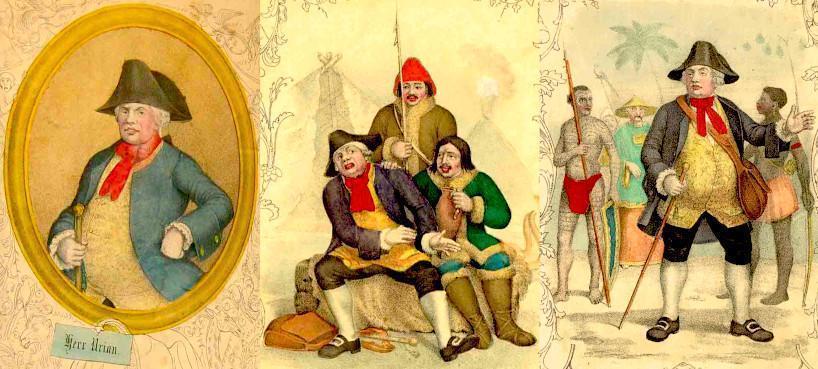
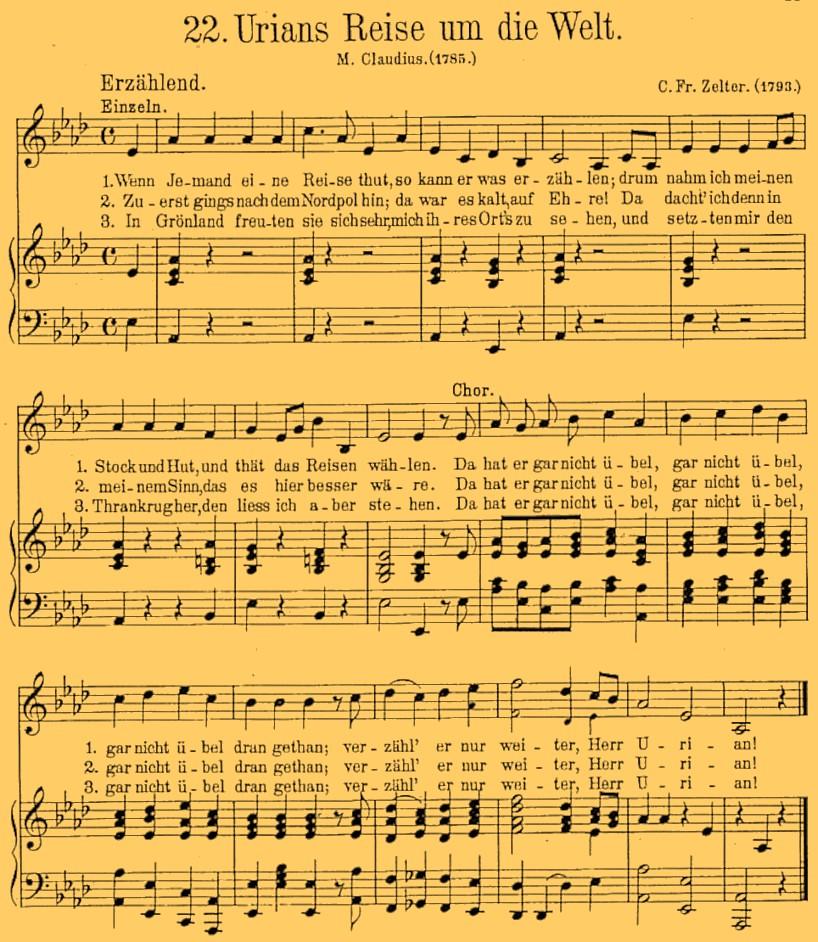
[2] These verses constitute the refrain from Matthias Claudius, “Urians Reise um die Welt,” in the Musen-Almanach für 1786, ed. Johann Heinrich Voss and Leopold Friedrich Goeckingk (Hamburg 1786), 166–71, a poem later set to music by Beethoven (Op. 52/1). The famous first stanza with refrain reads:
Those who choose a trip to take
A tale will surely have to tell;
So I myself picked up my staff
And decided to take one as well.
[Refrain:] Well, what a grand idea, good Sir,
Pray continue your tale, Herr Urian!
The poem comically relates a trip round the world during which the author finds that, after all, people are essentially the same everywhere and, indeed, are just as foolish as we ourselves. This popular poem was published as an illustrated children’s boook in 1850 (Urians Reise um die Welt: Ein Bilderbuch für Kinder [Mainz 1850]):
The 1793 composition by Karl Friedrich Zelter was probably the most widespread at the time (reprint: Musicaneo):
[3] Caroline is possibly alluding to passages such as the following from Fingal, an Ancient Epic Poem, trans. James Macpherson (London 1762), 14, part of the purported Ossian legend:
Weep on the rocks of roaring winds, O maid of Inistore, bend thy fair head over the waves, thou fairer than the ghost of the hills; when it moves in a sun-beam at noon over the silence of Morven. He is fallen! thy youth is low; pale beneath the sword of Cuchullin. No more shall valour raise the youth to match the blood of kings. — Trenar, lovely Trenar died, thou maid of Inistore. His gray dogs are howling at home, and see his passing ghost. His bow is in the hall unstrung. No sound is in the heath of his hinds.
Macpherson glosses the passage:
The maid of Inistore was the daughter of Gorlo king of Inistore or Orkney islands. Trenar was brother to the king of Iniscon, supposed to be one of the islands of Shetland. The Orkneys and Shetland were at that time subject to the king of Lochlin. We find that the dogs of Trenar are sensible at home of the death of their master, the very instant he is killed. — It was the opinion of the times, that the souls of heroes went immediately after death to the hills of their country, and the scenes they frequented the most happy time of their life. It was thought too that dogs and horses saw the ghosts of the deceased. Back.
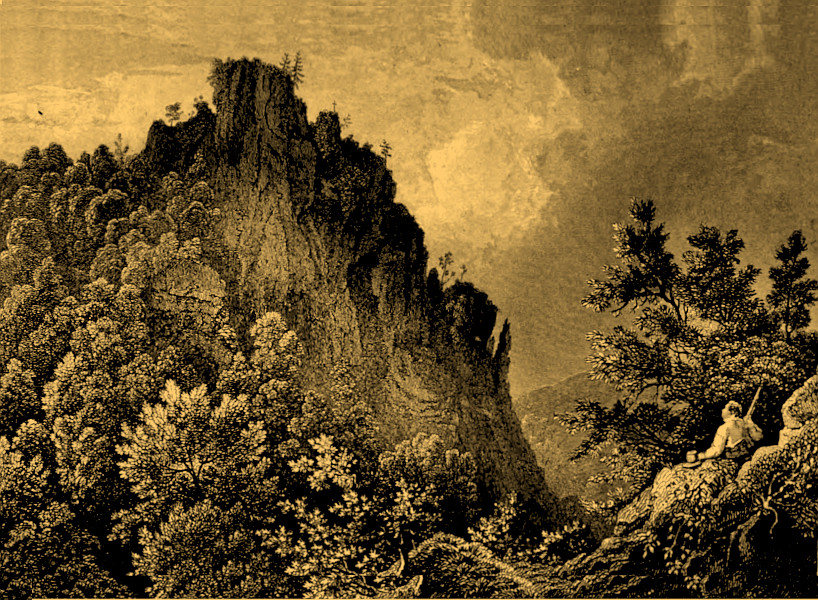
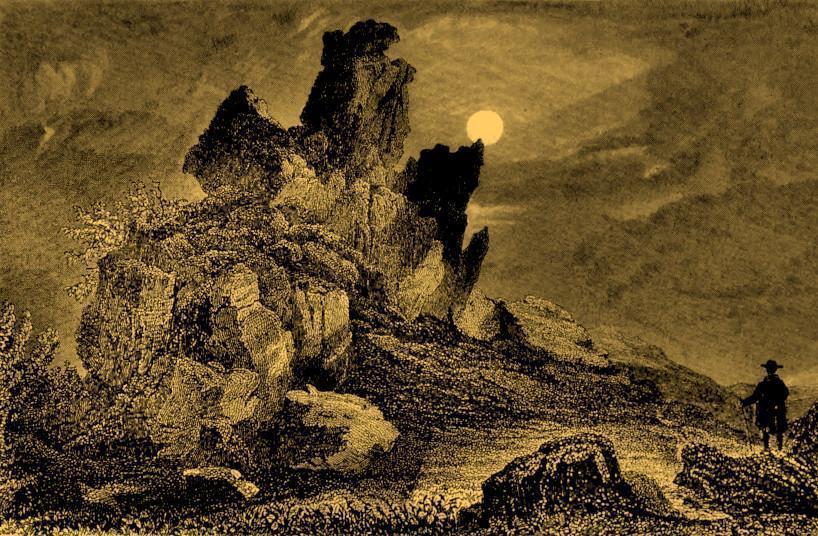
[3a] Caroline’s evocation of Ossian in this context is well taken, since the landscapes of the Harz Mountains can indeed be dark and moody quite after the Ossianic fashion (Wilhelm Blumenhagen, Der Harz, Das malerische und romantische Deutschland 4, 2nd ed. [Leipzig 1847], plates following pp. 34, 72):
[4] Dîner in French in original, as also exécrable, à la Hollandaise, and accent. Back.
[5] Unidentified. Back.
[6] Concerning the Swiss physician Michel Schuppach’s appearance, see William Coxe, Sketches of the Natural, Civil, and Political State of Swisserland; in a series of letters to William Melmoth, Esq; from William Coxe, M.A., 2nd ed. (London 1780), 374–80, here 375 (illustration: Schuppach examining a woman’s urine; B. Hübner [1775], after G. Locher [1774]):
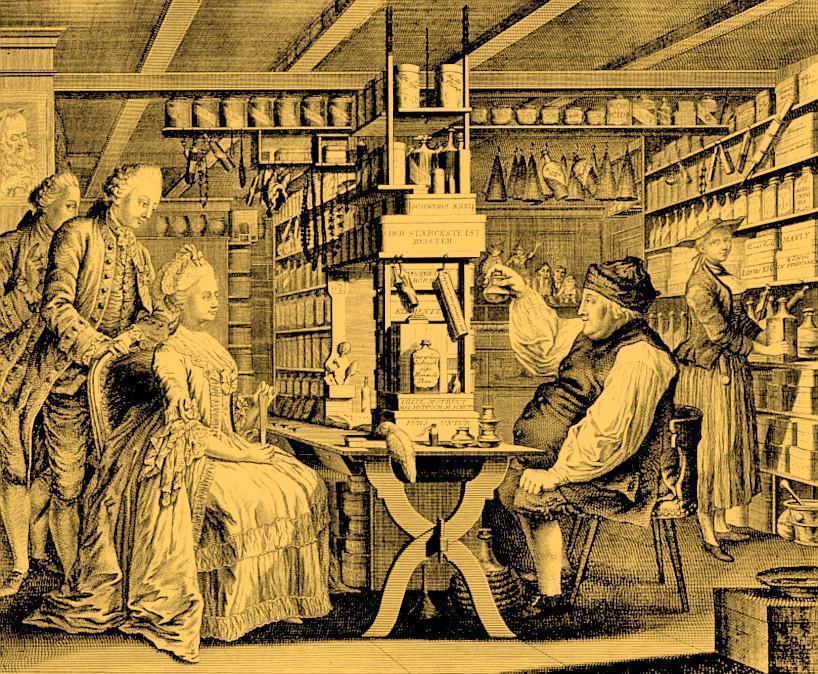
His figure is extremely corpulent; he has a penetrating eye; and one of the best-humoured countenances I ever saw. He sets himself opposite to the person who consults him, one moment examining the water [small bottle of urine each patient brings along], and the next the patient; and continues regarding alternately the one and the other for some time, always whistling during the intervals. . . . In a word, his knack of discovering disorders by urine, has gained such implicit faith in his skill, that one might as well doubt of the Pope’s infallibility before a zealous catholic, as of the doctor’s in the presence of his patients.
Caroline may have been familiar with Schuppach through her husband, who was a physician himself. Apparently Lotte was familiar with his story as well. Back.
[7] Title vignette to Christoph Friedrich Bretzner, Das Leben eines Lüderlichen: Ein moralisch-satyrisches Gemälde nach Chodowiecki und Hogarth, vol. 1 (Leipzig 1790):
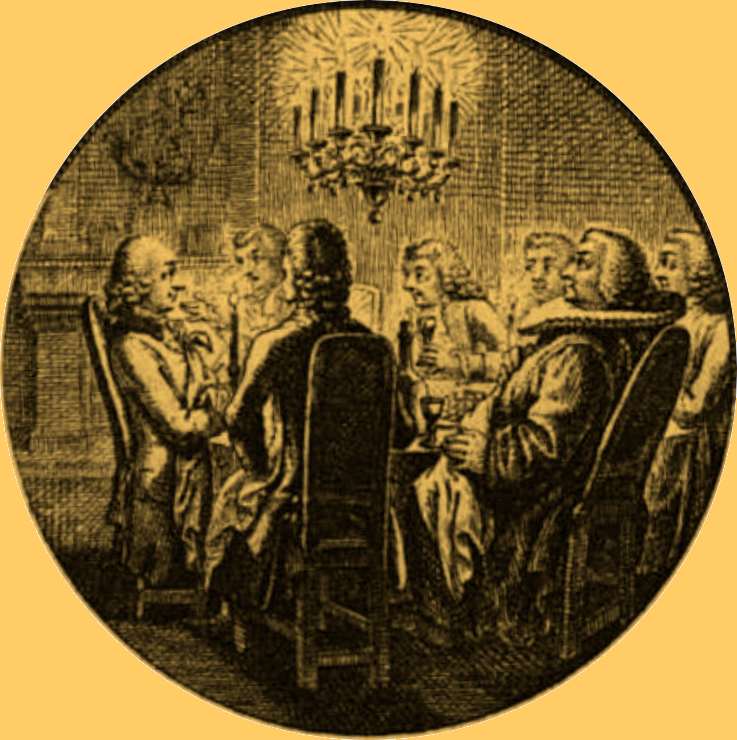
[8] Johann Gottfried Herder, Gott! Einige Gespräche (Gotha 1787), mentioned earlier in Caroline’s letter to Lotte earlier in 1787 (letter 74); see there note 8. Back.
Translation © 2011 Doug Stott