
• 80. Caroline to Lotte Michaelis in Göttingen: Clausthal 1787
[Clausthal] Thursday
6:00 a.m., in bed [1787]
|163| . . . Here is the letter back; let me thank you for relating the news to me. This business of spitting up blood was not really dangerous, was it? Assure me it was basically only as much as when Lovelace wanted to soften Clarissa’s heart, and only as much as was necessary to elicit sweet concern. [1]
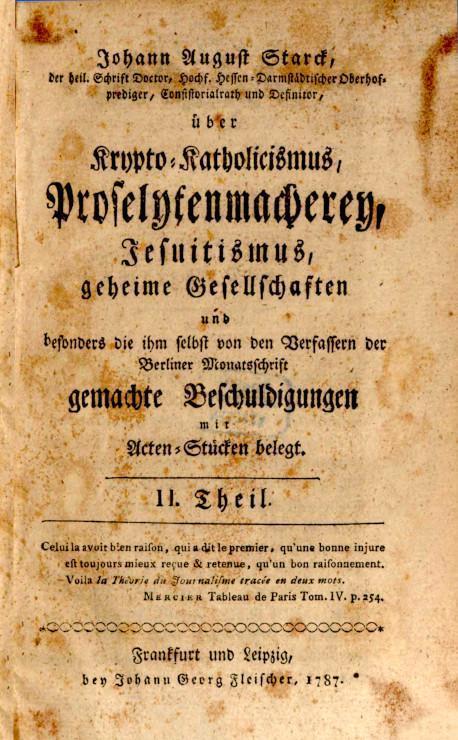
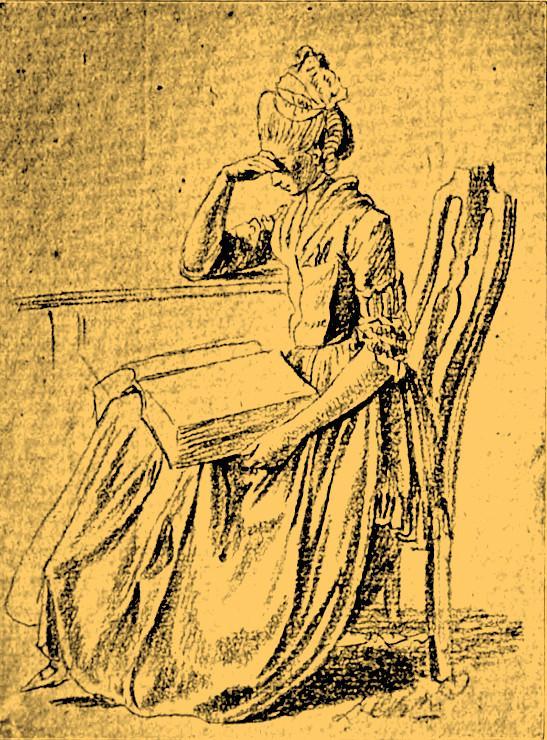
I cannot send along all the books to you. I am currently so absorbed in Stark’s quarrel — the fat second volume of his defense also serves as my table when I am in bed [2] — and even though I am weighing the various accusations and counter-accusations with as much impartiality as possible, I still cannot get a completely clear picture of things.
It seems to me that the Berliners do not go about things quite sincerely or honestly, and instead proceed in a manner that is rather chicaneux [3] and partisan; I do not particularly like them — as far as the main issue is concerned, Stark seems to me to be innocent, though in the lesser, secondary issues not quite so, or at least he has not yet entirely explicated them. Moreover his invectives are quite horrible, and that merely hurts his position because it tends to dégouter, [4] for against adversaries such as these I would otherwise certainly understand every expression of bile without it occurring to me that an innocent person does not really issue such invectives. They might, of course, well bring the innocent person to the point of rage, |164| for do not a child’s words of protestation often get caught in its throat when it wants so badly to answer an unjust accusation and say, “I did not do it.” [5] [Instructions for various errands.]
Notes
[1] Robert Lovelace and Clarissa Harlowe, the two principle characters in Samuel Richardson, Clarissa. Or the History of a Young Lady, 8 vols. (London 1748–49), in a letter from Lovelace to John Belford recounting a scene in which Lovelace uses illness as a means to manipulate Clarissa’s emotions. Concerning Caroline’s familiarity with the book, see her letter to Lotte on 28 March 1787 (letter 77), note 1. For the full text of the letter in question here, see supplementary appendix 80.1. Back.
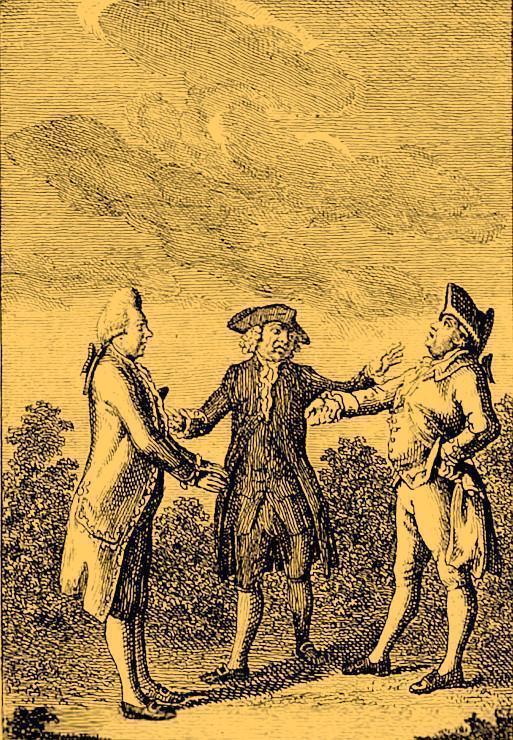
[2] Between 1787 and 1790, the Darmstadt senior court preacher Johann August Starck (or Stark) engaged in a vehement quarrel with Friedrich Nicolai, among others, in connection with accusations leveled by certain members of the Berlin Enlightenment that he, Stark, was a crypto-Catholic (representative illustration: Daniel Nikolaus Chodowiecki, Les Cures des trois Docteurs Doucet, Moellon et Sensé [ca. 1784–88]; Herzog Anton Ulrich-Museum; Museums./Signatur DChodowiecki-Kopie St AB 3.44):
His denial encompassed two lengthy volumes, Über Krypto-Katholicismus, Proselytenmacherey, Jesuitismus, geheime Gesellschaften, und besonders die ihm selbst von den Verfassern der Berliner Monatsschrift gemachte[n] Beschuldigungen mit Acten-Stücken belegt, 2 vols. (Frankfurt, Leipzig 1787). Volume 2, serving as Caroline’s table in bed, came in at over 1000 pages (Daniel Nikolaus Chodowiecki, Lesendes Mädchen, in Chodowiecki, Künstler-Monographien, ed. H. Knackfuss xxi [Bielefeld, Leipzig 1897], 95):
Nicolai weighed in with a piece explaining his association with the Illuminati, Öffentliche Erklärung über seine geheime Verbindung mit dem Illuminatenorden; Nebst beyläufiger Digressionen betreffend Hrn. Johann August Stark und Hrs. Johann Kaspar Lavater (Berlin 1788). See Pamela E. Selwyn, Everyday Life in the German Book Trade: Friedrich Nicolai as Bookseller and Publisher in the Age of the Enlightenment 1750–1810 (University Park, PA 2000), 5n8, 35n21 (brief notes on Nicolai’s involvement with the Illuminati and Elisa von der Recke’s publication against Stark). Back.
[3] Fr., “caviling, petty, quibbling, pettifogging.” Back.
[4] Fr., “cause aversion, disgust, distaste.” Back.
[5] A brief but arguably remarkable document attesting this twenty-three or twenty-four-year-old woman’s interest in and careful, even discerning reading of what even for scholars and erudite laypersons was an at times excruciatingly complicated or even abstruse discussion of slippery philosophical and theological issues, secret intellectual societies, and emotionally charged responses. Back.
Translation © 2011 Doug Stott