
• 7. Caroline to Julie von Studnitz in Gotha: Göttingen, 23[–28] May 1779 (Fr.)
Göttingen, 23[–28] May 1779
|12| While everyone in Göttingen’s fashionable society is getting ready for the ball to be given this evening in honor of Monsieur de Bremer, privy councilor of Hannover, and his family, I will converse with my dear Julie. And since I have found this means of consoling myself concerning my deceived hopes — for during this entire week I believed that I, too, would be attending — I no longer have any desire to do so, and I bear my misfortune with a philosophy that is rather astonishing for a creature like me.
Nonetheless, I cannot entirely suppress the wish: namely, that the weather were not so beautiful and warm today and that my mother were feeling better, those being the principle reasons we are not going. And could you blame me for that, my dear friend? I would have to deny my own character to be so stoic . . .
As for what you say about the rustic life, my dear Julie, I nonetheless share only half your sentiment. That is to say, during the summer I know of nothing more charming than a life like this amid a select circle of friends. But during the winter, when nature is robbed of her charms and seems in mourning, when there is nothing around us but a cultural desert, I cannot honestly respond that I do not then desire to see the town again and be a spectator anew of the different scenes of human life, to |13| divert myself with the unusual people I encounter (for it is indeed necessary that there be such in order that the theater of life itself be a bit diversified), and to exchange the serene, pure air of the country for that of town, which though it does not possess precisely those qualities nonetheless suits me very well.
I have read Emilie et Burgheim, [1] but it seems to me that the author writes too many novels, that he is getting thus spoiled and has developed an inclination for unhappy lovers, something of which I am not particularly fond. In the meantime I do not believe, however, that the character Alten will live very long. He was dispatched against the confederates to that end, and certainly they will dispatch him. As far as Grifberg is concerned, he will be seen safe and sound in the last volume, marrying Friederike notwithstanding his being truly in such great danger at present. But remember that at the end of the first volume Burgheim was in a situation similar to Grifberg’s in the second, and thus I do not doubt that the author, Miller, will find some means to save Grifberg as well.
Ultimately his Siegwart [2] pleases me more even though I do not disapprove of Emilie, and in this latter novel I criticize only the eternally monotonous love, unhappy lovers etc. which has become so insipid to me because I read so many of these things and see it is everywhere the same. I agree that a novel without love would be extremely uninteresting. I simply do not want it to be a question solely of that.
Sophiens Reisen is my idea of one of the best novels one might wish for. [3] —
Good Lord, what scribbling; yet I will make no excuses, for my dear Julie will excuse me when she considers that though I might well have been able to go to the ball today, that is not to be . . . but someone is calling me.
Thus does heaven reward its children! We have changed our minds and will be going after all . . .
|14| 28 May
. . . Besides, I had a very good time. Forster was here but was not part of the group, since he was leaving the same night for Hannover, where he had already sent all his clothes. But Boyé, whom you may perhaps know by reputation, did accompany us. What an extremely pleasant man; he has known me since my earliest childhood, and we renewed our friendship; since he has not seen me for five years, he did find me a bit changed. [4]
Mademoiselle Preissing was here and sang with considerable success; I did not hear her because my mother was sick, but several persons here preferred her to Madam Mara. [5] I believe that is saying a bit too much.
Did you ever notice that Mlle. Preissing resembled me? People here generally find that to be the case. [6]
Madame Schläger writes me that you have Madame Koch there now for three performances. So, you will be going to the theater? There was a time when she herself was certainly not the reason we attended the theater . . .
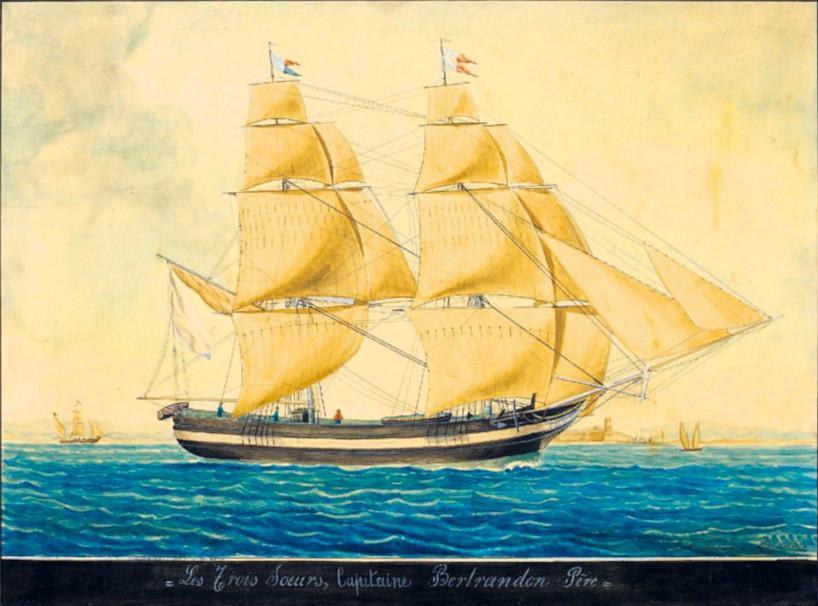
I had myself a ring made with the silhouette of my brother; it is a very strong likeness. He has now left, his vessel is called Les trois Soeurs. He chose it [7] . . .
Notes
[1] Johann Martin Miller’s (according to Erich Schmidt [1913], 1:674: dreary) four-volume epistolary novel Geschichte Karls von Burgheim und Emiliens von Rosenau. In Briefen. Von dem Verfasser des Sigwarts, 4 vols. (Hamburg, Leipzig 1778–79). See similarly Karl Rosenkranz’s review of R. E. Prutz, Der Göttinger Dichterbund: Zur Geschichte der deutschen Literatur (Leipzig 1841), in Jahrbücher für wissenschaftliche Kritik (1842) 28 (February), 217–23, here 223:
Miller surprised his friends with his corpulent novels . . . until finally, in his Karl von Burgheim, he squeezed out the very last tears of rapturous, self-conscious, slushy sentimentalism and libidinous coquetry, after which he promptly fell completely silent.
Click on the image below to open a gallery of the title pages and vignettes for all four volumes along with the, for Caroline’s time, familiarly sentimental and dramatic interior copper engravings:

[2] Miller’s bestseller, Siegwart, eine Klostergeschichte, 3 vols. (Leipzig 1776).
Click on the following image to open a gallery of the title vignettes and interior illustrations by Daniel Nikolaus Chodowiecki from vols. 1–3 of the 2nd ed.:

[3] Johann Timotheus Hermes, Sophiens Reise von Memel nach Sachsen, 6 vols. (Leipzig 1769–73), a long-winded and sprawling but enormously popular moral novel of interest especially from the perspective of cultural history.
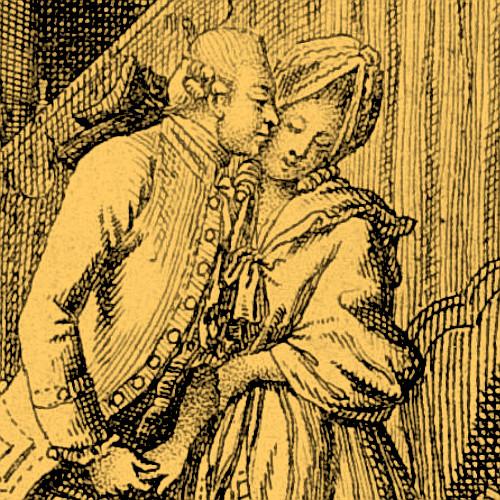
Click on the image below to open a gallery of illustrations to the early editions (Daniel Nikolaus Chodowiecki, Herr Less gibt Sophien einen Kuss [ca. 1777–80]; Herzog August Bibliothek; Museums./Signatur Uh 4° 47 [143]):
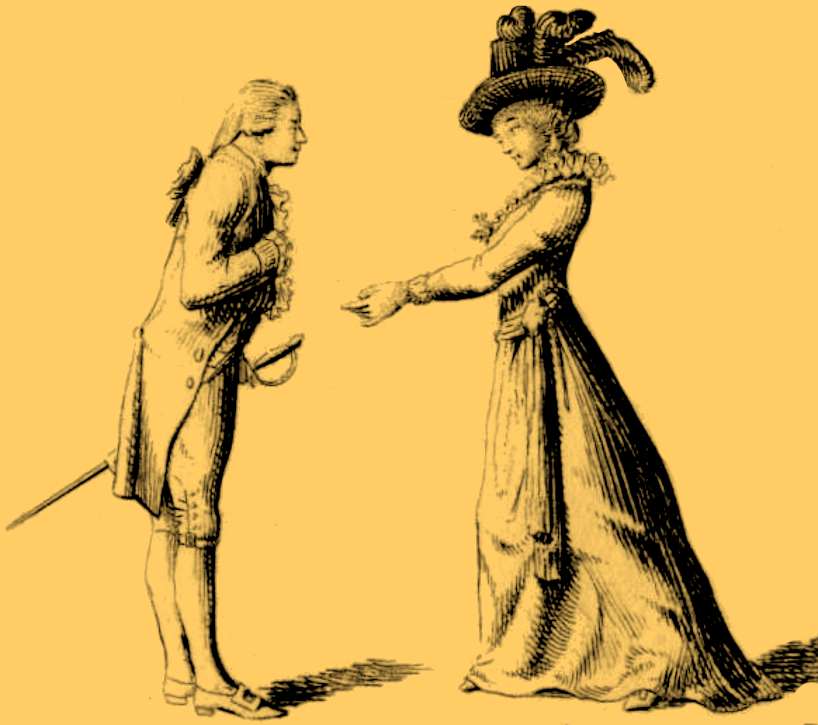
[4] Heinrich Christian Boie and Caroline — who was still three months shy of her sixteenth birthday — must have had a striking conversation about precisely this point, since the very next day, 24 May 1779, Boie himself had already written to Luise Mejer (Ich war wohl klug, dass ich dich fand: Heinrich Christian Boies Briefwechsel mit Luise Mejer, 1777 bis 1785, ed. Ilse Schreiber [Munich 1963], 38) that “Mamsell Michaelis is — a bit wild. She came right up to me without me even recognizing her, an experience I had with others as well: young girls had turned into young women” (Goettinger Taschen Calender vom Jahr 1783; Inhaltsverzeichnis deutscher Almanache, Theodor Springmann Stiftung):
[5] Concerning the singer Gertrud Elisabeth Mara’s performances in Göttingen, see Caroline’s letter to Julie von Studnitz on 7 October 1778 (letter 3). Back.
[6] No straightforward portrait of Sophie Elizabeth Preissing (Preysing), who was said to have an “incomparable voice,” seems to be extant. That said, the existence of but a single straightforward portrait (apart from two silhouettes) of Caroline makes it tempting, with the appropriate caveats, to examine those whom Caroline is said to have resembled, however poor the quality of the illustration or, of course, how distant the resemblance may have been in reality.
The following illustration represents such an edge case, for it does indeed allegedly provide a portrayal of Sophie Elizabeth Preissing in the Gotha theater in the role of Hannchen in the Singspiel Walder, ein ländliches Schauspiel mit Gesang in einem Aufzuge, music by Georg Benda, text by Caroline’s friend Friedrich Wilhelm Gotter after the piece Sylvain by Marmontel-Gretry. The piece had premiered in the Ducal Court Theater in Gotha on Friday, 23 February 1776.
“Mlle. [Mademoiselle] Preissing” as Hannchen [Han̄chen], Walder’s youngest daughter, is the character on her knees in full profile at far right. Walder is seated at center with his hands over his face. His wife, Sophie, has her faced covered and her head on his knee. Hannchen’s elder sister, Dorchen, is on his left in the bonnet (Theater-Kalender auf das Jahr 1777 [Gotha]; Inhaltsverzeichnis deutscher Almanache, Theodor Springmann Stiftung):


[7] Although certainty is difficult to establish in such cases, there was indeed a French brig afloat at this time bearing the name Trois Soeurs; here an undated watercolor by Antoine Roux (1765–1835), Les Trois soeurs, Capitaine Bertrand père:
Translation © 2011 Doug Stott