
• 66. Caroline to Friedrich Ludwig Wilhelm Meyer in Göttingen: Clausthal, Sunday after dinner 1786
[Clausthal] Sunday after dinner [1786]
|142| You recently complained that I would not grant you even a single quill full of ink for all your trouble, [1] and I for my part am angry you do so little justice to my good-natured discretion. But since I now notice that Lotte is doing such a remarkably poor job passing along my messages and requests, providing not even a single answer to any ten of my questions, I find I must intervene personally. She does not tell me whether the books I am requesting are in fact not really there, unless I am to take her silence to mean such. And now several have arrived of the sort I did not request; Moore’s Journeys [2] — why not simply a catechism instead, if it is supposed to be something one already knows by heart? And he is certainly not looking to be witty.
Although you will probably counter by reminding me that selecting books for me is a laborious undertaking, I refuse to recognize at least your reason for insisting such is the case, for precisely in the genre I like to read most there are still a remarkable number of books I have not read — I have absolutely no facility with regard to the titles of books that draw my attention during reading as being something worth noting; they disappear if I do not write them down immediately, so in the future I will begin doing just that; otherwise the ideal of what I would really like to have hovers on the tip of my tongue and I am utterly unable to provide the name.
Les Mémoires de Louise Juliane Electrice palatine par Fred. Spanheim do not seem to be in the library. [3] — So only send me a big, thick history book instead. [4] I like being captivated by a book that holds my interest in an ongoing, connected fashion, and enjoy feeling the urge to keep returning to it. I have a difficult time remembering disconnected pieces, and they do not really entertain me such that, while reading them, I no longer hear the storm roaring outside that brings the spring to us here, as they say, or am not aware of the fog that does indeed take away |143| not only the snow, but unfortunately also any view that we might have out into the open. Gustav was quite satisfactory, and I have also been quite satisfied with Mary Stuart and many others. [5]
You are dealing with a defiant impoverished person, my dear Meyer. But though I be admittedly somewhat extravagant [?] [6] in my demands, I am certainly also such in my gratitude.
Therese wrote to me; she seems to have suffered a great deal because of some indisposition or other of her husband. [7] But I cannot say anything about her, out of the fullness of my own heart I simply cannot.
Stay well.
C.B.
Notes
[1] Meyer worked in the Göttingen university library from early 1785 till the autumn of 1788 and had been at least partially instrumental in securing books for Caroline’s Göttingen friends and family to send to her in Clausthal. Back.
[2] The reference is presumably to John Moore, Abriss des gesellschaftlichen Lebens und der Sitten in Frankreich, Schweiz und Deutschland. Aus dem Englischen (Leipzig 1779; 1785); original: A View of Society and Manners in France, Switzerland, and Germany. With anecdotes, relating to some eminent characters, 2 vols. (London 1779); a continuation published in 1781 (translation 1786) described the Italian portion of the journey. Whether Caroline is requesting the English or German version is unclear from her request (Germ. Reisen); see below concerning her problems remembering titles. Back.
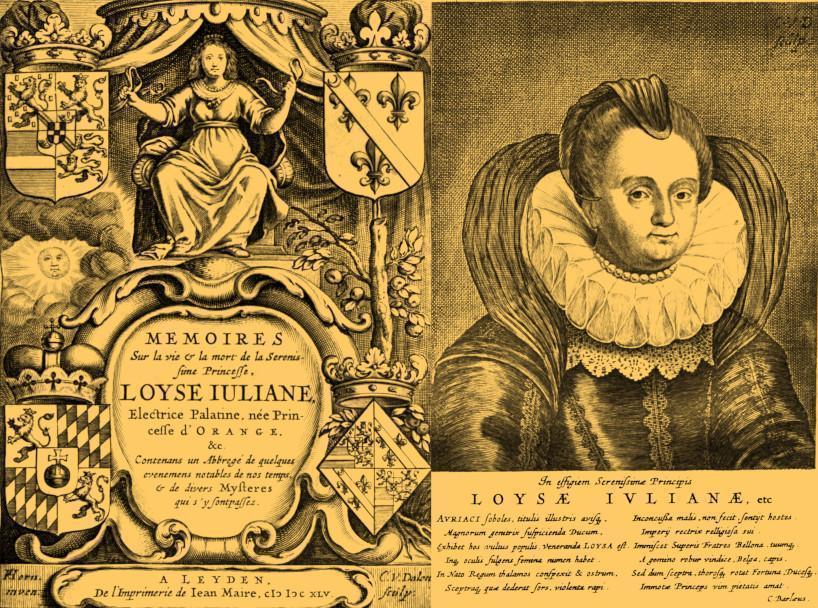
[3] Frederic Spanheim, Memoires sur la vie et la mort de Loyse Juliane Electrice Palatine, nee Princesse d’Oranges (Leyden 1645) (Princess Louise Juliana von Oranien-Nassau [1576–1644], mother of Elector Friedrich V of the Palatinate), whose title page reads: “Memoirs concerning the life and death of Her Most Serene Princess Juliane, Electress Palatine, née Princess Orange, &c.; containing a summary of some of the notable events of our times and of diverse mysteries that happened then” (here the title page vignette and the portrait of Princess Louise Juliana):
Although Spanheim’s book does not seem to have been translated, it did inspire Fanny Elizabeth Bunnett, Louise Juliane, Electress Palatine, and her Times (New York 1862), the latter being reviewed as follows in The New Englander 21 (1862) 3 (July 1862), 641–42 (article xii, “Notice of New Books”) (here the frontispiece):

This little volume, concerning the life and times of the Electress Louise Juliane, will undoubtedly be interesting to those who have read the fascinating pages of Motley’s History of the Dutch Republic. Any one who has followed the course of William the Silent, will be pleased to see how this daughter of his showed in her life very many of her noble father’s traits of character.
Born at a time of great political anxiety, when still at a tender age the terrified spectator of her father’s assassination, this young girl developed a character of wonderful thoughtfulness and enthusiastic love for the religious faith of her father. The good promises of her youth are confirmed and strengthened in her womanhood when she goes to the rude, coarse court of the Palatinate at Heidelberg, as the bride of Frederic IVth, and teaches those rough Germans by her own beautiful example the worth of true, religious character.
Then darker days come, her husband dies, and her unfortunate son loses the Palatinate by striving to be king of Bohemia — still, in her sad retirement the daughter of the Prince of Orange still maintains her cheerful hope and confidence in an everruling providence, and finds her chief joy in attending the sorrows of others, whether of high or low estate. As she lives, so she dies, strong in faith and rejoicing in the glories of the world hereafter. The volume is an interesting record of a noble life, showing that although there was so much to tempt and to dazzle, the Electress was enabled to pursue the simplicity and harmony of a faithful Christian life.
The work does not show much historic research, and in many cases there are serious literary defects, but they will be readily overlooked by those readers who are interested in the principal character of the book.
Caroline also mentions Spanheim’s book in her letter to Lotte Michaelis in late 1786 (letter 72a). Back.
[4] Luise Wiedemann recalls Caroline’s interest in history in her memoirs; see her chapter on Caroline, p. 78). Back.
[5] In connection with letter 72a in this present volume, a letter that in Georg Waitz (1871) (letter 24) and Erich Schmidt (1913) (letter 65) precedes this present letter (letter 66) (concerning the redating of letter 65 to 72a, see the editorial note to letter 72a), Waitz (1871), 1:30n1, wondered whether perhaps the reference was to Friedrich Traugott Hase, Gustav Aldermann. Ein dramatischer Roman (Leipzig 1779) (here the frontispiece):

Schmidt (1913), 1:684, doubted it, suggesting the reference might instead be to a historical piece and referring the reader to Caroline’s mention of Gustav and Mary Stuart here in this present letter (letter 66). Hence the reference to Gustav remains uncertain.
In any event, considering that Caroline has already mentioned John Banks, The Unhappy Favorite; or, the Earl of Essex. A Tragedy (London 1682) (to Luise Gotter, 13 July 1781 [letter 24], esp. note 4), the otherwise unspecified reference to Mary Stuart may possibly be to Banks’s The Island Queens, or, The death of Mary, Queen of Scotland: A Tragedy: Publish’d only in defence of the author and the play, against some mistaken censures, occasion’d by its being prohibited the stage (London 1684); later as The Albion Queens: Or, The Death of Mary Queen of Scotland: As it is Acted at the Theatre-Royal (London 1735).
This remark is more likely an oblique reference to the figure of Mary Stuart in Sophia Lee, The Recess; or, A Tale of Other Times, 3 vols. (London 1783–85); see Caroline’s letter to Lotte Michaelis just before Christmas 1786 (letter 73), note 1. Back.
[6] Erich Schmidt (1913), 143, seems to have been uncertain concerning the reading of this word, whence his brackets. In the Krakau manuscript, the word is indeed difficult to decipher, seeming to lack a syllable and reading “extrag[q?]ant.” Caroline may simply be hastily writing the French term extravagant. Back.
[7] Therese Forster later claimed to have been physically repulsed by her husband, Georg Forster. See her letter to Caroline on 25 February 1794 (letter 142). Back.
Translation © 2011 Doug Stott