
265i. Dorothea Veit to Schleiermacher in Berlin: Jena, 28 July 1800 [*]
Jena, 28 July 1800
It has been too long since I last wrote you, and Friedrich, too, must reproach himself for the same reason.
In the meantime, however, something has happened that will no doubt horrify you. Only imagine, dear Auguste had to serve as an atonement sacrifice for so much guilt on the part of others; she is no more! she died of dysentery on the twelfth of this month in dreadful Bocklet!
A week ago today, after receiving this horrific news, Schlegel immediately hastened to Bamberg, where Caroline had returned from Bocklet, and we alone are now inhabiting the desolate house that was so full of life when I arrived here. The mother is more composed and healthy than seemed possible to us — oh, that woman! [1] —
Whether she returns here or not is a matter of utter indifference to us, of that you can be assured; we are beginning to settle in here in a quite proper, respectable, pleasing fashion; although the Pauluses are still in Bocklet, [2] I can hardly describe for you how encouraging and pleasant it is that these excellent, charming people have taken such an interest in us. Moreover they themselves carry such weight among people here that their example prompts the most favorable consequences in that regard.
Over 40 students have already given their signatures (that is, quite on their own initiative) entreating Friedrich to hold lectures on transcendental philosophy, [3] each day there are more subscribers, and some who would know such things maintain he might have over 100 attendees who pay if the Hungarian contingent remains. [4]
Hence there is not only no reason to fear any sort of cabal, there is every reason to expect it to be a brilliant success. There is simply more one can do with people here than in Berlin, and our earthly hopes are beginning to blossom. The only thing is that for right now we are still short of money!
Please give my warmest regards to Jette, though I myself cannot write her today, since I have a migraine. The tea machine for 5 Thaler? that is a bit too little, since it originally cost 14. If she is unwilling to give me at least 8, let me ask Madam Herz to pack it up in a small box and send it to me, even if through the postal service. [5]
We ask that you really press Fröhlich with regard to the printing and the money. [6] Friedrich cannot write today, he has a great deal to do and also has so many errands to do from and for Wilhelm. In addition, Goethe is here, whom he is visiting quite frequently and who has been quite amiable toward him. [7]
Stay well, my friend; I am so dry that I really have no desire to add anything more. Florentin has not yet been corrected, so please be patient until it is printed and published. [8]
Adieu, adieu.
Dorothea
Notes
[*] Sources: Briefe von Dorothea Schlegel an Friedrich Schleiermacher 83–84; KGA V/4 174–76; KFSA 25:146–47. — This letter documents the date of Auguste’s death and of Wilhelm Schlegel’s departure from Jena for Bamberg. Back.
[1] Dorothea had arrived in Jena with her son Philipp Veit on 6 October 1799.
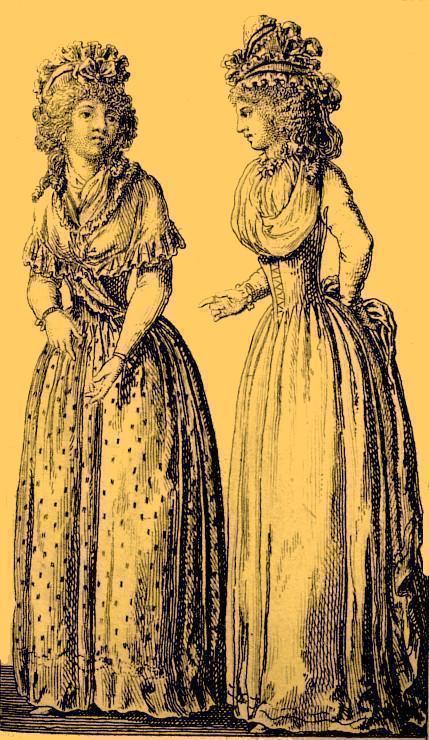
Otherwise, after just seven months together in the apartment at Leutragasse 5 and not quite three months separated, Dorothea and Caroline now entered a period of hostility — albeit essentially at a distance even after Caroline returned to Jena in late April 1801 — characterized by fault-finding and hard feelings; Dorothea especially, as coming letters document, was inclined to continue the back-biting even long after both women had left Jena for good (Goettinger Taschen Kalender für das Jahr 1794; Inhaltsverzeichnis deutscher Almanache, Theodor Springmann Stiftung):
[2] H. E. G. Paulus had taken his wife, Karoline, and daughter, Sophie, to Bocklet for more than a month during July and part of August 1800 (letter from Paulus to Christian Friedrich Schnurrer on 10 March 1801; Reichlin-Meldegg 1:347–50, here 349; see also 350):
During the breaks between semesters, Paulus and his wife and daughter, and later also little Wilhelm, took modest recreational or spa journeys to friends in Stuttgart, to their in-laws in Schorndorf, though also to the house of their friend Marcus in Bamberg, or — because of the health of his beloved spouse — to the mineral-springs spa Boklet north of Würzburg.
(Rudolf Koch and Fritz Kredel, Deutschland und angrenzende Gebiete [Leipzig 1937]):

Bocklet was a small village on the Saale River with steel mineral springs near Kissingen. A visit there was part of a “genteel” lifestyle at the time and was regularly recommended by physicians, whereas today Kissingen, which has in the meantime become so famous, has rather overshadowed its neighbor. Paulus’s wife often spent several weeks here in the company of her family and afterward always felt fortified and renewed by the effects of the springs.
Bocklet promenade by J. B. C. Foerisch, frontispiece to C. J. Haus, Bocklet und seine Heilquellen für Aerzte und Nichtärzte (Würzburg 1831):

[3] Caroline’s description of this entreaty on the part of the students is less flattering to Friedrich; in her letter to Wilhelm on 18 January 1802 (letter 341), she quips that in fact
Carl, who spends a great deal of time among the students, has assured us that they are not at all inclined now to, as it were, commit themselves [to lectures] through subscription. They would far prefer simply to attend on their own, with no further commitment. It would take someone like Winkelmann, a fly who shows up each and every time, to prompt them to come together the way he did for Friedrich; unfortunately, some people here still recall precisely this example with some ill will. Back.
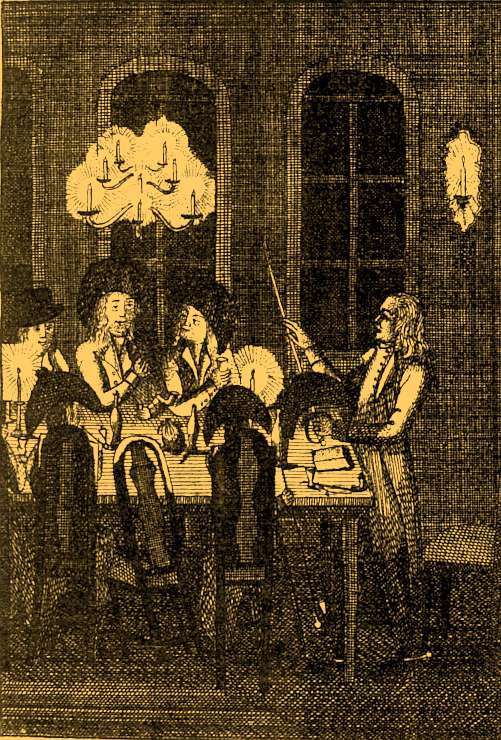
[4] The student body to some extent tended to socialize in associations of students from the same country or even region, both foreign (e.g., Hungary) or within the various circles or regions of Germany in the late-eighteenth century. Here an illustration of such a group celebrating the initiation ritual of the “piercing of the hat” (anonymous, Taschenbuch für Studenten und ihre Freunde [Halle 1797], plate following p. 124):
[5] Because she and Friedrich had already decided to move out of the house at Leutragasse 5, Dorothea was selling or retrieving household items left behind in Berlin. Concerning the move, see Friedrich and Dorothea’s letter to Schleiermacher on ca. 1 July 1800 (letter 264c), note 2, and Dorothea’s letter to Schleiermacher on 4 July 1800 (letter 264d); concerning the household items, see Dorothea’s part of the letter she and Friedrich wrote to Schleiermacher on 5–7 July 1800 (letter 264e). Back.
[6] The printing of the final overall volume of Athenaeum (it would appear in August 1800) and the settling of accounts for the volume. Back.
[7] Concerning Goethe’s stay in Jena during this period and Friedrich’s considerable contact with him, see Goethe’s letter to Wilhelm on 12 July 1800 (letter 265c), note 3. Back.
[8] Dorothea’s novel Florentin. Ein Roman herausgegeben von Friedrich Schlegel, vol. 1 (Lübeck, Leipzig 1801) (vol. 2 never appeared). Back.
Translation © 2014 Doug Stott