
250b. Wilhelm Schlegel to Goethe in Weimar: Jena, 22 October 1799 [*]
[Jena, 22 October 1799]
. . . You presumably have already seen the comedy contra Athenaeum performed in Leipzig. Unfortunately, I myself did not arrive until several days after the performance in Leipzig, and all further performances had already been prohibited by Geheimer Kriegsrath Müller. [1]
I am unsure in what capacity the Germans’ lack of wit manifests itself most brilliantly, in their antipathy toward wit as such or in their sympathy for that which is not wit. This play was an incomparable celebration for the Leipzig merchants and their journeymen.
Enclosed you will find the most recent volume of Shakespeare, with the request to pass along the other copies to His Ducal Excellency with expressions of my most humble deference, and to Herr Geheimrath Vogt. [2]
Our friend Tieck has now arrived, and our circle is thus now complete. [3] I am to pass along his kind regards to you. That said, however, your departure from Jena — and we now with no hope of seeing you so soon again among us — is a public calamity for us all. [4]
Stay well and please do not forget us.
Jena, 22 October 1799
AWSchlegel
Notes
[*] Source: Körner-Wieneke 88–89. Back.
[1] August von Kotzebue, Der hyperboreische Esel oder die heutige Bildung. Ein drastisches Drama, und philosophisches Lustspiel für Jünglinge in einem Akt (Leipzig 1799); here the title vignette:
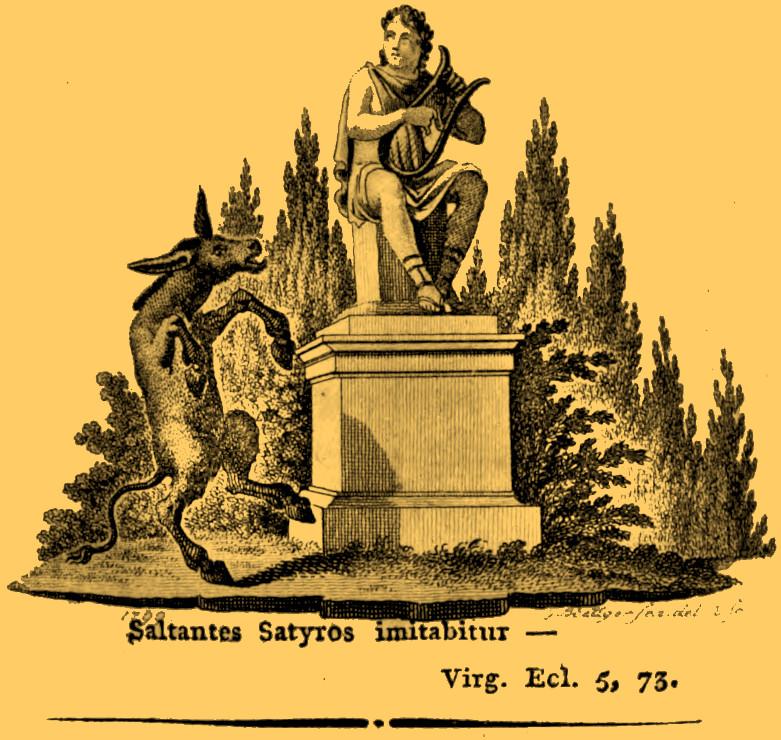
Wilhelm had gone to Leipzig himself on 15 October 1799. Friedrich Schlegel had traveled through Leipzig on his way from Berlin to Jena a few weeks earlier and was able to attend the performance of the hostile play. See Caroline’s letter to Auguste on 21 August 1799 (letter 250) with note 11 and supplementary appendix 250.1. — See Henrik Steffens’s account in Was ich erlebte, 4:264–67:
[Kotzebue] was the author of Der hyperboreische Esel, which was directed against Athenaeum and especially against Friedrich Schlegel. This play was performed in Leipzig and, if I am not mistaken, also in Berlin. Friedrich Schlegel, who happened to be travelling through Leipzig, was himself present. His important stature and the equipoise with which he sat there impressed the members of the audience, and one can say that his mere presence thwarted his adversaries’ intentions.
Although it is undeniable that this assassination on the part of the most flaccid baseness against a significant literary personality deserved the harshest reproach, Kotzebue’s Hyperboreischer Esel would long have been forgotten had it not prompted a poem of the sort that in any case is to be reckoned among the most significant in all German literature, namely, the well-known Ehrenpforte und Triumphbogen für den Theater-Präsidenten von Kotzebue.
This literary response was Wilhelm’s tour de force Ehrenpforte und Triumphbogen für den Theater-Präsidenten von Kotzebue bei seiner gehofften Rückkehr in’s Vaterland. Mit Musik. Gedruckt zu Anfange des neuen Jahrhunderts (Braunschweig 1801), with musical score inserts (one of the songs became quite popular among the children of Jena); reprinted in Sämmtliche Werke 2:257–342 + 4 pages of musical score. References to what became known as Wilhelm’s Kotzebuade recur frequently early in volume two of this edition. Back.
[2] König Johann and König Richard der zweyte (The Life and Death of King John, The Tragedy of King Richard II) appeared in vol. 5 of the edition of Shakespeare (Berlin 1799). According to his diary, Goethe began reading The Life and Death of King John the very next day (23 October) (Weimarer Ausgabe 3:2:266). Back.
[3] The Tieck family had arrived on Thursday, 17 October 1799. Friedrich had arrived on or about 2 September, Dorothea Veit on 6 October, and Friedrich von Hardenberg had already visited from nearby Weissenfels on 28–29 September and would return on 11–15 November. Back.
[4] Goethe had returned to Weimar on the morning of 14 October 1799 after receiving visits from Wilhelm on 12 October and Schelling on 13 October 1799 (Weimarer Ausgabe 3:2:265). Back.
Translation © 2013 Doug Stott