
212c. Henriette Mendelssohn to Wilhelm Schlegel: Berlin, 18 December 1798 [*]
[Berlin, 18 December 1798]
I am doing quite ill, my dear friend, quite ill indeed! I find myself in the saddest mood in the world, and I believe the grief oppressing me has been taken to a higher power still, since I am now morose from my own moroseness. —
Madam Veit left her house yesterday and took the grand, final step toward her happiness. [1] She is serenely looking beyond everything that oppresses her now toward a more beautiful future. Everyone who loves her is happy for her and shares her hopes; yet though I, too, assuredly love her greatly, I was enormously unhappy when she left us yesterday. But, then, I am a timorous creature wholly disinclined to come vis à vis with happiness for fear of glimpsing an unmistakable — “no.” Such happiness has become so accustomed to this peculiarity in my own affairs that it always keeps itself at a respectful distance, scarcely allowing me even to look right or left. —
And now your and Auguste’s cordial letter lies before me here smiling so amiably that I am about to perish from sheer impatience at not being able to come to you straightaway [2] — and perhaps not even this winter. I have been unable to find traveling companions even as far as Leipzig; all my acquaintances shrink from the unpleasant ride. [3] And so I am left with but a single hope; I have heard that Zelter might be planning to come to Jena, so I will speak with him today and if at all possible persuade him to do so. If I succeed, I will celebrate reconciliation with my fate, with my own fate, and you will henceforth discern not a trace of vexation in me.
Only please do not become weary, my dear, dear friend, of hearing me speak so incessantly about my coming, and be so kind as to save me a place at your tea table, of which I think with genuine reverence each and every evening. — You will henceforth hear not a single further indefinite word about any of this. After I have spoken with Zelter, I will send you a cheerful yes — or take leave of you for a long, long time.
I am counting on your friendship as on my most prized possession. I want to do everything I can to gain the love of your esteemed, beloved wife.
A thousand warm regards for my little sister; [4] I am too distracted to write her today myself. With the most disconsolate seriousness I can say with Mercutio, “How I feel, I cannot say.” [5] — Stay well! Your
Henriette M
Notes
[*] Source: Holtei, Dreihundert Briefe, 1:2:171–72. — Although Holtei does not date this letter (“Unknown date”), Friedrich Schlegel’s letter to Friedrich von Hardenberg on 17 December 1798 (letter 212b) mentions that on that very day he would be visiting Dorothea “in her own apartment,” and that in a short while she would be divorced (which happened on 11 January 1799). See also Friedrich to Caroline and Wilhelm on 15 December 1798 (letter 212): “the day after tomorrow will find my lady friend in her own logis.” Back.
[1] Concerning Dorothea’s situation and divorce, see supplementary appendix 210.1. Back.
[2] Königl. Großbrit. Genealogischer Kalender auf das 1786 Jahr; Inhaltsverzeichnis deutscher Almanache, Theodor Springmann Stiftung:

Henriette had for some time been planning to stay with the Schlegels in Jena on her way to Vienna; concerning her decision to try out her independence, see Friedrich’s letter to Caroline and Wilhelm Schlegel on 15 December 1798 (letter 212). Also earlier Caroline’s letter to Friedrich 14–15 October 1798 (letter 204) with note 30. As it was, she seems to have spent only 16 April 1799 in Jena with the Schlegels. Back.
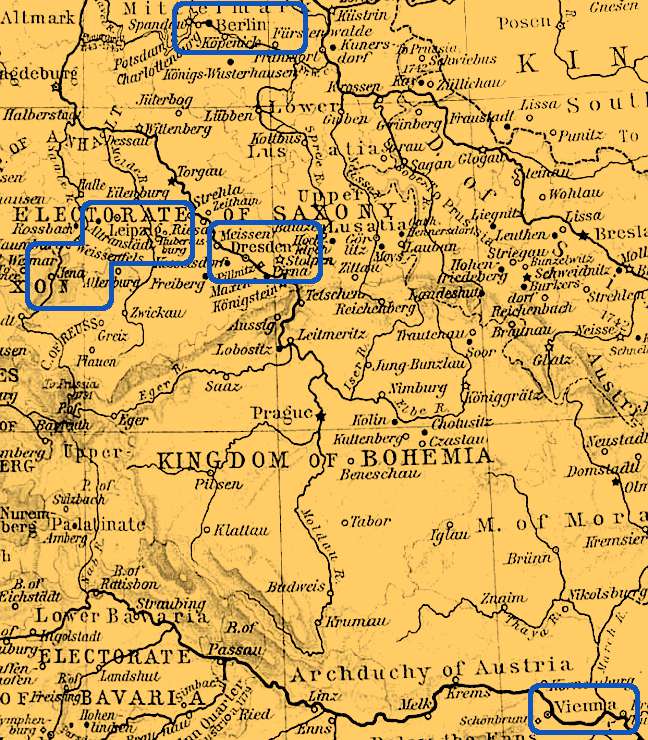
[3] Henriette did indeed have a lengthy journey ahead of her, since Berlin is over 500 km from Vienna, and the stretch between Berlin and Leipzig might even have been one of the easier (W. R. Shepherd, Historical Map of Central Europe about 1786 [1926]; illustration: “Le coche de voyage du dix-huitiéme siécle,” in anonymous, “La locomotion terrestre: Les ancients coutures de voyage,” La nature: Revue des sciences etc. 16 [1888], premier semestre, no. 768 [18 February 1888], 177–79, here 177):

[4] Auguste is referred thus later as well. Back.
[5] Germ., Wie mir ist, sage ich nicht. Obscure quotation, in any case not spoken by Mercutio or anyone else in Romeo and Juliet; perhaps a paraphrase of some of Mercutio’s lines after Tybalt mortally wounds him in act 3, scene 1 (e.g., “Ask for me to-morrow, and you shall find me a grave man”; text: Shakespeare: Complete Works, ed. W. J. Craig [London 1966]). Wilhelm’s translation of the play had appeared in 1797. Back.
Translation © 2013 Doug Stott