
194d. Wilhelm Schlegel to Schleiermacher in Berlin: Jena, 22 January 1798 [*]
Jena, 22 January 1798
Your letter would have been a total delight for me had it not so vividly aroused my concern that you are spoiling my brother in an undue fashion. How else could he have come upon the idea of engaging in his service thus a quill so considerably more witty and intelligent than his own? Had he but summoned you instead merely to make my acquaintance in written form, that is, to write to me with total purposiveness without purpose, rather than pursuing a specific business matter.
In any event, the gain remains for me even if you carry on the correspondence merely as, let us say, chargé d’affaires; for even in this one letter, I have as profit (1) the date, (2) the more dainty handwriting, and (3) the letter itself. I also reckon my brother’s marginal glosses as part of the gain, since he succeeds with such far better than with entire letters, just as he fares better with fragments than with treatises, and with self-coined neologisms better than with fragments. Indeed, in the final analysis his entire genius is limited to mystical terminology. Is it not a truly mystical assertion when he insists that “critical” and “fragment” constitute a tautology? And who, in any case, has given my brother the right to define the word fragment in this way? Hence you are to search for “critical fragments,” unless he prefers to call them marginal glosses, that is, glosses written in the margins of the age — even though we have not trained ourselves behind its back like locksmiths.
That he is having you search for fragments is similarly symptomatic of a topsy-turvy world. You could — and with far less effort and waste of time — doubtless sooner enrich our initial symphony of fragments through far better ones of your own. Alas, this particular presumption on his part is quite in character for someone who constantly offers up his own inner wealth in all sorts of distorted forms while simultaneously searching with unspeakable grief for this or that thought he has lost on the staircase like a pin. [1]
And things stand much the same as far as all that inner wealth is concerned. At first he had an infinite store and could deliver 6, 7, 8 printer’s sheets full. [1a] Now, however, with me hoping for at least a single sheet full, he is hoping to deliver 4 to 5 through some Herculean effort, and I myself fear even that will ultimately be considerably less. —
I think it really uncommonly astute of the young man to have noticed that the whole business of mystification is in fact directed against him. He is in the larger sense what the elder Nicolai boasts about me, namely, “a young man with splendid inborn talent,” and if you are willing to put forth some effort with his upbringing, perhaps something can come of him after all.
What you relate to me about his work on Wilhelm Meister convinces me that he has remained just as he always was. [2] — Indeed, pay attention a bit to the chronology of his works — nothing in the world, of course, can really be exhausted or totally fathomed, and if one leaves him to himself he ends up tunneling and burrowing like a mole, ever deeper — one cannot know when he might genuinely turn up with something, or indeed perhaps show up quite unexpectedly all the way round at the antipode.
Tell him that I cannot break off my work on the “Grammatische Gespräche” just now, [3] which raises the question whether they along with “Wilhelm Meister” and the fragments might not make the first issue too swollen — I will, of course, try to arrange them as briefly and sprightly as possible. [4] I myself still believe that “Wilhelm Meister” and the fragments would suffice for the 1st issue, and for the 2nd (1) the “Grammatische Gespräche,” (2) letters on Shakespeare, [5] (3) “Lessing,” and (4) “literarische Ansichten.” [6] — He, of course, should be thinking about his philosophical Ansichten. Even better: if you yourself might think about them with him as well.
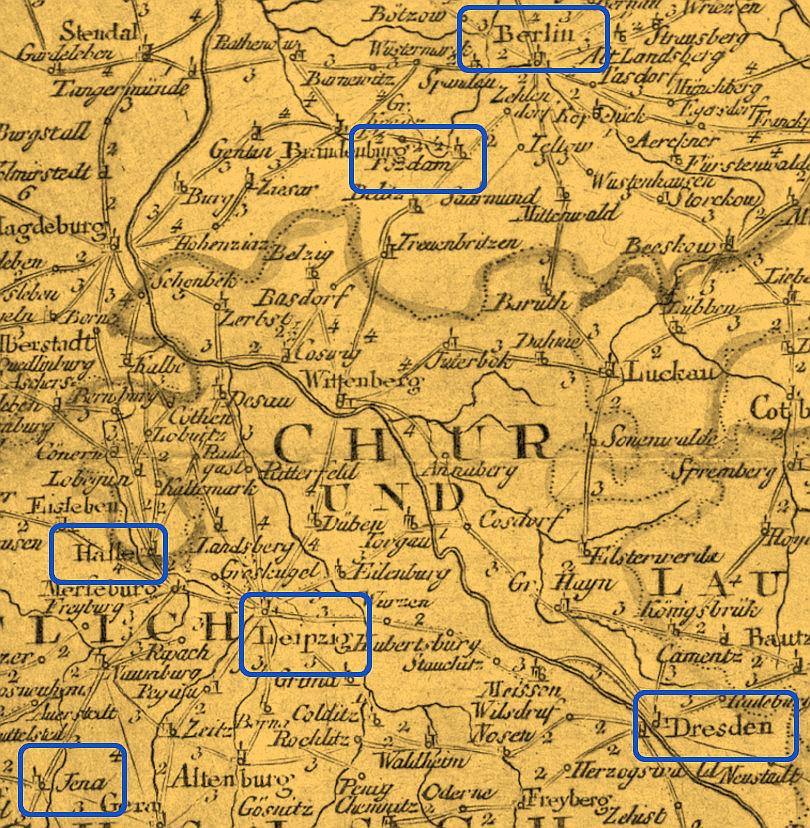
I will write him more about Dresden very soon [7] — today my time is too tight even for this letter to you, though I will get back around to it later. I cannot quite bring myself to sacrifice my own plans for the sake of his obstinacy, especially since a summer in Dresden would be quite beneficial for my wife. If the young man is absolutely opposed to the plan — accommodations together could certainly be arranged — then I must try to get through the summer without him. I want to work on poetry and also write my treatise on style and mannerism in the Dresden gallery. [8] Were I to translate a piece by some tragedian for the journal, we probably would not necessarily need to be together for that — though it would admittedly be preferable. But here he is at fault, and in return he will just have to labor all the more intensively alone on the journal.
I cannot conceal from you my suspicion that you bear no small responsibility for my brother’s disinclination to leave Berlin, and I am greatly looking forward to taking revenge on you when I myself come to Berlin. [9] And I have another bone to pick with you as well, namely, that you refer to my brother simply as “Schlegel,” thereby essentially declaring me to be null and void as far as you are concerned. Well, if one of us is indeed “Schlegel,” then it is doubtless I, he then being “Friedrich Schlegel” — that said, I would also graciously accept being called “A. W.” if need be. Though I am not originally the eldest brother, rough Esau has indeed sold the birthright to me, the more gentle brother Jacob, for a bowl of lentils. [10]
Please let me know what he is thinking about Agnes von Lilien; whatever it is, it should not, however, be published — that would be a blunder. [11]
I cannot wholly go along with your windmill metaphor. [12] I find that Eschen is more like a stamping and fulling mill that Voss, as master miller, has set into motion. But let us not be un-Christian with him.
Please forgive these scribblings — it would all be pardonable could I call the entire letter a “fragment.” The bell signaling the departure of the mail has just sounded — hence I commend myself to your gracious correspondence, albeit not through any deed, but through wishes and supplication. — Stay very well.
A. W. Wilhelm
or: Schlegel tout court [13]
Notes
[*] Sources: Aus Schleiermacher’s Leben 3:71–74; KGA V/2:260–64. This letter is a response to the one written to Wilhelm by both Schleiermacher and Friedrich Schlegel on 15 January 1798 (letter 194c). Included because of the dearth of letters from Caroline from this period, its references to the incipient project Athenaeum, and for its droll characterization of Friedrich and, by default, of Wilhelm himself, who is only just becoming acquainted with Schleiermacher.
Chronological note: A couple of days before this letter was written, Caroline’s review of Nonne und Aebtissinn im Wochenbett appeared in the Allgemeine Literatur-Zeitung (1798) 23 (Saturday, 20 January 1798) 183–84. Back.
[1] Representative illustration: Georg Steinhausen, Geschichte der Deutschen Kultur (Leipzig, Vienna 1904), 698):

[1a] Friedrich had mentioned these figures in a letter to Wilhelm on 1 December 1797 (KFSA 24:51–52). Back.
[2] The essay that eventually became “Über Goethe’s Meister,” Athenaeum (1798) 323–54 (KFSA 2:126–46). Back.
[3] “Die Sprachen: Ein Gespräch über Klopstocks grammatische Gespräche,” Athenaeum (1798) 3–69. See Caroline’s letter to Luise Gotter on 25 December 1796 (letter 175), note 9. Back.
[4] “Sprightly” in English in original. Back.
[5] Schleiermacher had mentioned Friedrich’s work on such a piece on 15 January 1798. Apparently Friedrich had decided to postpone it entirely; similarly also with the next-mentioned essays on Lessing and “philosophical Ansichten.” Back.
[6] What eventually became “Beyträge zur Kritik der neuesten Litteratur,” Athenaeum (1798) 141–77. Back.
[7] An allusion to the anticipated summer visit to Dresden; see Schleiermacher’s letter to Wilhelm on 15 January 1798 (letter 194c), note 4. See also map below. Back.
[8] Wilhelm never completed this piece. Concerning style and mannerism, see, however, the final paragraph of Caroline’s letter to Friedrich Hildebrand von Einsiedel on 18 October 1797 (letter 188a), with note 4. Back.
[9] Wilhelm would be in Berlin between ca. 20 May and 30 June 1798, after which both he and Friedrich would be in Dresden (Post Karte Durch ganz Deutschland, ed. J. Walch [Augsburg 1795]):
[10] Genesis 25:29–34 (NRSV) (illustration: Chrispyn de Passe, Esau verkauft sein Erstgeburtsrecht an Jakob [1612]; Herzog Anton Ulrich-Museum; Museums./Signatur CdPasse d.Ä. AB 3.107):
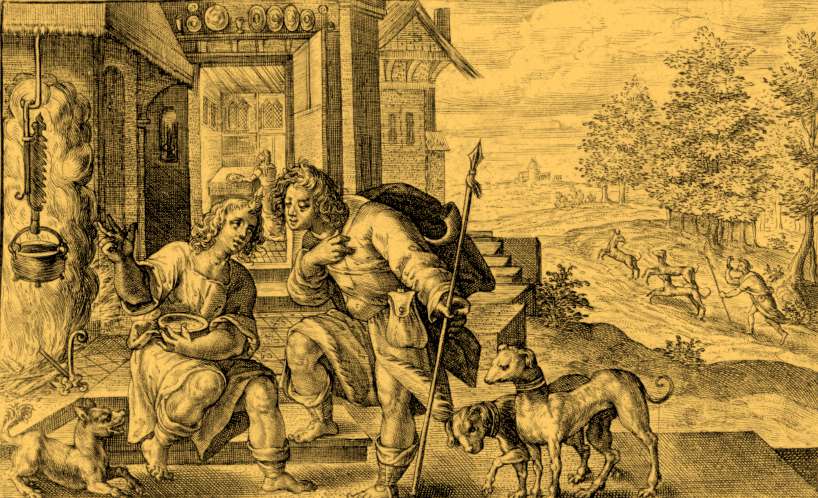
Once when Jacob was cooking a stew, Esau came in from the field, and he was famished. Esau said to Jacob, “Let me eat some of that red stuff, for I am famished!” (Therefore he was called Edom.) Jacob said, “First sell me your birthright.” Esau said, “I am about to die; of what use is a birthright to me?” Jacob said, “Swear to me first.” So he swore to him, and sold his birthright to Jacob. Then Jacob gave Esau bread and lentil stew, and he ate and drank, and rose and went his way. Thus Esau despised his birthright.
Wilhelm’s elder brothers were Moritz Schlegel, Johann Karl Fürchtegott Schlegel, and Karl August Schlegel (who had died in India 1789). Back.
[11] Concerning Agnes von Lilien, see Caroline to Luise Gotter on 12 December 1796 (letter 174) with note 9. Friedrich had already negatively reviewed this novel in “Notiz von deutschen Journalen,” Deutschland 4 (1796) no. 12, VIII, 350–61, here 359–61 (Jugendschriften 2:39–40):
[Concerning the installment in Die Horen, issue 10:] The most significant and attractive among the original essays written in German to be found in Die Horen for some time now is doubtless Agnes von Lilien. It would be premature to pass judgment before the rest of the piece is published [it was published in installments].
Perhaps its remaining parts will clarify and justify some of the elements that, the lofty quality of the rest notwithstanding, are somewhat disconcerting. Such include the often violent transitions, even in the dialogue between the stranger and the cleric, then also here and there an opulent or even cockeyed manner of expression. Another rather striking element are Agnes’s analytical observations on her own illness, on the first intimations of her full womanliness (p. 30), and her preeminent interest in knowledge of the political world (p. 66), whereas at a place where everything would seem to remind her of him, she seems to forget entirely the friend to whom she knows herself to be destined.
Of the two poems (nos. 5 and 6 in issue 11), the first is very frosty, indeed below the freezing point, and the other unclear.
[Concerning the continuation in issue 12:] In this continuation, our charming Agnes has unfortunately moved toward the mediocre, indeed, toward the ordinary. — We have already drawn attention to various maladroit and negligent elements in overall organization and manner of expression in the first installment. Here, however, such elements are so plentiful that we cannot possibly enumerate each individually.
Character development, which in the initial installment did manage to rouse the reader’s interest, has come to a standstill; or rather, the otherwise nicely implemented initial outlines have been confused and obscured by a plethora of petty, disconnected features. The more interesting situations and moments of passion have been squandered with neither a sense of proportion nor a goal, and never utilized with genuine artistic spirit.
By contrast, one’s curiosity is indeed kept occupied; unfortunately, such has become so utterly the main feature that this particular mainspring for all practical purposes loses its elasticity among readers who bring more lofty demands and needs to the piece. The imitation of a familiar model here distracts readers instead of delighting them, since it manifests itself not in an element of beautiful freedom now, but in the weak, passive copying of specific figures. That notwithstanding, however, the story does still have much that is both cogent and attractive, though to be fair given the initial expectations, one can compare it only with itself. Back.
[12] In Schleiermacher’s letter to Wilhelm on 15 January 1798 (letter 194c), also note 3 there. Back.
[13] Fr., “only that much, nothing more,” an allusion to his previous needling concerning his and Friedrich’s names. Back.
Translation © 2012 Doug Stott