
188a. Caroline to Friedrich Hildebrand von Einsiedel in Weimar: Jena, 18 October 1797 [*]
Jena, 18 Oct[ober] 1797
Your piece was no longer new to us. [1] We did not — if you will be so kind as to pardon us — wait for the author himself before becoming acquainted with it, and the copy from your own hand was then but the source of yet another round of enjoyment.
Schlegel will have the pleasure of presenting his own views to you publicly, which in this case will doubtless be a pleasure insofar as the book and its author permit him every possible liberty. He will presumably yet have the honor of discussing it with you in person beforehand. Sometime during the next two weeks I will be traveling to Gotha to pick up Madam Gotter, [2] and Schlegel will perhaps spend that time in Weimar, in which regard he requests that you might introduce him to your duchess on that occasion. —
The request to Madam Gotter has been passed along for now, and I hope we will be able to deliver the manuscript to you ourselves when we pass through. [3]
For me — in your piece you occasionally penetrated so deeply into the theory that I was only just able to comprehend in a larger sense the extent to which you based your views on your own, unique ideas. Ideas that come from within in this way continually awaken others in their own turn, and I would be quite interested in attending a discussion of this matter if one might refrain from asking me whether those ideas were in fact the right ones or the wrong ones. The individual things I did understand, and the piece’s overall style — both in the sense of how “the style of a role” is taken as well as often the extraordinary, beautiful manner of expression — exerted such an attraction on me that I was unable to refrain, as you can well see, from mentioning to you a bit about my own assessment. [4]
Caroline Schlegel [5]
Notes
[*] Source: Werner Deetjen, “Ein unveröffentlichter Brief Caroline Schlegels,” Archiv für das Studium der neueren Sprachen und Literaturen 86 (1929), no. 156, 233–34. Databases listing this letter as having an unknown recipient (e.g., the Goethe-Museum, Düsseldorf, which also holds the manuscript [personal communication Martin Reulecke]) seem not to be familiar with Deetjen’s cogent comments in that regard in his introduction, which follows here:
Caroline Schlegel was one of the many women and girls who stood in some relationship with the charming Friedrich Hildebrand von Einsiedel, senior court marshal for Duchess Anna Amalia. Her own interest in him is attested by her letter to Luise Gotter on 12 December 1796 [letter 174 in present edition], in which she expresses her disappointment at having sat quite close to the Weimar Kammerherr in the theater without, however, being able to make his acquaintance. Soon thereafter as well, on 23 [correct: 25] December 1796 [letter 175], she reports missing such an opportunity yet again: “What crafty purposes of fate are behind all this?”
Caroline then has herself introduced to Einsiedel’s lady friend, Corona Schröter, whom Caroline visits two days later accompanied by Wilhelm Schlegel that he might pay Einsiedel a visit himself. But Einsiedel had just gone out, and when he announced his intentions that afternoon to repay the visit, the Schlegels were already on their way back to Jena.
For the next excursion to Weimar, Caroline resolves to ask her spouse to have himself introduced to the dowager duchess, hoping to make contact with Einsiedel by this route [letter 175 present edition]. Their first meeting took place during the autumn of 1797. Caroline was most favorably impressed by this man whom she had so desired to meet, and he in his own turn sent to her his Grundlinien zu einer Theorie der Schauspielkunst along with “the most charming letter,” which the reicipient, in a letter to Luise Gotter [on 15 October 1797 (letter 188)], characterized as being “remarkably good, a carefully considered piece and quite sensitively expressed.” Her previously unknown letter of thanks reads as follows.
Chronological note: two days after this letter was written, Caroline’s review of Johann Gottfried Hoche’s Des Amtmanns Tochter appeared in the Allgemeine Literatur-Zeitung (1797) 334 (Friday, 20 October 1797) 175–76. Back.
[1] Caroline and Wilhelm Schlegel had acquired a copy of Einsiedel’s anonymously published Grundlinien zu einer Theorie der Schauspielkunst, nebst der Analyse einer komischen und tragischen Rolle, Falstaf und Hamlet von Shakespeare (Leipzig 1797) even before Einsiedel himself sent them a complimentary one; they likely acquired their copy from Georg Joachim Göschen, who had published it in Leipzig. Back.
[2] See Caroline’s letter to Luise Gotter on 15 October 1797 (letter 188); Caroline had been trying for some time to persuade Luise Gotter to visit them in Jena since the death of Luise’s husband, Friedrich Wilhelm Gotter, back in March 1797. Back.
[3] That is, when she and Luise Gotter pass through Weimar on the way back to Jena from Gotha (Post Karte Durch ganz Deutschland, ed. J. Walch [Augsburg 1795]; Rudolf Koch and Fritz Kredel, Deutschland und angrenzende Gebiete [Leipzig 1937]):

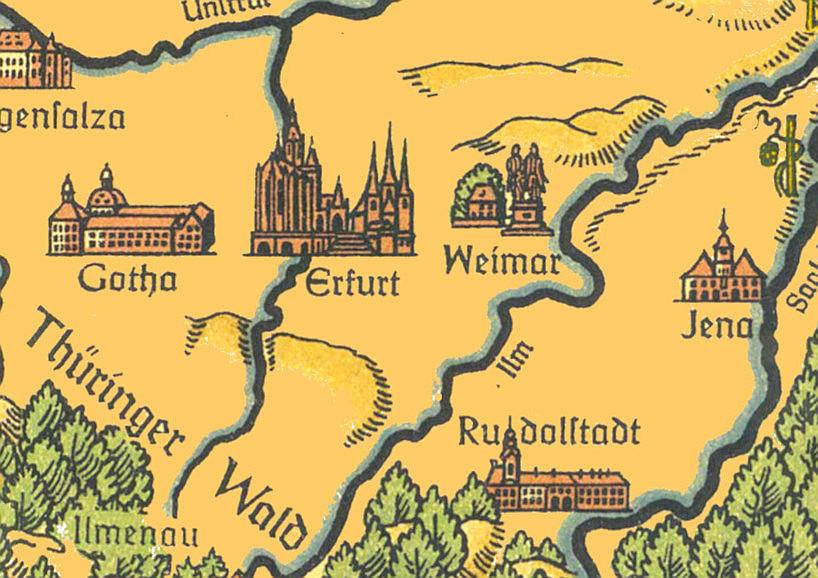
In her letter to Luise Gotter on 15 October 1797 (letter 188), Caroline mentions Einsiedel having requested the return of the manuscript of his play Lothimela, allegedly to be found among Friedrich Wilhelm Gotter’s papers, though nothing more is known about that piece. Back.
[4] Concerning the extended context of Caroline’s words of praise here, and for excerpts from Wilhelm’s review of Einsiedel’s piece in the Allgemeine Literatur-Zeitung, see supplementary appendix 188a.1. Back.
[5] Deetjen remarks by way of commentary at the end of this letter:
Einsiedel intended to expand his book into a complete theory of the art of acting and to publish it accompanied by copper engravings. Caroline interceded on his behalf with Georg Joachim Göschen [16 December 1797 (letter 193)]: “He is basically worth ten times what your other barons are.” But the plan never materialized.
Wilhelm Schlegel, who had already begun his classic translation of Shakespeare, could not but be interested in Einsiedel’s piece because of the latter’s analyses of the roles of Falstaff and Hamlet. Schlegel wrote a thorough review [in the Allgemeine Literatur-Zeitung; see note 4 above] into which he incorporated extensive passages from Einsiedel’s piece while also urging the author to move on to the execution of the larger work.
Deetjen concludes by referring the reader to his article “Der ‘Sturm’ als Operntext bearbeitet von Einsiedel und Gotter,” Jahrbuch der Deutschen Shakespeare-Gesellschaft 64 (1928), 77–89, in which (pp. 88–89) he also discusses the Schlegels’ intercession on behalf of the operatic text Einsiedel produced with Friedrich Wilhelm Gotter. Back.
Translation © 2012 Doug Stott