
• 191b. Friedrich Schlegel to Auguste Böhmer in Jena: Berlin, mid-November 1797 [*]
[Berlin, mid-November 1797]
To Auguste You, [1]
|623| The heart or inner disposition, my dearest You, is the innermost core of a person, what is left over after one has removed the outer covering and hull; [2] it is the most delicate spirit of the soul, and the most tender soul of the spirit. If you could understand this explanation, you would no longer ask about it at all; hence it really is of no use to you after all.
I empathized with your sadness about the Gotters not coming, though that sadness has probably long since passed by now. [3] —
Please write me soon again and let me know that everything is going excellently with your Greek, and send Herodotus. [4]
I am still hoping you will be coming along to Berlin as well. [5] Only insist on it. It absolutely will cost not the least bit more. There are many interesting things here for you to see and hear; and I think it will surely please you. I will see to that myself. |624| And will you not also be just a little bit happy to see me again as well? —
Madam Liebeskind was in Jena for quite a long while. [6] We here did not find her particularly pleasant with her boring personality and her nosiness, except, that is, when she departed, which was quite good of her. She spent a great deal of money and wrote Madam Herz a long letter full of praise for your mother, saying that whereas she formerly knew only her intellect, now she also admires and loves her heart, and all sorts of other tasteless stuff like that. [7]
Stay well, my dearest You, and do not forget
Your loyal
Me.
You can also hear music here of the sort you did not hear even in Dresden. Namely, in the Fasch vocal academy, about which there is something in the 2nd issue of Lyceum. [8] A while back I drank in a magnificent Miserere there. Pure vocal music performed by an extremely large number of very good voices, with the instruments only now and then providing the chords. [9]
I see now that I was mistaken with regard to the Lied. I will probably not be able to get you the one from What You Will. [10]
Notes
[*] Source: Schmidt (1913), 1:623–24 (letter no. 10); Waitz (1871), 1:361–62; KFSA 24:39–40 (with supplementary material). Supplementary material from Otto Braun, “Friedrich Schlegel an Auguste Böhmer,” Das literarische Echo 19 (August 1917), 1376.
Dating to mid-November 1797 following KFSA 24:346n31.1 based on Friedrich’s assurance in his previous letter to her before mid-November 1797 that he would secure a certain Lied from Johann Friedrich Unger as soon as possible, an assurance he retracts at the end of the present letter. — Concerning the textual history of Friedrich Schlegel’s letters to Auguste Böhmer, see supplementary appendix 181d.1. Back.
[1] Namely, you (Germ. formal form of address, Sie) as opposed to thou (Germ. familiar form of address, du). Friedrich touched on this subject in his earlier letter to Auguste in mid-September 1797 (letter 185a) with note 6. Back.
[2] Concerning the notion of “heart” or “inner disposition,” see Friedrich’s letter to Auguste, Caroline, and Wilhelm Schlegel in early November 1797 (letter 190) with note 1, and in connection with Friedrich’s explanations in this first paragraph esp. the fragment from Athenaeum cited in that note; see also his previous letter to Auguste in November 1797 (letter 191a). Back.
[3] Caroline had been urging Luise Gotter to visit them in Jena ever since Friedrich Wilhelm Gotter’s death on 18 March 1797. After several false starts, Luise had canceled the trip yet again; see Caroline’s response to her on 1 November 1797 (letter 189), in which she mentions how Auguste was “absolutely inconsolable” (Berlinischer Damen Kalender auf das Jahr 1802; Inhaltsverzeichnis deutscher Almanache, Theodor Springmann Stiftung):
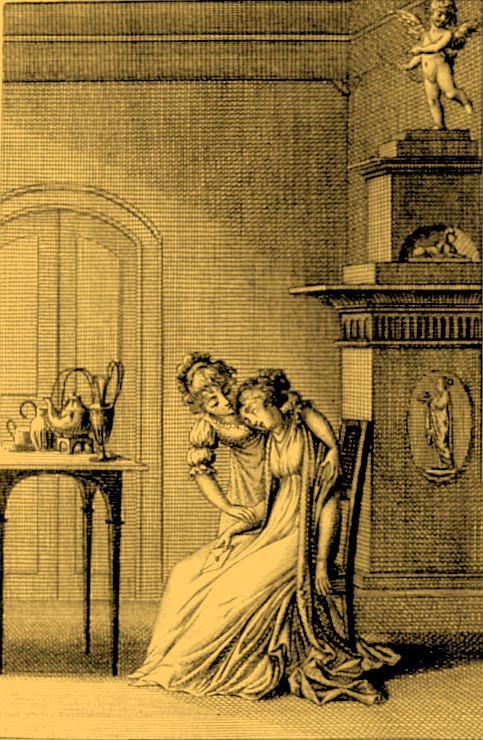
[4] Friedrich was expecting more Greek translation exercises from Auguste from the work of Herodotus, which he would then check; he mentions Herodotus in two earlier letters to her as well, on 26 August 1797 and in mid-September (letters 184d, 185a). Back.
[5] The anticipated “lengthier journey” in the spring about which Caroline speaks in her letter to Luise Gotter on 1 November 1797 (letter 189) (see note 2 there) was originally intended to take them to Berlin rather than Dresden. In that same letter, Caroline mentions that she and Wilhelm had no intention of taking Auguste along on the journey. See also Friedrich’s letter to Caroline on 12 December 1797 (letter 192c), in which he adduces all the reasons Auguste should be allowed to come along to Berlin. Back.
[6] Four days with Caroline; see Caroline’s letter to Luise Gotter on 15 October 1797 (letter 188). Back.
[7] Friedrich realizes, of course, that Auguste will be relating such remarks to Caroline.
Concerning the source of suspicion between Caroline and Meta Liebeskind (formerly Forkel), see Friedrich’s letter to Wilhelm Schlegel on 28 Auguste 1793 (letter 134), esp. with note 14. Back.
[8] The frontispiece of the first issue of Johann Friedrich Reichardt’s Lyceum der schönen Künste (1797) 1, no. 1 (this same issue included Friedrich’s essay “Georg Forster: Fragment einer Charakteristik der deutschen Klassiker”), was the following portrait of Karl Friedrich Christian Fasch:
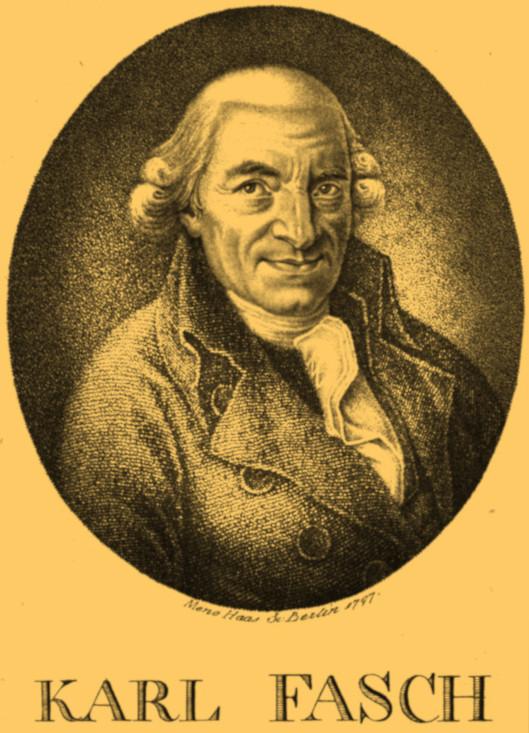
Then in issue no. 2, Reichardt himself published the following appreciation, “Karl Fasch,” Lyceum der schönen Künste (1797) 1, no. 2, 129–32:
Fasch, whose well-executed portrait we offer as a pleasant gift to our readers, is one of the few great artists whose name will not merely pass down to the next century, but whose name — rarer still — will recall not only the renowned artist, but also the noble, beneficent human being.
I have too much respect for the great, modest artist in my excellent friend to attempt to present here, before his eyes, my entire conviction concerning his sublime value; let such be reserved for a lengthier piece on the history of modern music, in which he cannot but occupy one of the most important positions.
I love this most amiable, sincere man, who with the rarest success and skill has managed throughout his life to maintain among the most delicate, refined forms the most perfect honesty and sincerity in so pure a form that not only his close friends trust him and are wont to seek out his bosom on which to rest, but also every person who comes to know him even a little is permeated by both his honesty and his amiability — I love this noble, sincere man much too ardently to linger even a single moment at the prospect that his artistic career might be so close to its end that the historian might with a good conscience take up the quill on his behalf. No, indeed, he will, he must yet live long as a magnificent model for artists; his sublime vitality and unshakeable serenity of soul, which throughout his entire life has so often withstood the harshest attacks and setbacks and provided him with enough courage and strength amid the most serious illnesses never to lose sight of art — such will yet remain with us for a long, long time to come.
Let me instead make do here with adding to the news and remarks I published in the eighth issue of my magazine on the musical arts concerning the grand, sixteen-voice mass — which alone would render the name Fasch eternal — that this rare artist — so he himself might hear and allow to be heard his grand work in an appropriate setting — founded a vocal academy in Berlin that slowly but surely has assembled everyone of both sexes with a pleasant voice to be found among the refined public, an academy that he, with his own powers and without outside support, developed to the point that now many of the greatest and finest singers participate for their own enjoyment, and developed to the point that the whole now provides for genuine friends of the arts the most varied enjoyments, so much so that even the rigorous connoisseur and critic have often enough been satisfied by individual performances, and who, given such loyally continued zeal, can anticipate over the next few years everything that otherwise only well-appointed vocal schools have accomplished, and what the Italian schools, which are always arranged exclusively for a single sex alone, and in which, unlike here, not pure love of art but rather vain and profit-seeking purposes reign, can never accomplish.
I intend to give my readers as precise a description as possible of this vocal academy in my next issue. I wish I could also promise them with equal assurance that this overly modest artist might present to friends of the arts and studious artists alike this masterpiece about which I delivered a few remarks in my art magazine, and might present it, moreover, in its entire, complete form — a form not yet adequately completed in his eyes only.
Johann Friedrich Reichardt Back.
[9] Miserere, a psalm of supplication for mercy, here: set to music, e.g., psalm 51, which begins “Miserere mei Deus secundum magnam misericordiam tuam” (“Have mercy on me, O God, according to your steadfast love” [NRSV]). Back.
[10] See Friedrich’s letter to Auguste before mid-November 1797 (letter 191a) with note 1. Wilhelm Schlegel’s translation of Twelfth-Night; or, What You Will appeared in Shakspeare’s Dramatische Werke übersetzt von August Wilhelm Schlegel, vol. 2, Julius Cäsar, Was ihr wollt (Berlin 1797), in Wilhelm’s edition of Shakespeare. Back.
Translation © 2012 Doug Stott