
• 185a. Friedrich Schlegel to Auguste Böhmer in Jena: Berlin, mid-September 1797 [*]
[Berlin, mid-September 1797]
|619| It is really nice of you to write me as often as you do. Even if I do not answer immediately each time, I am nonetheless quite grateful and would certainly write were it only possible. —
If you have not already done so when you receive this, write immediately and tell me how your mother is doing. I did indeed think especially of her on her birthday, just as you impress upon me to do yet again a week later; [1] but, then, I think of all of you every day in any case and certainly need no special celebrations to prompt me.
I am very pleased with your progress in Greek. How wonderful it will be when I am sitting there with you again someday and reading Greek, with you probably |620| knowing as much by then as I myself. If only your enthusiasm does not wane! something I yet fear may happen. —
I am also very pleased that you are getting so big and are doing so at such a rapid pace, something I can deduce from several different other bits of information and also from the fact that you speak in so bewildering and learned a fashion about “jealousy” and “non-jealousy” and about “I-forget” and “you-forget,” so much so that, quite frankly, it makes me completely dizzy. — I love you, and that is that. We commend it therewith to God, and now do not whine to me about it any further. [2]
Ask Niethammer whether any new issues of the Philosophisches Journal have appeared since the fourth issue, and please get them for me along with the other things.
Please pass along my apologies to Wilhelm. I will absolutely write him a lengthy letter on the next postal day. — Today I am doing so merely to use the opportunity, and am otherwise taking time from extremely pleasant company. —
I will write you about your translation only after I have been able to compare it further and more extensively. I would prefer that you write it out such that I can write my comments in the margins. There is, after all, ample opportunity to send it back. I was quite pleased the last time when a letter came rather than Herodotus again, since I was afraid you had started thinking of Herodotus as a substitute for a letter. — But as far as I can judge thus far, I am quite satisfied with it. [3] —
What you wrote me a couple of times about Lotte made me laugh, but did not surprise me. [4] Most young girls who are as vain and conceited as Lotte are naturally also just as silly, it is simply that they do not put their silliness on display like that. [5] It is, however, delightful that she does so.
Give my warmest regards to Fichte.
It has recently appeared to me, or has recently seemed to me that occasionally Your Royal Impudent Precociousness deigns to pull my leg with regard to my affection for her. Might I request that Your Royal Impudent Precociousness condescend to leave off with such? —
Stay well, my dear child. Considering your rapid progress, when I see you again you will doubtless no longer be a funny middle-thing between a child and a girl, but rather a complete, proper girl. I will then reverently kiss your hand but then immediately also call you by your first name again and with your benevolent permission give you a big hug. [6]
Your Friedrich
Listen, do exactly as your mother does and do not show anyone what you write to me.
Notes
[*] Source: Schmidt (1913), 1: 619–20 (letter no. 6); Waitz (1871), 1:359; KFSA 24:15–16 (with supplementary material). Supplementary material from Otto Braun, “Friedrich Schlegel an Auguste Böhmer,” Das literarische Echo 19 (August 1917), 1376. — Concerning the textual history of Friedrich Schlegel’s letters to Auguste Böhmer, see supplementary appendix 181d.1. Back.
[1] Concerning Caroline’s current health problems, see the editorial note to her letter to Luise Gotter on 7 September 1797 (letter 185).
Caroline had turned thirty-four on 2 September 1797. Back.
[2] Friedrich writes to Friedrich von Hardenberg (Novalis) on 26 September 1797 (Friedrich Schlegel und Novalis. Biographie einer Romantikerfreundschaft in ihren Briefen. Auf Grund neuer Briefe Schlegels, ed. Max Preitz [Darmstadt 1957], 107; KFSA 24:22):
Well, you have finally taken notice of Auguste. Can you comprehend that one can love such a child the way one loves but once, and can do so despite the fact that one is otherwise variously happy, and compared to which everything else is nothing?
Hardenberg had lost his own fiancée, Sophie von Kühn, in March 1797, she being fifteen years old at her death and considerably younger at their engagement. Yet Friedrich’s allusion in the next paragraph of this letter to Hardenberg demonstrates how his remarks concerning Auguste are to be understood as distinct from more sensual and erotic love: “Tonight I am anticipating a beautiful notturno,” viz. presumably with Dorothea Veit. Hardenberg in his own turn was in the process of transforming his love for Sophie von Kühn into a more spiritualized and mystical form of eroticism. Back.
[3] Concerning Herodotus, see also Friedrich’s letter to Auguste on 26 August 1797 (letter 184d), also with note 1b there. Back.
[4] Lotte is otherwise unidentified but may be identical with the “white-armed Lolo” mentioned in Friedrich’s letter to Auguste on 28 April 1797 (letter 181d), though not if the latter “Lolo” is indeed Charlotte Schiller; see esp. note 5 there. Back.
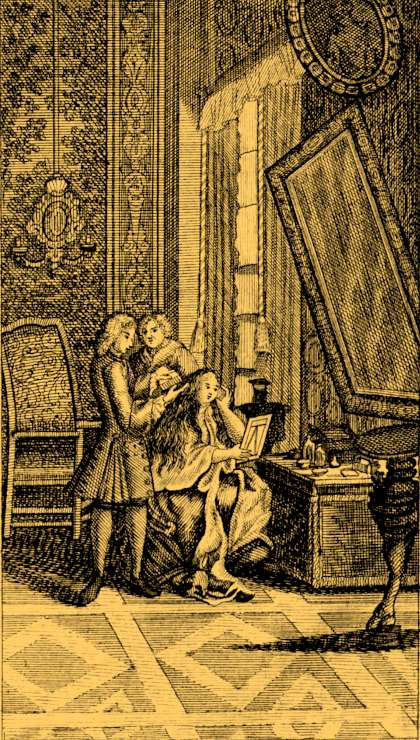
[5] Vanity among girls and young women was a popular topos in moralizing literature at the time (frontispiece to anonymous, Leibdiener der Schönheit Oder neuentdeckte Geheimnisse Von der Schönheit der Frauenzimmer etc. [Leipzig Bremen 1747]):
[6] That is, address her again with the familiar (du) rather than formal form of address (Sie), the latter perhaps with “Fräulein” or “Mademoiselle (Mamsell) Böhmer” (Almanac de Goettingue pour l’anneé 1786; Inhaltsverzeichnis deutscher Almanache, Theodor Springmann Stiftung):

Translation © 2012 Doug Stott