
150c. Friedrich Schlegel to Wilhelm Schlegel in Amsterdam: Pillnitz, 16 June 1795 [*]
Pillnitz, 16 June 1795
Dearest brother, today just a few lines at your departure from the morasses [1] . . .
If you cannot avoid Hannover, then perhaps it is better for you to go there first rather than to appear too obvious in avoiding it. I cannot say much more than that. [2] You cannot, of course, simply pass by the town gates. Moreover, just what effect your visit will have will, of course, depend on you. — I am also convinced you will have no trouble getting our mother to come around. She has hitherto clung tenaciously to her unreasonable ideas, and I hardly know what else to write her without simply repeating what I have already written. Charlotte wrote her an extremely expedient letter that cannot but have a good effect.
Things stand considerably worse, however, with Karoline’s mother. [3] What she has written about the matter greatly concerns me, but also greatly vexes me. The despotic old fool! Does it not occur to her that suffering wrong is often the first step toward committing wrong? I adjure you not to allow such petty circumstances to complicate decisions affecting the rest of your life. You two should lie as little as possible; be preferably coarse instead.
I cannot really make any judgment concerning your suggestion about going to America, [4] since, in your usual praiseworthy fashion, you wrote me nothing about the how, and because I know the country only through a couple of travelogues. If, however, you intend to acquire property without any real knowledge of commerce and finances, the prospects must be extremely reliable indeed. It is, of course, a free country, and that is invaluable. — I believe you view the Roman project too unfavorably. [5] —
Although Karoline is admittedly quite exhausted, her health seems tolerable; her hopes and the springtime are making it easier for her. It would have been lethal during the winter. [6]
My immutable goal will remain to unite with you for a lengthier period, something that may perhaps be possible as early as Easter [17]96. I absolutely cannot be satisfied here in the long run; moreover, my resources here are extremely limited. I am hoping to be far enough along by then that I need not shy away from a lengthier trip and no longer need to guarantee my residence here because of my Leipzig debts, so I am free to live wherever I want. Should it be possible for me to see you earlier for a brief period, that would be the greatest joy that could possibly refresh me in this vale of misery.
Your letter again contains a demi-confidence, [7] something toward which I am as disinclined as I am toward all demi-mesures. But far be it from me to feel anxiety and concern over something that could only vex me were it serious enough. If for the sake of a few hours of pleasure you give Karoline even a single moment of grief, I will hate you. [8] —
In the larger sense, be cautious of any excess of bonnes fortunes. If it comes quite on its own, then it can be a very nice thing indeed. That sort of refreshment, at the proper time, is extremely beneficial, spreading a certain sensuous calm over one’s life, quickening the mind and spirit with renewed serenity and lending to one’s manner a certain element of boldness and elegance not to be underestimated. Routine bestows superiority in all things, yet for precisely that reason is so dangerous here, excess so facile, and even the least thing so dangerous. If vanity is also admixed, and not merely sensuality, there is the danger of losing one’s character. —
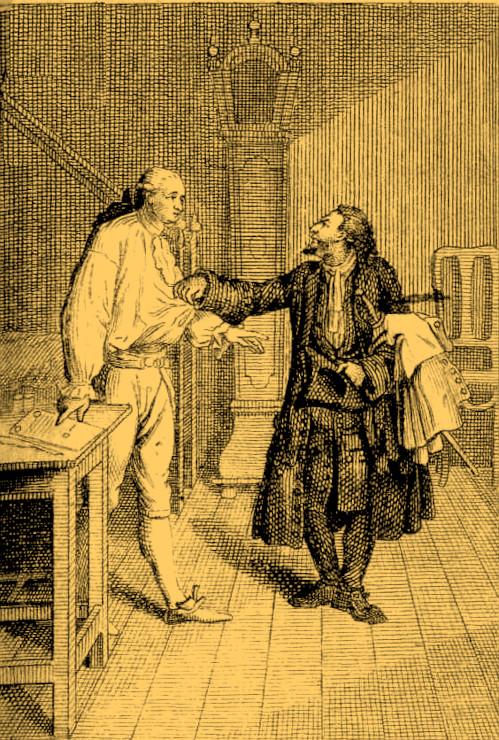
Women will soon be doing with you what they are doing with a certain other Wilhelm, with whom you will become acquainted when you are back in Germany. [9] It is true: bonnes fortunes multiply like debts. And hardly any Jew is as astute in measuring the size of your deficit from your countenance as is an innocent woman in reading the notice of dismissal in your eyes, to which the first innocent woman made her own contribution to the hasty departee. [10]
More anon. Stay very well. . .
Yours always,
Fr. S.
Notes
[*] Walzel, 221–22; KFSA 23:234–35. Back.
[1] I.e., from Amsterdam and the low country in Holland generally. Back.
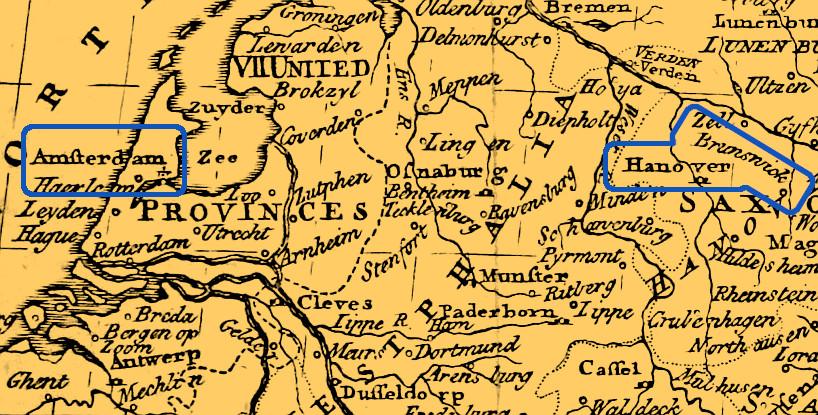
[2] The issue was postponing a visit to their mother; concerning their strategy for addressing her concerns about Caroline, see Friedrich’s letter to Wilhelm on 20 May 1795 (letter 150a). Hannover lay between Amsterdam and Braunschweig (Thomas Kitchin, Germany [n.p., n.d.]):
[3] Caroline’s family never learned of her pregnancy or the birth of son; in any event, Luise Michaelis and her mother were both now living in Braunschweig with Caroline and Auguste. Back.
[4] See Friedrich’s letter to Wilhelm on 20 May 1795 (letter 150a). Back.
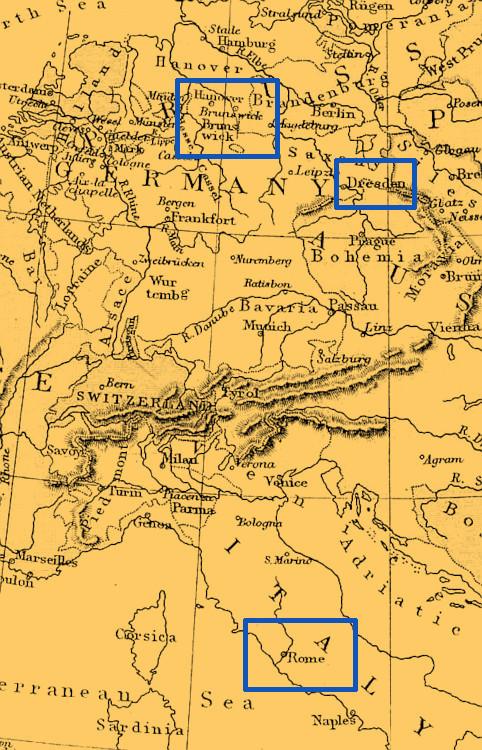
[5] I.e., Caroline’s suggestions (with Friedrich’s concurrence) that they consider moving to Rome (see Friedrich’s letters to Wilhelm on 7 April and 20 May 1795 [letters 148e, 150a]) (“Europe 1740,” frontispiece map to F. W. Longman, Frederick the Great and the Seven Years’ War [New York 1899]):
[6] Friedrich had mentioned Caroline’s health problems in his letter to Wilhelm on 28 April 1795 (letter 149b). Back.
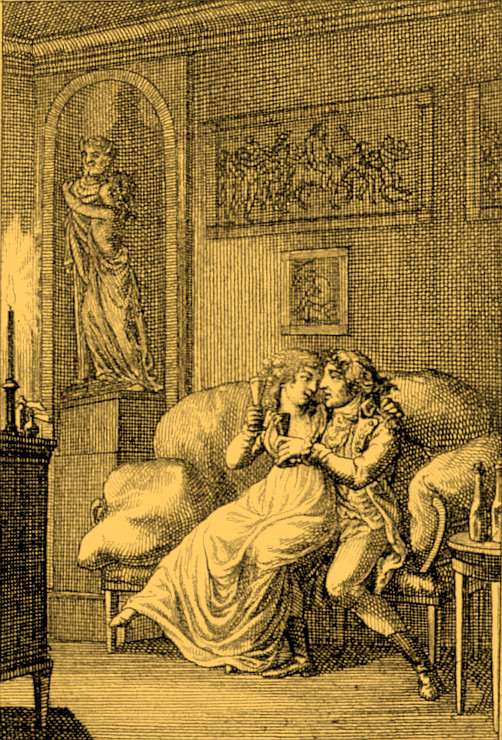
[7] Given the rest of Friedrich’s paragraph, the reference seems to be to a romantic affair (Göttinger Taschen Calender Für das Iahr 1798; Inhaltsverzeichnis deutscher Almanache, Theodor Springmann Stiftung):
[8] In some ways an augur of things to come. In a letter from Jena to Julie Gotter on 18 February 1803 (letter 375), while awaiting the final dispensation of the divorce from Wilhelm, Caroline refers to their marriage as “an alliance that the two of us otherwise never viewed as being anything but completely free. That is the side of my life where fate itself steps in and there can be no talk of culpability.” Back.
[9] Namely, the protagonist in Goethe’s Wilhelm Meisters Lehrjahre: Ein Roman, 4 vols. (Berlin 1795–96). Volume 1 (books 1 and 2) had appeared during the first few days of 1795, volume 2 (books 3 and 4) in mid-May 1795. Back.
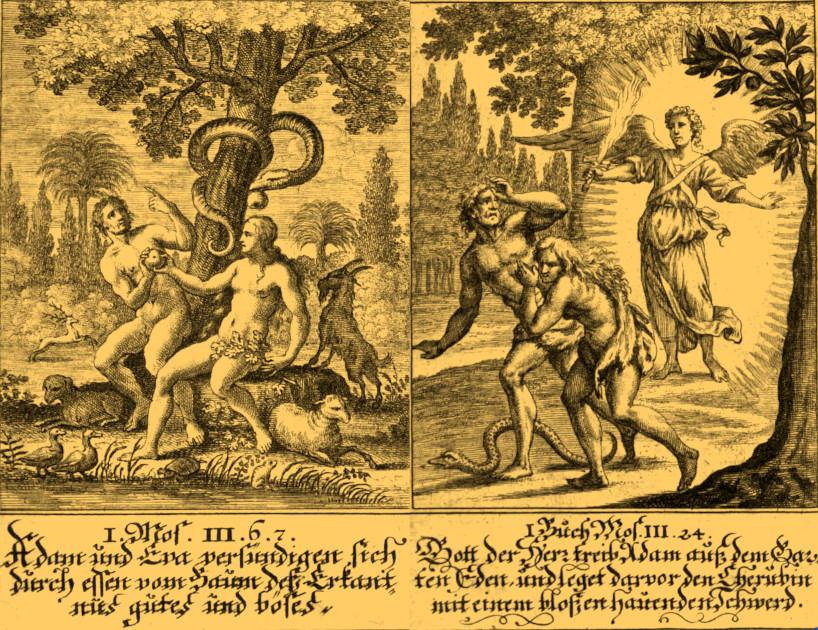
[10] Uncertain allusion, perhaps tongue-in-cheek to the expulsion of Adam and Eve from Paradise in Genesis 1? (Christoph Weigel, Biblia Ectypa: Bildnussen auß Heiliger Schrifft dess Alt- und Neuen Testaments, in welchen Alle Geschichte und Erscheinungen deutlich und schrifftmäßig zu Gottes Ehre und Andächtiger Seelen erbaulicher beschauung vorgestellet werden [Augsburg 1695]):
Otherwise not the last ethnically prompted reference to Jews in this correspondence; here a typical period illustration of a Jew collecting collateral (clothes) against a debt (König. Großer. und Churf. Braunschweig. Lünen. Genealogischer Kalender auf das 1776 Iahr; Inhaltsverzeichnis deutscher Almanache, Theodor Springmann Stiftung):
See also, e.g., Schelling‘s letter to H. E. G. Paulus on 13 March 1806 (letter 401a), with note 1 there. Back.
Translation © 2011 Doug Stott