
150a. Friedrich Schlegel to Wilhelm Schlegel in Amsterdam: Dresden, 20 May 1795 [*]
[Dresden] 20 May [1795]
My joy at receiving your letter, dearest brother, was dampened somewhat by my own impulse to reproach myself for having given you cause for concern in my own letter; [1] but I could do no other, nor did I have any desire to write anything but the absolute truth. If you do not know that Karoline is completely healthy again, and that she has every reason to be satisfied with her new domicile, [2] then it is not her fault, for she has written you several times since then. [3]
Are you also aware that she has a new reason to feel aggrieved and depressed? — Julius died of miliary fever. [4] There is much she can tell herself in the way of comfort and consolation, but nothing that can really help now. How agonizing must it be having to conceal such pain and grief? [5] — I am writing her often; if only I could comfort her, as you ask of me!
You are reacting too sensitively to my mother’s letter and giving the whole matter far more significance than it deserves. [6] You can no doubt calm her down with one or two good letters. You must make allowances for the fact that other people’s opinions considerably influence her, something often enough the case even among people who have more knowledge of the world. In the meantime, since she wrote me approximately the same thing she wrote you, I have tried to do some preliminary work for you by writing her two long letters, albeit with the greatest possible discretion such that you would be quite satisfied if you could read them.
You are being unfair to Charlotte; Karoline’s own letters as well as everything I have related to her have made an extremely favorable impression on her, at least to the extent her way of seeing things allows. Moreover, you yourself know that although most people do indeed have various prejudices, very few really act on them with any consistency. She genuinely was extremely cordial in the actions she took in connection with our plan last autumn. [7] —
The person who spoke with my mother about Madam Böhmer was old Madam Brandes. [8] I am sure it was her because she wrote as much to Charlotte. Perhaps she later asked other people as well, people who would not have spoken about it on their own initiative. It is possible that such was the case with the Rehbergs, who do not have a favorable opinion of Karoline. [9] But, really, none of this should make any difference to you both.
I would urgently advise you to go to Braunschweig first, and then to visit Mother. Depending on circumstances, however, you might have to make do with planning your journey there earlier after your arrival than might otherwise be agreeable. If you go to Mother first, then there will immediately be all sorts of questions, advice, plans, and that sort of thing; given her inclination to imagine the worst, it may well be that you cannot but leave her dissatisfied. —
The other way, not only will you be demonstrating your resolve and securing your independence, you will also, insofar as you need say no more than you want, find it much easier to keep Mother in a good mood by way of pleasant letters and through the prospect of a pleasant visit sometime soon. — It would also be a better choice with respect to your other considerations for you first to get moved and established before taking any trip for pleasure.
I am impatient to hear more specific news about the plan to go to America. [10] I am having a difficult time making sense of it because I believe that country does not really suit you. It would severely cut you off from German literature, whereas Italy would not involve such a break and would also promote your current plans. [11] For you will doubtless find more there on Dante and on the history of Italian poesy than in Göttingen. —
Although your erudition would be valued in any cultivated country, as would your manner of living, I do believe that in America, beauty is quite, indeed extremely subordinated to the utilitarian, and that it is only through knowledge associated with commerce, economics, etc. that one can be successful there. Apart from freedom, which is admittedly inestimable, the country seems to have little to offer in the way of more sublime pleasures.
I entreat you to consider the other plan seriously. [12] You can well imagine that it arose in a head brighter than my own. [13] I cannot help laughing at the foolish way I had to write you concerning it, always considering the constant risk involved in the letter passing through so many hands in the family; I preferred to appear crazy rather than say too much. But you should have sensed the method in this Hamletian madness, and taken into account the reasonable core in making allowances for the raging form. Nor can there be any endless discussions in this regard. Since it is I who will be losing, [14] it is also I who might sooner be permitted to confess to you that I am infinitely in favor of it [Rome].
Let me adjure you two merely to consider everything far enough in advance* [Friedrich’s fn: *it goes without saying that I will grant you both a Saxon grace period [15] for my own delight], and do not allow the pleasant circumstances of the present to make you overlook the true difficulties associated with what is more distant. All the family and civil quarrels would be immediately sundered; otherwise you may perhaps have to put up with such torment. —
By the way, I have no idea what you mean by “unfeasible,” [16] since everything depends solely on your own volition in any case. Moreover, the advantages virtually leap to the fore; no country is as excellently suited to the enjoyment of you both, to your knowledge and talent, your art, your taste, and so advantageous for both of you in terms of living arrangements and getting by. The only significant objection would be the high cost of travel. —
Do not write to Mother as long as you are so irritated; write her when you can be cordial. But all that can be so easily done, to calm a mother whose love for you is so tender, who has the greatest respect for your intellect, concerning something about which she is quite unjustly anxious.
You can imagine how very much I would like to see you as soon as possible. If you two do go away, I would indeed greatly wish to see you again, that is, before any long, second separation. If you stay very long in Braunschweig, then I would prefer to wait until I have both time and money, and then preferably stay a bit longer. In a year or a year-and-a-half I will be able to exchange Dresden for virtually any locale where a scholar can live, and that way we very likely could be together a bit longer if you remain in Germany. Although Dresden would be worth the trouble for you to see, I can well understand you are in a bit of ill humor toward us. [17] . . .
Notes
[*] Sources: Walzel, 216–18; KFSA 23:230–32. Back.
[1] I.e., concern about Caroline’s health; see Friedrich’s letter to Wilhelm on 7 April 1795 (letter 148e). Back.
[2] In Braunschweig, as Friedrich anticipated in letter 148e and confirmed in his letter to Wilhelm on 28 April 1795 (letter 149b). Back.
[3] Caroline’s letters to Wilhelm during this period do not seem to have survived. Back.
[4] Caroline’s son, Julius Wilhelm Krantz, whom she had left behind in Lucka, had died on 20 April 1795, albeit not, as KFSA 23:469n3 maintains, while she was still in Gotha, since Caroline was already in Braunschweig at the time (at least since 15 April; see the itinerary in Caroline’s letter to Luise Gotter on 16 April 1795 [letter 149]).
Concerning the cemetery in Lucka where Julius was likely buried, see the gallery on Caroline in Lucka. Back.
[5] Caroline’s family was unaware of the child or even, indeed, of Caroline’s pregnancy. Back.
[6] The letter Wilhelm’s mother wrote him from Hannover on 19 April 1795 (letter 149a [excerpt]). Back.
[7] Plans to have Caroline move to Dresden or its immediate vicinity. Back.
[8] Likely Marie Friederike Brandes, mother of Privy Cabinet Minister Ernst Brandes in Hannover, or another (elderly?) relative (Ernst Brandes himself never married). One of Ernst Brandes’s sisters, Louise Amalie, was married to Johann Friedrich Blumenbach in Göttingen; yet another, Georgine Christine Dorothea, to Christian Gottlob Heyne in Göttingen (and was thus Therese Huber’s stepmother). Back.
[9] The family of August Wilhelm Rehberg, an extreme conservative with respect to the French Revolution, could not but be prejudiced against Caroline, whose period in Mainz and subsequent incarceration were widely known. Concerning Caroline’s reputation at the time, see her letter to Friedrich Ludwig Wilhelm Meyer on 7 June 1794 (letter 145), note 13. Back.
[10] Mother Schlegel (in August 1795 [letter 152e]) and brother Karl Schlegel (on 23 August 1795 [letter 154a]) express concern later in the summer of 1795 about the apparent seriousness of this plan. Back.
[11] Friedrich had already discussed this plan in his letter to Wilhelm on 7 April 1795 (letter 148e). Back.
[12] I.e., to spend time in Italy, specifically Rome (“Europe 1740,” frontispiece map to F. W. Longman, Frederick the Great and the Seven Years’ War [New York 1899]):
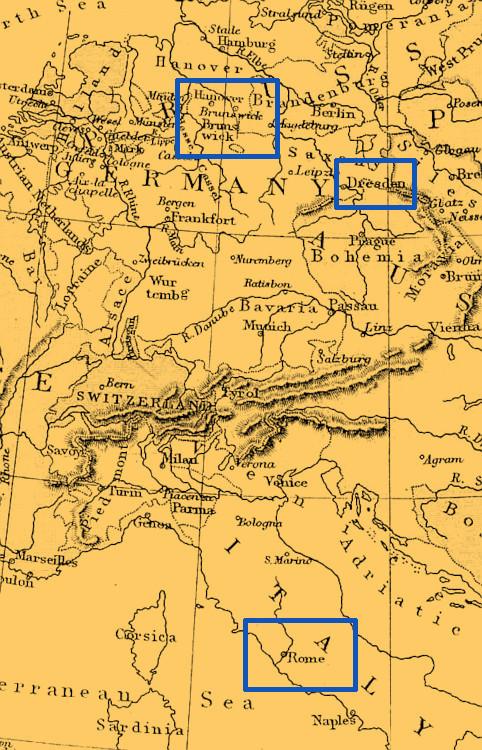
[13] I.e., Caroline’s. Back.
[14] I.e., if Wilhelm and Caroline were to go to America. Back.
[15] From medieval Saxon law, a term of six weeks and three days granted by a creditor to a debtor. Back.
[16] Apparently Wilhelm’s had voiced this objection in his response to Friedrich’s letter on 7 April 1795 (letter 148e). Back.
[17] Because of Caroline’s proscription there (see Friedrich’s letter to Wilhelm on 27 October 1794 [letter 148a]). Back.
Translation © 2011 Doug Stott