
144a. Friedrich Schlegel to Wilhelm Schlegel in Amsterdam: Dresden, mid-May 1794 [*]
[Dresden, mid-May 1794]
. . . I have already been corresponding with Caroline regarding the possibility of living here. — The place is inexpensive, and we will, I hope, easily enough win my sister over to our side. Caroline can go ahead and send you what I wrote her about it. The one difficulty I am unable to assess is the political question, though I do not believe it is of such significance. [1] Another consideration remains, namely, that my sister and the Körners already know everything about our secret and that it is thus of no consequence whether Caroline brings Julius with her or not.
A single man can live here (that is, in Neustadt) for 30 Thaler a year, quite nicely, and for 40 Thaler doubtless very elegantly indeed. I cannot really be more specific than that. I do know someone who for 30 Thaler has 3 very large rooms along with an unheated room on the third story. —
As far as meals are concerned, one can get soup and a very well-prepared meal for 3 to 4 Groschen, in the evening for 2 Groschen. One can choose from several sources; on the whole it is presumably a bit cheaper. So I am very conservatively figuring on 80 Thaler a year. Laundry is extremely inexpensive of the sort I have (2 Thaler quarterly), though admittedly also quiet bad; perhaps for 4 Thaler you can get much better laundry service.
It is difficult to be very specific as far as clothing is concerned. You can figure on ⅔ of what it costs in Lower Saxony; and then one also needs much less. Domestic services for a single man without a manservant are not particularly well organized here. The customary domestic service that comes with logis and is not really adequate is extremely inexpensive. The only thing that is expensive is the coiffeur, 1 1/2 to 2 Thaler monthly. —
I am less able to be specific about Caroline’s needs. — But I do not figure less than 250 Thaler for you. — . . .
The remaining advantages in Dresden as far as you are concerned are great indeed; the beauty of the surrounding area, the art collections, the library. [2] — I view things as being so expedient that I think you should go ahead and give notice to Muilman sooner than later. If you have news concerning the political considerations, I would advise writing to Charlotte — though not to ask whether Caroline ought to come — but to announce that she is coming, and then to ask for her friendship. But you cannot present too unequivocally nor make easy enough what you are actually demanding. —
A veil must remain over the real reason why Dresden is the best or even the only place of refuge, and we can come up with an explanation easily enough. As far as Caroline’s financial situation is concerned, [3] my advice is to let on to Lottchen as if Caroline could live extremely comfortably, and that she would voluntarily restrict herself, both for her child and out of natural inclination. — Do not throw that away.
Fritz
I will prepare Lottchen to receive this letter, how I will do that I already wrote to Caroline.
Notes
[*] Sources: Walzel, 185–86; KFSA 23:198–99. Dating according to KFSA 23:197.
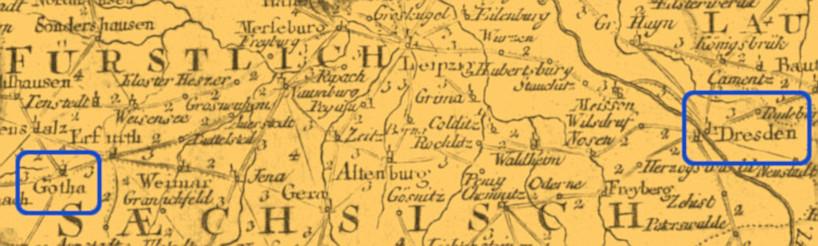
Friedrich, who was living in Dresden, suggests in this letter that Caroline do so as well insofar as the possibility of her and Auguste remaining in Gotha had become increasingly unlikely. Dresden is situated just over 200 km due east of Gotha (Post Karte Durch ganz Deutschland, ed. J. Walch [Augsburg 1795]; illustration: Johann Alexander Thiele, Prospect von der alt. und Neu Stadt Dresden, zu sammt der Brücken ad vivim pinx [1746]):

[1] It unfortunately proved to be of determinative significance; see Friedrich to Wilhelm on 27 October 1794 (letter 148a). Back.
[2] Esp. the Dresden gallery and Dresden Antiquities Collection.
The Japanese Palais in Dresden (originally so-named because of its eastern-influenced roof) was restructured during the years 1782–86 into a museum usui public patens (museum for public usage), and it was here that the antiquities were exhibited during the period when the Jena Romantics visited Dresden (summer 1798). From 1786 the building also housed the royal library from which later the Saxon State Library emerged. Here a rendering of the building from 1839 (frontispiece to Constantin Karl Falkenstein, Beschreibung der Königlichen öffentlichen Bibliothek zu Dresden [Dresden 1839]):

[3] Caroline’s widow’s pension and the support for her son, Julius Wilhelm Krantz (Böhmer), from the child’s father (see Caroline’s letter to Friedrich Ludwig Wilhelm Meyer on 10 May 1794 [letter 144]). Back.
Translation © 2011 Doug Stott