
125a. Luise Michaelis to Wilhelm Schlegel in Amsterdam: Göttingen, 7 May 1793
Göttingen, 7 May 1793
|649| Whatever will you think when you receive this letter? When you see that I, I must write to you in Charlotte’s stead. Does the black seal not prompt your foreboding? She is no more. Dead, torn from us forever. [1] . . .
Since you are already familiar with the various entanglements and circumstances through which Caroline ended up in Frankfurt, [2] I find myself relieved of at least one rather sad task and can immediately move on and relate to you what I myself know and what we have to fear or hope. Although it may yet be a while before she is freed, the hope for a quick — and just — investigation is already of considerable comfort to us. How depressing, how painful to be the bearer of nothing but sad news; never would I have believed such a strange course of events or that I myself would end up being the one to relate such things. But let me refer now to your letter and answer each of your questions in a timely fashion; I hope thus to fulfill all your wishes.
Those of our letters that may be read we have hitherto been addressing to the commandant, Herr von Blaviere at Königstein, who opens them and then passes them on; [3] you can see that one must |650| be very cautious and weigh every word one writes. Letters containing things that should not be read by others we have been addressing to Herr Porsch, though he is leaving Frankfurt; now, however, Massiair [?], [4] whose acquaintance you will remember making during your time here, is in Frankfurt and is also passing along the letters to Madam Forkel from her husband [5] such that he simply gives them to the ladies without being required to show them first, though it is always best that one write nothing involving affairs of state.
Yes, indeed, our good Caroline certainly did not act the way she would have had she been acting with full presence of mind, and I simply cannot comprehend why she did not leave Guntersblum, since they were, after all, alone there; even the Duke of Braunschweig had a letter written to Forkel saying that the officer intentionally left them alone to give them time to get away, [6] and that it was their own fault for not having taken advantage of this opportunity or the one they were given in Frankfurt, [7] and that, by the way, [neither] he nor the king of Prussia was satisfied with the actions of the Prince Elector of Mainz in this matter but had to deliver the prisoners over nonetheless, hence one must appeal to Mainz, so now a letter has been written to Chancellor Albini, to Stadion, who answered today: Herr von Mörs [8] has allegedly already been dispatched to investigate the matter and to ease the fate of the prisoners.
Von Mörs also granted the ladies permission to get fresh air in the castle garden, nor were they forbidden to use quill and ink as was initially to have been the case, but Stadion also writes that my sister would not be released without an investigation, an allegation having been raised by a citizen of Mainz (no doubt Clausius, [9] whom you will recall from Caroline’s own report) |651| that she took an active part in the events that took place there, hence one neither can nor is permitted to release her without an investigation.
Now, if she herself is conscious of not having done these things, as I myself am convinced, it cannot be very long before she is free again. As far as Forster is concerned, I know practically nothing about him, at least nothing specific; [10] you probably already know — and perhaps know in more detail than do we — that he is separated from his wife; also Huber wrote to my mother from Dresten [Dresden] [11] with some suggestions that also concurred with what had already happened. Stadion, by the way, can do nothing and also merely refers us to Albini, and as I mentioned earlier, the elder Böhmer wrote to the latter yesterday.
We told her a thousand times that she ought to leave Mainz, and I know that Tatter did as well, but she could not, and in part did not want to; her fate is now abominable, for her — for her spirit more than for any other woman. She loves freedom and not having to justify every action or every step she takes, and now look at the situation she is in!
I wrote Tatter immediately and prepared an extensive excerpt from your letter for him that he might have a complete overview and see that she was not culpable; I still have received no answer from him, nor do I even know for sure where he is. [12] The last letters I received from him 6 weeks ago were from Rome, but he wrote that he would soon be leaving Rome and that I should address my letters to General Gmelin in Frankfurt, that way they would be delivered correctly, since the general always knows where the prince is currently staying.
Indeed, this blow will be hard for him, especially since he was dissatisfied that she was staying there in the first place and also wrote me that he was no longer permitted to write her as often as both she and he wished because it could wholly discredit him. [13] |652| —
There has also been talk that no investigation would take place until after Mainz were in royal hands. [14] I cannot say for certain whether this has any basis in fact, and we ourselves are still feeling our way in the dark. We are doing everything we can on our end to hasten things along; we are also hoping to receive more certain news by the next postal day, and should this indeed happen I will let you know immediately. If it pleases you to respond to me or if you would still like to have this or that question answered, I am certainly willing to do so and hope I can give you more pleasant news than has been the case in this letter. . . .
I remain your devoted
Luise Michaelis
Notes
[1] Frontispiece to Friederike Helene Unger, Albert und Albertine (Berlin 1804):

Lotte Michaelis had died in connection with childbirth on 2 April 1793. Concerning the circumstances and the resulting scandal, see Georg Tatter’s letter to Luise Michaelis on 27 April 1793 with note 1. Back.
[2] Concerning the course of events, see Caroline’s letter to Friedrich Wilhelm and Luise Gotter on 19 April 1793 (letter 122), note 2. Back.
[3] Hussar Lieutenant Blaviere, commandant at Königstein, is mentioned in a surprisingly positive light in this subsequent account by Dr. Köhler of the horrific abuse of Clubbist prisoners on their trek from Frankfurt to Königstein on 8 April 1793. See B[ürger] Köler [Köhler], “Auszug aus einer Erzählung des B. Köhlers, Professors der hiesigen Centralschule,” Obscuranten Almanach auf das Jahr 1800, ed. Friedrich Georg Rebmann (Paris 1800), 84–93, here 90–92:
I myself was for a time an eyewitness and concerned participant in Blau’s indescribable sufferings, which he bore with exemplary steadfastness. On 8 April 1793 the order arrived from Frankfurt to take the prisoners to Königstein. . . .
We finally arrived in Königstein. All the faces of the upright residents of this small town reflected an element of sympathy with our plight. No one derided us. We were received at the fortress by Mainz soldiers commanded by the Hussar lieutenant Blaviere.
“Herr Comrade,” Blaviere said, “are these the persons whom you wanted to shelter [viz., Blau, Chaplain Martin Arensberger, and Johann Anton Scheurer, who had been subjected to brutal abuse]?” — The Darmstadt native [one of the prisoners] said nothing. — Could a more powerful answer be given? — “Do not be afraid,” Blaviere said, “that my soldiers will abuse you — we are not your judges.” . . .
We were counted. The list contained one prisoner less than were actually present. “What is going on?” Blaviere asked. The Darmstadt native did not know! and no prisoner said a word. — An old Jew, I was told, a native of Frankenthal, was not on the list. His body was swollen and had been beaten black and blue. He had lost his shoes with silver buckles and not been allowed to recover them, so his feet were terribly shredded and bloody from having to walk the entire way barefoot over stones and sand.
Blaviere asked him why he was not on the list, and he responded that in fact he was — not even a prisoner, and that at the Bockenheim Gate the raging mob had pushed him in among the prisoners, that the soldiers — quite deaf to his pleas and explanations — had beaten him the entire four hours between Frankfurth and Königstein, and that he was now afraid he was going to die from the abuse — !!
Blaviere had him put in a cart and driven back to Frankfurt that same day, where on that very same evening he died of his wounds.
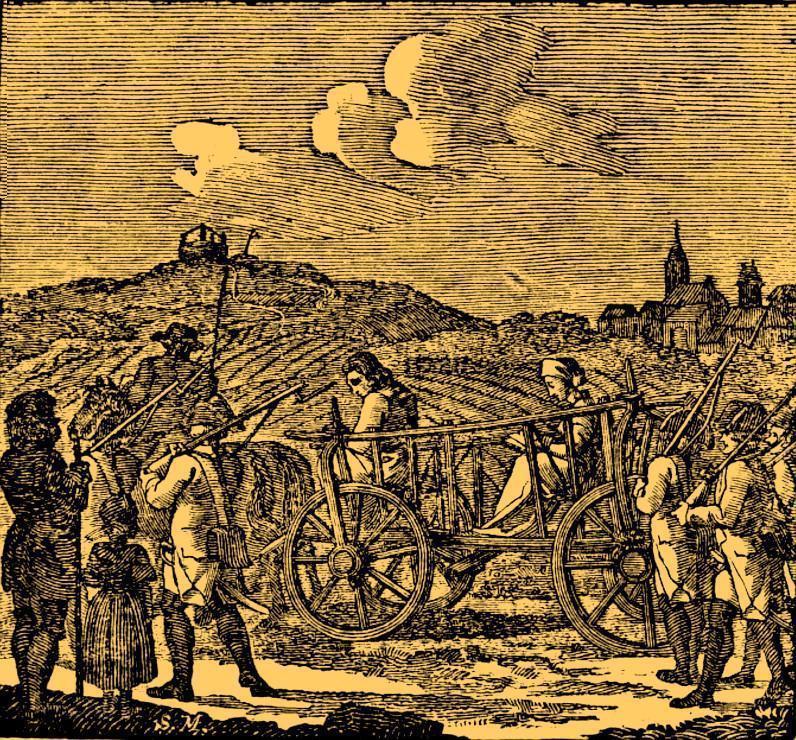
(Schwedtgeburt, Ein Fuhrwerk mit bewaffneter Begleitung [1814]; Herzog August Bibliothek; Museums./Signatur Graph. A1: 1830):
[4] Unidentified; Schmidt, who apparently did not see the manuscript to this letter, picked up the uncertain reading “[?]” from Waitz (1871), 1:376. Back.
[5] Meta Forkel was still married to the Göttingen professor Johann Nikolaus Forkel; they would not divorce until 11 February 1794. Back.
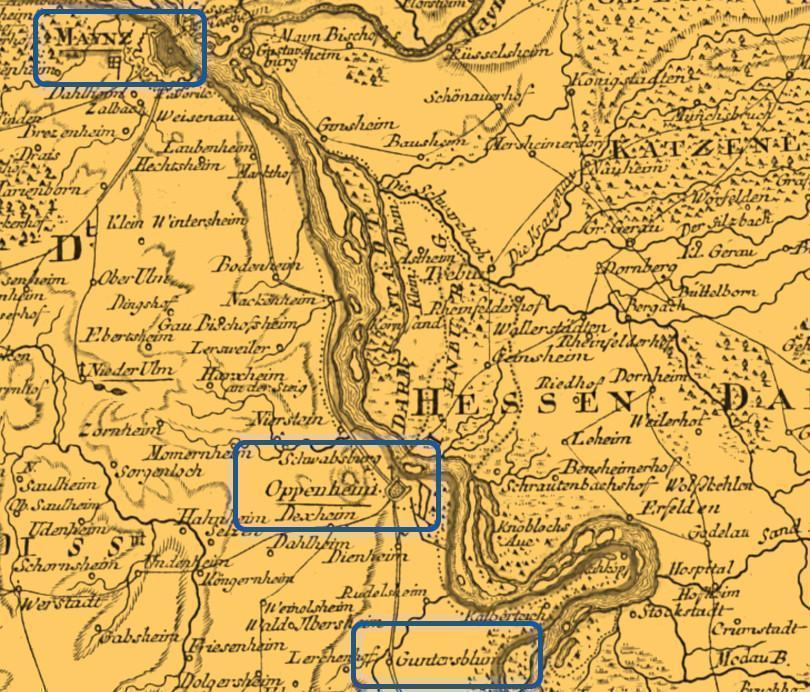
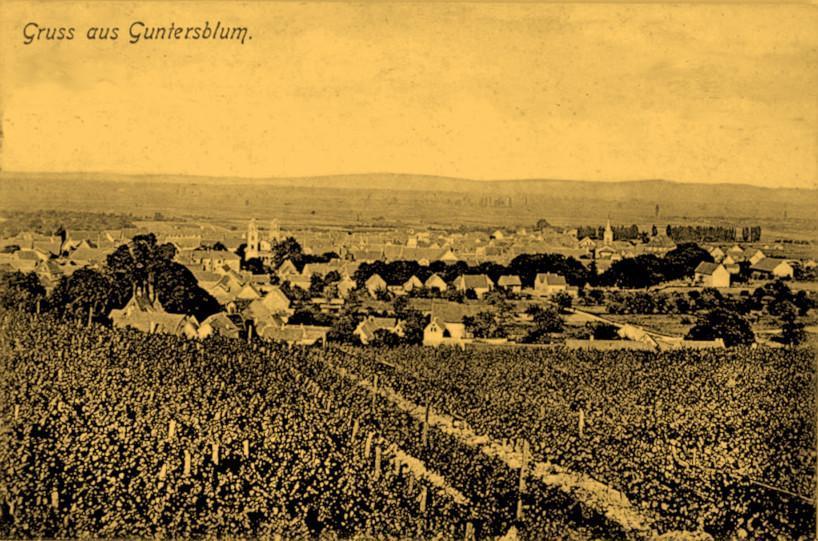
[6] Guntersblum, a town on the left bank of the Rhine River (albeit not on the river itself) between Mainz and Worms, approx. 25 km south of Mainz, shown here with Oppenheim, where Caroline and her companions were (according to Samuel Thomas von Sömmerring [letter 121d]) initially detained (Conrad Mannert, Charte der Laender am Rhein: von Coblenz der Mosel und Lahne südlich bis Mannheim; nach den besten Hilfsmitteln und astronomischen Bestimmungen [Nürnberg 1801]; photograph: 1911 postcard):
It may be recalled that Caroline and her traveling companions were on their way, ideally, to Gotha (to the east) by way of Mannheim further south:
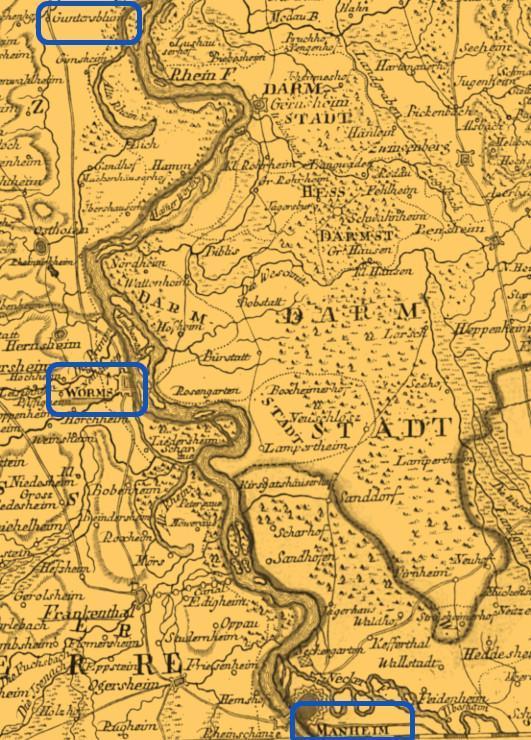
Here the broader route (Post Karte Durch ganz Deutschland, ed. J. Walch [Augsburg 1795])

Luise Michaelis’s letter here seems to be the only documented mention of Guntersblum in Caroline’s journey and could be adduced to contradict Samuel Thomas von Sömmerring’s allegation in his letter to Christian Gottlob Heyne on 6 April 1793 (letter 121d) that the women got no further than Oppenheim. Perhaps the women were allowed to continue under guard from Oppenheim to Guntersblum and then given the opportunity to escape. This point must likely remain unresolved. Back.
[7] Samuel Thomas von Sömmerring, in Frankfurt at the time, remarks similarly to Christian Gottlob Heyne in Göttingen on 8 April 1793 (letter 121e): “It truly pains me that these women did not take my advice and leave immediately, to which end they were even given a day and a half here.” Back.
[8] See Caroline’s letter to Friedrich Wilhelm Gotter on 28 April 1793 (letter 124), note 1. Back.
[9] An otherwise unidentified clubbist who was also arrested and taken to Frankfurt. Back.
[10] Georg Forster had left Mainz for Paris on 25 March 1793, where he arrived on 29 March. Back.
[11] Ludwig Ferdinand Huber was in Dresden clearing his name and seeking his dismissal after falling under suspicion for his ties to the Forster family; Caroline’s letter to Luise Gotter on 24 January 1793 (letter 120), note 2. Back.
[12] Georg Ernst Tatter, who had visited Caroline in Mainz back in September 1792, was currently in Italy with George III’s son Prince Augustus and was being extremely circumspect concerning his relationship or even acquaintance with Caroline lest it compromise his position with the royal family. Back.
[13] See Tatter’s letter to Luise Michaelis from Rome on 11 May 1793 (letter 125c). Back.
[14] Mainz would finally capitulate on 23 July 1793. Back.
Translation © 2011 Doug Stott