
• 125. Caroline to Friedrich Wilhelm Gotter in Gotha: Königstein, 1 May 1793
[Königstein] 1 May [17]93
|286| If you send me an open letter, do not mention the one to Humbold[t] you received [1] — the report sent from here that I mentioned was not from me. If you have something to say to me that is better left for me alone, instruct Porsch to keep the letter until I arrange to have it picked up. [2] They are not allowing any presentations to be sent from here either to the prince elector or to any of the ministers — do whatever you can. You spoke more of the truth than you imagined — namely, that a long period of imprisonment will endanger my life — albeit in a different sense — as you will eventually learn from me in any event. [3] Do not relate this to anyone.
I am, by the way, certainly not guilty — I am sharing the eminently bitter hatred that has been heaped upon Forster. [4] People are greatly mistaken in what they believe concerning my relationship with him [5] — it is for his sake alone that they are insisting on viewing me as a hostage. If it can be of any help, then mention my relationship with a certain German who is, however, currently too far away to help me. [6]
Notes
[1] Concerning Wilhelm von Humboldt’s role in Caroline’s efforts to secure her release, see her letters to Friedrich Wilhelm Gotter on 27 April and 28/29 April 1793 (letters 123, 124), and Humboldt’s own letter to Wilhelm Schlegel in Amsterdam on 25 May 1793 (letter 127a). Back.
[2] Caroline mentions the actor August Heinrich Porsch (not “Franz,” as in Erich Schmidt, [1913], 2:701, 711), who was currently working in Frankfurt, several times later, usually, it seems, as a courier; see also her letter to Luise Gotter on 12 December 1796 (letter 174). Coincidentally, on 2 May 1793, i.e., the next day, he performed the role of Fabrice in the premiere of Goethe’s play Die Geschwister in Frankfurt (E. Mentzel, Das alte Frankfurter Schauspielhaus und seine Vorgeschichte [Frankfurt 1902], 73). Back.
[3] Caroline was now aware of her pregnancy. The Gotters, however, seem never to have learned of it (A. M. Pachinger, Die Mutterschaft in der Malerei und Graphik [Munich, Leipzig 1906], 70):

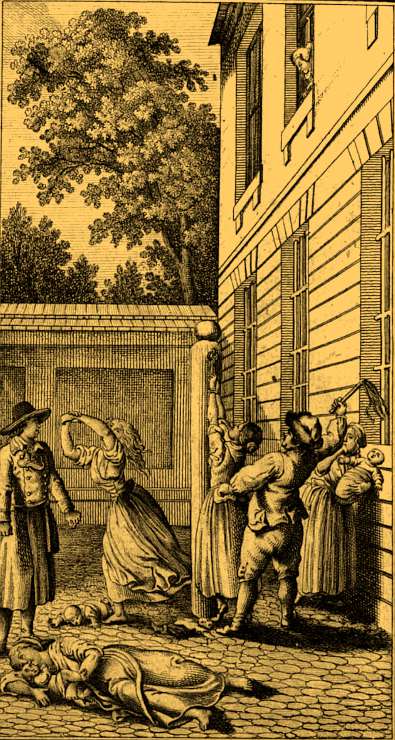
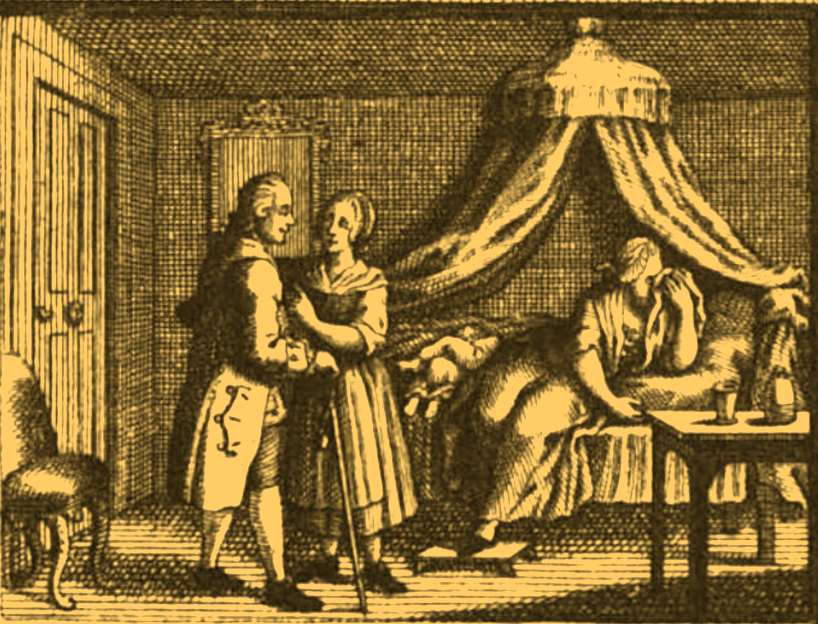
Caroline becomes increasingly, even frenetically desperate and, ultimately, suicidal in coming letters because of the inevitable consequences if her extramarital pregnancy become known, a condition that especially among bourgeois women (as opposed to the aristocracy and lower classes) was laden with moral reproach and had a history of severe consequences ([1] frontispiece to Christian Gotthilf Salzmann, Carl von Carlsberg oder über das menschliche Elend, vol. 1 [Leipzig 1783]; [2] frontispiece to Heinrich Leopold Wagner, Die Kindermörderin: ein Trauerspiel [n.p. 1776]):
[4] Forster was currently in Paris; as emerges later, the idea was to have him redeem Caroline by turning himself in. In the meantime, Emperor Franz II had imposed an imperial ban on him, according to which anyone encountering him on his way to France and delivering him over to the Prussians would received a reward of 100 Ducats. As it was, however, Forster never left Paris. Back.
[5] Namely, that she had been Forster’s lover; see her letter to Gotter on 16 May 1793 (letter 127), esp. the account from the French newspaper Gazette Nationale ou Le Moniteur Universel. Back.
[6] Uncertain allusion, though the likely reference is to Georg Ernst Tatter, who was currently in Italy with a member of the royal family, namely Prince Augustus. As becomes clear in Tatter’s letter to Luise Michaelis from Rome on 11 May 1793 (letter 125c), however, Tatter was unwilling to jeapordize his professional status on Caroline’s behalf and at the time was claiming he did not know where she was; see his letter to Luise Michaelis on 27 April 1793 (letter 123a). Back.
Translation © 2011 Doug Stott