
• 12. Caroline to Julie von Studnitz in Gotha: Göttingen, 17 March 1780 (Fr.)
Göttingen, 17 March 1780
|23| . . . I have received several letters from my brother, and indeed am the only one who has received any. He wrote just as he was embarking on an expedition under General Clinton, an expedition believed to be destined for Carolina (“the blessed land that bears your name,” my brother’s very words, “and where there are more pineapples than we have potatoes”), but since then, the newspapers have reported that the expedition debarked on the isle of St. Lucie. [1]
You will rejoice with me over the defeat of the proud Spaniards and the French loss. You, with your inclination for the English and your friendship for me, and me with my patriotism and my hope of seeing my brother again soon after the war is over. Although people have spoken a great deal here of peace after some of the letters our Englishmen have received, the rumor does not seem well founded. A large contingent of Hessians will be shipped out next week. [2]
|24| At my brother’s request, we have sent him all sorts of things: wine, clothes, medicine, etc. Besides all that, I also sent him, as a present, the celebrated quarrel between Monsieur Kästner and Monsieur Zimmermann in its entirety, with which you are probably familiar. [3] I am curious to see whether Zimmermann will respond once more, or whether he will do what both of them should have done, namely, say nothing. If by chance you might not yet have read it, Madame Schläger will be glad to give it to you. It will no doubt greatly amuse my brother; he asked me to send him from time to time news of all the Göttingen scandals.
Tomorrow we will have the last concert, Graun’s Passion, with the text by Rammler. [4] It is the most excellent and touching musical piece imaginable, and I know you will be quite enchanted by it; I myself am, though I am no connoisseur. I have already heard it several times, and each time with renewed pleasure. During the coming summer we will also be having concerts every fortnight. We are expecting Mademoiselle Preyssing here after Easter. Some of our gentlemen are so taken with her that they have spared no effort in getting her to come. [5]
The nuptials of Mademoiselle Stieler are so close now that I simply do not have sufficient time to make preparations for the journey. Otherwise — ah, my dear Julie, do not believe that I would not have come without fail. It is something that is totally impossible. . . .
Notes
[1] The English had taken the Caribbean island of St. Lucie from the French (the latter’s attempts to retake it failed). In late 1779, British General Henry Clinton prepared for an invasion of South Carolina. Clinton took personal command of this campaign, and the task force with fourteen thousand men sailed south from New York at the end of the year. By early 1780, Clinton had brought Charleston under siege (Charlestown on the map below, with “Sullivans Island and Fort”). Working together with Admiral Mariot Arbuthnot, he forced the surrender of the city on 12 May 1780 with its garrison of 5,000 (Die Vereinigten Staaten von Nord-America nach der von Wm Faden 1783 herausgegebenen Charte, in the Historisch-genealogischer Calender, oder Jahrbuch der merkwürdigsten neuen Weltbegebenheiten für 1784; Inhaltsverzeichnis deutscher Almanache, Theodor Springmann Stiftung):

[2] By Landgrave Friedrich II of Hesse-Kassel; see esp. Caroline’s account to Luise Gotter and Wilhelmine Bertuch on 16 April 1782 (letter 31), with the illustration in note 4 there. Back.
[3] Caroline is referring to the materials published in the dispute involving Abraham Gotthelf Kästner and the famous Hannoverian physician Johann Georg Zimmermann, originally initiated by the latter in the brief anecdote “Liebe für Kästnern,” Hannöverisches Magazin (1779) 39 (Friday, 14 May 1779), 613–14, the allegation being that Kästner allegedly “took pot shots at respectable men.”
The dispute dragged on until Kästner’s final, calm answer in January 1780. Kästner’s open letter of May 1779, Gegenantwort an Herrn Hofrath und Leibmedicus Zimmermann in Hannover (Göttingen 1779) and Zimmermann’s rejoinder An Herrn Hofrath und Professor Kästner in Göttingen. Streitschrift. Hannover, den 28. October 1779 (Hannover 1779) appeared earlier as separate publications.
Aus Lichtenbergs Nachlass. Aufsätze, Gedichte, Tagebuchblätter, Briefe. Zur hundertsten Wiederkehr seines Todestages (24. Februar 1799), ed. Albert Leitzmann (Weimar 1899), 99, 225, includes a lengthy draft Georg Christoph Lichtenberg planned to publish against Zimmermann. Rudolf Ischer examined the dispute in Johann Georg Zimmermann’s Leben und Werke. Litterarhistorische Studie (Bern 1893), 151–52, 319–22 (for text, see supplementary appendix 12.1). Back.
[4] Der Tod Jesu: Passions-Cantate, libretto by Karl Wilhelm Ramler, music by Karl Heinrich Graun (1755). Here the first page of the piano score (C. G. Graun’s Königl: Preuss. Kapellmeister Passions Cantate Der Tod Jesu, piano score, new ed. [Leipzig 1815]):
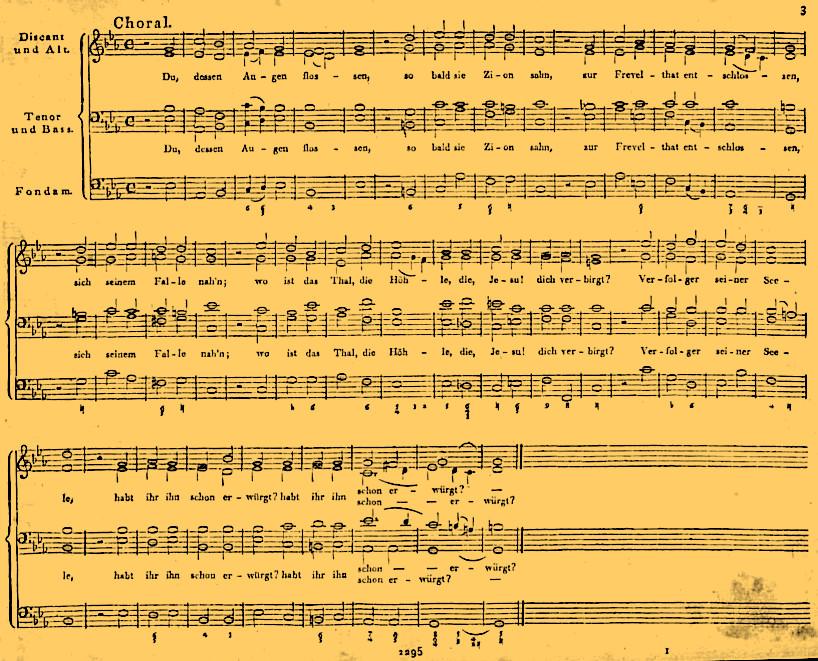
Concerning assemblies and concerts in Göttingen, see supplementary appendix 11.1. Back.
[5] Caroline also mentions Sophie Elisabeth Preyssing in her letter to Julie von Studnitz on 28 May 1779 (letter 7). Indeed, in that letter she mentions that “people here generally find that” Sophie Elisabeth Preyssing (or Preissing) resembled her — Caroline — in appearance. See esp. note 6 there. Back.
Translation © 2011 Doug Stott