
• 89. Georg Ernst Tatter to Friedrich Ludwig Wilhelm Meyer in London: Göttingen, 25 January 1789 [*]
Göttingen, 25 January 1789
|175| . . . [complaints about Meyer not writing him as promised] And on top of it all I was subjected to the annoyance of learning that you are a magician capable of maintaining your hold on certain hearts even across the sea; a diminutive, charming girl with large beautiful eyes pertly comforted me with the words, “I will brook nothing ill said of Meyer,” and there was the end to my bitter lament. [1] . . .
. . . . Have you heard that the dear woman in whose life you have taken an interest has now long since lost her only son? [2] Considerable sweet hopes were buried along with him. She will be leaving us at Easter to move in with her brother in Marburg. [3] I now find it incomprehensible that you knew this woman and indeed had long known her and thus knew what kind of a woman she is — and yet nonetheless appeared no longer to know her here. [4] Lotte is not only a smart, dear girl whom I love very much . . .
Notes
[*] Elise Campe, Erinnerungen, 1:312, cites a letter from Tatter from this same date but does not include this particular passage. The first paragraph here is from that letter of 25 January 1789, the second paragraph is letter 89 in Schmidt (1913) of the same date. Without manuscript evidence, however, there is no certainty these two paragraphs genuinely come from the same letter.
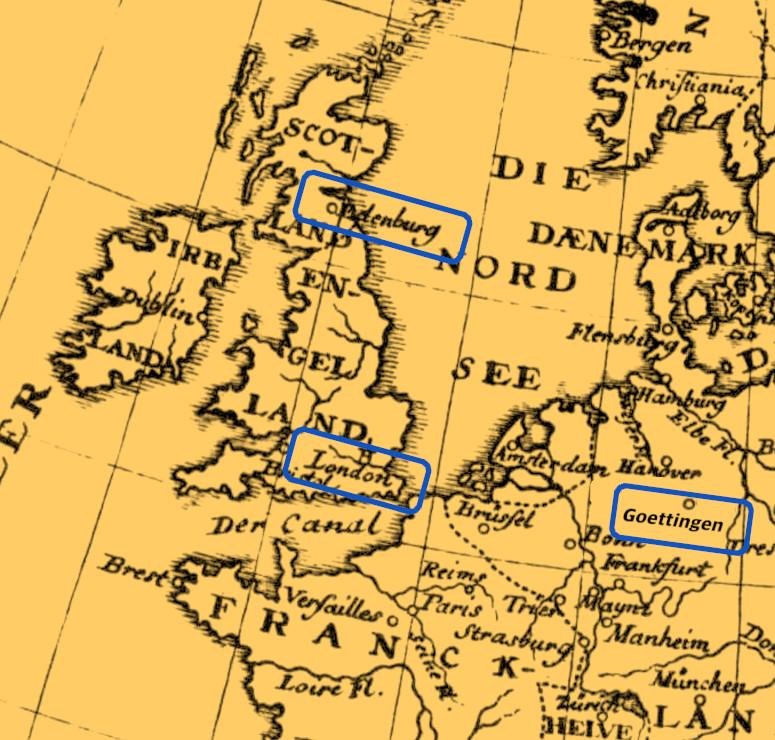
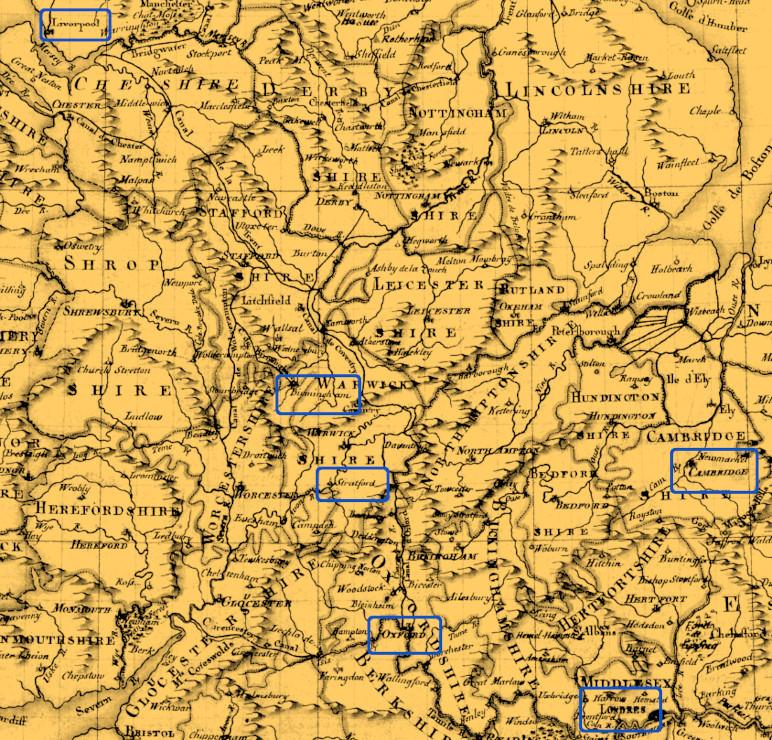
Meyer was in England at the time. According to Elise Campe, Erinnerungen, 1:238–40, he arrived in London on 25 August 1788 (Meyer’s diary entry), though the exact date of his departure from Göttingen is not known. On 24 June 1789 he took an excursion to Cambridge, returned to London, then visited Oxford for a lengthier stay, then Stratford, Birmingham, Liverpool, Edinburgh (visiting Adam Smith and attending the theater) ([1] Daniel Nikolaus Chodowiecki, Elementarische Landkarte von Europa Elementarwerk, in Kupfersammlung zu J[ohann] B[ernhard] Basedows Elementarwerke für die Jugend und ihre Freunde: Erste Lieferung in 53 Tafeln. Zweyte Lieferung in 47 Tafeln von L bis XCVI [Leipzig, Dessau, Berlin 1774], plate xl; [2] J.D. Barbié du Bocage, L’Angleterre [1800]; Bibliothèque nationale de France, département Cartes et plans):
He returned to London on 8 August 1789, where his numerous acquaintances included Mary Wollstonecraft, whom Meyer describes in his diary (in English) on 3 October 1789 as “an author, but a woman of very deep understanding, taste, refinement, and plain good sense,” and Edmund Burke, whom he visited on 28 October 1789.
In any event, Tatter would write to Meyer again from Göttingen a year later, on 14 March 1790 (Erich Schmidt [1913], 1:687; passage not included in the letter of the same date in Campe, Erinnerungen, 1:313–14, which includes numerous ellipses): “At least one thing of which I am absolutely not at all fond is to be fluttering about, and Caroline Böhmer and Lotte Michaelis are no longer here” (Caroline had already moved to Marburg, and Lotte was apparently visiting her at the time; indeed, both seem to have visited the Forsters in Mainz in that spring of 1790). Back.
[1] The reference is almost certainly to Lotte Michaelis. See also August Kotzebue on 22 October 1781 (letter 25a): “Her name is Lotte, she has black eyes, long eyelashes, looks like an angel.” In any event, Lotte did once entertain an amorous interest in Meyer (see, e.g., Caroline’s letter to her on 18 October 1785 [letter 61]).
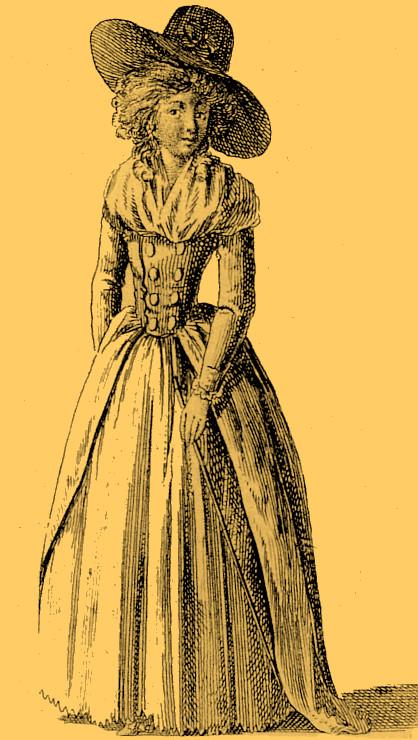
Here a representative illustration of a young woman much as Tatter describes, and from a Göttingen publication in the same year as Tatter is writing (Goettinger Taschen Kalender vom Jahr 1789; Inhaltsverzeichnis deutscher Almanache, Theodor Springmann Stiftung):
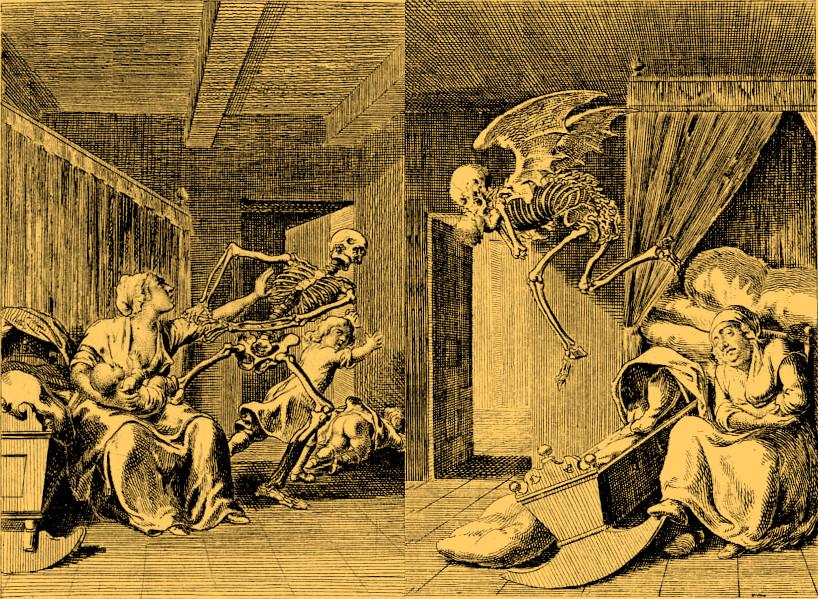
[2] The place where Caroline’s son died is uncertain: Clausthal or Göttingen. — Here two trenchant illustrations of the threat of infant death by Daniel Nikolaus Chodowiecki. In the first, a mother tries to ward off death while nursing; in the second, death snatches a child while the dry-nurse, unaware of what has just happened, continues to rock the empty cradle (Die Mutter [1791]; Herzog Anton Ulrich-Museum; Museums./Signatur DChodowiecki AB 3.889; Das Kind [1791] Herzog Anton Ulrich-Museum; Museums./Signatur DChodowiecki AB 3.898):
Here the grieving parents and the deceased infant (Daniel Nikolaus Chodowiecki and Daniel Berger, Nehm er ihm hin der uns ihn gab [1790]; Herzog Anton Ulrich-Museum; Museums./Signatur DBerger WB 3.4; Daniel Nikolaus Chodowiecki, Totes Kind [1774–75]; Herzog August Bibliothek; Museums./Signatur Chodowiecki Sammlung [1-56]):
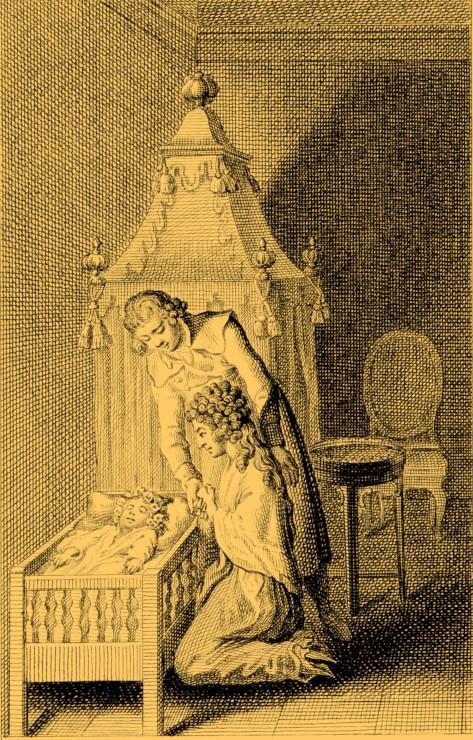

[3] Post Karte Durch ganz Deutschland, ed. J. Walch (Augsburg 1795):

Easter fell on 12 April in 1789; even allowing for the possibly quite general nature of this statement, Caroline seems to have left Göttingen a bit later. In her letter to Luise Gotter on 8 March 1789 (letter 91) she mentions an anticipated departure between Easter and Whitsun, and since in her letter to Meyer on 24 October 1789 (letter 92) she mentions having been in Marburg for only “4 months,” she seems to have left more toward Whitsun, which fell on 31 May in 1789. Back.
[4] An unflattering but premonitory attestation of the evasive, noncommittal behavior in which Meyer engages in his correspondence with Caroline herself over the coming years, at least judging from her responses (Goettinger Taschen Calender für das Jahr 1791; Inhaltsverzeichnis deutscher Almanache, Theodor Springmann Stiftung):

Translation © 2011 Doug Stott