
• 90. Caroline to Friedrich Ludwig Wilhelm Meyer in London: Göttingen, 1 March 1789 [*]
Göttingen, 1 March 1789
|175| If anything unexpected could cross my path in a world I find more wondrous with each passing day and about which I thus wonder increasingly less — for l’admiration est la fille de l’ignorance [1] — Madame Schläger [2] once told me — then that something was your letter, [3] though I was not taken aback by it, since you could and had to know quite well that I would have liked to ask for some news from you, and how I have quite often inquired about you whenever even the slightest occasion |176| for such presented itself.
Indeed, more than once my sister and I toyed with the adventurous idea — I call it adventurous because much of what is natural is called that — of having a missive sent to you, utterly without occasion, repeating my final words to you, namely, that you would never be a stranger to us. Although you had to seem such to me in Göttingen, [4] wherever I might find you in the future or wherever I might know you are, there you will not be such to me. Although taking an interest in your fate may perhaps prove an ungrateful task, nonetheless to the extent you and your own disposition create that fate, I must involuntarily follow it.
You, however, should worry as little as possible about my own and merely not completely withdraw from me the interest you do accord it — I myself am not all that concerned about it; I am not worrying and am making no plans. The only thing I believe I must pursue with firm resolve is the welfare of my two small girls; everything else stretches out before me like the surging sea, the mere sight of which makes me dizzy, so I close my eyes, and yet entrust myself to it without fear.
I know not whether I can ever be completely happy, but I do know that I will never be completely unhappy. You knew me during a time when, restricted on every side, I sank down under the pressure of my own weight — I was cruelly pulled away; and yet I do feel it is I, for things have gotten so bright around me, as if I were living for the first time, like the sick person who returns to life and recovers one power after the other and breathes in the new, pure spring air and revels within a hitherto unfamiliar consciousness.
One veil after another falls; nothing is that important to me anymore — experience diminishes the value of things, since it robs them of their novelty — I | 177| now value nothing except what my own heart gives me, and acquire nothing except what I make for myself. You boast a bit about your poverty, [5] and mine at least does not vex me; it seems as if I have never needed people less or looked down from a higher vantage point than since they have the nerve to believe it is I who would want to tie myself to them more firmly. —
We are proud beggars, my dear Meyer, and I know several others of the same sort; let us instead form a gang together, a secret order that reverses the order of things, and then, like the Illuminati, who would put the clever in the place of fools, let the rich step down and the poor rule the world. I thought your idea of marrying Bürger was excellent, [6] though Lotte believes you would make a poor match, and this much is certain, namely,
On earth neither near nor far
Will an altar be found
Your love to consecrate. [7]
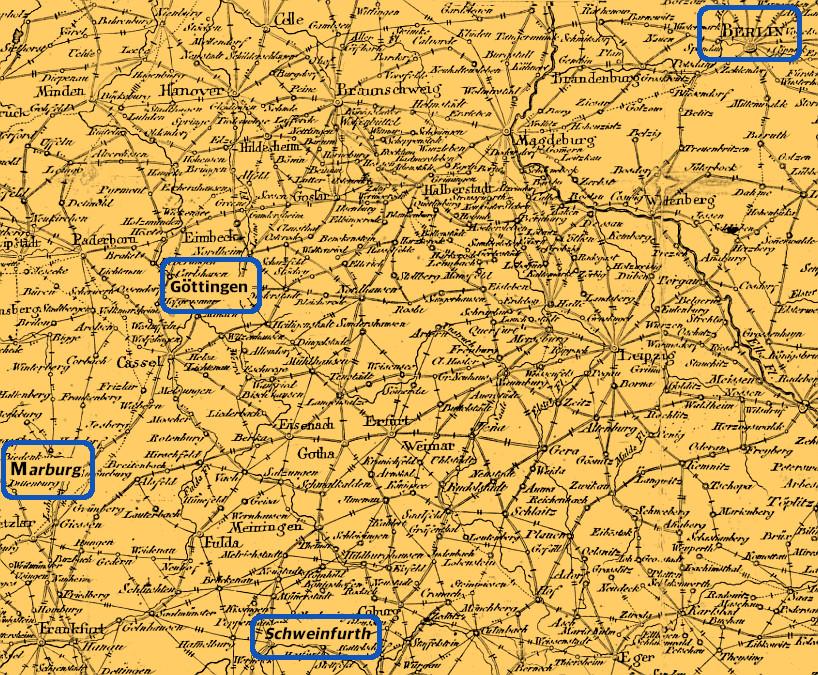
He told me you were probably going to Berlin together [8] — but if I were now to try to get you appointed professor of aesthetics in Marburg, where I will presumably be going? You are, after all, discounting only Schweinefurt, and have probably not renounced all fetters, have you? [9]
I wish you could stay in London, for a large city like that is more your element, a city in which you could lose yourself in the crowd but not in your own circle, where each evening at a banquet or in the theater you could cast off the burden you place on yourself during the day, and where in the push and shove of diversity you could forget yourself. [10] Are you not one of those people who must become intoxicated to be happy? And when that terrible gap between one intoxication and the next is not filled by some external object — |178| what do you do then? Having to fill this void entirely, or having to fill it up every day anew, is a sad alternative. [11]
Hence may your salutary spirit guide you! It will probably not be a smooth path. My father and mother send their thanks, my sisters respond, Lotte is happy, Louise is happy, the one is just now writing, the other is at a ball. You mention Feder in your letters to T[atter]. I heard him speak about you just the other day, and never has an honorable man spoken more favorably about you than he; I was happy to hear it for the sake of you both. Again, be commended to the good, and may no evil acquire the power to harm you!
Caroline Böhmer
Notes
[*] Concerning Meyer’s itinerary, see Georg Ernst Tatter’s letter to him in London on 25 January 1789 (letter 89), note 1. Back.
[1] The full French proverb reads, “l’admiration est la fille de l’ignorance et la mère des merveilles,” “admiration is the daughter of ignorance and the mother of marvels.” Back.
[2] Though the Krakau manuscript of this letter clearly attests the name “Schlegel,” that manuscript is a copy of the original, and the copyist obviously misread or projected that name into the letter. The reference is instead to Sarah Elisabeth Schläger, in whose house Caroline spent two years while attending school in Gotha. Back.
[3] None of Meyer’s letters to Caroline seem to have survived. Back.
[4] Caroline may have seen Meyer during her visit to Göttingen in July 1788, when she came to have her child, and Meyer had possibly not yet left for England; or during one of her previous visits from Clausthal. In any event, concerning Meyer being a “stranger” to her, see Georg Ernst Tatter’s letter to Meyer on 25 January 1789 (letter 89). Back.
[5] Meyer had not had an easy time finding a position after his university studies, nor would his financial situation improve dramatically until his younger brother’s death in 1795. Back.
[6] That Caroline is alluding to some jesting remark Meyer made in his letter is clear, but that Meyer was indeed an intimate friend of Gottfried August Bürger is attested by their correspondence (see Elise Campe, Erinnerungen, 1:323–40) and by Meyer’s poem, among others, “Georgia Augusta an Gottfried August Bürger,” Göttinger Musenalmanach (1789), 42, which begins, “Most pleasing of my sons, / You master in the art of the beautiful.” See also Bürger’s “personal attestation” for Meyer (supplementary appendix Friedrich Ludwig Wilhelm Meyer). Meyer, incidentally, never married. Back.
[7] These verses are modified from Bürger’s “Elegie als Molly sich losreißen wollte,” Gedichte (Göttingen 1789), 163–80, here 172:
For, oh Lord, in Christian lands,
On earth neither near nor far
can an altar be found
our love to consecrate.
The same poem is also mentioned in Caroline’s letter to Lotte Michaelis from 1785 (letter 54). Back.
[8] Bürger had been a private instructor in Göttingen since 1784; in 1789 he would be appointed special (extraordinarius) professor of aesthetics. Back.
[9] Nothing came of the Marburg plan. The reference to Schwein[e]furth is unclear (J. Walch, Neueste Post-Karte von Deutschland und dessen angrenzenden Laendern [Augsburg 1813 ]):
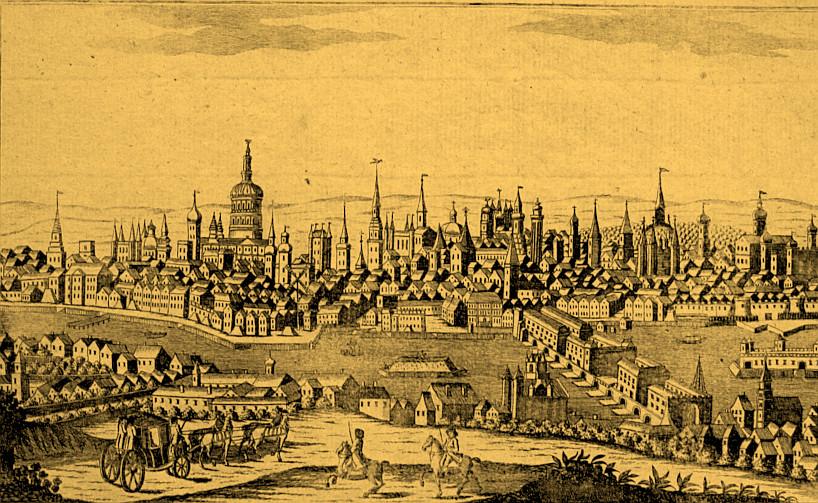
[10] Concerning Meyer’s stay in London (and elsewhere in England), see the editorial note to Georg Ernst Tatter’s letter to Meyer on 25 January 1789 (letter 89). Here London ca. 1780 (Joseph Eder and A. Sommer, Prospekt der Stadt London in England [ca. 1800]):
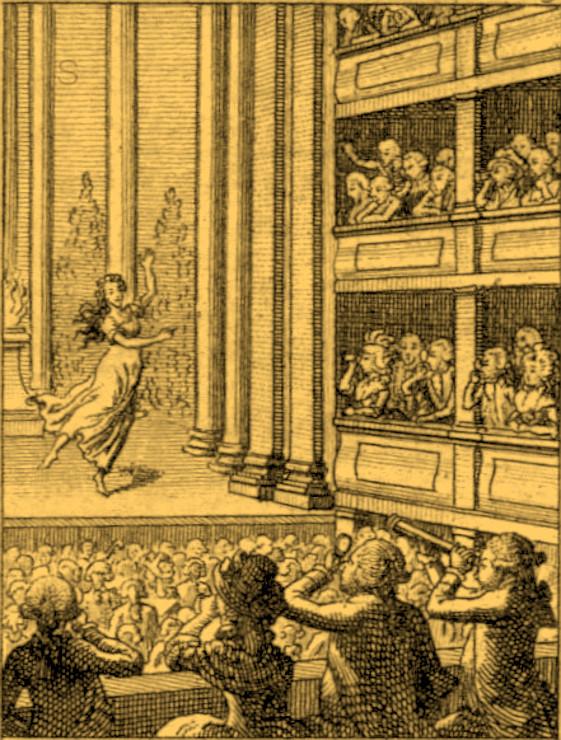
Here a theater tableau from 1795, essentially contemporary with Meyer’s journey (Der neuesten Moden Almanach auf das Jahr 1795; Inhaltsverzeichnis deutscher Almanache, Theodor Springmann Stiftung):
[11] Alternative is French (or English) in original. Back.
Translation © 2011 Doug Stott