
25a. August von Kotzebue to unidentified student in Göttingen: Weimar, 22 October 1781 [*]
Weimar, 22 October 1781
My dear old friend,
I have a request to make of you, one you surely will not and indeed cannot possibly refuse me. First, however, I must acquaint you with the circumstances and background.
This past summer I spent some time in Gotha, where I made the acquaintance of the second daughter [1] of Sir Michaelis, [2] fell in love with her, and she with me, as deeply as two people can fall in love. She asked me to write to her as soon as she was back in Göttingen. At first we did not quite know how we should go about it, and to whom I might be able to address the letters.
Finally she asked whether I might not have any acquaintances of my own in Göttingen. I thought of you, and then, suddenly, all obstacles were removed. She immediately wrote your name into her portefeuille and would like to speak with you as soon as she can meet with you in some public place.
Since she is still in Gotha, the enclosed letter will have to reside well concealed for a time in your desk; but as soon as she returns to Göttingen (I myself do not yet know for certain when that will be), take advantage of the first opportunity to pass it along to her. [3]
Since I will be going to Petersburg as a secretary in two weeks, [4] please be so good, my dear, best friend, and answer me with the first post to let me know whether you have indeed received this letter and the enclosure. Were you not to answer me, you would be putting me into a position of cruel anxiety and embarrassment, something your old friendship for me will not allow. Is that not the case, my good friend?
Please be careful not to confuse these girls when you pass the letter along. Her name is Lotte, she has black eyes, long eyelashes, looks like an angel, and is not very tall. If I have perchance forgotten to specify anything in this letter, only ask me in your response, and you will have the information immediately.
It is imperative that not a single soul learn anything about either the letter or the entire matter, neither here in Weimar nor in Göttingen. Here not even my best friends know anything about it, and if you were to let anything out through careless talk, that would make the girl extremely unhappy.
But I will leave everything to your own sense of prudence. You will surely not deny me this service of friendship, for which I will be profoundly grateful to you for my entire life. I have absolutely no one else on God’s earth to whom I can turn in this matter apart from you. So please do answer me soon, my dear friend! —
Should it prove necessary, and should your letter (which I will now be daily anticipating) require it, I will write you again from here; if not, you will be receiving a letter from Berlin, in which I will send you yet another address whither you can address your letters in Berlin, and whence they will then be forwarded to Petersburg in the diplomatic pouch. [5]
Please write and also let me know how long you will yet be remaining in Göttingen. That is very important to me; you can easily guess why.
If you can find out what people in general say about Lotte, I would very much like to know that as well. [6] She recounted her entire story to me herself.
So, my good friend! please do not let my request for a quick answer be in vain, and let me assure you that regardless of the distance between us, I will remain your ardent friend.
Kotzebue [7]
Notes
[*] Source: Otto Deneke, “Die Göttinger Lotte,” Nachrichten von der Graetzel-Gesellschaft vol. 1 (1925), 2. Back.
[1] Lotte Michaelis was the daughter between Caroline (1763) and Luise (1770).
On the date Kotzebue wrote this letter, he was twenty (born 3 May 1761) and had already finished his law degree (1780) and settled in his hometown of Weimar as a lawyer. Lotte Michaelis had just turned fifteen on 17 October 1781, hence would have been fourteen when Kotzebue developed his relationship with her in Gotha in the summer of 1781 Goettinger Taschen Calender vom Jahr 1789; Inhaltsverzeichnis deutscher Almanache, Theodor Springmann Stiftung:
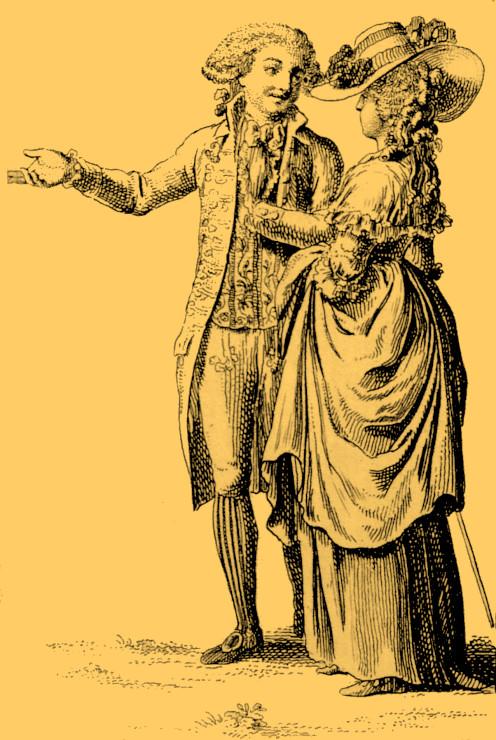
“Once, when a certain Baron Grothaus chanced to become acquainted with the thirteen-year-old Lotte at the home of Grätzel, he remarked, ‘Well, she is indeed a little devil, that one.’ ‘Ah,’ Grätzel responded, ‘then you really should see her elder sister [Caroline]'” (Otto Deneke, “Die Göttinger Lotte,” 3) (illustration: Johann Timotheus Hermes, Sophie’s Reise von Memel nach Sachsen, vol. 2 [Worms 1776], following p. 112):
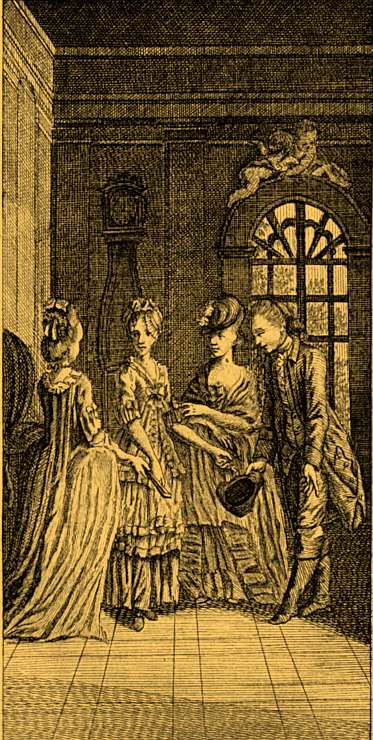
It was precisely to remove Lotte from the influence of the attentions of a Göttingen student, Pedro Hockel, that she had been sent to Gotha in the first place at the end of 1780 and put under the supervision of Madam Schläger, as was Caroline earlier (Post Karte Durch ganz Deutschland, ed. J. Walch [Augsburg 1795]):

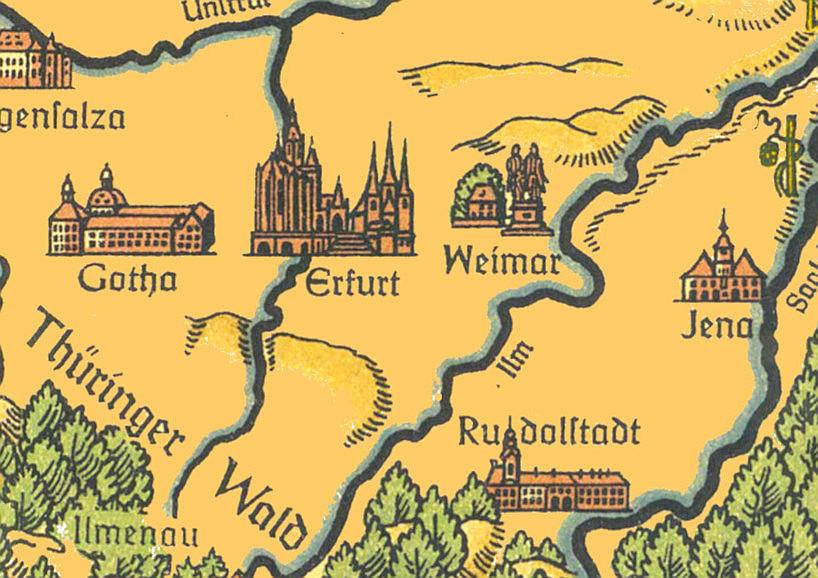
Kotzebue is writing from Weimar (Rudolf Koch and Fritz Kredel, Deutschland und angrenzende Gebiete [Leipzig 1937]):
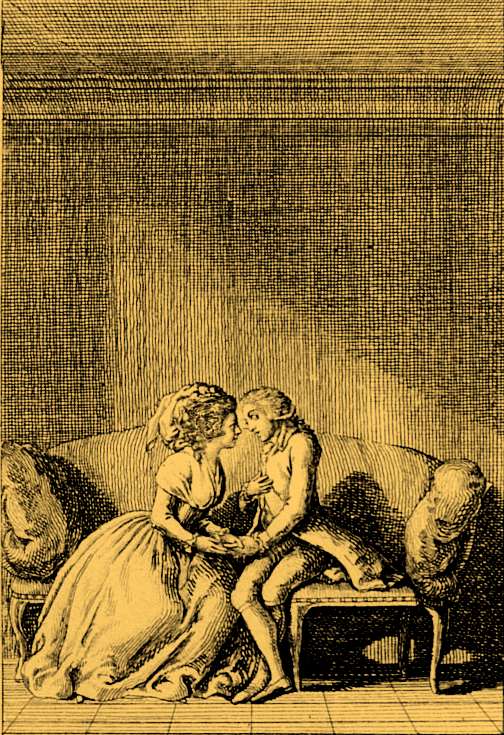
See Luise Wiedemann’s brief account of Lotte’s situation in this regard in her Erinnerungen, p. 87), not least also because Therese Heyne had taken the side of Lotte and Hockel against Caroline and her parents’ objections to the relationship, making it easier for them to meet (see notes to Caroline’s letter to Luise Gotter on 12 January 1781 [letter 21] and esp. supplementary appendix 21.1) (Daniel Nikolaus Chodowiecki, Heyrath durch Zuneigung [1788], Herzog Anton Ulrich Museum, Museumsnr./SignaturDChodowiecki AB 3.765):
This situation intensified the tensions already present between the Heyne and Michaelis families. Back.
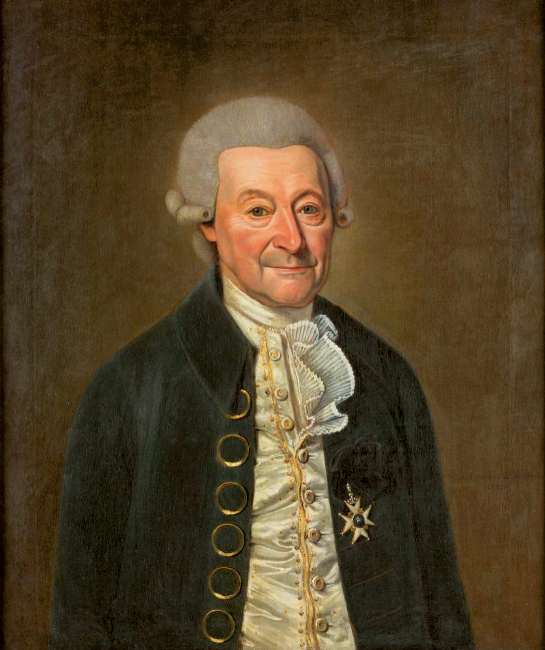
[2] In 1775 Caroline’s father received the Swedish Order of the Polar Star (Nordstjärneorden, “north star”) with the rank of “knight,” a reward for Swedish and foreign “civic merits, for devotion to duty, for science, literary, learned and useful works, and for new and beneficial institutions.”
Here a portrait of a contemporary of Johann David Michaelis, namely, Stockholm professor Nils Rosén von Rosenstein (1706–73), wearing the medal (Lorenz Pasch the Younger, Porträtt föreställande Landshövding Nils Rosén von Rosenstein med Nordstjärneorden):

And Johann David Michaelis himself with the medal (Georg-August-Universität Göttingen; Kunstgesch. Seminar und Kunstsammlung der Universität; Inventarnummer GG 314):
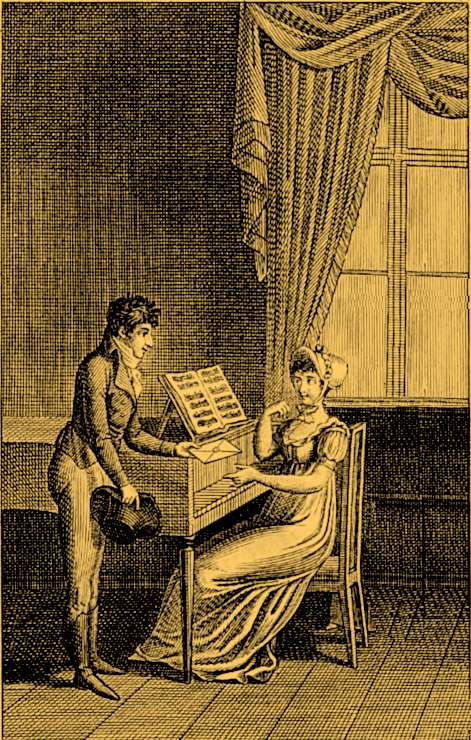
[3] Frontispiece to Christian August Fischer, Erotische Schriften, vol. 2 (Leipzig 1807):
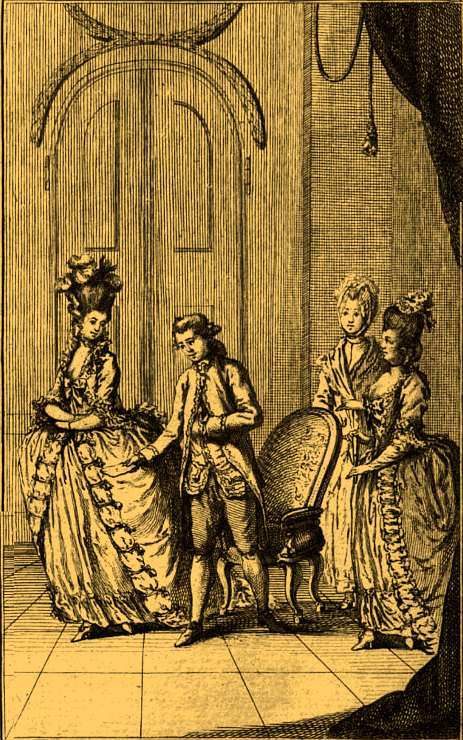
The surreptitious passing of letters in society was a popular device in literture ([1] Östreichischer National Taschenkalender für das Jahr 1787 [also: Österreichischer Taschenkalender für das Jahr 1801; [2] frontispiece to Der allzugefällige Ehemann: Ein Lustspiel in drey Aufzügen , in Gottlieb Stephanie, Stephanie des Jüngern sämmtliche Schauspiele, vol. 4 [Vienna 1778], preceding p. 88):

The threat of Pedro Hockel was eliminated when he left Göttingen for Lisbon in December 1781; Lotte returned on 17 April 1782; see Caroline’s letter to Luise Gotter and Wilhelmine Bertuch on 16–18 April 1782 (letter 31). Back.
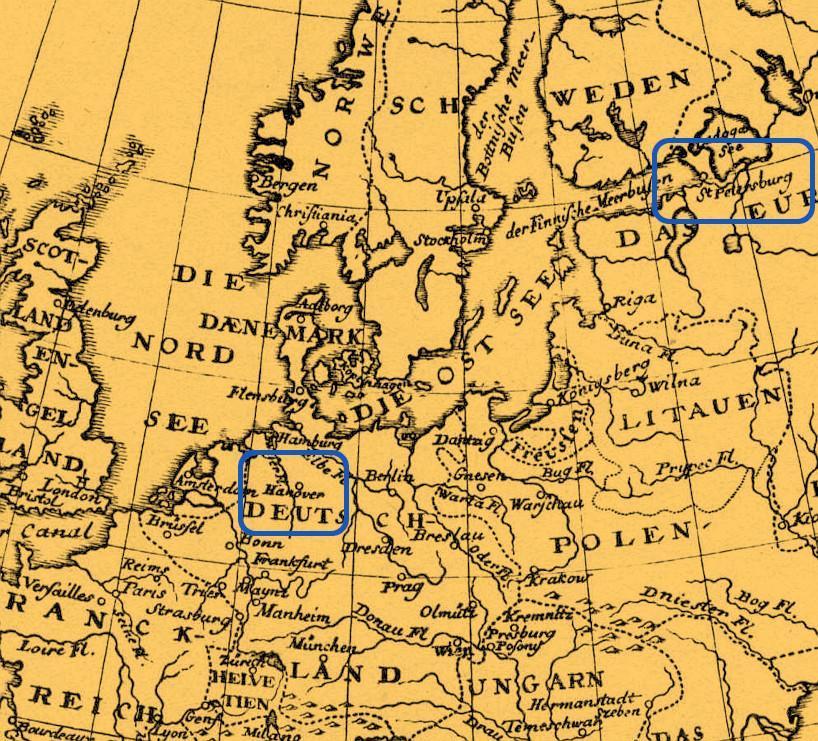
[4] Through the influence of Johann Eustach Graf von Görtz (1737–1821), Prussian ambassador at the Russian court in St. Petersburg, Kotzebue had received a position as secretary to Governor General Bauer in St. Petersburg. Göttingen was, incidentally, part of the Electorate of Hannover (Daniel Nikolaus Chodowiecki, Elementarische Landkarte von Europa, from the Kupfersammlung zu J[ohann] B[ernhard] Basedows Elementarwerke für die Jugend und ihre Freunde: Erste Lieferung in 53 Tafeln. Zweyte Lieferung in 47 Tafeln von L bis XCVI [Leipzig, Dessau, Berlin 1774], plate xl):
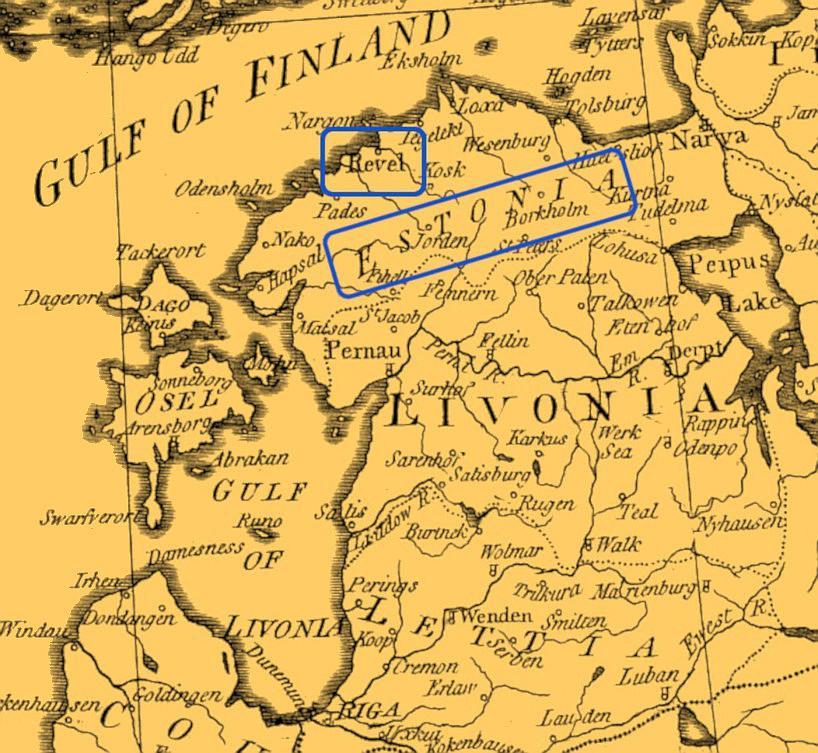
After Bauer’s death in 1783, Empress Catherine II of Russia appointed him assessor to the high court of appeals in Reval (Tallinn), Estonia (one of the Baltic states at the time); after returning to Germany briefly in early 1785 (including, Caroline suspects, a trip to Göttingen), he returned to Reval and, that same year, married Friederike von Essen, whose death in 1790 plays a role in the relationship between Kotzebue and Lotte Michaelis in Mainz.
Kotzebue was ennobled in 1785 (whence the surname von Kotzebue) and became president of the magistracy of the province of Estonia (Thomas Kitchin, A new map of the Northern States containing the Kingdoms of Sweden, Denmark, and Norway (London 1790):
[5] Chodowiecki, Elementarische Landkarte von Europa, from the Kupfersammlung zu J[ohann] B[ernhard] Basedows Elementarwerke für die Jugend und ihre Freunde:

[6] Almanach de Goettingue pour l’anneé 1786; Inhaltsverzeichnis deutscher Almanache, Theodor Springmann Stiftung:

[7] See Kotzebue’s later reminiscence concerning his affair with Lotte (George S. Williamson, “August von Kotzebue, Mein Umgang mit dem schönen Geschlecht. Transcribed, edited, and with an introduction by George S. Williamson,” in Goethe Yearbook 27 (2020), 257–304, here 287):
It was in the summer of 1781 that I traveled to Gotha to visit the sister of my hearty friend Musäus, whose heart and mind Madam Irmel already quite possessed, an excellent and respectable woman in whose company even young men felt comfortable. The several days I had originally planned to linger with her, however, turned into an entire month because it was there that I made the acquaintance of Lotte Michaelis, daughter of the renowned knight in Göttingen, an extremely pretty, lively, and cultured young woman, albeit frivolous and inclined to cunning artifice. After her father discovered her affair with a young Portuguese, she was exiled to Gotha, where she resided with an old, inaccessible lady but spent each afternoon at the home of Madam Irmel.
It could not escape me that in certain respect Lotte was far more cultured that Luise [a previous lover], since she was able to converse in French and write quite well in German, had read all the current novels and indeed herself acted the heroines of such novels quite fetchingly. Although we were both initially far removed from the beloved object, and both flighty and fiery, nonetheless not three days had passed before we were speaking quite animatedly with each other with only our gazes, and before the week was out she was my Lotte and I her August.
Madam Irmel, however, noticed immediately what was going on and pronounced with jocular gravity a ban on our love. She doubled her own vigilance, and we were never allowed to be alone together. Once, however, during a walk in the park, we suddenly ran away from her and after a hundred paces were able to steal some kisses behind a hedge. But the violence of the thundering reprimand that then rained down upon us was enough to prevent us from ever risking such audacious behavior again in her presence.
And yet later we were again able to sneak behind the valiant woman’s back with a rather droll trick. After all, no power on earth can prevent lovers who want to kiss from indeed kissing. Although Madam Irmel resided in the rez-de-chaussée, her windows were so high that someone could at most extend a hand down from the window to anyone standing below. The house’s foundation, however, was decorated with broad stone that provided a ledge several inches wide. If one had a firm grip on the windowsill with both hands and at the same time stood on one’s tiptoes on the ledge and then swung up slightly, then at the risk of skinning one’s hand and slipping one could nonetheless just extend one’s head up to the window. In the evening after dark, when Madam Irmel was sitting quietly on the sofa, I would leave the room under one pretext or the other, Lotte would open the window, I would clamber up from the outside, and we would steal a kiss on the fly.
Although my dear lady friend laughed heartily when in later years I related this ruse to her, she swore never again to take on the task of supervising such a fiery young woman.
Here my love affair with Lotte Michaelis came to an end, for a letter I wrote to her from Weimar that Madam Irmel was to deliver was returned unopened, as was to be expected, along with maternal admonitions that at the time I found quite superfluous. I visited Lotte a once more later in Göttingen and found her as vivacious as ever, and yet the old attraction was simply no longer there. She later married the bookseller Dieterich and died in childbed. Back.
Translation © 2011 Doug Stott