
123a. Georg Ernst Tatter to Luise Michaelis in Göttingen: Rome, 27 April 1793 [*]
Rome, 27 April 1793
Louise, my dear friend, what news! I received it yesterday and at the moment cannot describe the effect it has had on me. [1]
But neither am I really able to indulge my pain here. How intimately were we once connected, how happily did we live alongside one another, how many moments and hours did we spend together — so utterly delighted in our own existence and friendship!
And now what has become of all those memories, how sadly do they now arise in my soul? I flee them as best I can. A short period of a few years has now dispersed all of us, and now we will be without her forever, never again can we come together in this world the same way. Your poor, poor mother! How sorry I feel for her at this moment! And her husband, for whom she can never be replaced! Wholly the same as with my own poor sister, even unto the smallest details.
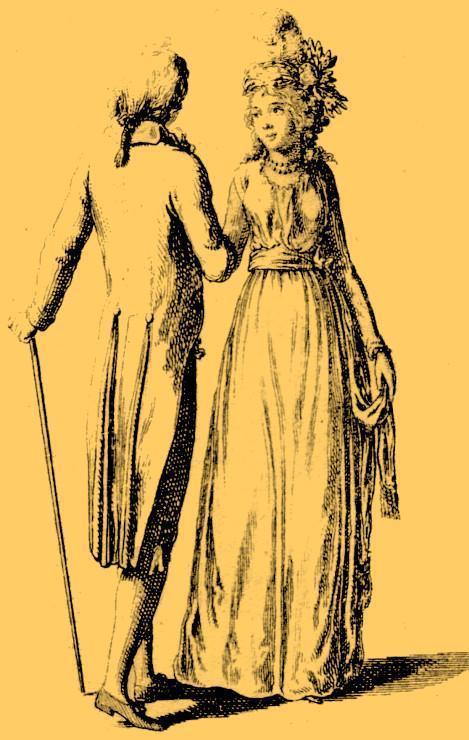
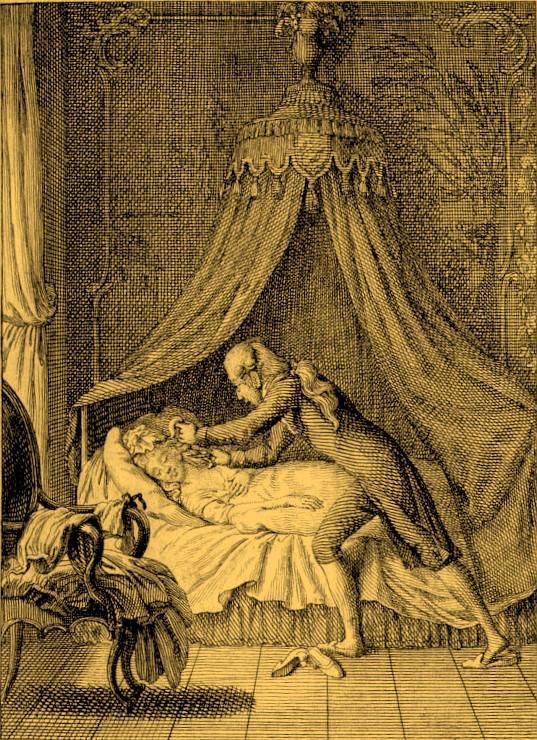
I saw her for a moment yet back on 4 August, she was so happy, and when we parted she embraced me so ardently, I never dreamed it would be the last time. [2] But I am writing quite disconnectedly now. I requested a bit of her [Lotte’s] hair, surely someone thought of that, I would so like to have this remembrance with me [?], [3] which I would then perpetually carry with me; please see to it that I receive something soon, I would so treasure it.
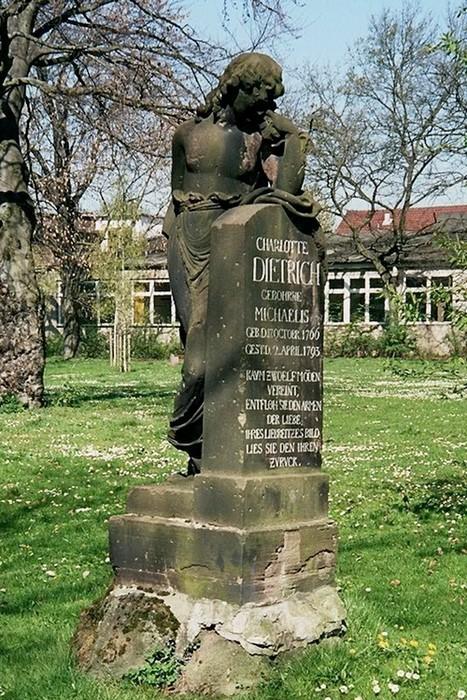
If you can, please do occasionally go to her grave and place a flower there in my name; I myself, if ever in my life I am again there, will also bring tears to her ashes; [4] only then, it seems, will they be willing to flow once more, for now my eyes are dry. Please write to me more diligently that I might more frequently hear whether your good mother can be consoled.
I know absolutely nothing about Caroline, not even where I should write her; my last letter to her was still at your mother’s. I have recovered once more after being rather sickly and in pain for six weeks.
If you can, please write me at length about everything pertaining to L[otte] — my hand trembles when I try to write her name. Stay well, my dear Louise; ah, if only you can, do stay well.
Prince Augustus specifically charged me with relating to your mother his heartfelt sympathy.
I forgot to mention in my letter to your mother that Philipp wrote me from Milan (17 April) that he had written three letters home one after the other, of which he fears all got lost, and at the time intended to send yet a fourth. [5] In them, he requested that the amount in the letter of credit be raised.
Notes
[*] Source: Luise Wiedemann, Erinnerungen, 104–6. — Tatter was in Rome accompanying Prince Augustus; it was during this journey and indeed merely three weeks earlier that the prince entered into his unsanctioned marriage with Lady Augusta Murray.
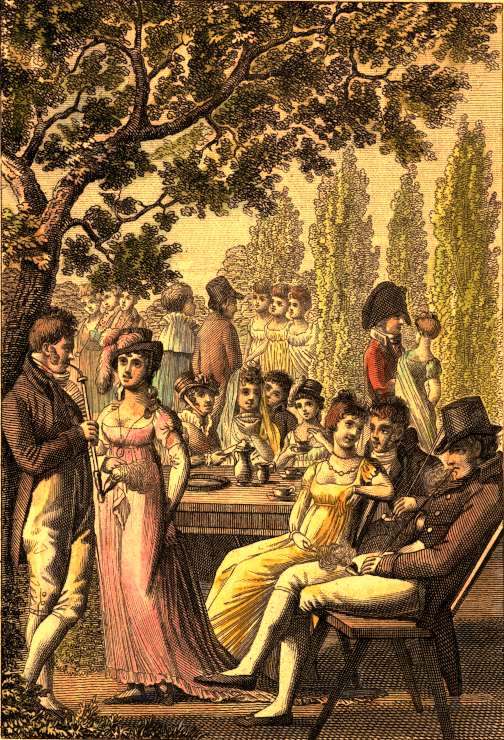
In this letter, Tatter responds to news of Lotte Michaelis’s tragic death. Tatter had been part of the social groups attached to the Michaelis house and to younger Göttingen society in the broader sense (Der Freund des schönen Geschlechts: ein angenehm und nützlicher Taschenkalender für das Jahr 1808):
[1] Lotte Michaelis, who had given birth to a baby girl on 27 March 1793, died in Göttingen on 2 April 1793 apparently because questionable methods were employed at that delivery by the Göttingen physician Friedrich Benjamin Osiander.
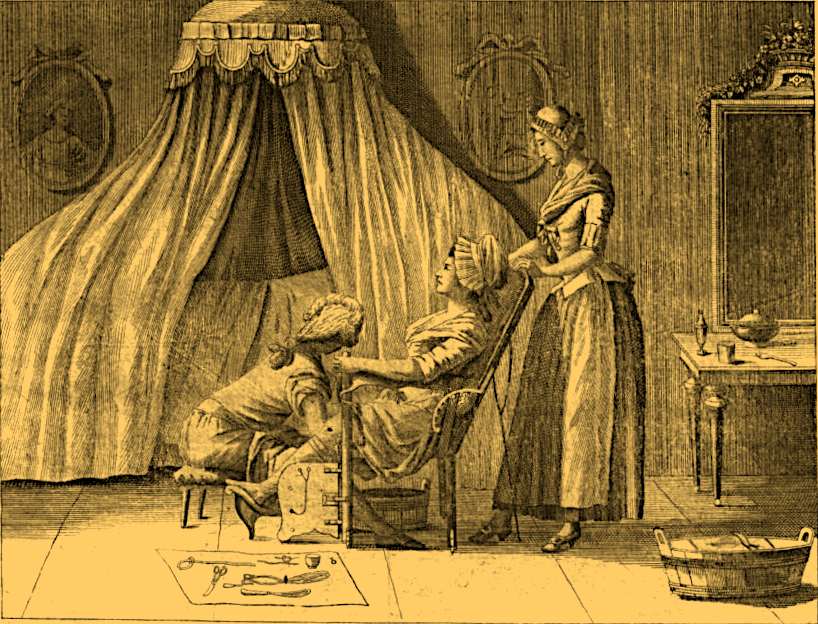
To wit, Osiander had used a birthing stool instead of a more traditional method, e.g., allowing the mother to give birth in bed as shown in this illustration from the late seventeenth century (Christoph Völter, Neueröffnete Hebammen-Schul/ Oder Nutzliche Unterweisung Christlicher Heb-Ammen und Wehe-Müttern/ wie solche sich vor/ in und nach der Geburt/ bey Schwangern und Gebährenden/ auch sonst gebrechlichen Frauen zu verhalten haben [Stuttgart 1687], plate following p. 176):

Here illustrations of the birthing stool Osiander presumably used with the woman’s feet in the stirrups, from Osiander’s Abhandlung von dem Nutzen und der Bequemlichkeit eines Steinischen Geburtsstuhls. Geburtshelfern, Hebammen und Gebährenden zur Belehrung, plates between pp. 41 and 43:
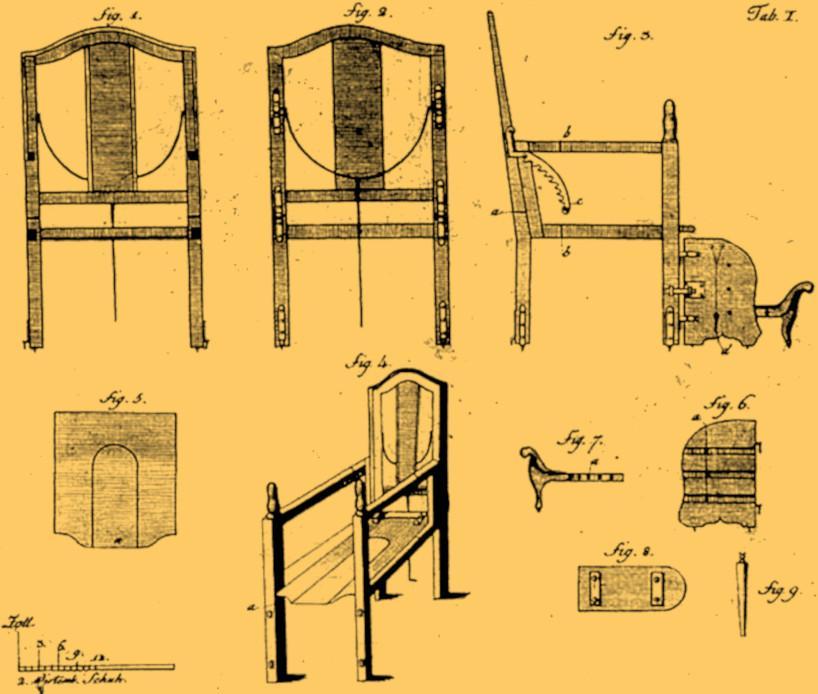
Osiander immediately published an unusual self-defense, unusual insofar as he included it among the otherwise quite normal announcements of his lectures for the summer semester 1793, Fried. Benj. Osiander’s Anzeige seiner Vorlesungen im Sommerhalbenjahr 1793. Das Neueste aus meiner göttingischen Praxis (Göttingen 1793) (complete text see supplementary appendix 123a.1).
The midwife he accuses of having contributed substantially to Lotte’s death, Catharine Margaretha Klocken, quickly published her own rejoinder, Vertheidigung gegen einige Beschuldigungen des Herrn Professors Osiander (N.p. [Göttingen] 1793) (complete text see supplementary appendix 123a.2.
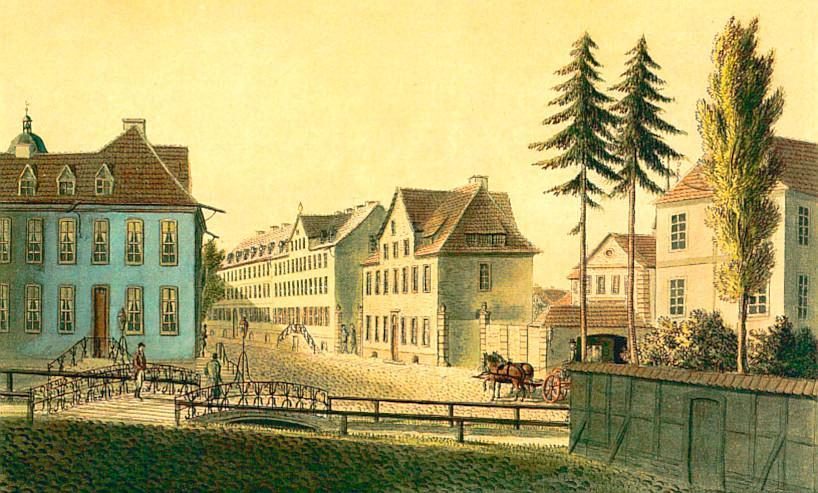
Georg Christoph Lichtenberg also tracked the sequence of events in his diaries (Schriften und Briefe, vol. 2, Sudelbücher II, Materialhefte, Tagebücher [Munich 1967]; cited in Horst Gravenkamp, “‘Ein Mädchen, kaum zwölf Moden alt’: Lotte Michaelis und Sigmund Freud. Hintergründe eines Lichtenberg-Aphorisums,” in Lichtenberg-Jahrbuch [1989], 161–75, here 170–71); since 1775, Lichtenberg himself had also lived in the Dieterich house in Göttingen, what was known as the “Prince’s House,” having been the residence of Prince Ernest during the latter’s stay in Göttingen 1786–91. Here the house ca. 1820 in a painting by Friedrich Besemann (across the street from the blue Michaelis house on the left, and with the raised entrance):
He remarks on 27 March 1793: “Young Mad. Dietrich is making some serious noise . . . At 8:00 p.m. things get serious with Mad. Dietrich, and she gives birth to a little daughter amid considerable pain.” Then on 2 April 1793 he notes the “extremely great commotion and horror in the house” after Lotte has died. On 4 April 1793: “Mad. Dietrich is autopsied. Her bed linens are lying out in the garden!!” And on 6 April 1793: Young Mad. Dietrich laid to rest, no carriages, no entourage, which I greatly admire” (i.e., a quiet burial without liturgical imposition).
Concerning the perils of childbirth at the time that endangered both mother and infant, see esp. Caroline’s letter to Luise Gotter on 22 June 1785 (letter 57), notes 2, 2a, and 3, with cross references. Back.
[2] Göttinger Taschen Calender Für das Iahr 1796; Inhaltsverzeichnis deutscher Almanache, Theodor Springmann Stiftung:
[3] Brackets from Julius Steinberger, the editor of Luise Wiedemann’s Erinnerungen.
The popular motif of obtaining a lock of the beloved’s hair as a remembrance extended to obtaining such covertly as well (“Trembling he lifted one of the beautiful blond locks,” from August Lafontaine, Quinctius Heymeran von Flaming, vol. 1, rev. 3d. [Berlin 1798], passage on p. 166; repr. in the Brittischer Damenkalender und Taschenbuch für das Jahr Achtzehenhundert; Inhaltsverzeichnis deutscher Almanache, Theodor Springmann Stiftung):
[4] Lotte was buried in the Bartholomäus Cemetery along the Weender Landstrasse in Göttingen, where her marker is still extant (photo: Martin Reulecke). The motif of weeping at a gravesite was common (N. Monciau and Pierre Philippe Choffard, Trauriger Mann auf einem Friedhof [ca. 1776–1800]; Herzog August Bibliothek; Museums./Signatur Graph. A1: 444a):

[5] It was from Italy that Philipp Michaelis returns to Germany to assist in Caroline’s release from Kronberg, whither she would be transferred later from Königstein. See Caroline’s letter to to Friedrich Wilhelm and Luise Gotter on 13 July 1793 (letter 131). Back.
Translation © 2011 Doug Stott