
101a. Friedrich Schlegel to Wilhelm Schlegel in Amsterdam: Leipzig, 18 May 1791 [*]
Leipzig, 18 May [17]91
. . . I have been enriched by Madam B[öhmer]’s letters. [1] And yet she does nonetheless remain a bit incomprehensible to me — specifically how such a facile, adroit imagination and tenderness of feeling can exist alongside such sublimity. You must not have any regrets about it (for should you profane this sacred idea, you would feel remorse). — I sympathize with her sublimity and find access to the more delicate side with my understanding. — I do not believe I would violate her delicateness even in the most free of relationships. — Please be so good as to copy out some of the poems for me. [2]
20 May
I imagine you being caught up in the maelstrom of petty worries and petty business. You will learn how to ennoble the insignificant through a grand purpose as does Madam B[öhmer] — like the spirit hovering over the face of the waters. [3] — You are often too impatient for that. — One’s wholly poetic cultivation contributes to it. — The purpose of art is to bring forth the beauty of life, and it does indeed effect just that. . . .
Notes
[*] Source: Walzel, 1–2; KFSA 23:10–11. Back.
[1] Friedrich Schlegel was studying in Leipzig at the time; Wilhelm was working as a private tutor in Amsterdam, where he remained until the summer of 1795. Caroline would remain in Marburg until just before her father’s death on 22 August 1791, thereafter remaining in Göttingen (see Luise Wiedemann’s marginal note in her biography of Caroline) (Post Karte Durch ganz Deutschland, ed. J. Walch [Augsburg 1795]):
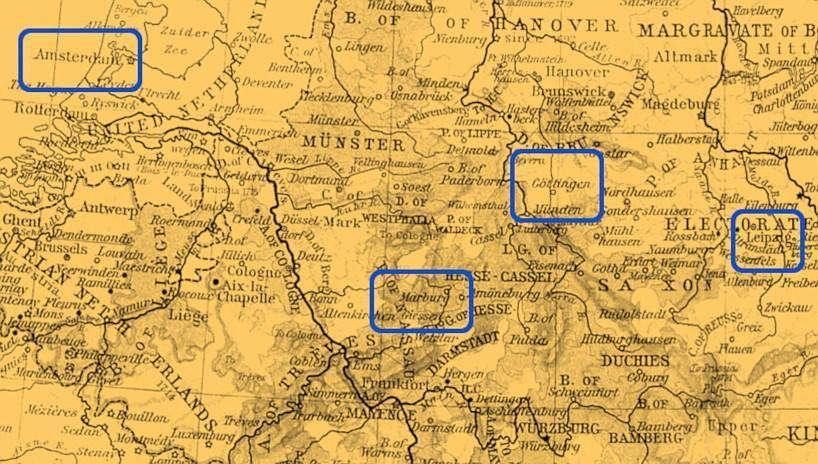
In the meantime, Wilhelm was sharing with Friedrich portions of her correspondence with him from this period, none of which, however, seems to have been preserved except in the excerpts Friedrich himself cites in his own letters. Friedrich generally refers to Caroline as “B” or “Madam B.” (Caroline Böhmer). Back.
[2] Presumably those Wilhelm wrote for Caroline: “Abendlied für die Entfernte,” “Entsagung und Treue,” and “Der letzte Wunsch” (Sämmtliche Werke 1:17–18, 19–22, 23–24); texts see supplementary appendix 101a.1. Back.
[3] Paraphrase of Genesis 1:2: Friedrich writes: “Wie Geist über den Waßern schwebend.” See Luther, Die gantze Heilige Schrifft Deudsch (Wittenberg 1545) (Ausgabe letzter Hand): “Vnd der Geist Gottes schwebet auff dem Wasser.” Here the frontispiece to Luther’s translation of Genesis from that volume:

English: NRSV: “The earth was a formless void and darkness covered the face of the deep, while a wind from God swept over the face of the waters.” Or KJV: “And the earth was without form, and void; and darkness was upon the face of the deep. And the Spirit of God moved upon the face of the waters.” Back.
Translation © 2011 Doug Stott