
• 86. Caroline to Philipp Michaelis in Marburg: Clausthal, 24 October 1788 [*]
[Clausthal] Friday, 24 October [1788]
|170| Like the baby that immediately squeaks after escaping its mother’s womb — “Oooh, brrrr, so cold here — oh, my, my, where are my soft blankets and soft sheets? — oooh, I shudder — Mommy, Mommy, do let me creep back under instead.” The houses nodded toward each other like a couple of old aunts with long noses — I must lift my long legs up so high to climb the old |171| wigs. Woe, and double woe, where has my friend gone with whom I once roamed the meadows? Where will I find love again? Clever ladies are not for me. O thou sun of elegance, you have set. O my splendid, robust days, you have come to an end. [1]
Thus the lament of Brother Novice. [2] I was hoping with all my heart you would be well pleased, since that would also encourage me; [3] but I cannot really feel sorry for you. One must simply become accustomed to such things in the world, learn early on how to make every place one stays bearable, and I think this stay, too, will quickly become such for you if you can find but a single person who even halfway sympathizes with you and who will take walks with you. Always taking walks alone — I do not much fancy that, despite the pleasure it might indeed give me now and then — for it isolates one’s existence. [4]
At some time or other Mother will probably take pity on you and set you up better. Either you are not reporting what Fritz wants you to tell me, or he did not give you anything to pass on to me in the first place. My God, surely you two did not immediately have everything torn down and rebuilt? For that miserable stove is not enough by a long shot. For example, there is no out-of-the-way corner where the domestics might sleep — no cubby hole where one might store things one does not use every day. Having the kitchen so close to the foyer — how often would Brother Fritz be disturbed by such an arrangement? No space, no corner where one can wash up, no place to arrange even the most necessary cabinets. [5]
In a word, one simply cannot keep up a real household there. It would be neither something half nor something whole, it would be nothing at all. Do you know what I would like to see? Either that my dear Fritz might simply make do until he had another house, or that it might be possible to live with him without organizing the household such, to have meals supplied instead and not |172| to construct things in that way for all eternity.
In that case, I myself would need nothing more than space for me and my children. [6] We — you and I — would have our meals delivered, and he would eat at his usual place of board. But where are you currently eating? Surely they are cooking things there that are edible — all of you do not have rhinoceros gums there in Marburg, do you? You need to relate all this whining litany to me in detail, [7] something you surely can learn how to do in circumstances such as those.
Is Fritz still talking about Christmas? I am not asking behind his back, and you need have no qualms about showing him this letter. One thing is certain, namely, that my pension must be clarified before I leave. Trebra has strongly advised me to wait until then, and since the mining receipts are not reckoned until December, heaven knows when anything will be decided! [8] Yes, I openly own that I would prefer to remain here for the winter. Trebra would also like to advise Fritz that, if he really wants to get healthy in body and soul, he ought to get married. [9] . . .
My good brother [Fritz] has probably received the letter from me that the pastor was keeping for him. If he considers the circumstances, the passion with which I made the decision at that time to throw myself into his arms — certainly he will be able to excuse me a bit for having changed it again somewhat.
[End of the letter is missing.]
Notes
[*] Dating: Waitz (1871), 44, dates this letter “[Clausthal] Freytag d. 25. October [1788]”; Schmidt (1913), similarly dates the letter in the running head to “25. Oktober 1788,” but in the letter itself transcribes “[Clausthal] d. 25. 8b. [1788].” That is, both editors read “8b.” phonetically as “Octo-ber” (Sigrid Damm, ed., Caroline Schlegel-Schelling: Die Kunst zu leben [Frankfurt, Leipzig 1997], 133, understands “8b.” not phonetically, but as referring to the eighth [Latin octo] month and dates the letter “[Clausthal] Freytag d. 25.8.[1788]”).
The problem is that in 1788, the 25th fell on a Friday only in January, April, and July. The content of this letter suggests a mistake on Caroline’s part insofar as Philipp Michaelis is already in Marburg, having matriculated on 13 October 1788, and insofar as Caroline is already talking about moving to Marburg herself to stay with her brother Fritz Michaelis, and indeed is looking for Philipp’s encouragement. In any event, that Caroline mistook the date of the day of the week (25 rather than 24) is arguably more likely than that she mistook the day itself (Friday), though certainty is not possible. These considerations prompt the present editor to date the letter to Friday, 24 October 1788. Back.
[1] In this initial paragraph, Caroline seems to be drawing from a private inventory of imagery shared by her and Philipp, or perhaps the Michaelis children in general, a collage of citations (from children’s stories?) that in places exhibits an almost surreal quality (e.g., the “climbing of wigs”). The reference in any case seems to be to Phillip Michaelis’s less-than-comfortable initial experiences in Marburg, about which he has written Caroline.
Concerning Philipp Michaelis’s earlier experiences with women in Göttingen (as opposed to “clever ladies,” presumably in Marburg), see Caroline’s letter to him from Marburg in late 1790 (letter 99) (“For your age, you have already had too much to do with females”), esp. with note 1 there (Goettinger Taschen Calendar vom Jahr 1790; Inhaltsverzeichnis deutscher Almanache, Theodor Springmann Stiftung):

[2] Philipp Michaelis had “newly” arrived from Göttingen in Marburg, where he would live with his half-brother, Fritz Michaelis, and pursue his medical studies, registering as a student on 13 October 1788. Marburg is located ca. 115 km southwest of Göttingen (Post Karte Durch ganz Deutschland, ed. J. Walch [Augsburg 1795])

[3] As becomes clear in the letter, Caroline herself has apparently already made at least tentative arrangements to move in with Fritz Michaelis in Marburg. Back.
[4] Daniel Nikolaus Chodowiecki, Du weinst Amalia? und das sprach er mit einer Stimme! (1783); Herzog Anton Ulrich-Museum; Museums./Signatur DChodowiecki AB 3.544; Johann Christian Klingel, Frau mit Hut und Sonnenschirm [1781]; Herzog August Bibliothek; Museums./Signatur Graph. A1: 1372d:

[5] Fritz Michaelis resided in Marburg in the house at Reitgasse 14 (the house was demolished in 1965). No documentation specifies how much space he was renting or what size the apartment was (or how many rooms). In any event, click on the image below to open a gallery of illustrations of a typical mid-18th-century bourgeois residence of the sort to which Caroline was likely accustomed:

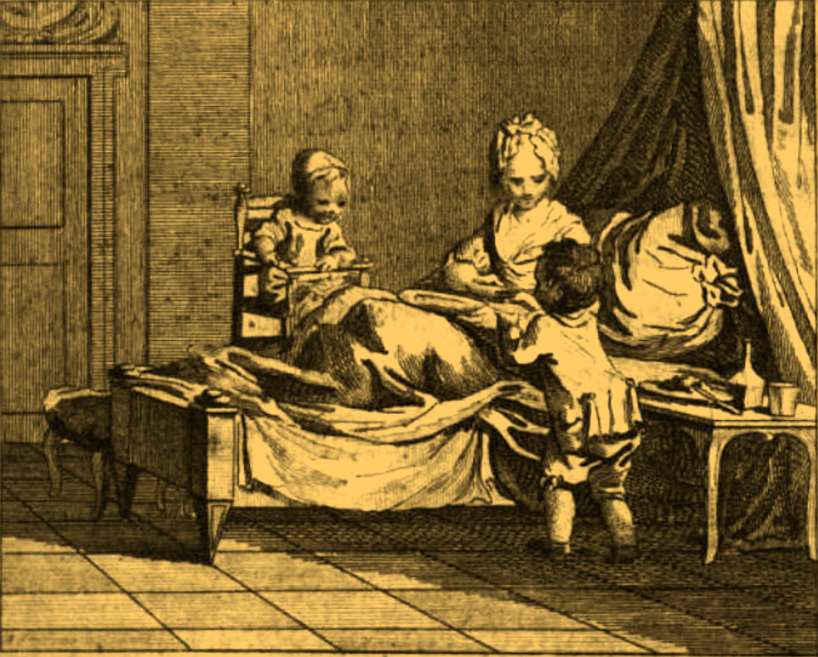
[6] Although Caroline had two young daughters rather than a daughter and son, the following illustration quite represents the configuration at the time (Johann Caspar Lavater, Geheimes Tagebuch, 2 vols. [Leipzig 1771, 1773], 2:169):
[7] Erich Schmidt (1913), 1:687, points out that Caroline uses a rather unusual word here, namely, the Göttingen term vorschwögen, “tell, preach someone a long rigamarole.” Grimm, Deutsches Wörterbuch s.v., glosses the word as “weepily relate, lament about,” adducing, however, Caroline’s as the only example. Georg Schambach, Wörterbuch der niederdeutschen Mundart der Fürstenthümer Göttingen und Grubenhagen, oder Göttingisch-Grubenhagen’sches Idiotikon (Hannover 1858), does not include the word. Back.
[8] Caroline’s brother Fritz seems to have asked whether Caroline would be arriving in Marburg before or by Christmas. She seems in any case to have left Clausthal once and for all in the late autumn of 1788. She would thereafter receive the customary quarter of her husband’s annual salary as a widow’s pension. Back.
[9] Fritz Michaelis seems not to have married until 1794. In her memoirs (Erinnerungen), Luise Wiedemann echoes Friedrich Wilhelm Heinrich von Trebra’s concerns about Fritz’s “body and soul,” remarking that at least one consideration prompting Caroline’s decision to move in with Fritz in Marburg was the possibility of sweetening his “solitary life.” See Luise’s biography of Caroline, p. 79, where, it might be noted, Luise remembers Fritz as having “urged” Caroline to make the move. On the other hand, in the next paragraph Caroline speaks of having “thrown” herself into his arms, presumably out of desperation concerning her next plans. Back.
Translation © 2011 Doug Stott