
35a. Therese Heyne to Luise Mejer in Celle: Göttingen, 1 March 1783 [*]
[Göttingen, 1 March 1783]
. . . Just to pass the time, let me relate a scandalous story to you that would sound quite silly were young people not usually so careless as to give something of this sort a really malicious turn.
Canon Meier is here just now to see his enchanting Friederike, [1] and on Thursday they traveled out to Kerslingerode, [2] including with a certain Frankenberg, [3] who is constantly visiting the family. The Böhmers, Michaelises, [4] Frankenberg, Meier, and several others. Unfortunately, Koskull, Schulenburg, and Poel were also there.
The two Michaelis girls took a walk with Franken[berg], and on their way back went into an open barn with lots of hay lying around, and there, as Koskull related, they cavorted in an indecent manner. Koskull went over and closed the door and blocked it with a big piece of wood. [5]
The next day Poel asked Frankenberg in the lecture hall whether he knew a certain song, a very nice one in fact, and passed him a note with the words, “Three geese a-sitting in the hay, the hay, so merry were they, so happy a-day; then strode three men right into the chaff, each carrying an oh-so-large, large staff, asking out loud, Who’s there? Who’s there? Just three geese a-sitting in the hay, the hay, so merry were they, so happy a-day . . . ” [6] Frankenberg gave a start, “Oh, my God! Oh, my God!” and begged him please not to relate it to anyone else. —
How do you think this story might get turned and twisted were it to fall into the right hands? [7]
Notes
[*] Source: Therese Huber Briefe, 1:83. Back.
[1] Friedrich Johann Lorenz Meyer had just returned from a trip to Switzerland (see Caroline’s letter to Luise Gotter on 6 February 1783 [letter 35]) and was visiting Friederike Böhmer. Back.
[2] The preceding Thursday was 27 February 1783. — The reference is not to the village Kerstlingerode southeast of Göttingen (Therese Heyne varies the spelling slightly), but rather Kerstlingeröderfeld ca. 7 km east of Göttingen, a popular excursion locale among both students and professors (see esp. supplementary appendix 35a.1); here an illustration of the estate that served as a tavern for visitors there and was simply called by the name of the locale, from a student album in 1778, just five years before these events took place (Niedersächsische Staats- und Universitätsbibliothek Göttingen: 8 Cod. Ms. Hist. Lit. 48t [IX]):

Another view ca. 1800 (copper engraving by an unknown artist [ca. 1800]):
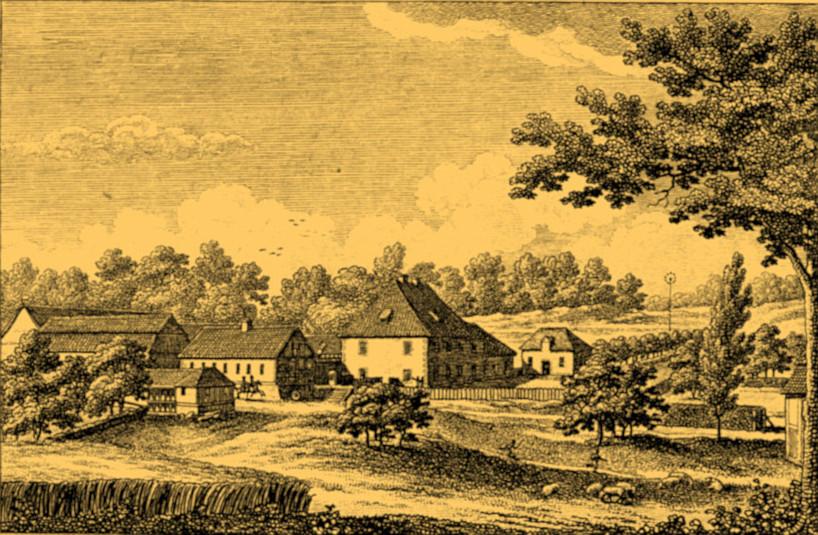
[3] Frankenberg is an otherwise unidentified student in Göttingen. Back.
[4] Friederike Böhmer and possibly some of her siblings; Caroline and Lotte Michaelis. Back.
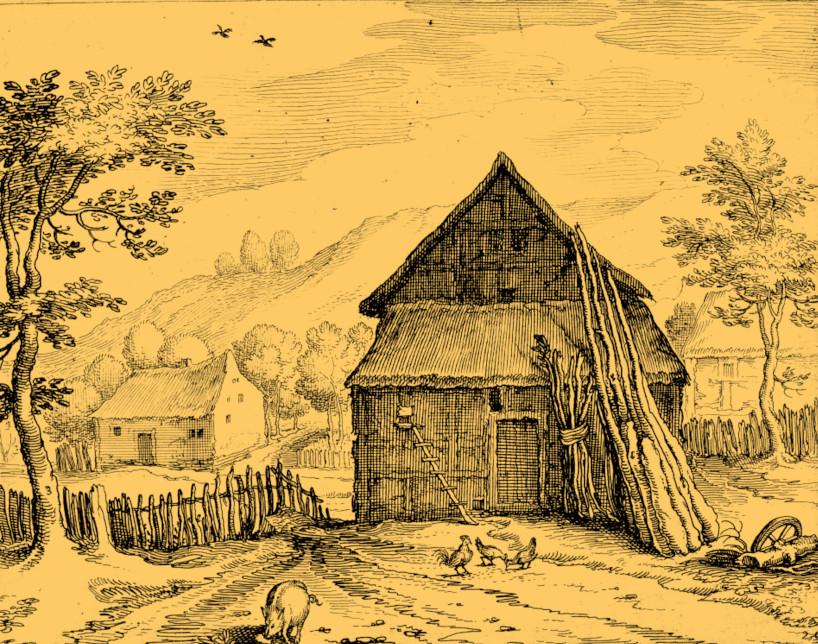
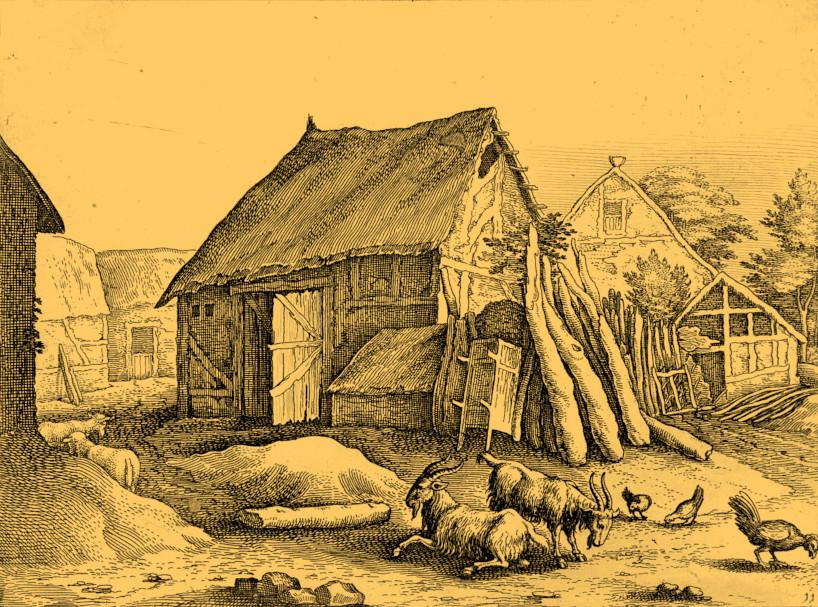
[5] Here two views of rural barns with, coincidentally, plenty of wood with which to block the door (both illustrations by Anton Mirous, Ein Schuppen mit Fachwerk, drei Baumstämme lehnen an der Vorderseite [1620]; Herzog August Bibliothek; Museums./Signatur 28.1 Geom. [2-16]; second illustration: Fachwerkschuppen mit halboffener Tür [1620]; Herzog Anton Ulrich-Museum; Museums./Signatur MMerian AB 3.185):
[6] German Volkslied with regional variations; here Therese’s version:
Es sassen drei Gänsse im Haberstroh,
die waren so lustig und waren so froh,
da kamen drei Männer gegangen,
und trugen so grosse Stangen,
und sprachen Wer ist da, Wer ist da?
Hier sizen drei Gänsse im Haberstroh und sind so lustig . . .
Therese Huber Briefe 1:516 cites as the source of this folk song the Deutscher Gesellschafts-Kanon von 1669; repr. in Deutscher Liederhort: Auswahl der vorzüglicheren Deutschen Volkslieder, nach Wort und Weise aus der Vorzeit und Gegenwart, ed. Ludwig Erk and Franz W. Böhmer, vol. 3 (Leipzig 1894), no. 1785 on p. 563 (illustration: anonymous, Lieder und Bilder für jung und alt [Düsseldorf 1904], 13):
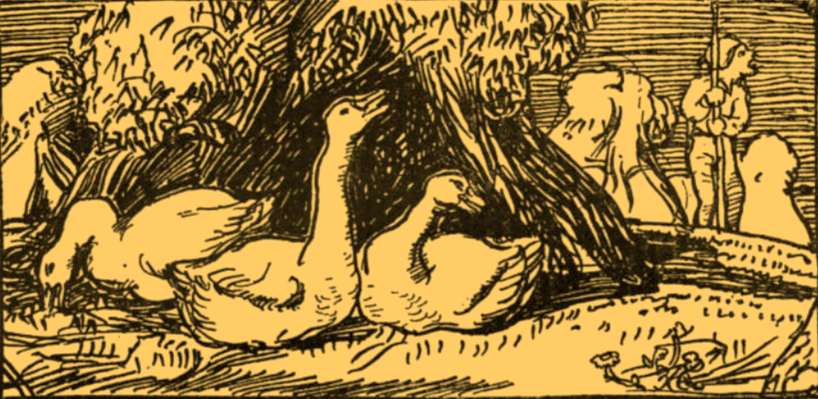
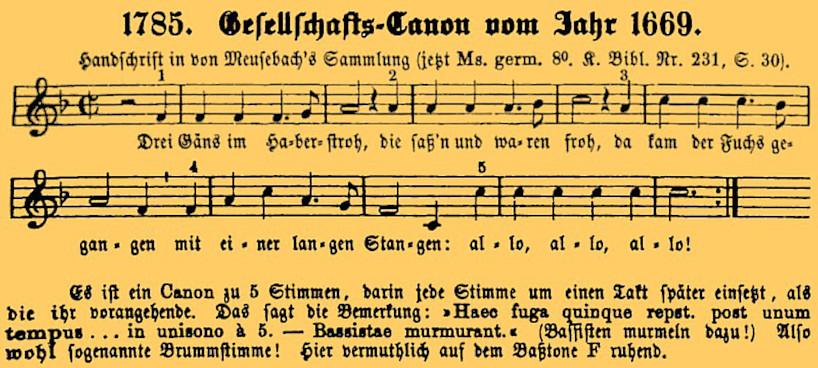
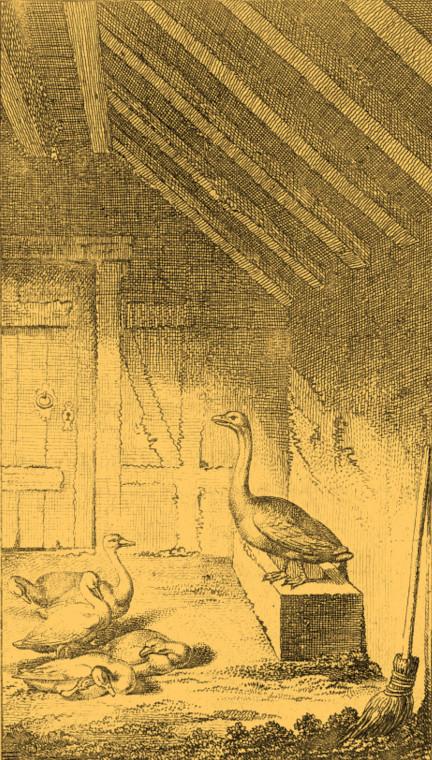
(Three geese in the hay / were sitting so gay, / then along came the fox / with a very long staff: / Hello, hello, hello . . .”) (illustration of topos, albeit not in the context of this song: Daniel Nikolaus Chodowiecki, Gänse in einer Scheune [1780]; Herzog August Bibliothek; Museums./Signatur Chodowiecki Sammlung [7-569]):
This material is cited in its own turn in Werner Danckert, Symbol, Metapher, Allegorie im Lied der Völker, 4 vols. (Bonn 1978), vol. 3, Pflanzen, 919. Slightly different readings can be found elsewhere as well, including in Clemens Brentano and Achim von Arnim, Des Knaben Wunderhorn: Alte deutsche Lieder, vol. 3, Anhang: Kinderlieder (Heidelberg 1808), 58:
Drei Gäns im Haberstroh
Sassen da und waren froh,
Dann kam ein Bauer gegangen,
Mit einer langen Stangen,
Ruft: wer do! wer do!
Drei Gäns im Haberstroh
Sassen da und waren froh!
(Three geese in the hay / were sitting so gay, / then along came the farmer / with a very long staff, / calling: Who’s there? Who’s there? / Three geese in the hay / were sitting so gay!)
(Franz Magnus Böhme, Deutsches Kinderlied und Kinderspiel: Volksüberlieferungen aus allen Landen deutscher Zunge, gesammelt, geordnet und mit Angabe der Quellen, erläuternden Anmerkungen und den zugehörigen Melodien [Leipzig 1897], 243):
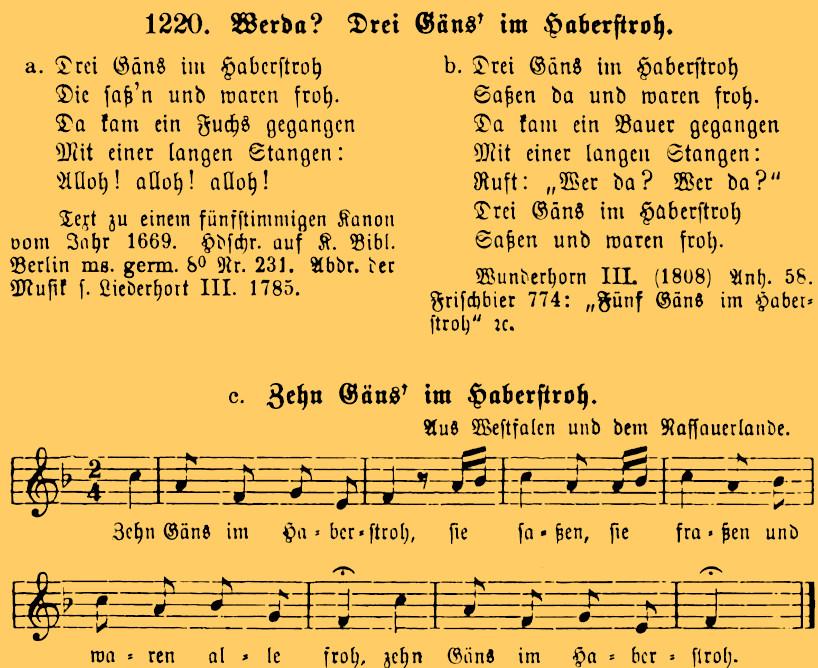
According to Danckert, Symbol, vol. 4, Tiere, 1353, in popular usage geese were viewed as aphrodisiacal birds, and as erotically dangerous given their attachment to the water. Back.
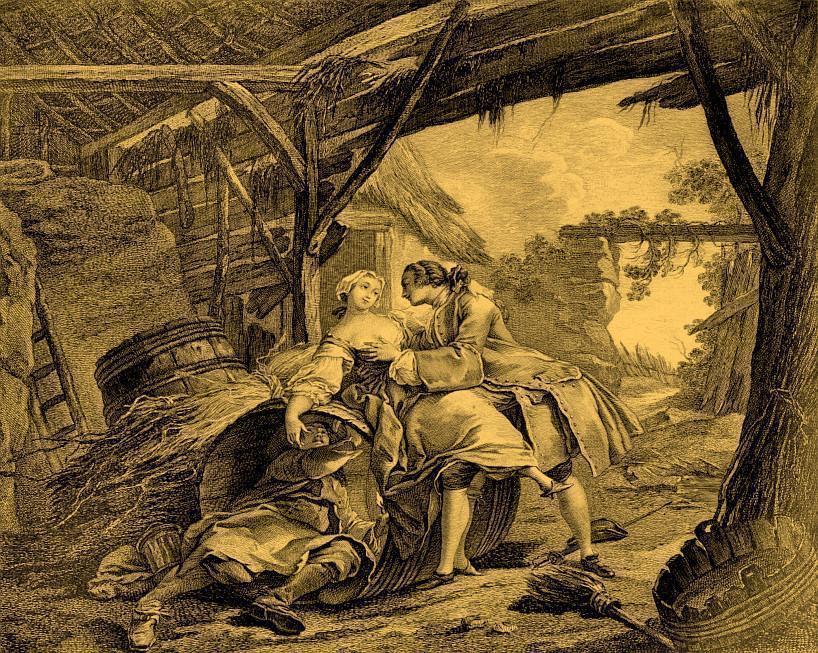
[7] Therese, who throughout Caroline’s life rarely misses an opportunity to cast aspersions on Caroline’s character or otherwise to find fault with her, even at the cost of distorting the truth, is here clearly encouraging Luise Mejer to see to it that, indeed, this “story . . . get turned and twisted” precisely that it might “fall into the right hands” (P. Le Mesle, Suite d’estampes tirées des Contes de la Fontaine: Le cuvier [1743]; Herzog Anton Ulrich-Museum; Museums./Signatur PFilloeul AB 2.2):
Translation © 2011 Doug Stott