
264b. Schelling to his Parents in Schorndorf: Künzelsau, 30 June 1800 [*]
Monday, 30 June [1800]
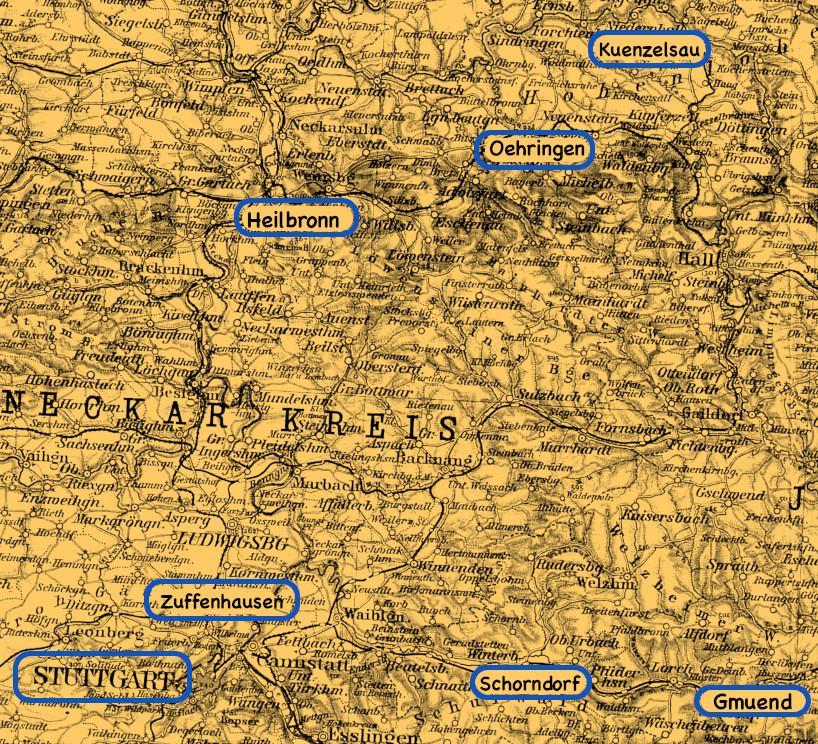
My dear parents, I am writing you from Künzelsau — already quite beyond any dangers of the war. [1] —
Beate will relate to you how wholly unsuccessful my plans to travel on horseback were from the very outset, and how I found myself forced to travel on by express postal coach. I departed Stuttgart at six o’clock in the evening and arrived safely in Heilbronn at one in the morning after traveling through the advanced posts of Szekler hussars. [2] I had hardly been there a quarter hour when these same hussars received orders to saddle up and march to Oehringen. [3]
Thus, and because I could not immediately secure horses in Heilbronn, I would have fallen directly into the midst of these columns had an Oehringer retour chaise not quite fortuitously been able to take me along as well. [4] And so I arrived in Oehringen early this morning and finally here around midday, where I will rest up a bit, having for all practical purposes not slept at all for four nights now. —
How and when I will get farther, I cannot yet say. I will not be able to let you know anything more definite until my next letter about where you can write me. If, however, you have anything you must write me about, simply enclose your letters in one to Professor Röschlaub in Bamberg, to whom I will more likely be able to give my address. [5] If any letters have arrived for me — I heard in Stuttgart that the postal service between Gmünd and Schorndorf is now open again [6] — please send those to Röschlaub as well, who will make sure they are forwarded on to me.
It was only after I had left you for good and had also said farewell to my sister, who accompanied me the short distance to Zuffenhausen, [7] that I appreciated how good it felt to be among you. Let me thank you a thousand times, my dear parents, for the love you showed me; it will be a sacred memory for me, and though it doubly grieves me having to be so far removed from you, it will nonetheless be a balm and encouraging keepsake for me when I am so far away. May God richly bless you and maintain both your and my courage even amid such uncertain prospects — stay very well.
Only now do I regret having been able to provide so little relief for you during my stay in Schorndorf — in times of greater tranquility, let us also live together more tranquilly. Nor was I able to provide even the slightest joy for my sister, and, constantly focused on my journey as I was, did not even leave anything behind for her as a keepsake, really nothing at all. [8] —
I must close now. Again, stay well; I wish you security and peace. Where I am now going it is indeed peaceful — but I am also alone and lonely.
Please remember me fondly.
Your
Fritz.
Notes
[*] Sources: Plitt 1:301–2; Fuhrmans 2:227–28. — Schelling had been in Schorndorf since approx. 4 June 1800. Concerning his journey and the location of Schorndorf, see Auguste’s letter to him on 4/5 June 1800 (letter 261), esp. editorial note and note 1. He did not arrive back in Bocklet until ca. 4 July 1800.
Below a map of the locales mentioned in this letter (Karte des deutschen Reichs, ed. C. Vogel [Gotha 1907], no. 23):
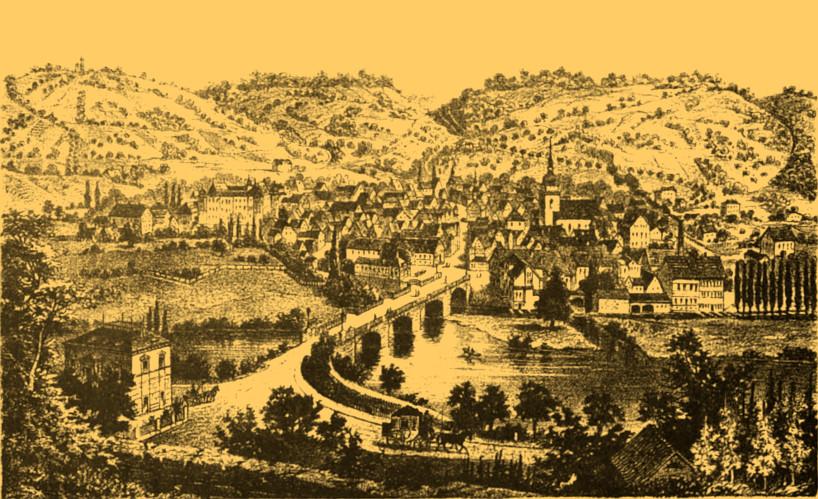
[1] Künzelsau is located approx. 67 km northeast of Stuttgart and 37 km northeast of Heilbronn (one travels through Heilbronn to get to Künzelsau) (frontispiece to Beschreibung des Oberamts Künzelsau, vol. 1 [Stuttgart 1883]):
At this time during the Second War of Coalition (1799–1802), French and Austrian troops were standing off against each other northeast of Heilbronn (at the time approx. 52 km north of Stuttgart [both towns are larger today]). Concerning the background to the present campaign, see Auguste’s letter to Schelling on 4/5 June 1800 (letter 261), note 3. Back.
[2] The Szekler hussars in the imperial army carried out what are known as the Rastadt murders in 1799 (see Caroline’s letter to Johann Diederich Gries on 10 May 1799 [letter 236c], note 25). Concerning this regiment in the imperial army, see J. G. Kohl, Austria, Vienna, Prague, and Hungary, Bohemia, and the Danube; Galicia, Styria, Moravia, Bukovina, and the Military Frontier (London 1844), 285:
The military frontier of Transylvania is not organised like that of Hungary. It forms no separate territory in which the whole population incurs the obligation of military service, but the troops, on whom this duty is laid, live scattered about in various parts of the country, and come at the appointed time from great distances to the “Cordon.” The finest of these troops are the Szekler hussars, though the Szeklers have besides two infantry regiments.
These Szeklers form one of the three nations inhabiting Transylvania (Saxons and Magyars are the other two), for the most numerous people, the Walachians, pass for no nation at all. The Szeklers boast of being the direct descendants of the men of Attila, although this can be just as little proved as that they are a Magyar people, as is asserted by the Hungarians. One thing, however, is certain, that the Szeklers speak the purest Hungarian, and have longest preserved the ancient customs of their supposed ancestors.
Each of the houses on the frontier belonging to the Szekler regiment are obliged to furnish one hussar, and to equip him from head to foot. The officers equip themselves, and in consideration of this are released from all other public burdens.
The Szekler hussars have the best horses and the best uniform; and while the other eleven Hungarian regiments of hussars are said to excel all the other hussars in the world, these Szeklers again are considered to be the aristocracy of the hussars of Hungary. They are the lightest and most skilful cavalry in the world, and at the same time a bold, frank, and noble spirited set of men. Their high reputation, and their romantic life on these Turkish frontiers, has induced many English officers to join them.
The whole regiment does not come together above once in every four years, but to those who take an interest in these things, to see the Szekler hussars go through their exercise, is counted one of the prettiest spectacles in Europe, and alone worth a considerable journey.
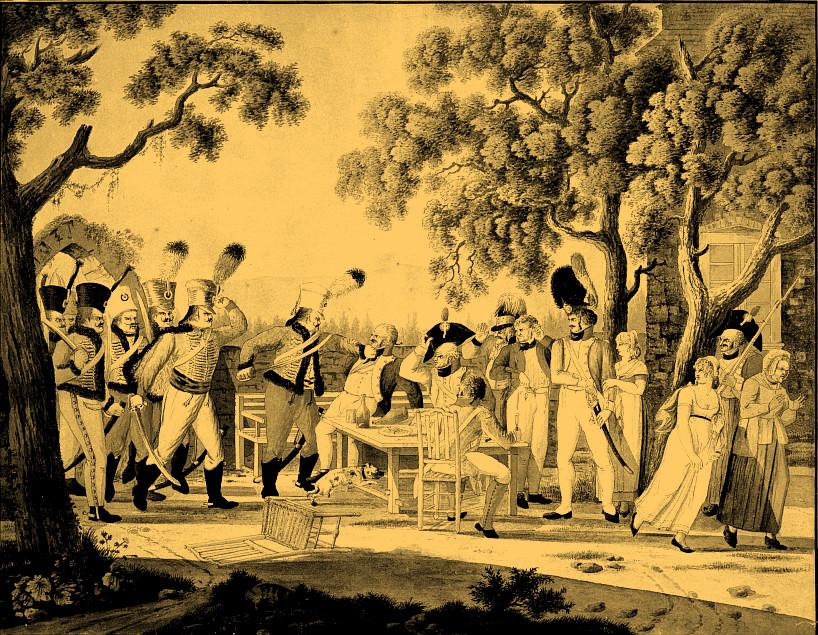
Here an illustration by Friedrich Rottmann of Szekler hussars (on the left) surprising a group of French soldiers (on the right) outside an inn in Siebenmühlental (just south of Stuttgart; Überfall der Szekler Husaren auf die Französen im Siebenmühlental; one of a pair of hand colored etchings by and after Rottmann, 1805) (© Anne S. K. Brown Military Collection, Brown University Library; by permission):
[3] Oehringen is located ca. 25 km east of Heilbronn, 16km southwest of Künzelsau. Back.
[4] Retour chaise, Fr., “returning carriage,” i.e., a carriage returning whence it came and in many cases seeking paying passengers to help cover costs; at inns and other stations, such carriages often had signs or simply chalk writing on them reading “Retour nach, “returning to . . . ” Here in letter 264b: a carriage returning to Oehringen. Back.
[5] By this time, Caroline and Auguste had been in Bocklet since approx. mid-June, having departed Bamberg on 12 June 1800. Back.
[6] Gmünd (today: Schwäbisch Gmünd) is located ca. 50 km east of Stuttgart; that is, Schorndorf is situated between the two towns. Back.
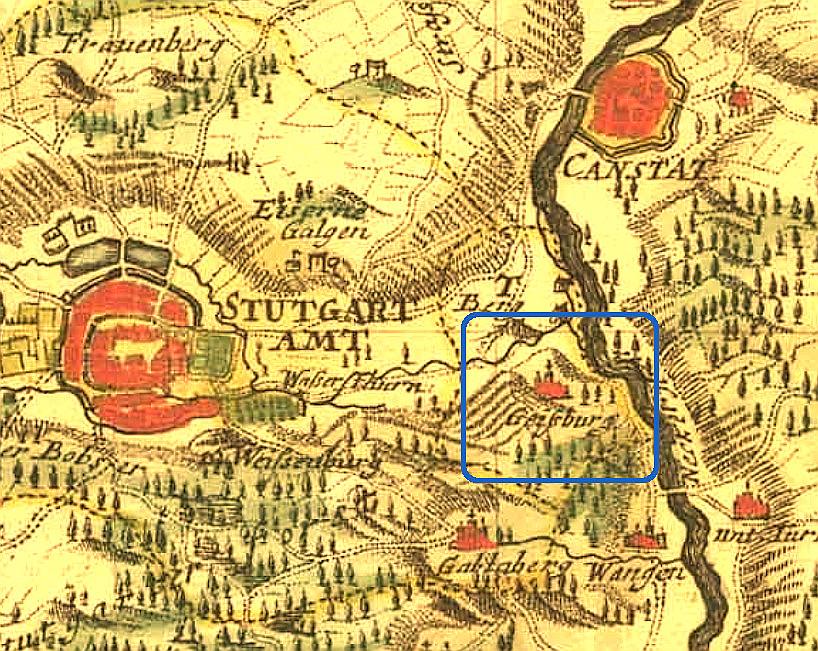
[7] Today part of Stuttgart, Zuffenhausen is located just north of the city (see map above). — Beate Gross, née Schelling, lived in Gaisburg, essentially a suburb of Stuttgart (first map: Stutgart, mit dero Gegend auf 2 Stund. 81 G. Bodenehr fecit et excudit; Recens emendavit, auxit atque divisit R. H. Stuttgardiae [1716–50]):
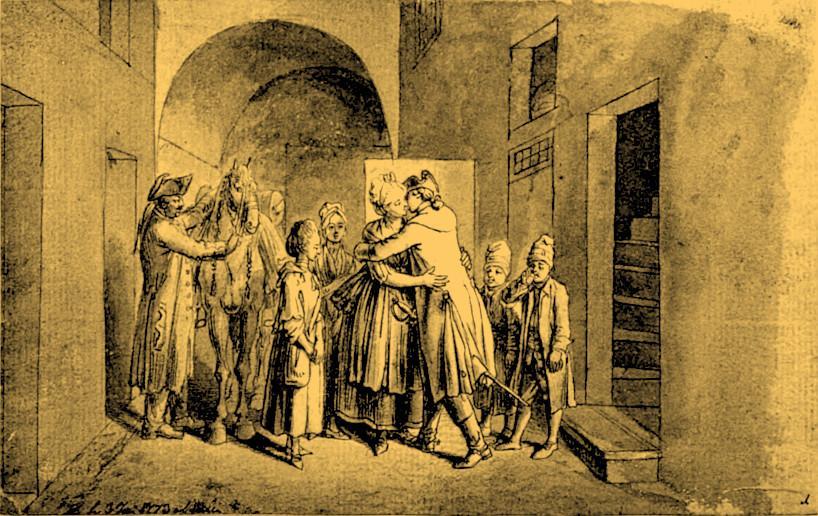
[8] Daniel Nikolaus Chodowiecki, Von Berlin nach Danzig. Eine Künstlerfahrt im Jahre 1773 von Daniel Chodowiecki. 108 Lichtdrucke nach den Originalen in der Akademie der Künste in Berlin. Mit erläuterndem Text und einer Einführung von Professor Dr. W[olfgang] von Oettingen (Berlin, Amsler & Ruthardt, Kunsthändler o.J. (1883), plate 1, “Der Abschied” (“The farewell”):
Translation © 2014 Doug Stott