
259k. Dorothea Veit to Schleiermacher in Berlin: Jena, ca. 28 April 1800 [*]
[Jena, ca. 28 April 1800]
Not losing is the first step toward winning, and as such let us give it its due and accept it with gratitude. [1] But do let me know by the by whether you were able use the winnings to pay for the new lottery ticket for the 5th class, or whether you paid for it for me yet again. I would also like to know how much Jette paid for the guirlande, I do not want to forget to charge Caroline for it. [2] Thank heavens we are rid of Madam Lange. [3] If Friedrich succeeds in placing Florentin with Bohn, he will probably pay out some money immediately, and if not, then for sure — indeed, for sure what? God knows I know not. [4] . . .
Caroline continues to be ill; more specifically, she has had a rash now for more than a week, which her physicians are calling the final crisis, reassuring us that it will end soon. [5]
For several days I found it advisable (namely, at Friedrich’s insistence) not to go up to see her, and this time he was right. [6] This was a good crisis for me, prompting an explanation that improved my own condition insofar as they now know what one can offer me and what not. And I especially became better acquainted with myself during this calmer period, and gained more clarity concerning my feelings of having no respect for certain persons. Before I came here, I would never have thought that this particular woman here would end up being so troublesome to me. —
What a Baroque mixture of heinousness and tenderness, of intentional deception and thoughtless lack of understanding! — the lover, an arrogant, defiant braggart whom, God knows, one can find amiable only if one loves him inordinately in the first place.
And Wilhelm, incessantly raising his heels that he may all the more easily swing up into life’s saddle; but once successfully in, he is too ponderous to get back out again; au reste il est fort bon garçon. [7] As Friedrich says, only three devils ever got into him: the schoolmaster, the professor, and the husband. [8]
I can say, however, that I will definitely not be going along to the mineral-springs spa; [9] we would be quite happy indeed were she already residing sain et sauf [10] in the proximity of the archbishop! [11] but that is not as easy as one might think, since she wants to wait for Charlotte to persuade her of all sorts of things; [12] Wilhelm loyally assists her and supports her petitions to Charlotte, while Friedrich works against them with all his powers, and from every quarter there are cries of “You have no right to do that!” —
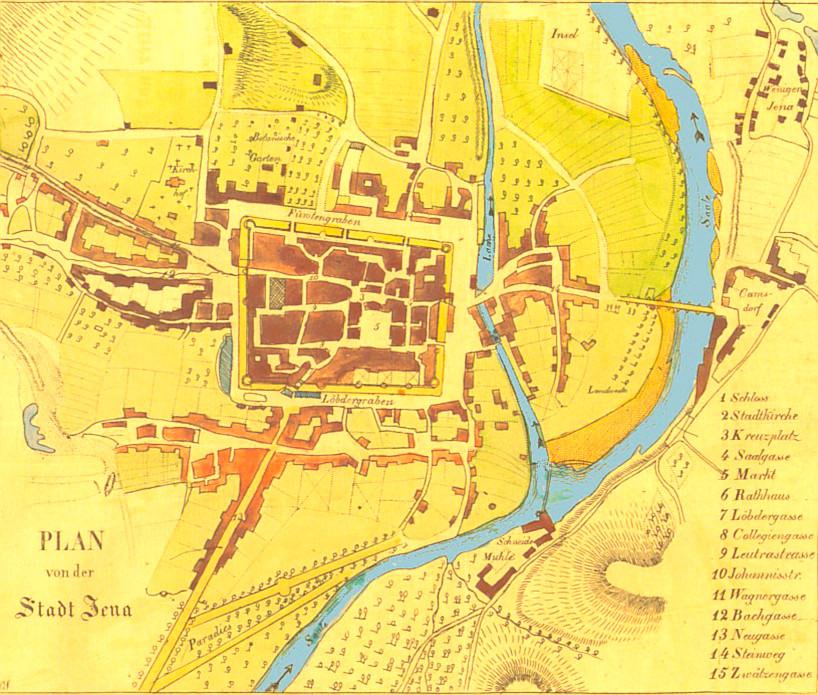
In a word, it is a proper muddle. That said, we have gotten to the point that we can joke about it; there is no talk of either sadness or vexation, I am working again, and because my room has been desecrated and turned into a common place during this illness, [13] a place where I have not a moment’s peace and quiet, I rented a quiet room very cheaply in a very nice area right on the water, [14] and there I will be working in solitude for several hours during the day. But this is a secret, no one knows but Friedrich and the Tiecks. Nor should anyone else learn about it.
If you want to show Madam Bernhardi the Roast Turkey, [15] then do so, but such that she does not sense it might conceal any sort of malice or secret, she must be informed that Tieck himself read it, and that it is nothing but a little society jest; I did it after one of Shakespeare’s plays was read aloud. [16] —
How could you, dear Schleyer, read anything else into it other than the various artistic opinions of our circle? of course with a bit of poetic enhancement. If you would greet her in my name and relate to her some of the bambocciate from here, you would be doing me a great favor; [17] I promised to send her news, but since that news is not what either she or I thought it would be, I chose not to write her about it; [18] I would have had to write too much, and I simply did not have the time. If you want to relate it all to her, I am sure it would amuse her.
I am to come up with a title? [19] I am not quite skilled enough for that. Why not call it simply: “To my Friend, from Sophie.” Or: “Solitary Observations,” or: “Missive to the Unknown Gentleman.”
How often I think of you now, my dear friend! Berliners have no experience with a springtime such as this; for me the certainty that spring genuinely does exist is a completely new experience. If only you could see these velvet meadows with their violets and primroses, this animated, meandering river with its cheerful banks, these gentle hills, and the thousand wonders, and take it all in with all your senses! It really is divinely beautiful here! If Florentin can be lucratively placed with a publisher, I will be quite cheerful here indeed. —
I longingly await your answer to my last letter, I really would like to come to peace with Friedrich one day, that much I must confess; but how best to begin?
Please do go see my Jonas, and give him my regards; [20] I will be writing to him soon, I did receive his letter. Stay well and give my regards to Jette as well. . . .
Notes
[*] Sources: Briefe von Dorothea Schlegel an Friedrich Schleiermacher 58–61; KGA V/4 4–7; KFSA 25:97–99. — Dating: KFSA 25:445 and KGA V/4 3. Back.
[1] Schleiermacher had played the lottery for Dorothea and Friedrich; see Friedrich’s letter to Schleiermacher on 21 March 1800 (letter 258u), also with note 2 concerning the lottery in Berlin. Back.
[2] Concerning the garland Henriette Herz was to secure for Caroline, see Dorothea to Schleiermacher on 14 February 1800 (letter 258m); the garland apparently arrived successfully in Jena. Back.
[3] Dorothea owed money to an otherwise unidentified Madam Lange in Berlin (see Dorothea to Schleiermacher on 14 February1800 [letter 258m]); the debt had apparently been paid. Back.
[4] Friedrich was indeed successful in placing the book with Johann Friedrich Bohn in Lübeck: Florentin. Ein Roman herausgegeben von Friedrich Schlegel, vol. 1 (Lübeck, Leipzig 1801); vol. 2 never appeared. Back.
[5] Grimm, Deutsches Wörterbuch, s.v. (Dorothea uses Germ. Friesel), identifies this rash as febris, then distinguishes two kinds, white and red, febris miliata and febris purpurata. See Adelung 2:308, s.v. Friesel:
An illness accompanied by fever that consists of raised blotches on the skin deriving from the causticity of the watery substance in the blood, blotches that remain visible for a time and then dry up and fall off as scales. Red Friesel, purpura, is also called scorbutic Friesel and usually accompanies the extremely pernicious River Fever. . . . White Friesel, which bears this name because of the white color of its rash and, because its rash is often the same size as millet seeds, is also called miliary fever, febris miliaris, is more pernicious that red Friesel, which it occasionally also accompanies. Back.
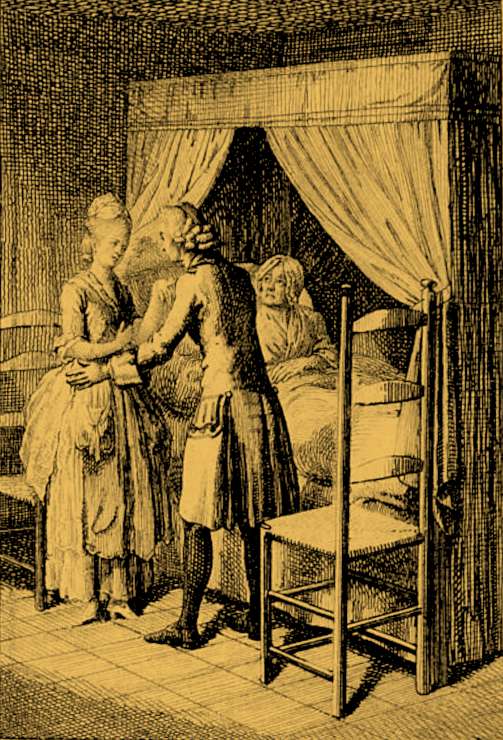
[6] On 11 October 1799, shortly after arriving in Jena, Dorothea wrote Schleiermacher the following about the distribution of rooms in the house at Leutragasse 5 (letter 247c): “I myself live downstairs, one flight up Caroline, then Wilhelm, and finally, in the uppermost story, Friedrich” (Daniel Nikolaus Chodowiecki, Ists möglich, Herr Feind? ists möglich. [1776]; Herzog Anton Ulrich-Museum; Museums./Signatur DChodowiecki AB 3.166):
[7] Fr., “otherwise he is a good fellow.” Back.
[8] Friedrich’s assessment was portentous, since these traits would contribute to the undoing of Wilhelm’s later marriage (1818) to Sophie Paulus. Back.
[9] To Bocklet. See Dorothea’s letter to Schleiermacher on 4 April 1800 (letter 259c), note 8. Back.
[10] Fr., “safe and sound.” Back.
[11] Caroline, Schelling, and Auguste were planning on going first to Bamberg (ca. 125 km south-southwest of Jena), with its prince bishop, Christoph Franz von Buseck (rather than archbishop, as in Würzburg, the latter ca. 50 km south-southwest of Bocklet); Bocklet itself is situated just over just over 70 km northwest of Bamberg, ca. 32 km north-northwest of Schweinfurt. See Dorothea’s letter to Schleiermacher on 4 April 1800 (letter 259c), note 8, and esp. the galleries on Bamberg and Bocklet. Back.
[12] Charlotte Ernst had been planning to come to Jena that spring, with Caroline planning to return to Dresden with her; neither Charlotte’s nor Caroline’s trips materialized; see Caroline’s letter to Auguste on 17 October 1799 (letter 249), note 5. Back.
[13] “Common place” in English in the original. Back.
[14] Somewhere along the Saale River, which runs along the southern edge of town (Carl Schreiber and Alexander Färber, Jena von seinem Ursprunge bis zur neuesten Zeit, nach Adrian Beier, Wiedeburg, Spangenberg, Faselius, Zenker u. A. von Carl Schreiber u. Alexander Färber: Mit Kupfern, Karten, Lithographien u. Holzschnitten [Jena 1850], map following p. 52):
[15] Dorothea’s bit of “deviltry” (regrettably not extant) in which she satirizes members of the Romantic circle in Jena (see Dorothea to Schleiermacher on 17 March 1799 [letter 258t]).
Sophie Bernhardi writes to her brother Ludwig Tieck in early June 1800 (Briefe an Ludwig Tieck 3:258; incorrectly attributed to Wilhelm Schlegel [KFSA 25:446fn24]): “On the occasion of a roast turkey I saw a poem by Madam Veit that comically presented you and the rest. Do you also find it witty?” Perhaps Schleiermacher arranged such an evening, based on taking the title of Dorothea’s satire literally, at the home of Henriette Herz (KFSA 25:446fn24). Back.
[16] Presumably from Wilhelm’s edition of Shakespeare; volume 6, containing the two parts of Henry IV, would appear in May. Back.
[17] Allusion to August Ferdinand Bernhardi’s Bambocciaden (Berlin 1797–1800), three collections of humorous, in part satirical stories, often malicious portrayals of Berlin social and literary life in miniature, whence the title (bambocciate, also bambocciade, from bamboccio, “cripple,” term originally used to refer to — sometimes grotesque — Dutch paintings of low life such a country wakes and “penny weddings”; name originally given to Pieter van Laer), to which Sophie Bernhardi had also contributed and including also Ludwig Tieck’s Die verkehrte Welt. Ein historisches Schauspiel in fünf Aufzügen in the 1799 issue. Back.
[18] See Dorothea’s cautious letter to Sophie Bernhardi on 16 January 1800 (letter 258f), esp. with note 2. Back.
[19] For Sophie Bernhardi’s contribution to the final issue of Athenaeum (1800) (and final overall); the title ended up being “Lebensansicht” (“view of life”), the piece appearing on pp. 205–15. Back.
[20] Part of Dorothea’s divorce settlement with Simon Veit was that her eldest son, Jonas Veit, would remain in Berlin with Simon Veit. Back.
Translation © 2014 Doug Stott