
254b. Schelling to Friedrich August Carus (?) in Leipzig: Jena, 9 November 1799 [*]
Jena, 9 November 1799
. . . It is to be expected that the reputation of the university here will soon be reduced to that of mediocrity; Fichte’s fate will have additional consequences. [1] —
Do not believe any rumors to the effect that I am destined to replace him. A few days after he received his dismissal, when someone in Weimar was maintaining that I would be taking over his lectures, I officially denied that I could ever become Fichte’s successor, and also issued that same assurance in my first lecture after that particular event. [2] —
Nor do my own current plans even involve staying here in any case, and since I now find myself in a position to spend some time on journeys, I will perhaps be leaving Jena next summer, a journey that will ultimately probably also take me to Vienna. [3] —
That notwithstanding, our overall situation here is still far freer and no doubt more fortunate than your own. There is little fear now that freedom of thought might be restricted, and no notion of even discussing such. There is interest in the work I am doing, and that Goethe is a minister provides some not inconsiderable advantages. —
A while back he spent several weeks here, and for a while I saw him daily, even had to read and discuss my piece on the philosophy of nature to him aloud. [4] You can well imagine how much these conversations profited me with respect to additional ideas. —
At the behest of a large number of people, I am repeating the previous semester’s lectures on transcendental philosophy this winter [5] and at the same time am working on a system of transcendental idealism, [6] which I hope will illuminate some points that are yet obscure and provide a better indirect refutation of various objections that do not merit a direct one. . . .
Notes
[*] Source: Fuhrmans 1:176–77. — Addressee uncertain; Fuhrmans (1:175n25) also considers the Leipzig professor of physics Hindenburg, with whom Schelling was acquainted during his earlier period in Leipzig; Schelling seems, however, to have been good friends with Carus as early as 27 May 1796 (see his letter to his father, Plitt 1:119). Back.
[1] An essentially correct statement insofar as by 1803, albeit not entirely a result of Fichte’s dismissal, the university would lose several prominent members, including Schelling, Friedrich Immanuel Niethammer, and H. E. G. Paulus, all of whom received appointments in Würzburg after the political developments there (see volume 2). See in any case the assessment of H. E. G. Paulus in supplementary appendix 377c.1. These developments exercise determinative influence on Caroline and Schelling’s lives. Back.
[2] Schelling was never a salaried professor in Jena, that is, a full professor of philosophy. Neither, however, did Fichte occupy either of the two full professorships in philosophy at Jena (speculative and practical), and had only received Karl Leonhard Reinhold’s title as professor ordinarius supernumerarius in 1794. After Fichte’s dismissal, that title was retired (see Fuhrmans 1:176n26). Back.
[3] Concerning Schelling’s plans to leave Jena and journey to, among other possibilities, Vienna and Bamberg, see his correspondence with Fichte during July–November 1799 (supplementary appendix 241.1, documents 5, 6 with note 13). See also his letter to his father on 2 March 1800 (cited in Caroline’s letter to Auguste on 21 October 1799 [letter 250], note 15) (W. R. Shepherd, Historical Map of Central Europe about 1786 [1926]):

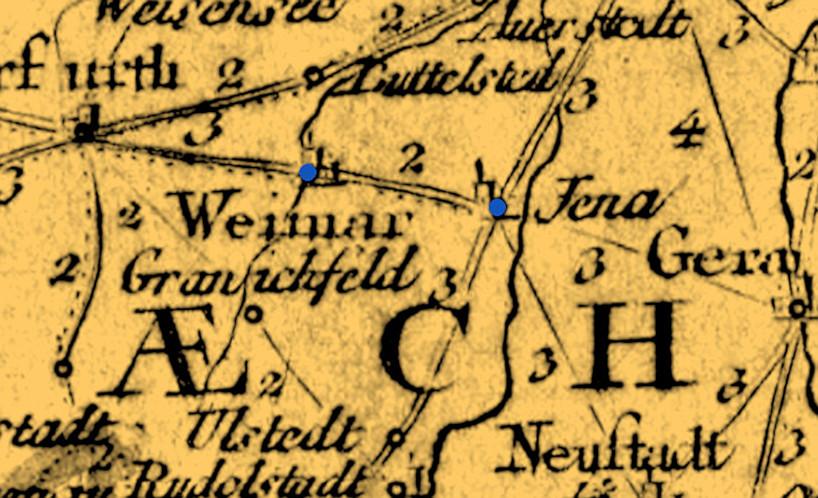
[4] Goethe was in Jena 16 September–13 October 1799 (Weimarer Ausgabe 3:2:259–65), meeting numerous times with Wilhelm Schlegel to discuss metrical revisions to the poems he was preparing for publication (see supplementary appendix 245.1) and also regularly with Schelling as indicated in this letter (Post Karte Durch ganz Deutschland, ed. J. Walch [Augsburg 1795]):
Goethe’s diaries (Weimarer Ausgabe 3:2:259–65) contain the following entries during this period:
15 September [still in Weimar]: “Evening Lucinde and Schelling’s philosophy of nature”;
19 September [now in Jena]: “Schelling’s philosophy of nature . . . evening at Schiller’s, first concerning magnetism, then the relationship between empirical experience and transcendental philosophy”;
20 September: “evening at Hofrath Schiller’s, Professor Schelling was present”;
22 September: “evening Schelling; interesting discussion about the philosophy of nature and empiricism”;
23 September: “Prof. Schelling; introduction to the outline of his philosophy of nature [Einleitung zu seinem Entwurf eines Systems der Naturphilosophie, oder: Ueber den Begriff der speculativen Physik und die innere Organisation eines Systems dieser Wissenschaft (Jena, Leipzig 1799)]”;
29 September: “evening at Schiller’s with Gries and Schelling”;
2 October: ” . . . afterward Prof. Schelling, together read through to page 33 in his “Entwurf der Naturphilosophie;
3 October: “. . . Then Prof. Schelling, Einleitung zu seinem Entwurf;
4 October: “Prof. Schelling, conclusion to the Einleitung zur Naturphilosophie;
5 October: “Prof. Schelling, outline of the Entwurf seiner Naturphilosophie;
7 October: “At 3:00 Prof. Schelling”;
10 October: “Prof. Schelling concerning electricity and magnetism”;
13 October: “at 11:00 Schelling with whom I once again discussed some interesting points.” Back.
[5] The lecture on transcendental philosophy was not announced in the official catalogue, which instead announced lectures on the philosophy of art, which he did not give until 1802–3, and (in the department of natural sciences rather than philosophy) on the organic doctrine of nature. Horst Fuhrmans (1:177n29) conjectures that Schelling had to alter his plans and lecture on transcendental philosophy because of Fichte’s departure. Back.
[6] System des transcendentalen Idealismus (Tübingen 1800); translatd by Peter Lauchlan Heath as System of transcendental Idealism (1800) (Charlottesville 1978). Back.
Translation © 2013 Doug Stott