
• 25. Caroline to Julie von Studnitz in Gotha: Göttingen, 3 September 1781 (Fr.)
Göttingen, 3 Sept[ember] 1781
|48| . . . We have had quite a singular visitor here, a certain princesse de Gallizin, whose husband is the ambassador of the court of Russia at The Hague. [1] An extremely knowledgeable woman, dressed in a sort of Greek drapery cloth, with short-trimmed hair, flat shoes, whom one rarely sees without a servant, who carries around a half dozen |49| large books in folio format, who goes to bathe with an entourage of 6 to 8 gentlemen in broad daylight in our Leine River etc.
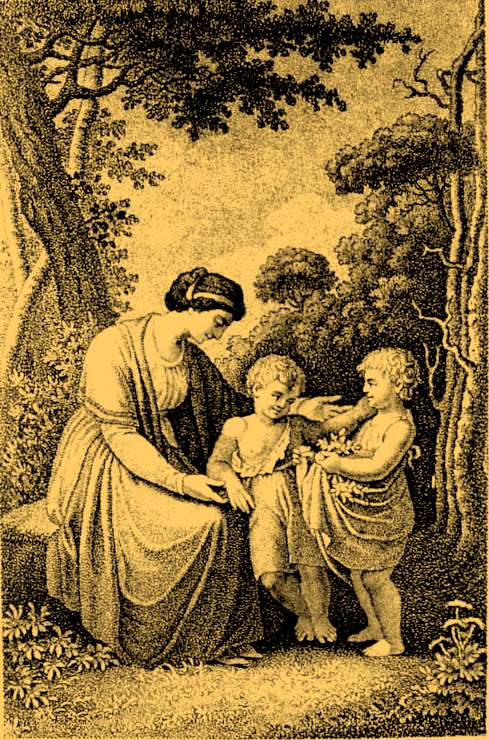
Her children are quite lightly dressed, the son in long culottes and a shirt, but no other clothes at all, and the daughter in a kind of nightgown, open in the back from top to bottom and tied once at the top; both walk about barefoot, their hair not really cut but shorn. [1a] They are as black as negroes.
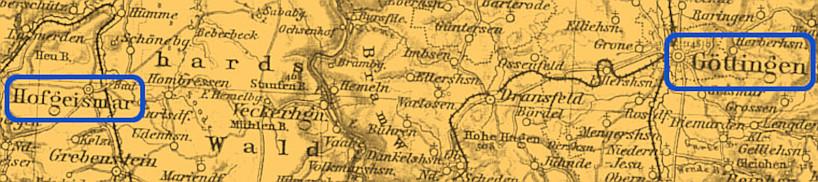
The princess herself is rather pretty, and her complexion beautiful even though she exposes it a great deal. She must have a great deal of intelligence, spirit, and knowledge. She reads Homer in the original, and at Hofgeismar, [2] whence she comes just now, she had Homer carried along to her bath each morning.
As for the education of her children, she seems to take simple nature as her model without worrying about the fact that nature is sometimes a bit dirty. Perhaps she wants to imitate Rousseau, though I fear that Rousseau raised his Emile a bit differently. [3]
She lives in Münster, separated from her spouse, so that she is able to devote herself entirely to her children and to philosophy. It was the library and the teaching of our professors that attracted her here, and she intends to stay a long time.
You can well see, my dear Julie, that this lady is one of our greatest geniuses, except that she is erudite, and I believe I have already remarked on occasion that erudition is not exactly the strength of our geniuses today. In any case, I submit her to your judgment.
As for me, I feel I could admire her but never honor her, and I believe she will please less as a women than as an oddity, and so I renounce with all my heart the honor of such admiration. I believe that a woman has so many tasks to fulfill on earth that, though they are not talked about as much as men’s, are much more |50| laborious, and also have more influence on humankind. For one’s initial education is the most important and determines the rest of a person’s life, such that a woman has no need either of being erudite or of affecting uniqueness in that which should constitute her preferable occupation.
I say nothing about the fact that the princess, with all this business of erudition, is also neglecting her husband. We have had many interesting visits during the past summer. I have not yet told you that the Duke of Weimar was here and paid a visit to my father, who afterward received an extremely nice and obliging letter from him. [4]
It does seem, however, that the duke has quite reformed, the same as his favorite, Goethe. At least that is what people are constantly telling me, though lately people have related so many of the deeds of these two concerning the young Duchess of Meiningen, and other stories as well, that I have been tempted to modify my judgment. But it is almost impossible for me to believe them entirely because the Duke of Gotha had to have played a role in it. You, my dear friend, must at least know whether it is true that your duke courted the duchess of Meiningen, and if it is true that they stayed only five days at the court in Gotha because Goethe and the Duke of Weimar tried to arouse jealousy in the Duke of Meiningen, who departed first and had his spouse follow, and other, similar deeds. [5]
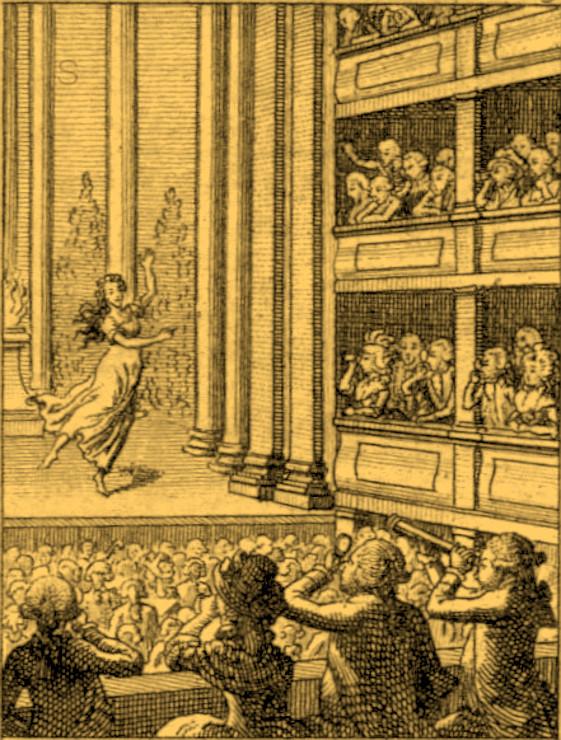
Our theater has just been closed. When the curtain fell for the last time, my heart did indeed pound a bit. It is true that among such entertainment a good play is the one I most love and the one to which I prefer neither a ball nor a redoute nor any other amusement; all those things are usually something only for the |51| senses, while a play nourishes both the senses and the soul. Even though our performances were not always the best, I attended them with pleasure, and the company one encountered there often enough compensated for the play itself. [6]
Most of the people who attend do so only for the people they meet. I would love with all my heart to be able to come to Gotha to see the performance of the Six Plats [7] on the duchess’s birthday, and to see Gotter play the role of the councilor, which he doubtless performs in a superior fashion. [8]
I have not yet told you anything about my brother, who has not written for six months. [9] Ah, Julie, consider what that might mean! But I dare not yield to those ideas, lest their weight crush me. I was heavy with sadness, a sadness without tears that is near desperation, when I then learned that he was still alive and that his letters had no doubt simply gotten lost. I have come to life again a bit, but how often is this heart of mine anxious! . . .
Notes
[1] Johann Stephan Pütter, Gelehrten-Geschichte, 2:16–17 (with the incorrect date “[summer] 1780”), recounts that “Princess Amalia von Gallitzen, née Countess von Schmettau, among other things attended several days of lectures on the history of the Thirty Years’ War in a course on German imperial history,” Pütter himself being the lecturer during that summer. Back.
[1a] That is, clothed and groomed after the Graecizing and Romanizing fashion that had become popular in certain European circles Taschenkalender für Damen auf das Jahr 1800; Inhaltsverzeichnis deutscher Almanache, Theodor Springmann Stiftung:
[2] Hofgeismar is located ca. 40 km west of Göttingen (Karte des deutschen Reichs, ed. C. Vogel [Gotha 1907], no. 13):
[3] Princess Gallitzin was in Göttingen with her children as part of her regular pedagogical visits with them to the better-known towns in Germany.
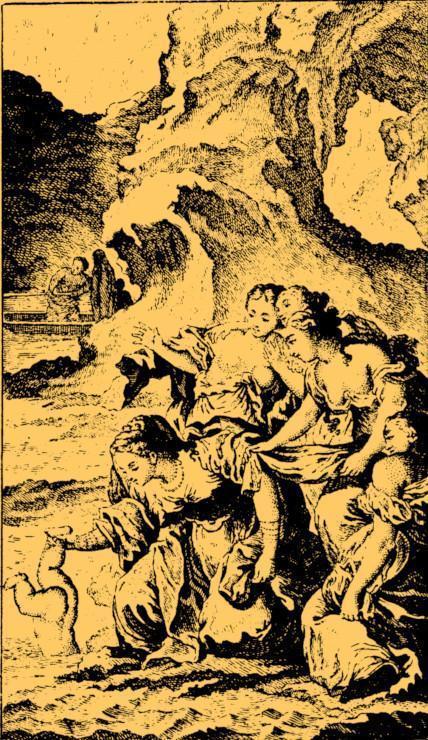
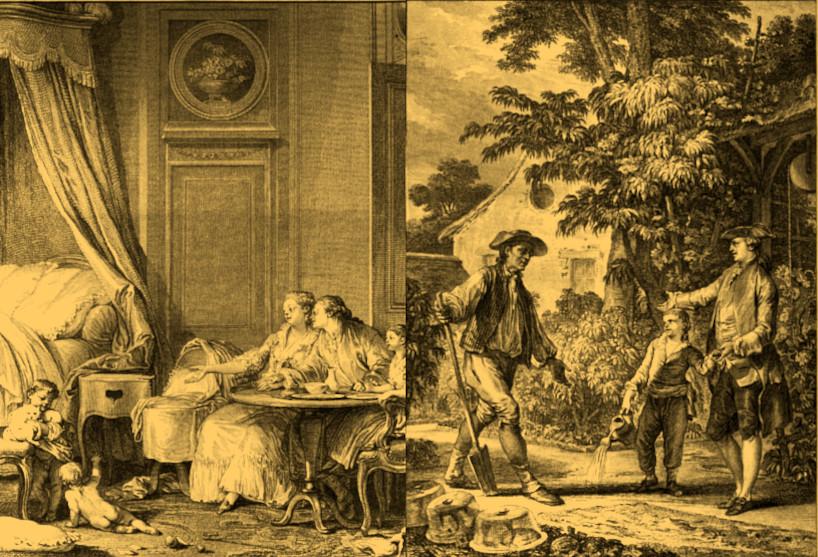
Jean-Jacques Rousseau, Émile, ou de l’éducation (Amsterdam 1762), a treatise on education that not only was condemned in France, but also resulted in Rousseau’s flight to avoid arrest. The frontispiece to vol. 1 of the edition of 1765 portrays Thetis plunging the infant Achilles into the river Styx to render him invulnerable; the heal by which she holds him, however, was not covered by the water (“Achilles’ heel”):
Here the four interior illustrations to vol. 1 of the London edition of 1774 (Émile, ou de l’éducation, vol. 1 [London 1774]):

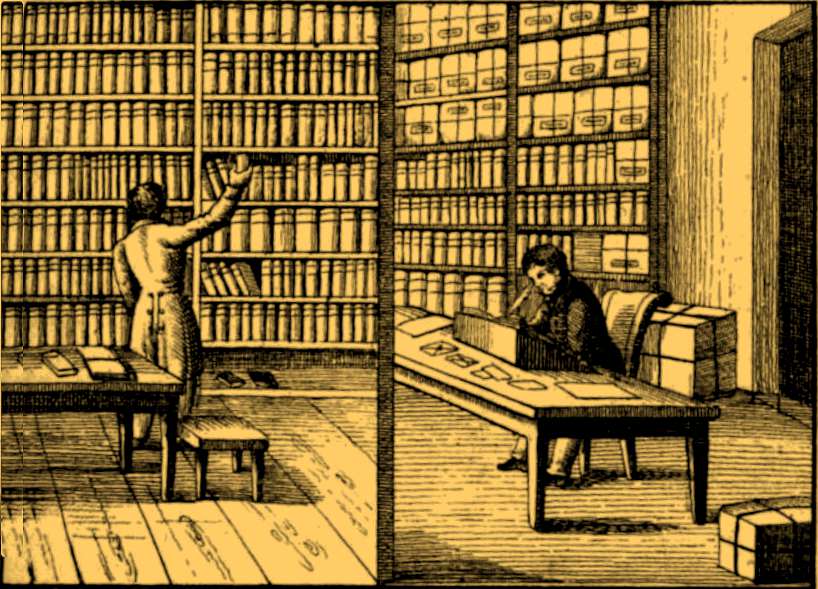
[4] Duke Karl August of Weimar had been in Göttingen in March 1781 with Johann Heinrich Merck, also visiting Gottfried August Bürger. Indeed, in August 1781 the duke purchased for the university in Jena the considerable library (40,000 volumes) of Göttingen professor Christian Wilhelm Büttner (1716–1801) for 8000 Thaler, a pension, and a free apartment in the Weimar castle; Goethe afterward reckoned that collection among the four most important in Jena (illustrations: [1] frontispiece to the Magazin für die neue Historie und Geographie 19 [1785]; [2, 3] J. E. Gailer, Neuer Orbis Pictus für die Jugend oder Schauplatz der Natur, der Kunst und des Menschenlebens [Stuttgart 1832], plate 231):

[5] Uncertain if intriguing reference. Briefly: the reigning Duke of Meiningen’s sister Charlotte was the reigning Duchess of Saxony-Gotha-Altenburg as wife of Ernst II; since 5 June 1780, the reigning (as Caroline says: young, having been born in 1764) Duchess of Meiningen was Luise, née Stolberg-Gedern. Back.
[6] A remarkably enduring self-assessment on the part of the young Caroline (Der neuesten Moden Almanach auf das Jahr 1795; Inhaltsverzeichnis deutscher Almanache, Theodor Springmann Stiftung):
[7] Fr., “six plates/dishes,” i.e., courses; the reference is to Gustav Friedrich Wilhelm Grossmann, Nicht mehr als sechs Schüsseln. Familiengemälde in fünf Aufzügen (published Bonn 1780); see Caroline’s letter to Julie von Studnitz on 14 June 1781 (letter 23), esp. note 8. Back.
[8] Charlotte, Duchess of Saxony-Gotha-Altenburg was born on 11 September 1751, hence the birthday would be celebrated a little over a week following Caroline’s letter here. The “councilor” is the play’s protagonist, Hofrath and Justizdirektor Reinhard. Back.
[9] For a brief and general account of Hessian participation in the American Revolutionary War, see supplementary appendix 4.1. Back.
Translation © 2011 Doug Stott