
• 249a. Friedrich Schlegel to Auguste Böhmer in Dessau: after 17 October 1799 [*]
[Jena, after Thursday, 17 October 1799]
|644| Dearest Auguste, actually I am glad you are a bit impatient to be getting back here; so, there is hope after all that |645| you will not be staying away for good. [1] Except for the fact that you are not here, everything is wonderful and fine. We really do wish you might be here now, and indeed wish it quite often; Madam Veit especially wishes it. I have already had to tell her all about you, and she thinks she is quite fond of you.
Wilhelm is composing verses, I am reading some, Madam Veit is listening to some, and your dear mother is thinking of some; Tieck is doing all these things together. When you are here again, we also want to do some acting, something like the play about which you write. [2] You will play the beautiful but unfaithful Angelica, Tieck the small, delighted shepherd Medoro, Schelling the raging paladin, Orlando the Furious, I the emperor Charlemagne, and Wilhelm the noble cousin Rinaldo of Montalban. [3]
Now that I have told you what we are doing, you need to tell me what all of you there are doing. Is it just as clever and just as diverse?
Please pass along my most respectful and upright regards to Madam Tischbein. Tell Caroline that I know full well that she already gave me the kiss, nor will I forget it, but that the one she still owes me is a different one entirely, as she well knows. [4] — You nutty children; do you not even notice when someone is pulling your leg, as it were?
Fear the Lord and learn to sing.
The fact that you must be confirmed is necessary, [5] strange, sad, and exceptionally funny. (Just do not be afraid of it. I myself was once confirmed and can assure you that it passes quickly.) [6] I would prefer to do it myself, but for that one must have a tonsure. [7]
Your Friedrich
Notes
[*] Source: Schmidt (1913), 1:644–45 (letter 33); Waitz (1871), 1:374–75; reprinted in KFSA 25:16.
Dating according to Friedrich’s remarks that assume the presence in Jena of Ludwig Tieck and his wife, Amalie, and daughter, Dorothea, who arrived on 17 October 1799. Because the reference to Betty Tischbein’s “kiss” suggests that not much time has passed between this letter and Friedrich’s letter to Auguste on 7 October 1799 (letter 247a), this present letter is likely not the one (no longer extant) to which Caroline refers in her letter to Auguste on 4 November 1799 (letter 253), which had even at that time not yet been sent. In any event, this present letter is the last extant letter from Friedrich to Auguste.
Concerning the textual history of Friedrich Schlegel’s letters to Auguste Böhmer, see supplementary appendix 181d.1. Back.
[1] Auguste returned to Jena from Dessau on 26 November 1799 accompanied by Wilhelm Schlegel, who had picked her up; see Caroline’s letter to Ludwig Ferdinand Huber on 24/27 November 1799 (letter 257). Back.
[2] Auguste’s letter is not extant. Back.
[3] Characters from Boiardo’s Orlando innamorato (1487) and Ariosto’s continuation in Orlando furioso (1516, 1532), not, as suggested in KFSA 25:380, Cervantes’s The Ingenious Hidalgo Don Quixote of La Mancha (El ingenioso hidalgo don Quijote de la Mancha) (1605, 1615) and Torquato Tasso’s Jerusalem Delivered (Gerusalemme liberata) (1580).
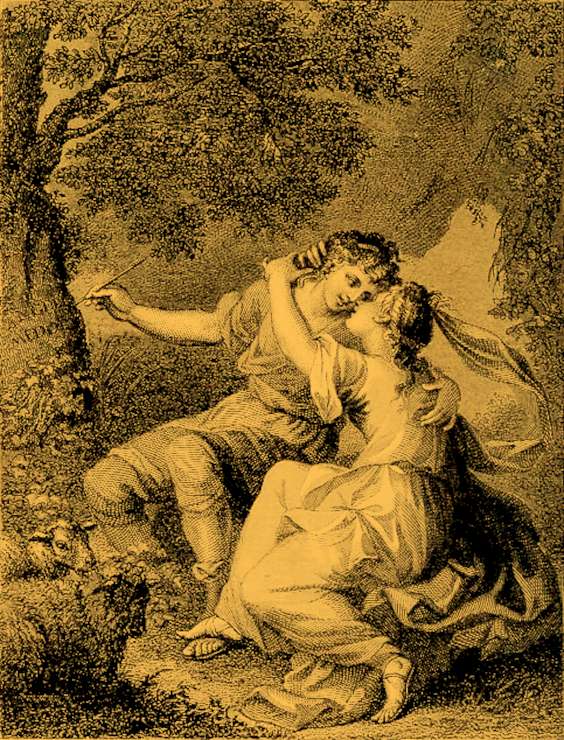
Charlemagne’s paladin Orlando (Roland), falls in love with the pagan princess Angelica, whom he pursues amid various adventures until she meets and falls in love with the Saracen soldier Medoro, with whom she, according to Friedrich, “unfaithfully” elopes, after which Orlando goes mad and “rages” throughout Europe in despair. Here an illustration of Medoro (whose character Tieck is to play) and Angelica (whose character Auguste is to play) by G. B. Cipriani, engraved by J. Stephenson, from Orlando Furioso. vol. 1 (London 1858), plate following p. 110:
Concerning a famous episode involving Angelica and Orlando (Roland), see Wilhelm’s letter to Johann Diederich Gries on 10 May 1799 (letter 236c), note 30.
In any event, Ludwig Tieck published a translation of Don Quixote, and Johann Diederich Gries a translation of Tasso’s piece as Befreites Jerusalem, 4 vols. (Jena 1800–1803). Back.
[4] See Friedrich’s letter to Auguste on 7 October 1799 (letter 247a). Back.
[5] “Necessary” written above the line, according to Waitz, (1871), 1:375, i.e., without a comma before “strange,” a comma added here for clarity (KFSA 25:16 omits the comma to maintain manuscript accuracy). Back.
[6] Parenthetical remarks added later, according to Waitz, (1871), 1:375. Back.
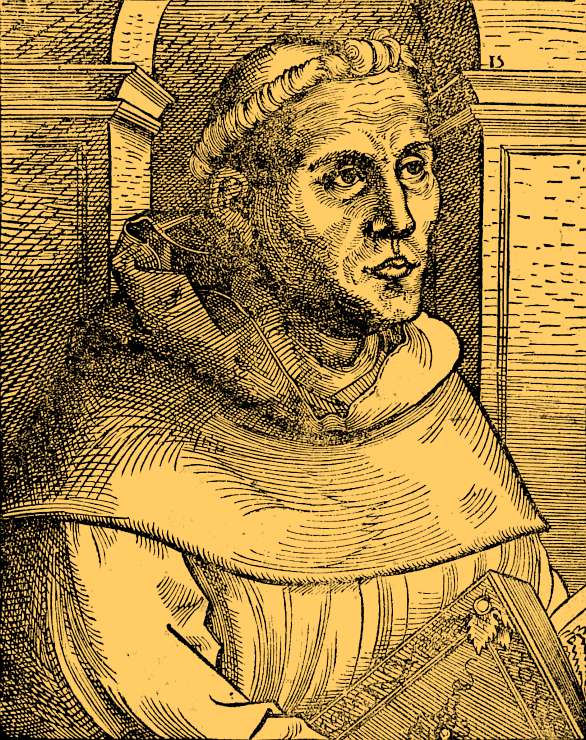
[7] That is, one must be a cleric, e.g., a priest or a monk as characterized by the tonsure haircut of the sort found in the following illustration of Martin Luther:
Auguste was confirmed in Jena in December 1799 together with Louise Seidler; Caroline discusses the attendant problems in several letters while Auguste was in Dessau and afterward, when she announces it to Johann Diederich Gries in her letter on 27 December 1799 (letter 258). For a time she was even considering entrusting Auguste to her, Caroline’s, former suitor, Josias Friedrich Löffler (see her letter to Luise Gotter on 5 October 1799, letter 246). See also Louise Seidler’s memoir, cited in Caroline’s letter to Auguste on 28 October 1799 (letter 252). Back.
Translation © 2013 Doug Stott