
225b. Karl Gustav von Brinckmann to Rahel Levin in Berlin: Paris, 29 March 1799 [*]
Paris, 29 March 1799
. . . When the Schlegels are in Berlin, you must absolutely and particularly give my regards to Schlegel’s wife. [1] She is one of those women whom — completely at my own risk — I respect, admire, and — love. (Since neither of us is quite as stingy with this particular word as are all the bourgeois-gentilshommes en fait de sentiments, [2] who never know where or how they ought to boast or be stingy or generous.) Her understanding and intellect are like those of a god who has wised up! (One who, e.g., no longer quite believes in his own existence.) And since you know that for me, all enchantment comes through the sense of hearing, I need not deny that Madam Schlegel had me at her feet in the first fifteen minutes; [3] and I was horrified at the thought of having to be measured against her should anything like a serious duel arise. It is also noteworthy that I managed to get Humboldt to own — who, as you know, is certainly not so quickly inclined to lower his sails — that he, too, would not dare try to hold his own against her in a contest of understanding and acumen. [4] — But go ahead and simply take them with you. Everyone to Paris — [5] Afterward things will move on further quite of their own accord.
Notes
[*] Source: Norbert Oellers, “Die Dame Lucifer zwischen Revolution und Literatur,” in Acta Universitatis Wratislaviensis 1115 (1990), 129–30n32, who cites the letter according to a copy made by Karl August Varnhagen von Ense now housed in the Jagiellonian Library, Krakau, Poland. Back.
[1] Rahel Levin had made Caroline. Auguste, and Wilhelm’s acquaintance in Dresden and, during late August 1798, had also taken an excursion with them and Schelling to Saxon Switzerland.
Wilhelm and Caroline were anticipating a trip to Berlin for the premiere of their translation of Hamlet; although the planning for this journey has occupied many of the letters prior to this one extending back to December 1799, neither the premiere nor the trip came off as planned.
Brinckmann had visited them in Jena a year earlier on his way to his current diplomatic position in Paris (1798–1801); see the editorial note to Friedrich Schlegel’s letter to Caroline from Berlin in mid-February 1798 (letter 195a). Concerning Brinckmann’s contact with Goethe and Schiller during this visit, see Wilhelm Schlegel’s letter to Goethe on 19 February 1798 (letter 195d), note 4 (Goethe mentions the visit in his return letter to Wilhelm on 24 February 1798 [letter 196a]). Concerning Friedrich’s less-than-flattering assessment of Brinckmann, see his letter to Caroline from Berlin in mid-February 1798 (letter 195b), note 2. Back.
[2 Fr., “gentlemen[,] in matters of the emotions.”Back.
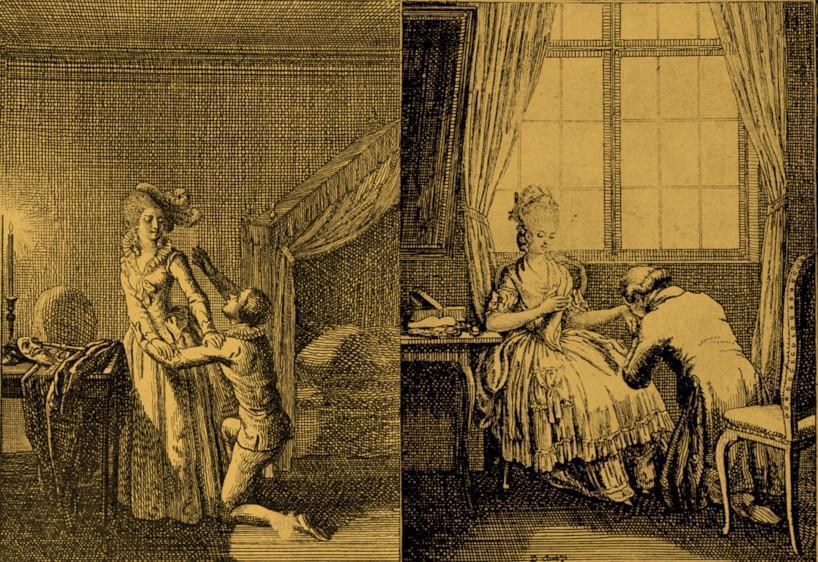
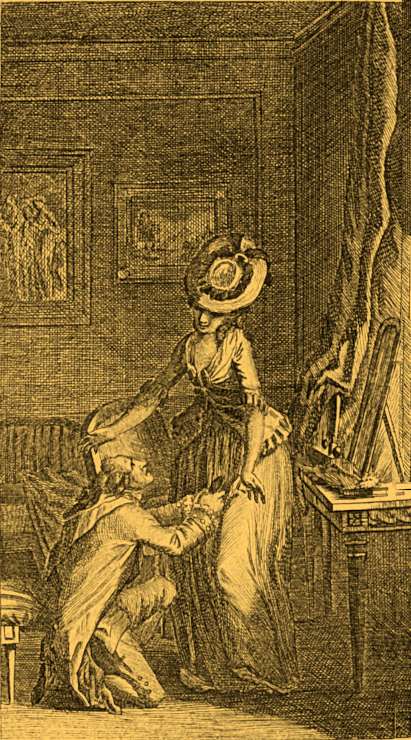
[3] A surprisingly common motif in popular literature at the time associated both with the woman’s rejection (illustration 1) and acceptance (illustrations 2 and 3[?]) ([1] Daniel Nikolaus Chodowiecki, Mein Herr ich verachte Sie zu sehr; Herzog August Bibliothek; Museums./Signatur Chodowiecki Sammlung [5-318]; [2] Der Capit. Puff küsst kniend Sophien die Hand [1777]; Herzog August Bibliothek; Museums./Signatur Uh 4° 47 [147]; [3] title vignette to Christian Leberecht Heyne, Bagatellen von Anton Wall [Frankfurt, Leipzig 1787]):
[4] Humboldt and his family were living in Paris at the time; they would return to Berlin in the summer of 1801. Back.
[5] At least according to Friedrich Schlegel’s remarks in a letter to Caroline on 29 October 1798 (letter 207), Brinckmann was “dissatisfied and unhappy” in Paris. — Rahel would spend the period between July 1800 and late April 1801 in Paris, where, among others, she would meet Madame de Staël at the Humboldts’ residence. Back.
Translation © 2014 Doug Stott