
188c. Friedrich Schlegel to Wilhelm and Caroline Schlegel in Jena: Berlin, 31 October 1797 [*]
[Berlin] 31 October 1797
I am currently extremely busy, my good friend, having to attend social gatherings, even diners and soupers, quite proper ones, in fact. . . . Because Auguste had recently written about a cough that would not subside, I was almost convinced she was sick, and so I spent an entire week amid the most terrible anxiety and grief.
Your new poems surprised me most beautifully. [1] Hardenberg can easily be more delighted by the 6th stanza of the “Zueignung” than I; I, however, more by the ending than he. I find much of Romeo in the first stanza, though I would almost have wished for more within the whole poem. The weak part of the poem seems to me to be the second stanza, the way the notion that love is the highest thing is explicated. . . .
But the main thing now is that a grand plan is occupying all my thoughts both day and night. I have long thought it time for us to begin our common journal. [2] What you recently wrote me about Caroline prompted me to speak with Vieweg about it, who seems very receptive to the idea. It is now up to you finally to consider the matter and, if you agree, to write to Vieweg in this regard immediately. . . .
I must confess to you, however, that I presented the plan to Vieweg a bit differently than you (at least to my knowledge) have hitherto imagined it; however you choose to take it: considerably broader or considerably more narrow. — To wit, a journal not merely edited by the two of us, but also wholly authored by us alone, without any regular co-contributors, and where neither the form nor the material itself would be more closely specified, except to exclude anything wholly unpopular or that is a larger piece or part of such a piece. Hence at least for now nothing by you would be excluded, and only very little by me. – Both Vieweg and I are of the opinion that 6 issues annually of 12 printer’s sheets each would be just right. [3] . . .
Just imagine the infinite advantages of our being able to do everything according to what we alone think best. [3a] Is it not a sin and abomination that a person like you has to accommodate himself to the Allgemeine Literatur-Zeitung?
I did not want to and cannot demand a certain honorarium without your concurrence. I recommend asking no more but also no less than 3 louis d’or. He will perhaps want to haggle a bit, but he is nonetheless quite taken with the project. I am hoping that, all things considered, you will lose absolutely nothing economically with respect to Die Horen and the Literatur-Zeitung, and that the freedom you thereby acquire will be pure profit.
I am also hoping that Caroline will be fired up by the beauty of the entire enterprise and will participate to a greater extent than previously.
Although I stipulated no regular co-contributors — since one must, after all, stand on one’s own — the exception would be that we would seek out masterpieces of higher criticism and polemic wherever such might be found — indeed, anything characterized by sublime audaciousness and that is too good for all other journals. . . .
Yet another considerable advantage of this enterprise would likely be that we will establish considerable critical authority for ourselves, sufficient after 5 to 10 years, in fact, to become literary-critical dictators in Germany, to drive the Allgemeine Literatur-Zeitung into the ground, and to publish a critical periodical that had no other purpose than criticism itself. . . .
You two can determine the title. Schleiermacher and I are for Herkules. . . . I was initially thinking about Freya, and not without ambiguity. But Schleiermacher is opposed. So you two need to think about it. . . .
It goes without saying that things must get going after New Year’s — two issues must already be ready by Easter. [4] . . .
I would think we first need to wait a bit with Tieck until we see how he is as a critic. I anticipate some good things from him with respect to characterizations of the individual tone of the various Shakespearean pieces, but nothing more. [5] — He is quite taken with your 2nd volume, almost at the expense of the 1st, [6] similarly also with respect to the essay on Romeo. He sends his regards and says he intends to write. He visits me quite often and interests me not inconsiderably, notwithstanding he always looks as if he is freezing to death and is equally gaunt in both mind and body. More about him anon. . . .
I am enormously glad that my fragments pleased you so. [7] A lady friend of mine calls them my “spoiled children.” [8] Schleyermacher contributed about as much to them as you and Caroline. That suffices for me. — I am delighted with the notion of composing fragments collectively, which would be divine for our Herkules. I have an endless supply, though next time I am thinking about offering a more condensed and complete treatise and characterization rather than merely inspired ideas. But I always have trouble deciding exactly how it should be done even though I certainly sense it quite precisely. Completely different, and yet just so. . . .
Please give my warm regards to both Fichte and Niethammer . . . I will write to the former on the next postal day. And to Karoline as well, whom I would like to send along my warm thanks for her letter. I must take time to answer it properly, something I have already long done in thought; but I cannot write it today. — Everything she writes is as beautiful as the main point is good. It is just that I was not pleased with the fact that she found it necessary to inquire about me and my circumstances from a creature such as Madam Liebeskind, whom she herself so despises. [9] — Please ask her to write me often but not to count so precisely on my own responses, since my time is so frightfully occupied just now. — Please consider Herkules quite reasonably, dear Karoline. I commend this unruly child to your maternal tenderness and your maternal protection.
One more pet plan, my dear friend. You are completely right in your assertion that I have quite properly set myself on wit and have philosophized not inconsiderably on it as well. It has occurred to me that I might learn a bit from an examination of Shakespeare’s wit and understanding of the comical. How would it be if all three of us wrote something on this topic collectively? — I would give you fragments and outlines to choose from as you wish. Once your Excellency has chosen, you two could do the execution. Such would then keep a middle road between a completely general treatise and the wholly specialized one on Romeo, and would moreover be quite beautiful and indeed useful. At least consider it. — With the completion of the third volume there would certainly be enough comedies there from which to draw examples. — [10]
I have read Caesar together with Tieck, who reads without ηθος, [11] but reads the pathos quite excellently. Then I read What You Will with various good friends of both sexes. Tomorrow it will happen yet again in an extremely mixed, almost public society. [12] I have been assured that I read Malvolio well, but the clown incomparably. [13] . . .
Karoline should correspond with Hardenberg. Do you two know nothing about him? . . .
Your Friedrich S.
I will send Auguste the music next time. [14]
Notes
[*] Source: Walzel, 297–306; KFSA 24:29–35. — This letter attests the birth of the idea of the journal Athenaeum as well as the considerable interest in Wilhelm’s edition of Shakespeare. — Editorial note: In subsequent letters, Friedrich often refers to Caroline with two different spellings in the same letter: Caroline, Karoline. Friedrich also refers in this letter to the play Romeo and Juliet by the shortened title Romeo. Back.
[1] The reference is to poems Wilhelm had published in Schiller’s Musen-Almanach für das Jahr 1798, a copy of which Friedrich had just received (though he was familiar with two of the poems in manuscript form). Wilhelm’s poems there include: “Prometheus” (49–72); “Gesang und Kuss. Sonett” (157); (mentioned specifically here) “Zueignung des Trauerspiels Romeo und Julia” (175–78); “Die entführten Götter” (199–203); and “Arion. Romanze” (278–86) (Sämmtliche Werke 1:35–37; 49–60; 61–63, 204–10; 333). Here the frontispiece and title page to that Musen-Almanach

[2] The plan was to launch the periodical that eventually became Athenaeum: eine Zeitschrift, ed. August Wilhelm Schlegel and Friedrich Schlegel, 3 vols. (Berlin 1798–1800):

[3] As it turned out, each volume had but two issues, and each issue 11–12 sheets (octavo). Back.
[3a] Heinrich Christoph Steinhart, Meine Reise nach Frankreich in den Jahren 1800 und 1801, vol. 2 (Berlin 1802), 480:
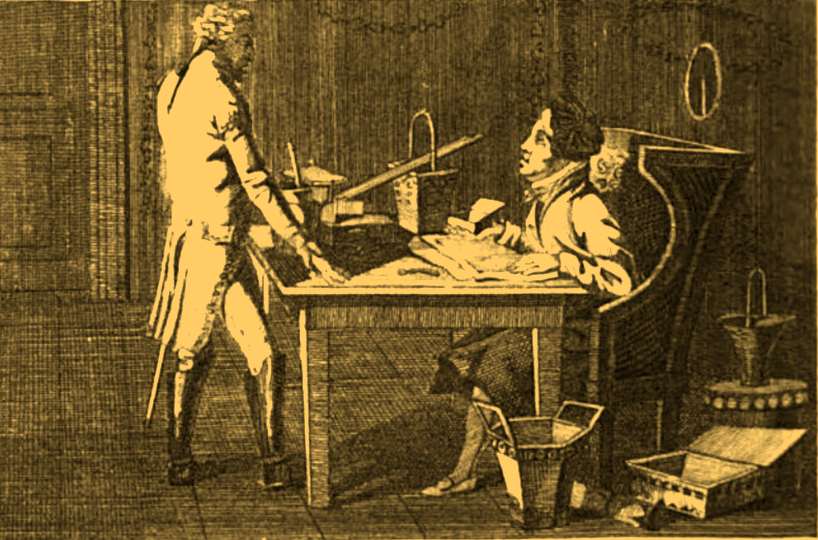
[4] The first two issues of volume 1 (1798) were published one after the other in early May and July 1798. Back.
[5] Ludwig Tieck never contributed to Athenaeum. Back.
[6] Shakspeare’s Dramatische Werke übersetzt von August Wilhelm Schlegel, vol. 1, Romeo und Julia, Ein Sommernachtstraum (Berlin 1797); vol. 2., Julius Cäsar, Was ihr wollt (1797). Back.
[7] “Kritische Fragmente” in Lyceum der schönen Künste (1797) 1, no. 2, 133–69; reprinted in Charakteristiken und Kritiken, 2 vols. (Königsberg 1801), 1:224–55; KFSA 2:147–63. Translated by Peter Firchow as “Critical Fragments,” Friedrich Schlegel’s Lucinde and the Fragments, (Minneapolis 1791), 143–59. Back.
[8] Friedrich’s first mention of Dorothea Veit to Wilhelm and Caroline. Back.
[9] Meta Liebeskind had spent four days visiting Caroline in Jena. See Friedrich’s letter to Auguste on 26 August 1797 (letter 184d) with note 6 and Caroline’s letter to Luise Gotter on 15 October 1797 (letter 188) with the second part of note 5. Back.
[10] As noted above: Shakspeare’s Dramatische Werke übersetzt von August Wilhelm Schlegel, vol. 1, Romeo und Julia, Ein Sommernachtstraum (Berlin 1797) and vol. 2., Julius Cäsar, Was ihr wollt (1797), had already appeared (vol. 2 in October). Volume 3, Hamlet, Der Sturm, would be printed in the spring of 1798. The comedies Friedrich is envisioning were thus A Midsummer-Night’s Dream, Twelfth-Night; or, What You Will, and The Tempest. Back.
[11] Gk., “ethos.” Back.
[12] Possibly the Berlin Wednesday Society, also known as the “Society of Friends of the Enlightenment.” Founded in 1783 and devoted to the exchange of ideas and opinions for the sake of mutual and social enlightenment, it met on the first and third Wednesdays of each month in the winter between 5:30 and 8:00 p.m. (1 November 1797, to which Friedrich here refers, fell on the first Wednesday of the month); it would, however, cease meeting in November 1798. If Friedrich is not referring to this society, the reference may instead be to an alternative to the traditional Wednesday Society, of which one had to be a member. Back.
[13] Malvolio is the steward of Olivia’s household in Twelfth Night; or, What You Will; the clown (or fool) is Feste, one of Olivia’s servants. First illustration: Malvolio in Twelfth Night, act 2, scene 5 , by John Massey Wright and Charles Heath, the elder (ca. 1825–40); Metropolitan Museum of Art; second illustration: Feste seated at left; introductory illustration to the play by H. C. Selous, from The Plays of William Shakespeare, ed. Charles and Mary Cowden Clarke (London, Paris and Melbourne (1864–68?):
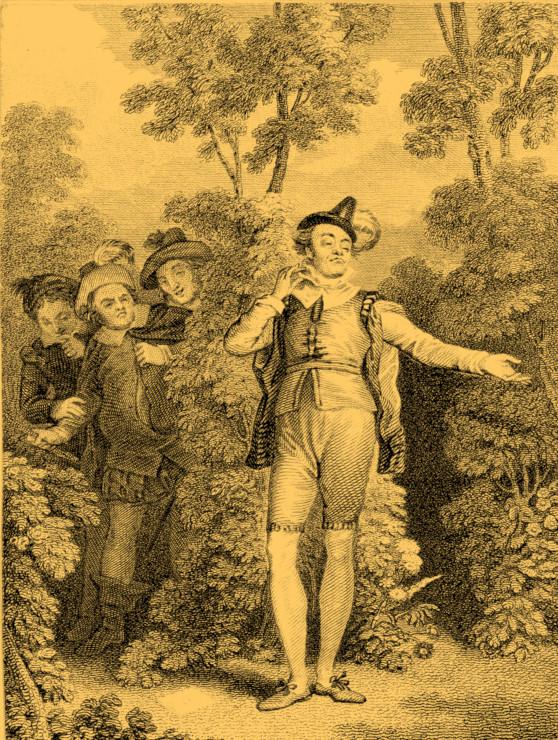

Karl August Böttiger writes to Wilhelm Schlegel from Weimar on 17 September 1797 concerning his own recent visit to Berlin (Körner [1930], 63):
Your brother seemed to be living quite contentedly in Berlin. And indeed, that city is perhaps the only one where one yet finds a public interested in philosophical and literary matters. I myself would like to live there forever. For example, I heard people speaking there about your masterful translation of Shakespeare not with hackneyed, inchoate praise, but rather with profound penetration and understanding. It is, moreover, usually the intelligent Jewesses who set the tone. [Ed. note: including, e.g., Henriette Herz, Rahel Levin, and Dorothea Veit.]
Surely we will be getting the second part of your Shakespeare [vol. 2] at the coming book fair, will we not? Back.
[14] Possibly the art song (Lied) mentioned in his letter to Auguste in mid-November (letter 191a). Back.
Translation © 2012 Doug Stott